
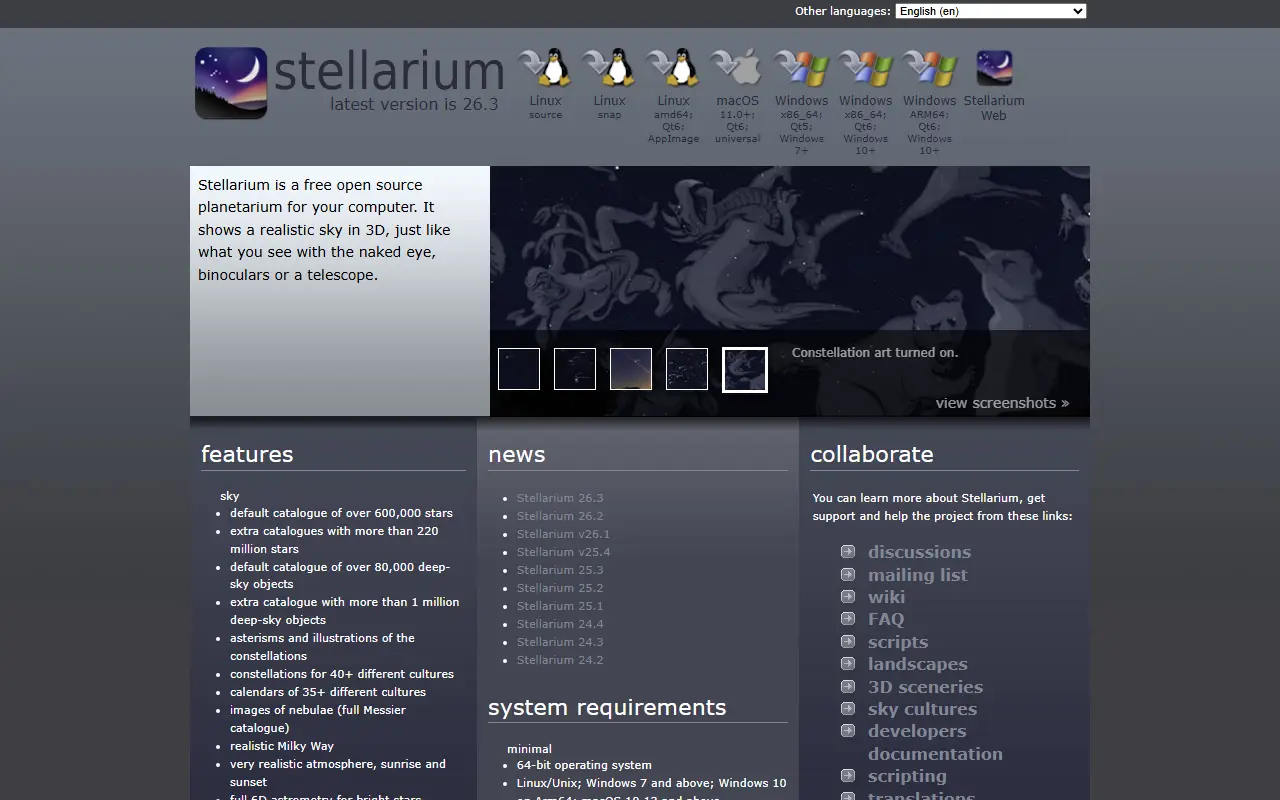
About Stellarium
Stellarium is a free, open-source planetarium for the computer. It shows a realistic sky in 3D, just as you would see it with the naked eye, binoculars or a small telescope, and renders it in real time using OpenGL. It is used by hobbyists, educators and anyone curious about astronomy.
The software is available for Linux and Unix, Windows, macOS and Haiku. Its codebase is written in C++ on Qt 5 and Qt 6. A User Guide covers installation and getting started, there are instructions for building from source, a credits file lists contributors, and contribution guidelines explain how to help.
Stellarium is licensed under the GPL-2.0 and financed by backers and sponsors through Open Collective. Windows packages are signed through the free code signing service provided by SignPath, and the project uses the PVS-Studio static analyzer for C and C++ code. Further information and downloads are on the project website.
Key features
- Realistic real-time 3D sky rendering
- Views matching eye, binoculars or telescope
- OpenGL rendering with Qt interface
- Linux, Windows, macOS and Haiku builds
- User guide and build instructions
Good fit for
- →Planning stargazing sessions
- →Teaching astronomy in classrooms
- Built with
- C++
- Tags
- astronomy
- planetarium
- science
- stars
- education
- opengl
- qt
- cross-platform
Stellarium: questions and answers
- What is Stellarium used for?
- Stellarium is a free open-source planetarium that renders a realistic 3D night sky in real time, as seen by eye, binoculars or a small telescope. It is a good fit for planning stargazing sessions and teaching astronomy in classrooms.
- Is Stellarium open source?
- Yes. Stellarium is open source under the GPL-2.0 licence. Its source code is on GitHub at Stellarium/stellarium and is written mainly in C++.
- Is Stellarium free?
- Yes. Stellarium is open source, so the software itself is free to use.
- Can I self-host Stellarium?
- Yes. Stellarium can be self-hosted on your own server or infrastructure.
- What are some alternatives to Stellarium?
- Similar open-source tools in the Education & LMS category include freeCodeCamp, Anki and AnkiDroid. SaaS products in the same category include Khan Academy, Wolfram Alpha and ACT School Reports.
- Is Stellarium actively maintained?
- Yes. The most recent commit to Stellarium was on 2 October 2026, and the latest release is v26.3, published on 28 September 2026. The project has 10k stars on GitHub.
Open-source alternatives to Stellarium
See all
freeCodeCamp
Education & LMS
freeCodeCamp.org's open-source codebase and curriculum. Learn math, programming, and compu
BSD-3-Clausevs Codecademy★ 457k
Anki
Education & LMS
Anki is a smart spaced repetition flashcard program
OSSvs Quizlet★ 32k
AnkiDroid
Education & LMS
AnkiDroid: Anki flashcards on Android. Your secret trick to achieve superhuman information
GPL-3.0vs Quizlet★ 12k
Frappe Learning
Education & LMS
Easy to Use, 100% Open Source Learning Management System
AGPL-3.0vs Thinkific★ 3.3k
Kiwix Android
Education & LMS
Kiwix for Android
GPL-3.0★ 1.5k
Kolibri
Education & LMS
Kolibri Learning Platform: the offline app for universal education
MITvs Google Classroom★ 1.1k
SaaS alternatives to Stellarium
See all
Khan Academy
Education & LMS
Nonprofit education platform with free lessons in math, science and more
SaaS
Wolfram Alpha
Education & LMS
Computational knowledge engine for math, science and data questions
SaaS
ACT School Reports
Education & LMS
Helps ACT teachers write personalised, compliant school report comments with AI
SaaS
AI Math Solver+
Education & LMS
iOS app that solves math problems from a camera photo with step-by-step AI explanations
SaaS
AlgoDrill
Education & LMS
Interactive recall drills for practising coding interview solutions line by line
SaaS
AlgoMind
Education & LMS
iOS app that explains algorithms with animated visualizations and synced highlighted code
SaaS