 TrackMedia
 TrackRev

About Anki
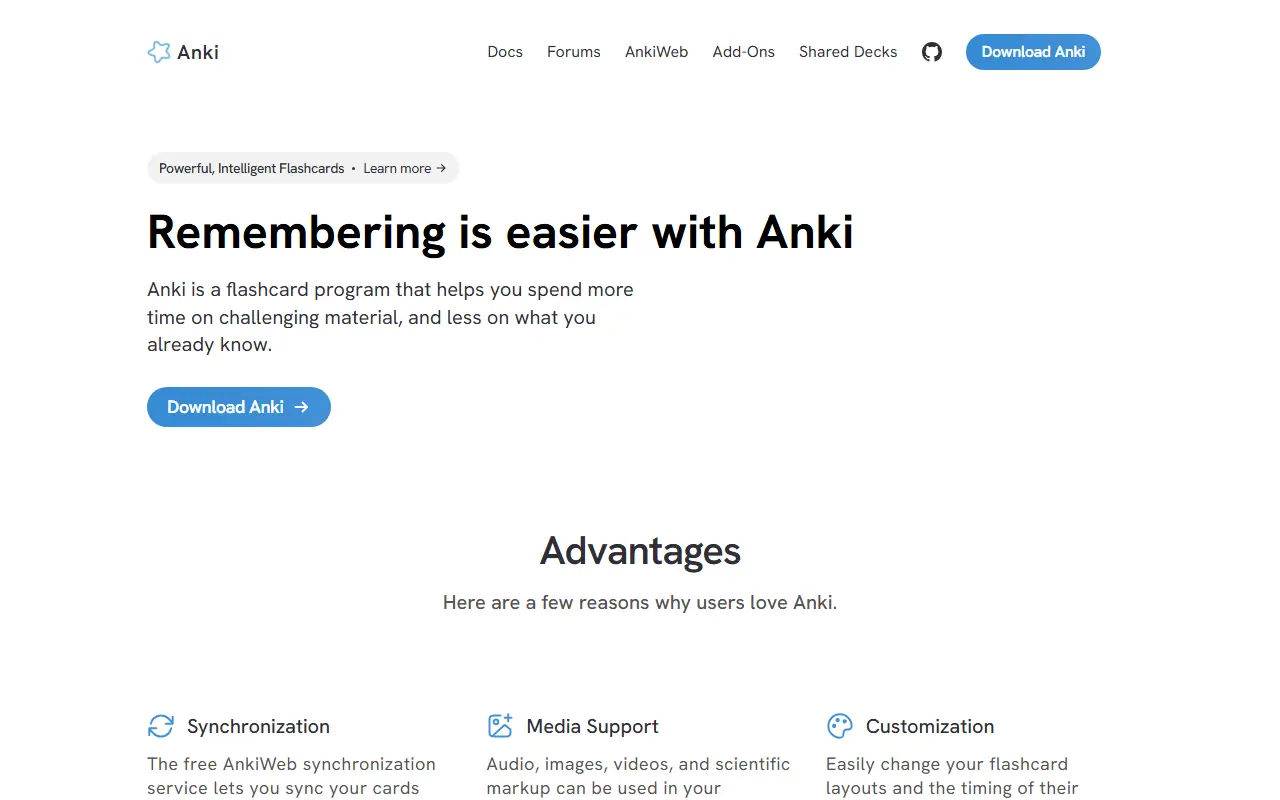
Anki is a flashcard program built on spaced repetition. You build decks of cards, rate how well you recalled each one, and Anki schedules the next review for the moment you are most likely to forget, so time goes to the difficult material. The desktop source code lives in this repository, written mainly in Rust, and the project is open source with community contributions.
Cards can include audio, images, video and scientific markup, and both layouts and review timing can be customized. The homepage says decks of more than 100,000 cards work without trouble, and add-ons extend the program with new features. The free AnkiWeb service synchronizes your collection across devices. Anki Betas let non-developers try development builds. The repository metadata lists the license as Other, so check the LICENSE file for the exact terms.
Key features
- Spaced repetition review scheduling
- Decks of flashcards for targeted study
- Audio, images, video and math markup in cards
- Customizable card layouts and review timing
- Add-ons to extend functionality
- Free AnkiWeb synchronization across devices
Good fit for
- Language vocabulary learning
- Exam preparation and medical study
- Memorizing any fact-based material
Anki: questions and answers
- What is Anki used for?
- Anki is a spaced repetition flashcard program that schedules reviews for when you are most likely to forget, with sync and add-ons. It is a good fit for language vocabulary learning, exam preparation and medical study, and memorizing any fact-based material.
- Is Anki open source?
- Yes. Anki is open source under a custom licence. Its source code is on GitHub at ankitects/anki and is written mainly in Rust.
- Is Anki free?
- Yes. Anki is open source, so the software itself is free to use under the terms of its own licence. A managed cloud version is also available.
- Can I self-host Anki?
- Yes. Anki can be self-hosted on your own server or infrastructure.
- What is Anki an alternative to?
- Anki is an open-source alternative to Quizlet, Memrise and RemNote. Other open-source alternatives to Quizlet include AnkiDroid.
- Is Anki actively maintained?
- Yes. The most recent commit to Anki was on 11 November 2026, and the latest release is 26.09.4, published on 4 November 2026. The project has 33k stars on GitHub, with 805 added in the last 30 days.
Open-source alternatives to Anki
See all
AnkiDroid
Education & LMS
AnkiDroid: Anki flashcards on Android. Your secret trick to achieve superhuman information
GPL-3.0vs Quizlet★ 12k
SiYuan
Note Taking
思源笔记 - 隐私优先的个人知识管理系统,支持 Markdown 排版、块级引用和双向链接
AGPL-3.0vs Notion★ 47k
Joplin
Note Taking
Joplin - the privacy-focused note taking app with sync capabilities for Windows, macOS, Li
OSSvs Evernote★ 57k
Logseq
Note Taking
A privacy-first, open-source platform for knowledge management and collaboration. Download
AGPL-3.0vs Notion★ 46k
Zettlr
Note Taking
Your One-Stop Publication Workbench
GPL-3.0vs Typora★ 14k
Foam
Note Taking
A personal knowledge management and sharing system for VSCode
OSSvs Roam Research★ 17k
SaaS alternatives to Anki
See all
Quizlet
Education & LMS
Study tool with flashcards, practice tests and AI-generated study aids
SaaS
Memrise
Education & LMS
Language learning app using video clips of native speakers and spaced repetition
SaaS
RemNote
Note Taking
Note-taking app with built-in spaced repetition flashcards
SaaS
Brainloop
Education & LMS
Spaced repetition platform for learning and memorizing material
SaaS
Anti-Agent
Education & LMS
Build a page for any subject and get scheduled reviews and practice to retain what you learn
SaaS
izeo
Education & LMS
Web study companion that turns notes and files into flashcards, with Pomodoro sessions, statistics and AI assistance
SaaS