8 open-source alternatives ranked by real activity

Open-source RemNote alternatives

A curated, ranked list of the 8 best open-source alternatives to RemNote.

The best open-source alternative to RemNote is Anki. If that doesn't suit you, other good options are Joplin, SiYuan, Logseq and Zettlr.

Commercial alternatives to RemNote include Obsidian, Roam Research, Saga and Heptabase. See all 26.

RemNote alternatives are mainly note-taking tools, but some are also education & LMS tools. 8 of them shipped code in the last 30 days, 8 can be self-hosted, and none uses a permissive licence.

Last updated November 13, 2026 · ranked by GitHub stars, growth and recent commits

Anki

Anki is a spaced repetition flashcard program that schedules reviews for when you are most likely to forget, with sync and add-ons.

GitHub stars
33k
Last commit
yesterday
Latest release
26.09.4
Hosted version
Available
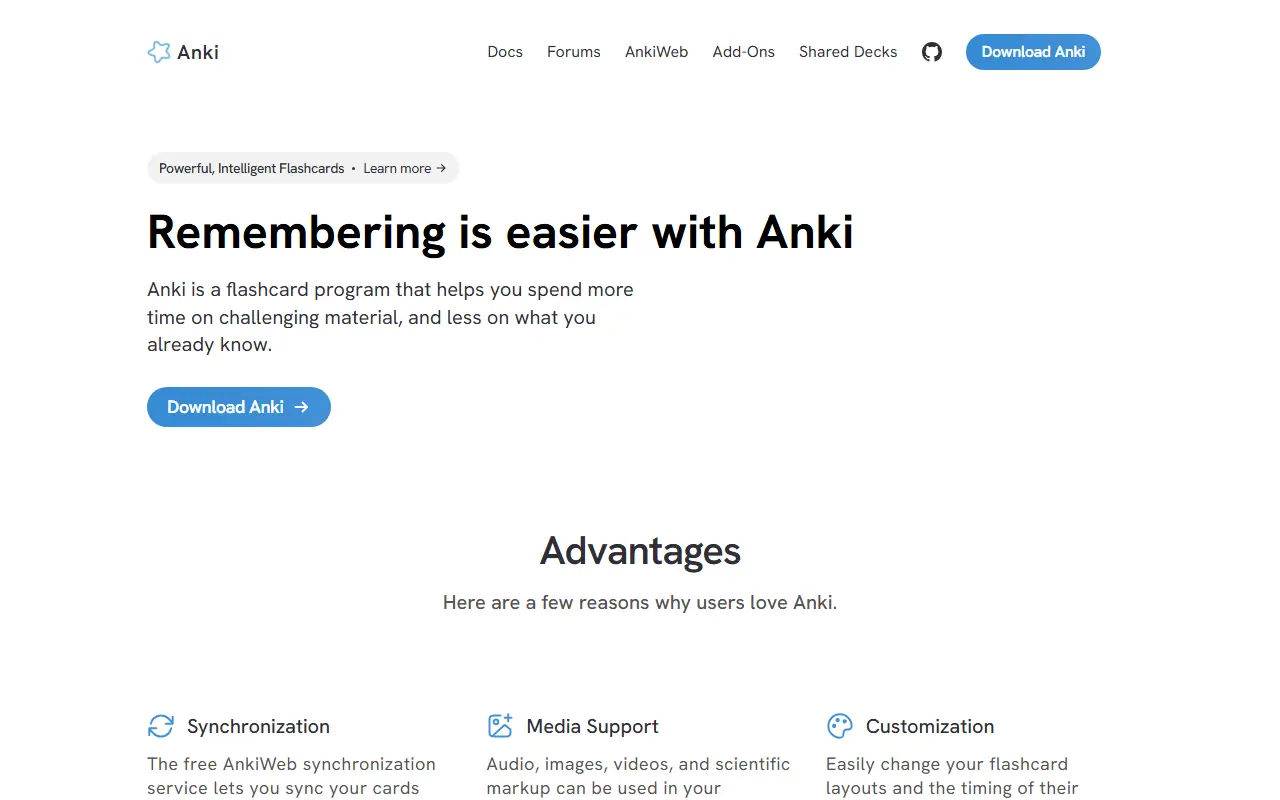
apps.ankiweb.netAnki homepage screenshot

Anki is a flashcard program built on spaced repetition. You build decks of cards, rate how well you recalled each one, and Anki schedules the next review for the moment you are most likely to forget, so time goes to the difficult material. The desktop source code lives in this repository, written mainly in Rust, and the project is open source with community contributions.

Cards can include audio, images, video and scientific markup, and both layouts and review timing can be customized. The homepage says decks of more than 100,000 cards work without trouble, and add-ons extend the program with new features. The free AnkiWeb service synchronizes your collection across devices. Anki Betas let non-developers try development builds. The repository metadata lists the license as Other, so check the LICENSE file for the exact terms.

Key features

  • Spaced repetition review scheduling
  • Decks of flashcards for targeted study
  • Audio, images, video and math markup in cards
  • Customizable card layouts and review timing
  • Add-ons to extend functionality
  • Free AnkiWeb synchronization across devices

Pricing: The desktop source is open; the homepage describes the AnkiWeb sync service as free.

Read more about AnkiWebsiteGitHub#1 RemNote alternative

Joplin

A free, open-source, offline-first note-taking and to-do app with Markdown notes, end-to-end encrypted sync, plugins and apps for desktop and mobile.

GitHub stars
57k
Last commit
today
Latest release
v3.7.22
Self-hosted
Yes
Hosted version
Available
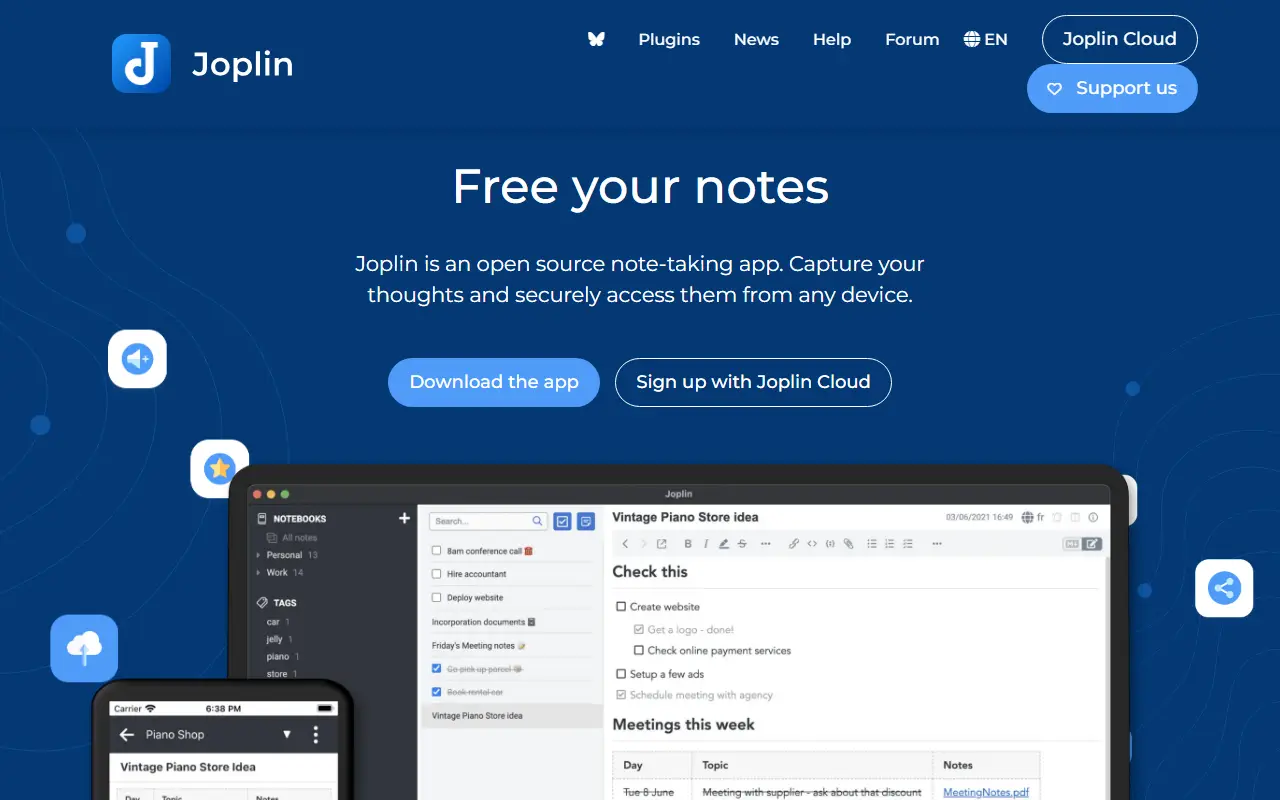
joplinapp.orgJoplin homepage screenshot

Joplin is a note-taking and to-do application, free and open source, that can manage large collections of notes organized into notebooks. Notes are written in Markdown, are searchable, can be tagged, and can be edited either in the app or in your own text editor. Apps are available for Windows, macOS, Linux, Android and iOS.

The app is offline first, so all your data lives on your phone or computer and stays accessible without a connection. Notes can be synchronized with end-to-end encryption through services such as Nextcloud, Dropbox, OneDrive and Joplin Cloud, and topics also mention WebDAV. Full-text search is available on every platform, and plugins and themes let you customize the app. A web clipper saves pages, and notes exported from Evernote can be imported with formatting, attachments and metadata intact; plain Markdown files can be imported as well.

The repository license is listed as 'Other', so check its terms if you plan to redistribute. Joplin is a popular choice for people who want an Evernote replacement that keeps data local or on storage they already control.

Key features

  • Markdown notes organized into notebooks
  • Offline-first storage on your own devices
  • End-to-end encrypted sync via Nextcloud, Dropbox or OneDrive
  • Evernote import with attachments and metadata
  • Plugins and themes
  • Web clipper for saving pages
  • Apps for desktop and mobile

Pricing: Joplin Cloud costs 2.99€ (Basic), 5.99€ (Pro) or 9.99€ (Pro 100 GB) per month, and Teams 7.99€ per user per month. Self-hosted Server Business is 3.33€ per user per month; 14-day trial.

SiYuan

A privacy-first, self-hostable personal knowledge management system with block-level references, Markdown WYSIWYG editing, flashcards and optional AI chat.

GitHub stars
47k
Last commit
today
Latest release
v3.8.10
Licence
AGPL-3.0
Self-hosted
Yes
b3log.orgSiYuan homepage screenshot

SiYuan is an open-source, privacy-first personal knowledge management system. Its distinctive feature is fine-grained, block-level referencing: any block can be linked to or embedded elsewhere, with two-way links, custom attributes and SQL query embeds. Editing is Markdown WYSIWYG, and the project describes itself as a workspace where humans and AI agents work together. It is local-first and self-hostable.

The editor supports block-style writing, list outlines, block zoom-in, very large documents, math formulas, charts, flowcharts and Gantt charts. Web clipping, PDF annotation links, flashcards with spaced repetition, a database table view, Tesseract OCR and multi-tab split-screen layouts are included. You can export blocks and embeds, standard Markdown with assets, or PDF, Word and HTML. AI writing and Q and A chat can use the OpenAI API, and template and JavaScript or CSS snippets allow customization.

SiYuan is AGPL-3.0 licensed and available as desktop apps, mobile apps for Android, iOS and HarmonyOS, an installation package, a package manager, and Docker, Kubernetes, Unraid and TrueNAS hosting. A command line interface and an app market for extensions exist. Most features are free, even for commercial use.

Key features

  • Block-level references and two-way links
  • Markdown WYSIWYG editor
  • Flashcards with spaced repetition
  • SQL query embeds and database table views
  • Export to Markdown, PDF, Word and HTML
  • AI writing and Q and A chat
  • Docker, Kubernetes and mobile apps

Pricing: Most features are free, even for commercial use; check the project FAQ for any paid options.

Logseq

A privacy-first, local-first knowledge management app built around linked, outliner-style notes in Markdown or Org-mode, with a graph view and plugin support.

GitHub stars
46k
Last commit
today
Latest release
2.0.2
Licence
AGPL-3.0
Self-hosted
Yes
logseq.comLogseq homepage screenshot

Logseq is an open-source platform for knowledge management and collaboration that puts privacy and local storage first. Notes are organized as linked blocks in an outliner, forming a knowledge graph, and topics show it works with both Markdown and Org-mode files and can be backed by Git.

The project is moving toward a database-backed version that introduces DB graphs. That version is in beta, comes with a new iOS mobile app in alpha and a Real Time Collaboration approach to syncing graphs across devices or working with others, also in alpha. Because data loss is possible while these features mature, the maintainers recommend automated backups. A plugin API, themes and a public roadmap round out the ecosystem.

Logseq is written in Clojure and ClojureScript under the AGPL-3.0 license, and desktop builds are available from the releases page. It appeals to researchers, students and knowledge workers who want a personal wiki with bidirectional links and full ownership of their files.

Key features

  • Outliner-style linked notes
  • Markdown and Org-mode support
  • Knowledge graph of connected pages
  • Local-first storage with Git compatibility
  • Plugin API and themes
  • Real Time Collaboration sync in alpha

Pricing: Free and open source under the AGPL-3.0 license.

Zettlr

Markdown editor for researchers and writers with citation management, Pandoc exports and Zettelkasten-style note linking.

GitHub stars
14k
Last commit
2 days ago
Latest release
v4.9.0
Licence
GPL-3.0
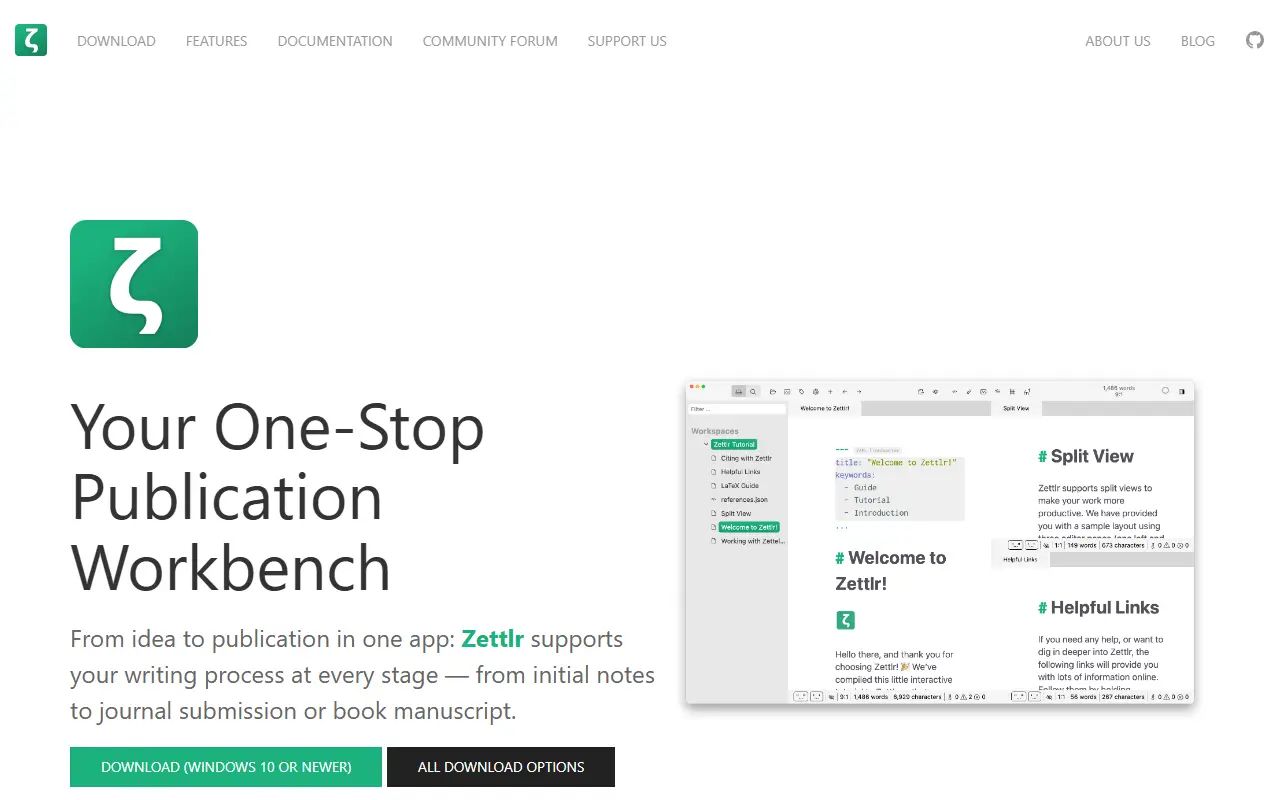
zettlr.comZettlr homepage screenshot

Zettlr is a desktop Markdown editor aimed at academic and long-form writing. It presents itself as a publication workbench, combining note-taking, drafting, reference management and export in one application, with a focus on keeping your notes private and stored as ordinary files on your own computer.

Citations integrate with reference managers such as Zotero and JabRef, and exports rely on Pandoc, LaTeX and Textbundle, with support for LaTeX and Word templates. Other capabilities include snippets for boilerplate text, themes with dark modes and custom CSS, code highlighting, full-text search, and techniques from the Zettelkasten knowledge management method. The interface is translated into over a dozen languages.

Zettlr is built with TypeScript, Electron and Node.js and released under GPL-3.0. Installers are provided for macOS, Windows and most Linux distributions, and the repository documents building from source, command-line switches and contribution workflows. The project is also reachable through a community forum, Discord and Mastodon.

Key features

  • Markdown editor with a distraction-free writing focus
  • Citation support for Zotero and JabRef
  • Export via Pandoc, LaTeX and Textbundle
  • Zettelkasten-style linking and full-text search
  • Snippets, themes and custom CSS
  • Installers for macOS, Windows and Linux

Pricing: Free and open source under the GPL-3.0 license.

Foam

A notes and knowledge-sharing system that lives in VS Code and GitHub, with wikilinks, a link graph and optional web publishing.

GitHub stars
17k
Last commit
today
Latest release
vscode@0.48.0
Self-hosted
Yes
foam.mdFoam homepage screenshot

Foam is a personal knowledge management system that lives inside Visual Studio Code and GitHub. It is intended for organizing research, keeping notes you can rediscover, writing long-form content and, if you want, publishing it to the web. The notes are plain Markdown files you own, so you can share and collaborate on them with anyone.

Its features center on linking notes together. A graph visualization shows how notes connect, link autocompletion helps create connections and placeholders, and links are updated automatically when a file is renamed. Foam supports files with the same name in different folders by using the shortest identifier needed, and it helps find and fix ambiguous wikilinks. Link preview, go to definition and peek references let you see where a note is mentioned. Topics include Zettelkasten and PKM workflows.

Foam is a free, open-source VS Code extension written in TypeScript, and its license is listed as 'Other' on GitHub. It requires VS Code, so it suits developers and technical writers already comfortable in that editor who want a notes workflow built on files and Git instead of a separate app.

Key features

  • Graph visualization of linked notes
  • Autocompletion for wikilinks and placeholders
  • Automatic link updates on file rename
  • Link preview and peek references
  • Markdown files in a Git repository
  • Optional publishing to the web
Read more about FoamWebsiteGitHub#6 RemNote alternative

TiddlyWiki

A non-linear personal web notebook and wiki written in JavaScript that runs as a single HTML file in a browser or as a Node.js application.

GitHub stars
8.7k
Last commit
2 days ago
Latest release
v5.4.1
Self-hosted
Yes
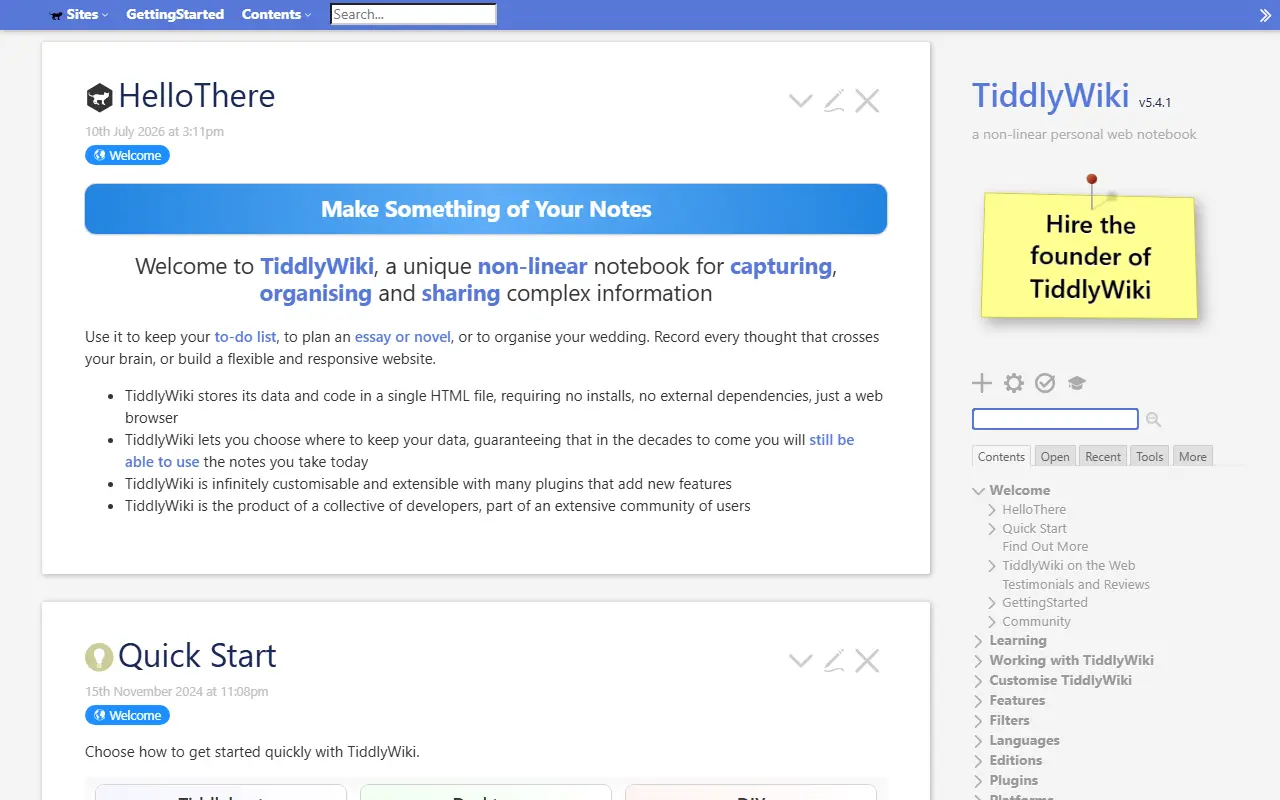
tiddlywiki.comTiddlyWiki homepage screenshot

TiddlyWiki is a personal web notebook with a non-linear structure, usable by anyone and kept indefinitely without depending on any company. It is a complete interactive wiki written in JavaScript, in which content is stored as small units called tiddlers that can be linked, tagged and rearranged.

It can be used as one self-contained HTML file in the browser, or run as a Node.js application with a client and server setup for advanced users. The whole interface is implemented in WikiText, which makes it highly customizable, and there is a plugin ecosystem. The project description also mentions that it can run in places such as AWS Lambda.

The community talks on the Talk TiddlyWiki forum, a Google Group that dates back to 2005, GitHub Discussions, Reddit and Discord, and developer documentation is published on the project site. The repository lists the licence as Other. TiddlyWiki is suited to personal knowledge bases, journals, task lists and small documentation sets.

Key features

  • Single-file HTML wiki
  • Node.js client and server mode
  • Non-linear linked notes called tiddlers
  • User interface written in WikiText
  • Plugins and community extensions
  • Runs in browsers and on servers

Pricing: Free and open source; the repository lists the license as Other.

Standard Notes

An end-to-end encrypted note-taking app with sync across devices and a self-hostable server, available on web, desktop and mobile.

GitHub stars
6.7k
Last commit
today
Latest release
@standardnotes/desktop@3.202.11
Licence
AGPL-3.0
Self-hosted
Yes
Hosted version
Available
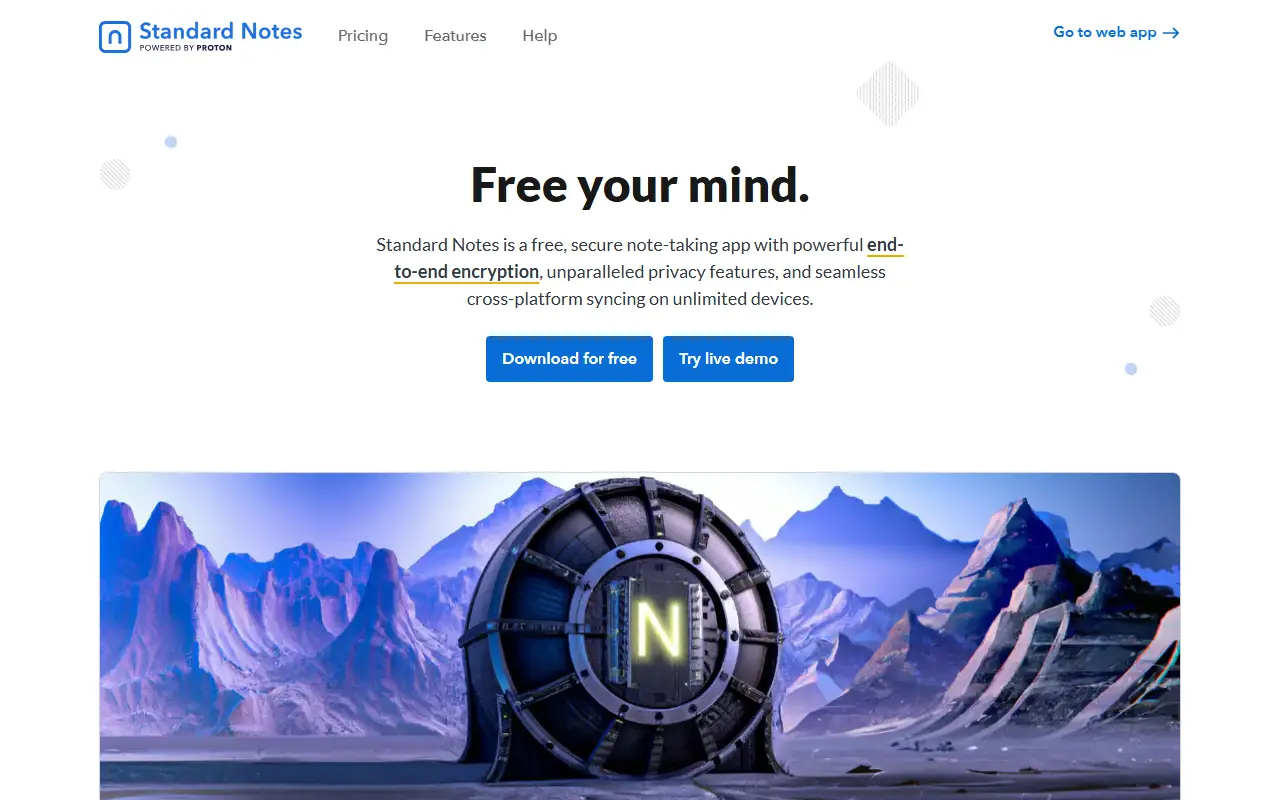
standardnotes.comStandard Notes homepage screenshot

Standard Notes is a note-taking app with end-to-end encryption, built for digitalists and professionals, aiming to keep notes, files and life's work in one secure place. Only the user can read their notes, and sync across devices is encrypted by default.

You register for an account on the web app and install clients for Mac, Windows, Linux, iOS and Android. The README highlights fast, free and encrypted sync on an unlimited number of devices, public source code, the option of hosting your own server with a few steps, and a focus on longevity and sustainability. A companion service called Listed turns notes into an online publication with email newsletters, and developers can build and publish extensions.

The web app compiles to static HTML, JavaScript and CSS files that can be served from any web server, and the README includes build and development instructions. Standard Notes is written in TypeScript and licensed under AGPL-3.0, with a forum and help pages for support. It suits privacy-minded users who want encrypted notes with the option to host their own backend.

Key features

  • End-to-end encrypted notes and files
  • Sync across unlimited devices
  • Apps for web, desktop and mobile
  • Self-hostable sync server
  • Listed publishing and newsletters
  • Extensions published by developers

Pricing: Free Standard plan includes end-to-end encryption and device sync. Productivity costs $90 and Professional $120 per year; there is no trial, but refunds are offered.

Commercial RemNote alternatives

Hosted, closed-source products that compete with RemNote. Showing 12 of 26.

See every RemNote alternative on its tool page

RemNote alternatives: questions

What is the best open-source alternative to RemNote?
Anki is the top-ranked open-source alternative to RemNote on Enlisted: Anki is a spaced repetition flashcard program that schedules reviews for when you are most likely to forget, with sync and add-ons. Other strong options are Joplin, SiYuan, Logseq and Zettlr.
What are the best commercial alternatives to RemNote?
Obsidian, Roam Research, Saga, Heptabase and Reflect are among the hosted, closed-source alternatives to RemNote listed on Enlisted, which lists 26 in total. Compare their pricing and features on each tool page.
Are these RemNote alternatives free?
All 8 are open source, so the code is free to use under its licence, and all of them can be self-hosted on your own server or computer. 3 also offer a paid or managed cloud version if you'd rather not host it yourself.
How is this list of RemNote alternatives ranked?
By a score built from GitHub stars, star growth over the last 30 days and how recently the code changed. 8 of these projects shipped code in the last 30 days. Data is refreshed daily, and nobody can pay to move up.

People also look for alternatives to…

View all