
About Sponge
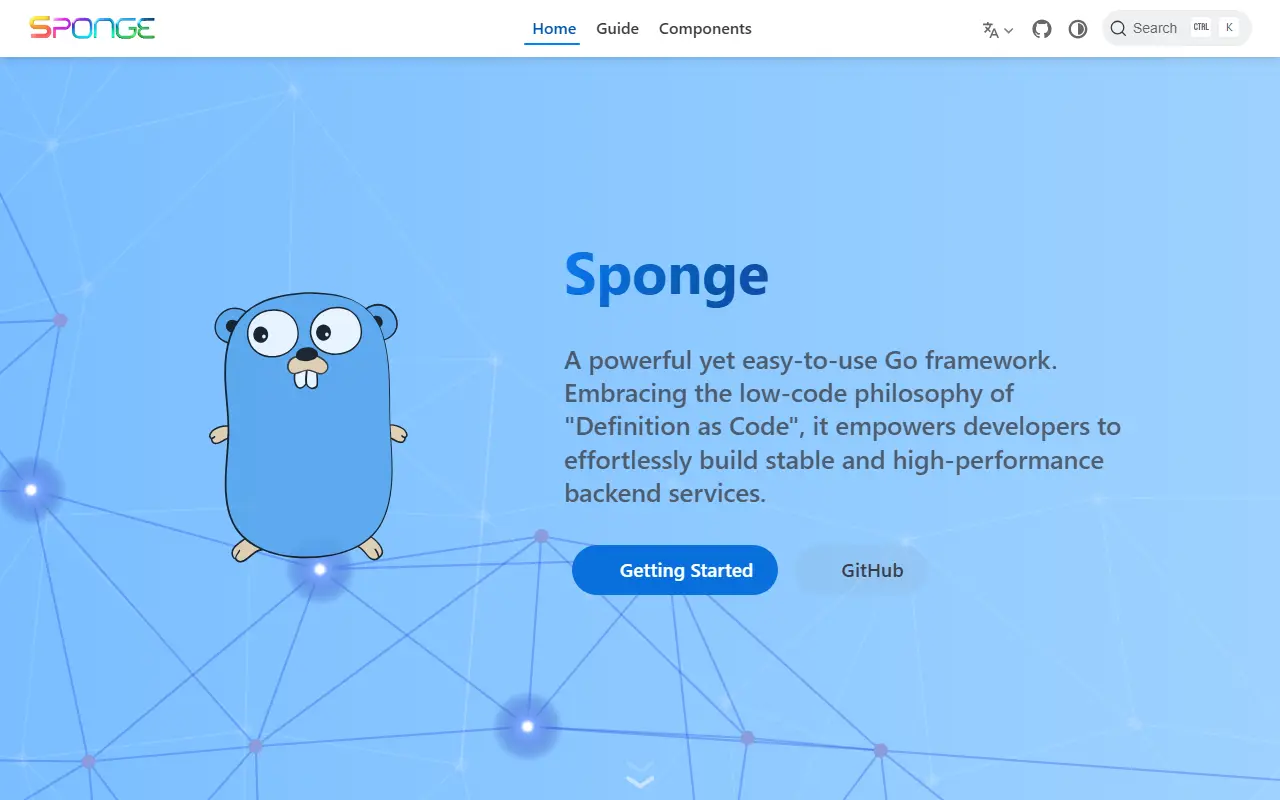
Sponge is a Go development framework built around the idea that a definition becomes code. It reads SQL, Protobuf and JSON configuration files and generates modular backend code, so developers can skip repetitive work such as building the base framework, writing CRUD operations and configuring routing and service governance.
It integrates a code generation engine with Gin for web services and gRPC for microservices. Generated modules are loosely coupled, so the same pieces can be assembled into a monolith, a microservice cluster or a gateway service, including RESTful APIs, gRPC, HTTP plus gRPC and gRPC gateway setups. The toolchain spans project generation, business logic, testing, API documentation, deployment and monitoring, and it uses mainstream Go libraries such as Gin, GORM and Protobuf.
Topics also mention custom templates and AI-assisted code generation. Sponge is MIT licensed and the documentation is available in English and Chinese.
Key features
- Code generation from SQL, Protobuf and JSON
- Gin web and gRPC microservice support
- Monolith, microservice and gateway assembly
- Generated CRUD, routing and API documentation
- Toolchain from testing to deployment and monitoring
- Custom templates for generated code
Good fit for
- →Bootstrapping Go backend services quickly
- →Standardizing microservice projects in a team
- Built with
- Go
- Tags
- go
- low-code
- code-generation
- microservice
- grpc
- gin
- framework
- backend
Sponge: questions and answers
- What is Sponge used for?
- Sponge is a Go development framework that generates backend services from SQL, Protobuf and JSON definitions, covering Gin and gRPC projects from scaffolding to deployment. It is a good fit for bootstrapping Go backend services quickly and standardizing microservice projects in a team.
- Is Sponge open source?
- Yes. Sponge is open source under the MIT licence. Its source code is on GitHub at go-dev-frame/sponge and is written mainly in Go.
- Is Sponge free?
- Yes. Sponge is open source, so the software itself is free to use.
- What are some alternatives to Sponge?
- Similar open-source tools in the Developer Tools category include System Designer, golangci-lint and XGo. SaaS products in the same category include GoLand, 1DevTool and 3 Pixel Grid.
- Is Sponge actively maintained?
- The most recent commit to Sponge was on 15 December 2025, and the latest release is v1.16.1, published on 15 December 2025. The project has 2.9k stars on GitHub.
Open-source alternatives to Sponge
See all
System Designer
Developer Tools
A low-code development platform for creating systems 🇺🇦#standwithUkraine
Apache-2.0★ 1.1k
golangci-lint
Developer Tools
Fast linters runner for Go
GPL-3.0★ 19k
XGo
Developer Tools
XGo is a programming language that reads like plain English. But it's also incredibly powe
Apache-2.0★ 9.5k
assh
Developer Tools
:computer: make your ssh client smarter
MIT★ 3.2k
Agent Beacon
Developer Tools
The cross-harness, self-improving memory layer for AI agents.
MIT★ 1.7k
Visual Studio Code
Developer Tools
Visual Studio Code
MITvs Sublime Text★ 193k
SaaS alternatives to Sponge
See all
GoLand
Developer Tools
JetBrains IDE for Go development
SaaS
1DevTool
Developer Tools
Desktop workspace for running several AI coding agents side by side across multiple projects
SaaS
3 Pixel Grid
Developer Tools
Library of tiny animated 3x3 grid indicators with copyable configs for use in your own project
SaaS
act101
Developer Tools
Codebase quality and refactoring toolkit for coding agents, with code porting and verification
SaaS
ActivityProof
Developer Tools
Live GitHub-based shipping-status badge you embed as an SVG on indie product sites
SaaS
Adapty
Developer Tools
In-app purchase and subscription SDK with paywall A/B testing for mobile apps
SaaS