
About SonicJS
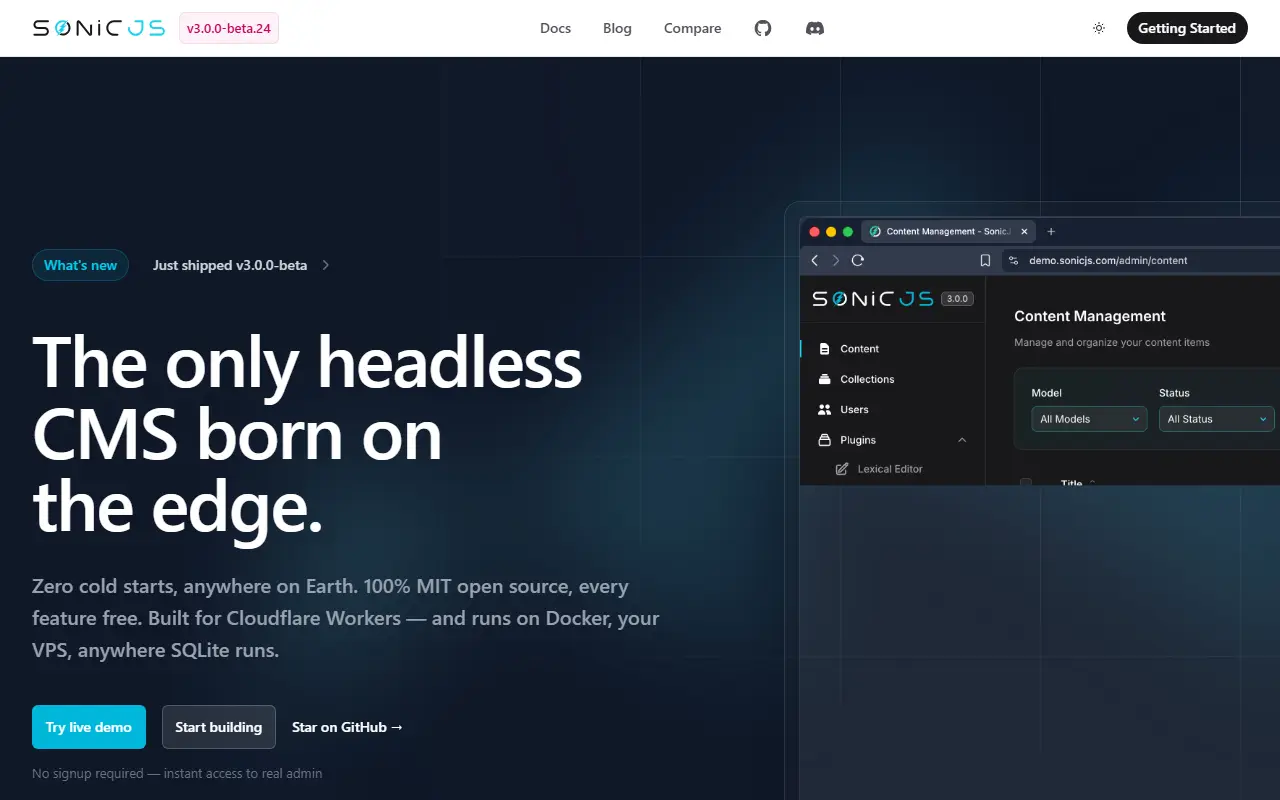
SonicJS is a headless CMS designed to run at the edge on Cloudflare Workers. Content is stored in Cloudflare D1 and R2, the API layer is built on Hono, and content models are defined as TypeScript code, from which SonicJS generates the REST API and an admin interface.
Beyond the REST API, it offers an optional GraphQL endpoint with a GraphiQL playground, a rich text editor based on TinyMCE, and an MCP server whose generated tools let AI coding assistants such as Claude Code, Cursor and VS Code read, create and publish content. Semantic search is also listed among its features. A create-sonicjs CLI scaffolds new projects, and local development uses Wrangler with hot reload.
The project is MIT licensed and states that every feature is free, with no enterprise-only tier. If you do not use Cloudflare, it can also run on any server with Docker and SQLite, and the self-hosting guide covers Docker Compose, Node.js and backups. Its topics tag it as an alternative to Strapi and Payload, making it a fit for JavaScript developers building Jamstack sites.
Key features
- Schema-as-code content models in TypeScript
- Auto-generated REST API and admin UI
- Optional GraphQL endpoint with playground
- MCP server for AI coding assistants
- Runs on Cloudflare Workers, D1, and R2
- Docker and SQLite self-hosting option
Good fit for
- →Powering Jamstack sites with a headless CMS
- →Teams moving off Strapi or Payload
- →Letting AI assistants manage site content
- Tags
- headless-cms
- cloudflare-workers
- typescript
- hono
- graphql
- mcp
- jamstack
- edge
- mit
SonicJS: questions and answers
- What is SonicJS used for?
- SonicJS is a TypeScript headless CMS designed for Cloudflare Workers, using D1, R2 and Hono, with an MCP server and an option to self-host with Docker. It is a good fit for powering Jamstack sites with a headless CMS, teams moving off Strapi or Payload and letting AI assistants manage site content.
- Is SonicJS open source?
- Yes. SonicJS is open source under the MIT licence. Its source code is on GitHub at SonicJs-Org/sonicjs and is written mainly in TypeScript.
- Is SonicJS free?
- Yes. SonicJS is open source, so the software itself is free to use.
- Can I self-host SonicJS?
- Yes. SonicJS can be self-hosted on your own server or infrastructure.
- What is SonicJS an alternative to?
- SonicJS is an open-source alternative to Contentstack, Storyblok, Hygraph and DatoCMS. Other open-source alternatives to Contentstack include Strapi, Webiny and Payload.
- Is SonicJS actively maintained?
- Yes. The most recent commit to SonicJS was on 13 September 2026, and the latest release is v3.0.0-beta.28, published on 8 September 2026. The project has 1.7k stars on GitHub.
Open-source alternatives to SonicJS
See all
Strapi
CMS
🚀 Strapi is the leading open-source headless CMS. It’s 100% JavaScript/TypeScript, fully
OSSvs Contentstack★ 73k
Webiny
CMS
Open-source, self-hosted CMS platform on AWS serverless (Lambda, DynamoDB, S3). TypeScript
OSSvs Contentstack★ 8k
Payload
CMS
Payload is the open-source, fullstack Next.js framework, giving you instant backend superp
MITvs Contentstack★ 45k
Directus
CMS
The flexible backend for all your projects 🐰 Turn your DB into a headless CMS, admin pane
OSSvs Contentstack★ 38k
KeystoneJS
CMS
The superpowered headless CMS for Node.js — built with GraphQL and React
MITvs Contentstack★ 10k
Alinea
CMS
Content management, streamlined
MITvs Storyblok★ 855
SaaS alternatives to SonicJS
See all
Contentstack
CMS
Enterprise headless CMS and digital experience platform
SaaS
Storyblok
CMS
Headless CMS with a visual editor for component-based pages
SaaS
Hygraph
CMS
GraphQL-native headless CMS with content federation
SaaS
DatoCMS
CMS
Headless CMS with a GraphQL API and image CDN
SaaS
Contentful
CMS
Headless CMS and content platform with APIs, structured content and localization
SaaS
Agility CMS
CMS
Headless CMS with page management for marketing teams
SaaS