7,363 open-source and SaaS tools, with GitHub stats refreshed every day.

9 alternatives ranked by real activity

Open-source DatoCMS alternatives

A curated, ranked list of the 9 best open-source alternatives to DatoCMS.

The best open-source alternative to DatoCMS is Strapi. If that doesn't suit you, other good options are Pages CMS, Sveltia CMS, Keystatic and SonicJS.

DatoCMS alternatives are mainly CMS tools. 8 of them shipped code in the last 30 days, 9 can be self-hosted, and 6 use a permissive licence.

Last updated October 2, 2026 · ranked by GitHub stars, growth and recent commits

Strapi

An open-source headless CMS written in JavaScript and TypeScript that generates REST and GraphQL APIs from content models you design.

GitHub stars
73k
Last commit
today
Latest release
v5.56.0
Self-hosted
Yes
Hosted version
Available
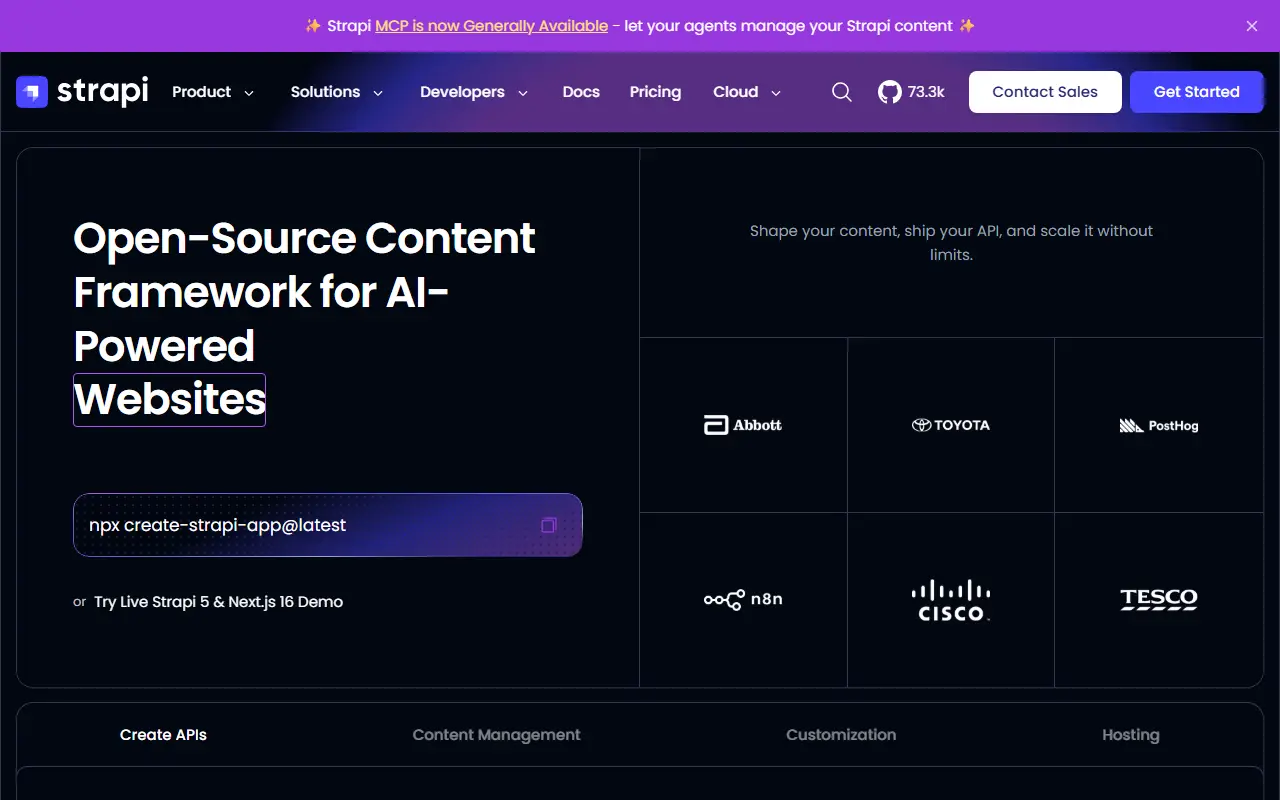
strapi.ioStrapi homepage screenshot

Strapi is a headless content management system. Developers define content models, and Strapi generates a complete API that a website, mobile app or other client can consume, while editors get a friendly admin interface for writing and managing content. It is written entirely in JavaScript and TypeScript on Node.js.

A visual Content-Type Builder lets you design structures without code, and every content type gets REST and GraphQL endpoints automatically. Granular roles and permissions, a media library, internationalization and draft and publish workflows are built in. It works with SQLite, PostgreSQL, MySQL and MariaDB, and offers a plugin system and a customizable admin dashboard. Requests pass through routes, middlewares, controllers and services, which is where backend customization happens. Strapi AI adds help with content modeling, media alt text and translations.

You can self-host Strapi on your own infrastructure or use Strapi Cloud, the managed service. Its license is listed as 'Other' in the repository metadata, so confirm the terms for any enterprise features. It suits teams building Jamstack or multi-channel sites that want a flexible, developer-first backend.

Key features

  • Visual Content-Type Builder
  • Auto-generated REST and GraphQL APIs
  • Granular roles and permissions
  • Media library with internationalization
  • Draft and publish workflow
  • Plugin system and customizable admin panel
  • SQLite, PostgreSQL, MySQL and MariaDB support

Pricing: Strapi Cloud has no free tier on this page: Starter is $35, Pro $90 and Business $450 per project per month. Custom limits go through sales.

Pages CMS

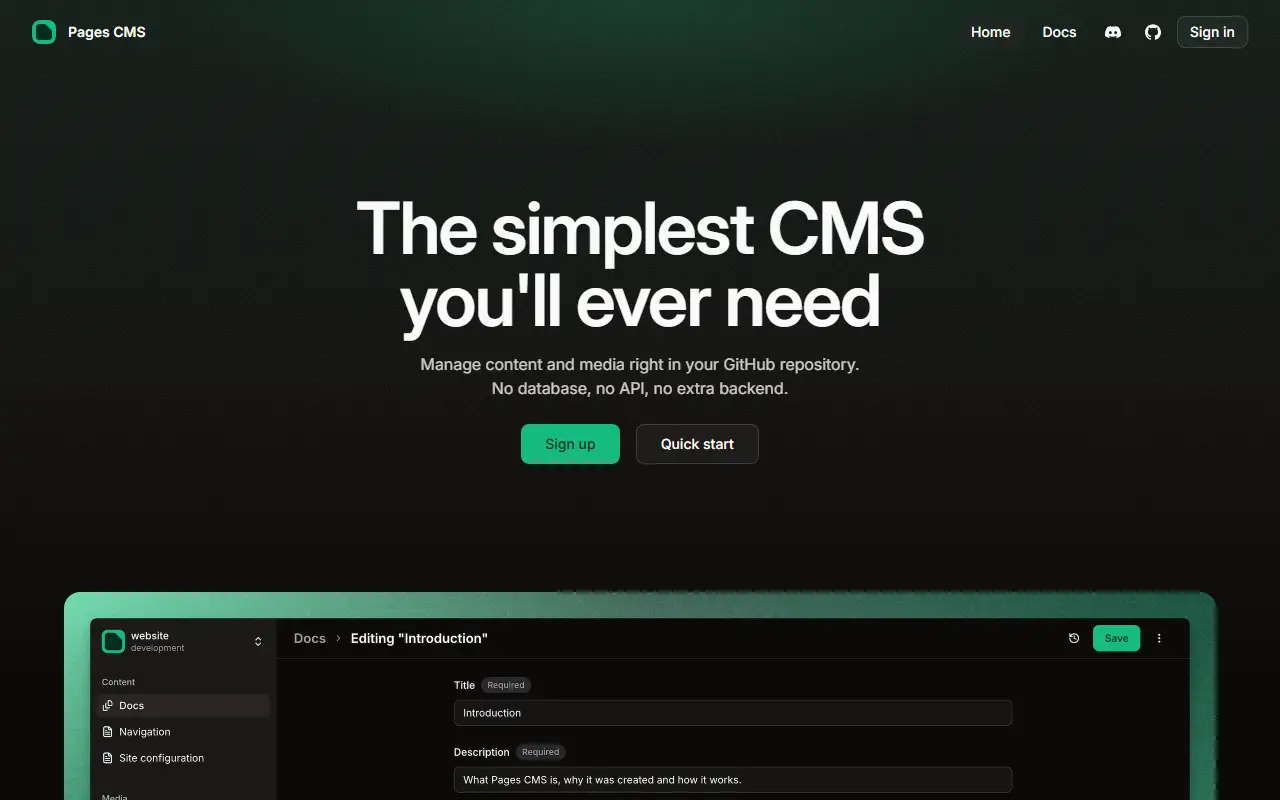
Pages CMS is an open-source content manager for GitHub repositories, built for static sites made with Jekyll, Hugo, Astro, Next.js and similar tools.

GitHub stars
4.1k
Last commit
2 days ago
Latest release
2.1.8
Licence
MIT
Self-hosted
Yes
Hosted version
Available
pagescms.orgPages CMS homepage screenshot

Pages CMS is an open-source CMS that edits content and media directly in a GitHub repository. It works especially well for static websites and content-led apps made with Jekyll, Hugo, Next.js or Astro, and the topic list also mentions Eleventy, Gatsby, Docusaurus, VitePress and VuePress.

Because content lives as files in your repo, editors get a friendly interface while developers keep the Git workflow and ownership of the content. You can either use the hosted app at app.pagescms.org or run a development copy yourself from the repository, which involves creating a GitHub App and setting environment variables. Documentation covers installing locally and upgrading to version 2.

Pages CMS is written in TypeScript with Next.js and is licensed under MIT. It suits developers who build sites for clients or teams and want non-technical editors to update content without touching Git.

Key features

  • Edit content and media in GitHub repos
  • Works with Jekyll, Hugo, Astro and Next.js
  • Hosted version at app.pagescms.org
  • Self-hostable via a GitHub App
  • Git-based content ownership
  • Documentation for configuration options

Pricing: Free and open source under the MIT license; a hosted version is available.

Sveltia CMS

Git-based headless CMS for Jamstack sites, built as a modern replacement for Netlify and Decap CMS with strong multilingual support and mobile editing.

GitHub stars
2.9k
Last commit
yesterday
Latest release
v0.227.2
Licence
MIT
Self-hosted
Yes
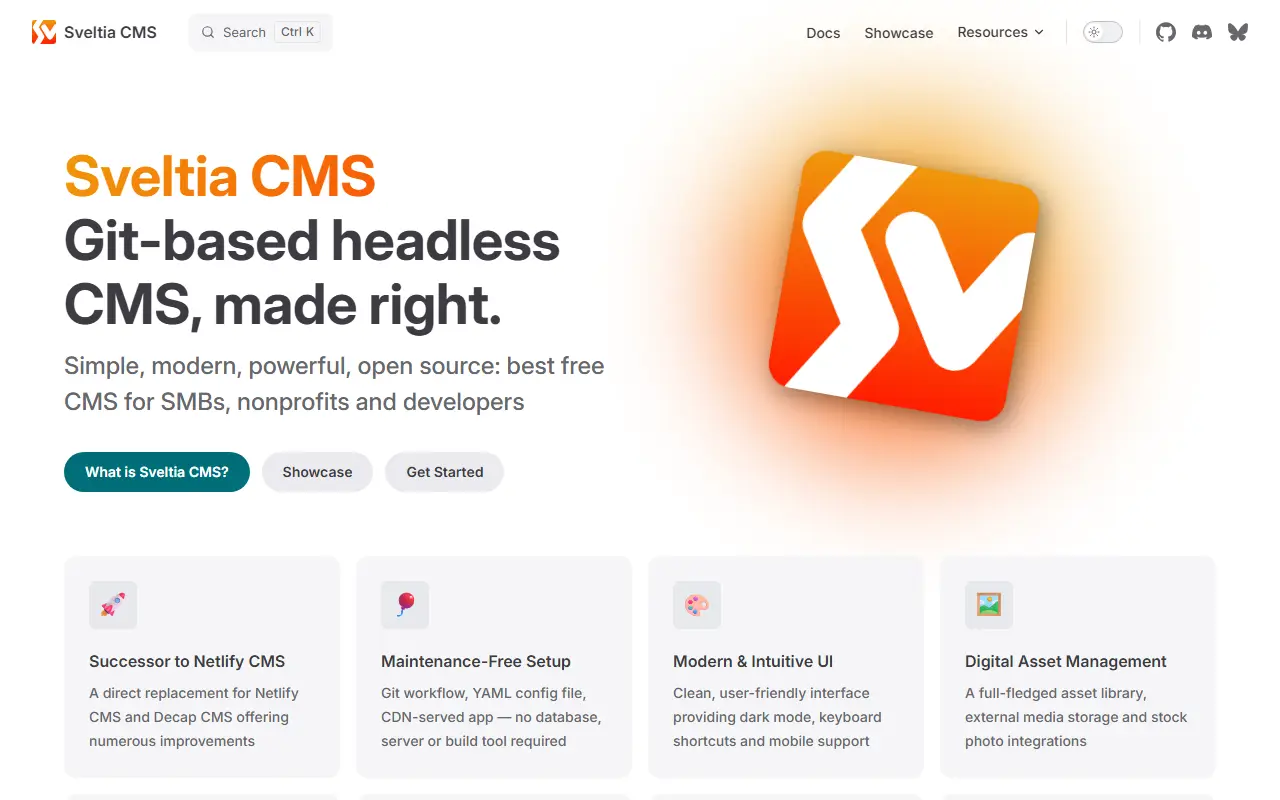
sveltiacms.appSveltia CMS homepage screenshot

Sveltia CMS is a Git-based headless content management system for static and Jamstack websites. It is a full rewrite of Netlify CMS, now known as Decap CMS, and keeps high compatibility with existing configurations while improving performance, security, and user experience. It is open source under the MIT license and runs as a small single-page web app served from a CDN.

It is designed for both content editors and developers, with first-class internationalization, dark mode, and mobile support. The topics mention integrations with GitHub and stock-photo providers such as Pexels, Pixabay, and Unsplash, plus digital asset management features. The maintainers say hundreds of issues from the Decap repository have been resolved, and the project shows migrated sites from Decap and WordPress in its showcase.

Sveltia CMS is framework-agnostic and works with static site generators like Astro, Eleventy, and Hugo, from personal blogs and portfolios to marketing sites and knowledge bases. It suits teams that want to keep content in Git while giving non-developers a friendly editing interface.

Key features

  • Git-based content editing for static sites
  • Compatible with Netlify and Decap CMS configs
  • First-class multilingual content support
  • Mobile-friendly editing interface
  • Stock photo search from Pexels, Pixabay, and Unsplash
  • Works with Astro, Eleventy, and Hugo
  • Dark mode

Pricing: Free and open source under the MIT license.

Keystatic

Git-based CMS from Thinkmill that stores content as Markdown, YAML, or JSON files with a TypeScript API and no database, built for Next.js, Remix, and Astro.

GitHub stars
2.4k
Last commit
yesterday
Licence
MIT
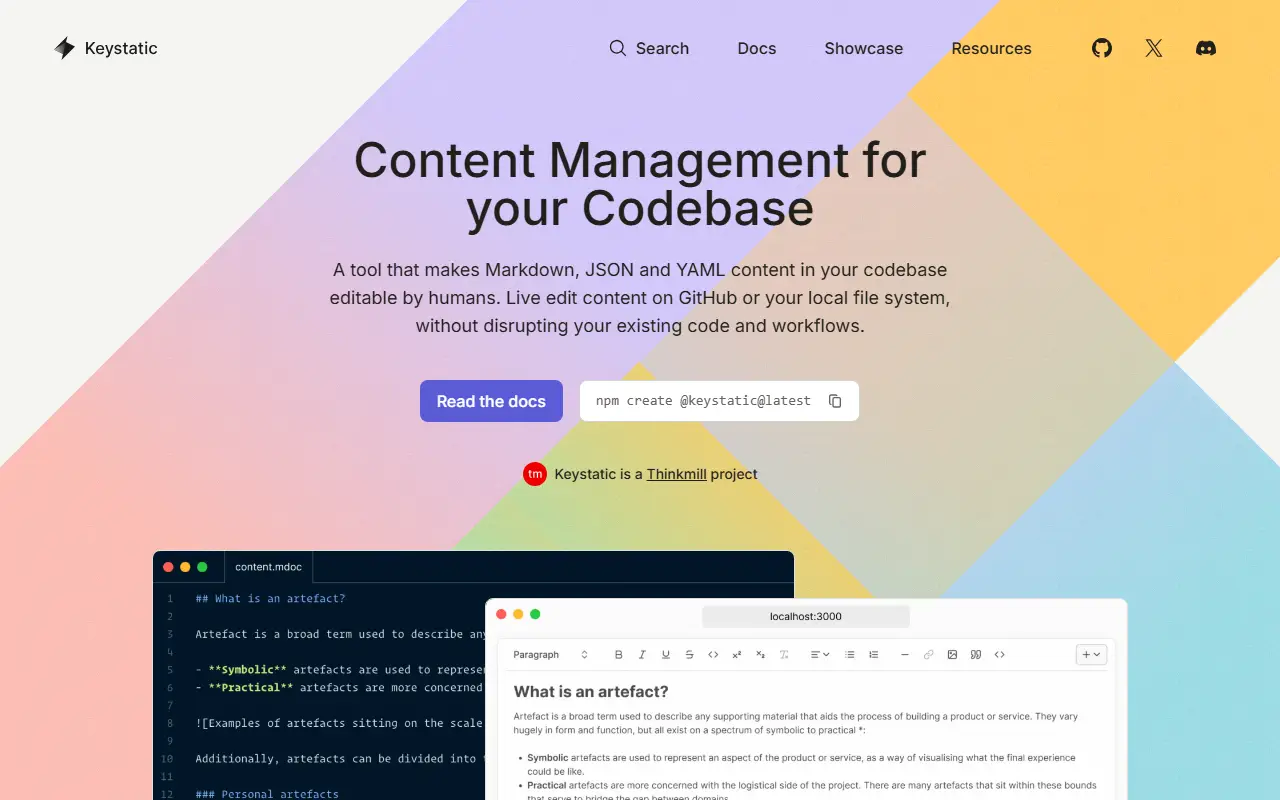
keystatic.comKeystatic homepage screenshot

Keystatic is a content management system that keeps content as Markdown, YAML, or JSON files in your own repository instead of in a database. It offers a TypeScript API and a visual editing interface, connects directly to GitHub, and does not alter your source code. It carries over ideas from Keystone, a previous project from the same team, Thinkmill. It is released under the MIT license.

It is designed for modern front-end frameworks such as Next.js, Remix, and Astro, and is meant to fit into existing developer workflows. Because content is plain files, it can be versioned, reviewed, and deployed along with the rest of a site, and editors who are not developers get a friendly interface to change it.

The README describes the project as experimental while it is being developed and points readers to keystatic.com, guides, templates, and the CLI to try it. Development of the monorepo requires Node.js 18 and pnpm. Keystatic suits developers building content-driven sites who want a lightweight CMS without running a separate backend.

Key features

  • Content stored as Markdown, YAML, or JSON files
  • TypeScript API for defining content
  • Visual editing interface for non-developers
  • Direct GitHub connection
  • No database required
  • Designed for Next.js, Remix, and Astro

Pricing: Free and open source under the MIT license.

SonicJS

A TypeScript headless CMS designed for Cloudflare Workers, using D1, R2 and Hono, with an MCP server and an option to self-host with Docker.

GitHub stars
1.7k
Last commit
20 days ago
Latest release
v3.0.0-beta.28
Licence
MIT
Self-hosted
Yes
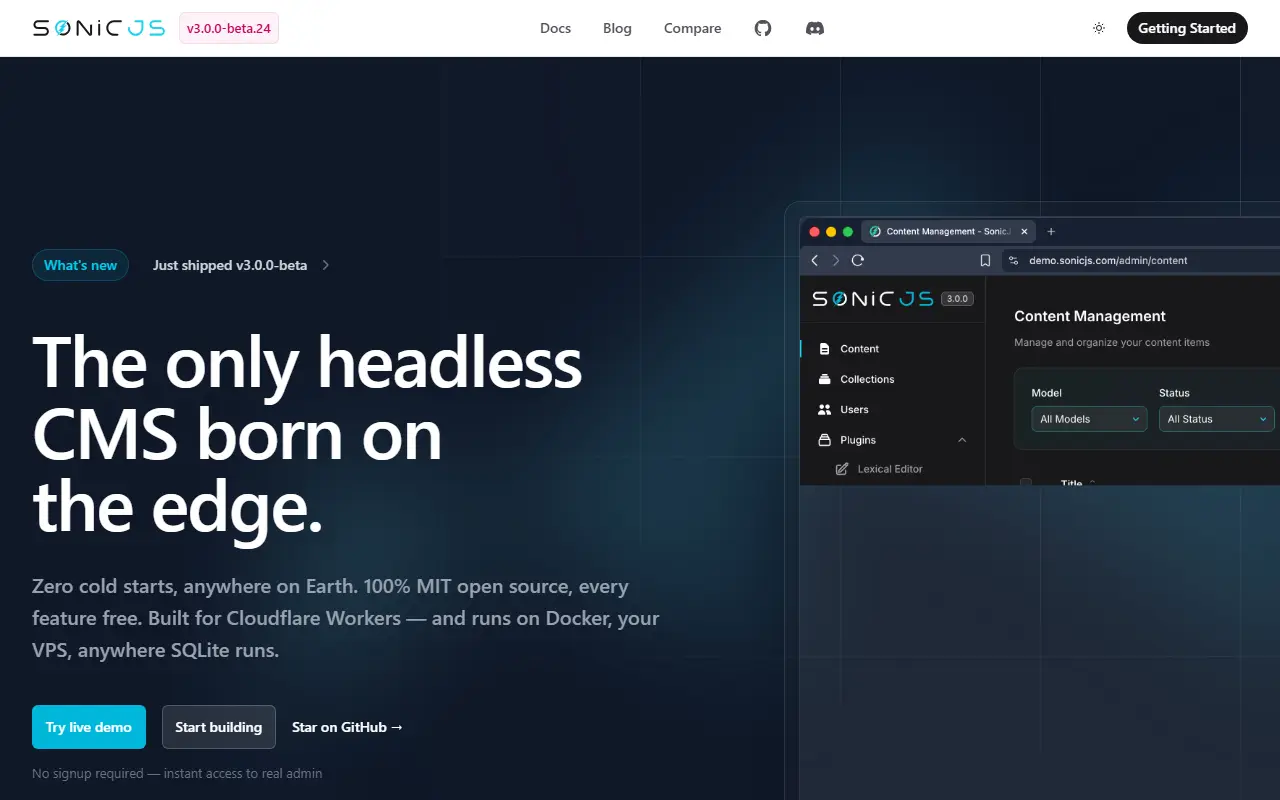
sonicjs.comSonicJS homepage screenshot

SonicJS is a headless CMS designed to run at the edge on Cloudflare Workers. Content is stored in Cloudflare D1 and R2, the API layer is built on Hono, and content models are defined as TypeScript code, from which SonicJS generates the REST API and an admin interface.

Beyond the REST API, it offers an optional GraphQL endpoint with a GraphiQL playground, a rich text editor based on TinyMCE, and an MCP server whose generated tools let AI coding assistants such as Claude Code, Cursor and VS Code read, create and publish content. Semantic search is also listed among its features. A create-sonicjs CLI scaffolds new projects, and local development uses Wrangler with hot reload.

The project is MIT licensed and states that every feature is free, with no enterprise-only tier. If you do not use Cloudflare, it can also run on any server with Docker and SQLite, and the self-hosting guide covers Docker Compose, Node.js and backups. Its topics tag it as an alternative to Strapi and Payload, making it a fit for JavaScript developers building Jamstack sites.

Key features

  • Schema-as-code content models in TypeScript
  • Auto-generated REST API and admin UI
  • Optional GraphQL endpoint with playground
  • MCP server for AI coding assistants
  • Runs on Cloudflare Workers, D1, and R2
  • Docker and SQLite self-hosting option

Pricing: SonicJS is free, MIT-licensed software with every feature included and no hosted service of its own. You pay only your own hosting, typically $0 to $5 per month on Cloudflare.

FireCMS

FireCMS is a React and TypeScript admin panel and headless CMS framework for Firebase and Firestore, available as a managed cloud or self-hosted.

GitHub stars
1.3k
Last commit
2 days ago
Latest release
v3.1.0
Self-hosted
Yes
Hosted version
Available
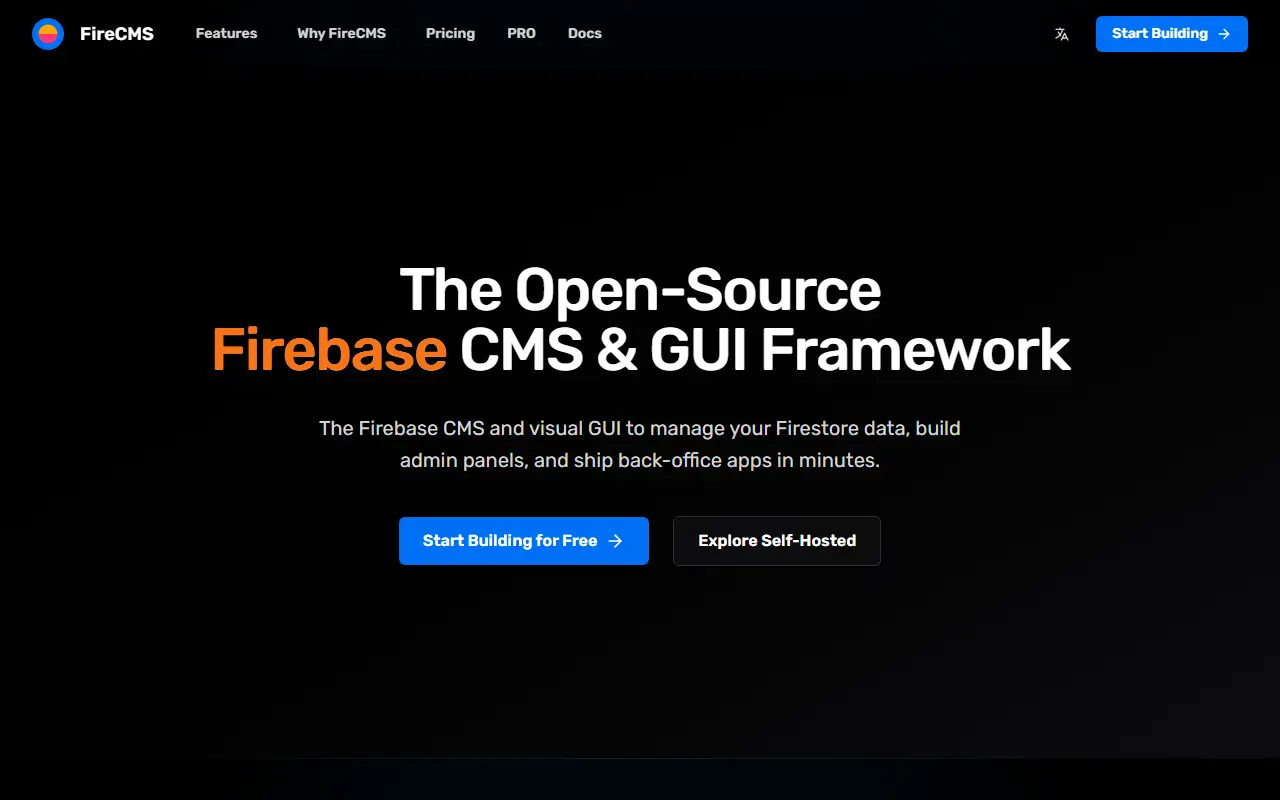
firecms.coFireCMS homepage screenshot

FireCMS is a developer-focused, open-source framework for building admin panels, back offices and headless CMS tools on top of Firebase and Firestore. It is built with React and TypeScript, connects natively to Firebase and also to MongoDB, and generates CRUD interfaces, forms and data management tools from the schema you define.

Highlights include real-time data with Firebase Auth and Storage, a visual schema editor that can infer schemas from existing collections, a Notion-style rich text editor with slash commands, and AI features such as autofilling fields, generating collections and querying data in natural language. The framework can be extended with custom components and plugins to fit particular workflows.

You can use FireCMS Cloud, a fully managed service where you connect your Firebase project, or self-host the framework with Community or PRO editions for full control. The README says the core is MIT licensed, while repository metadata lists the licence as other. It suits agencies and developers who already use Firebase and want an admin interface without building one from scratch.

Key features

  • Native Firebase and Firestore integration
  • Auto-generated CRUD interfaces from schemas
  • Visual schema editor
  • Notion-style rich text editor
  • AI-assisted field autofill and queries
  • Managed cloud or self-hosted options

Pricing: The Community edition is free and self-hosted. Cloud costs €9.99 per user per month after a 1-month trial; self-hosted PRO is €99 (about $119) per month for the first project; Enterprise is quoted on request.

Alinea

Alinea is an open-source, Git-based headless CMS for Next.js where content is typed in TypeScript and stored as JSON files in your repository.

GitHub stars
855
Last commit
today
Latest release
v1.7.0
Licence
MIT
Self-hosted
Yes
Hosted version
Available
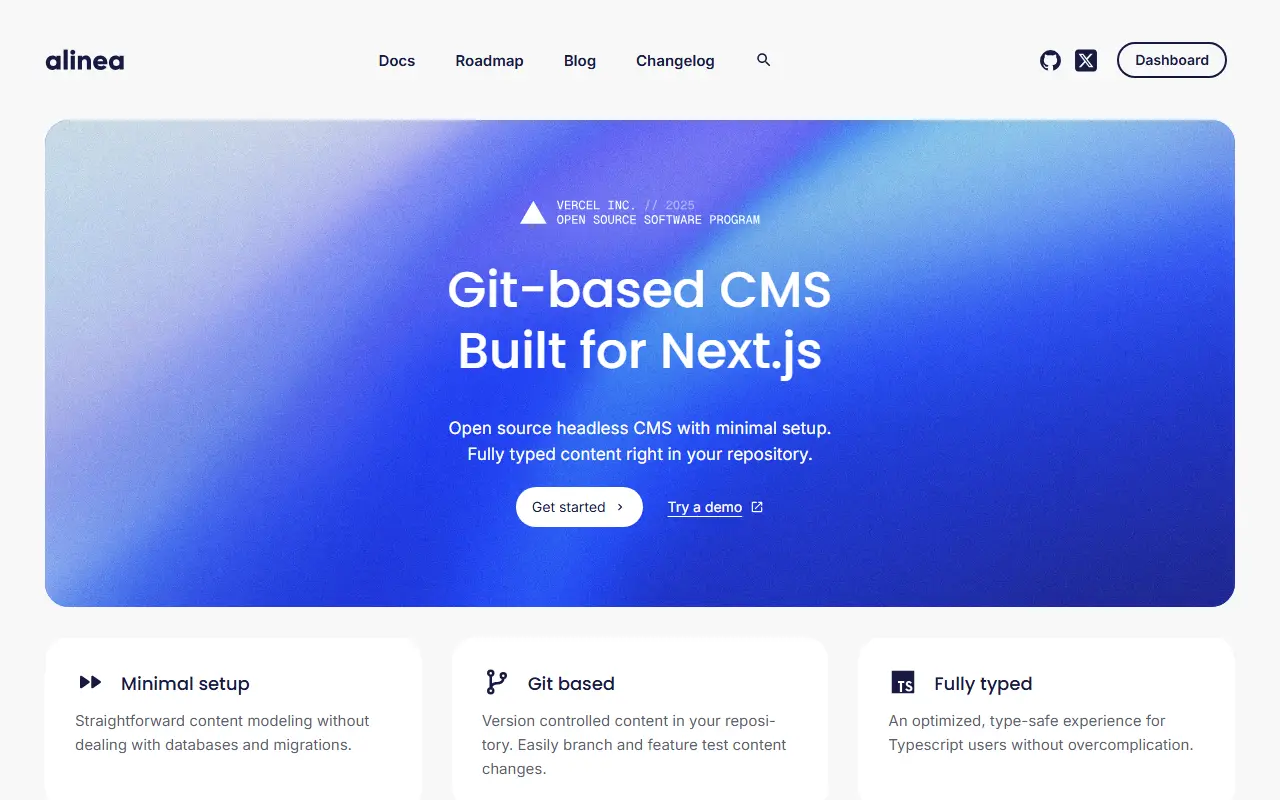
alineacms.comAlinea homepage screenshot

Alinea is an open-source headless CMS built for Next.js. You describe your content model in TypeScript, editors work in a dashboard that ships inside your own app, and every entry is saved as a JSON file in your Git repository, so content can be reviewed, branched and rolled back like code.

Queries are typed directly from your schema without code generation. Content is indexed in SQLite and bundled with the site, so no separate content database server is needed, and the dashboard offers full-text search. Live previews render drafts through your server components while editors type, and each publish is a Git commit that deployed sites pick up without a rebuild. The dashboard is built on React Aria Components with dark mode, entry history, roles and permissions, and per-field translations.

You can self-host the backend on your own database or let Alinea Cloud handle sign-in and publishing. Alinea needs Node.js 24 or higher, React 19 and the Next.js App Router, installs with an alinea init command, and is licensed under MIT.

Key features

  • Content model defined in TypeScript
  • Entries stored as JSON in Git
  • Typed queries without codegen
  • Live draft previews
  • Dashboard with roles and translations
  • Self-host or Alinea Cloud

Pricing: Open source under the MIT license; a managed Alinea Cloud option is also available.

StudioCMS

StudioCMS is a server-side rendered headless CMS built natively for Astro, with libSQL, MySQL and PostgreSQL support and a plugin system.

GitHub stars
843
Last commit
yesterday
Latest release
effectify@0.3.2
Licence
MIT
Self-hosted
Yes
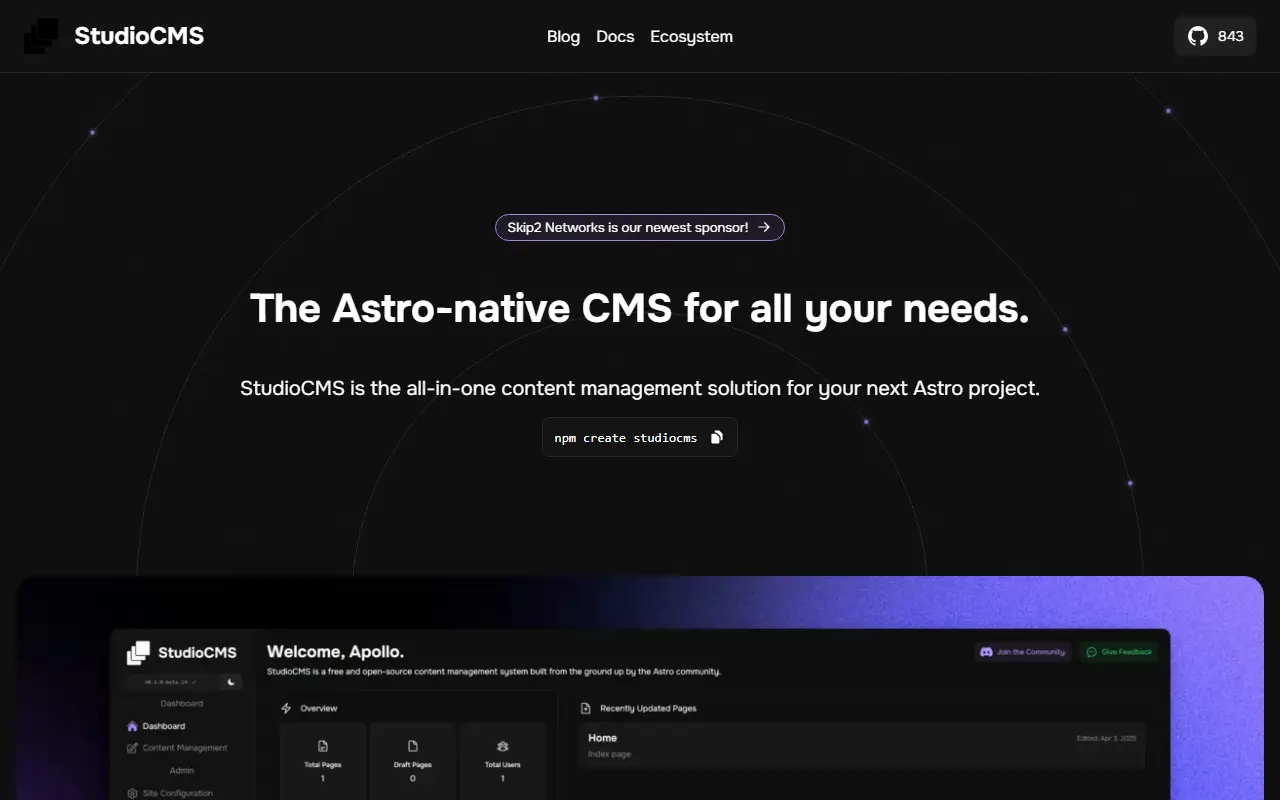
studiocms.devStudioCMS homepage screenshot

StudioCMS is a headless CMS designed specifically for the Astro ecosystem and built by members of its community. It runs as server-side rendering in Astro and ships as an Astro integration, so content management lives inside the same project as the site.

The repository is a monorepo with the core integration, development apps, authentication through OAuth, renderer plugins for HTML, Markdoc, Markdown, MDX and WYSIWYG content, a Cloudinary image service and a blog front-end. Storage options include libSQL and Turso, MySQL and PostgreSQL through Kysely, and shared utilities cover authentication, builds, configuration and a template language.

StudioCMS is written in TypeScript and licensed under MIT. Documentation on studiocms.dev explains how to get started, and since it is software you deploy with your Astro site, hosting is under your control.

Key features

  • Native Astro integration
  • Server-side rendered headless CMS
  • Markdown, MDX, Markdoc and WYSIWYG renderers
  • OAuth authentication plugin
  • libSQL, MySQL and PostgreSQL storage
  • Cloudinary image service plugin
  • Blog front-end plugin

Pricing: Free and open source under the MIT license.

Cockpit CMS

Self-hosted headless CMS built with PHP that serves content through REST and GraphQL APIs, using SQLite or MongoDB for storage.

GitHub stars
750
Last commit
1 mo ago
Latest release
2.14.1
Self-hosted
Yes
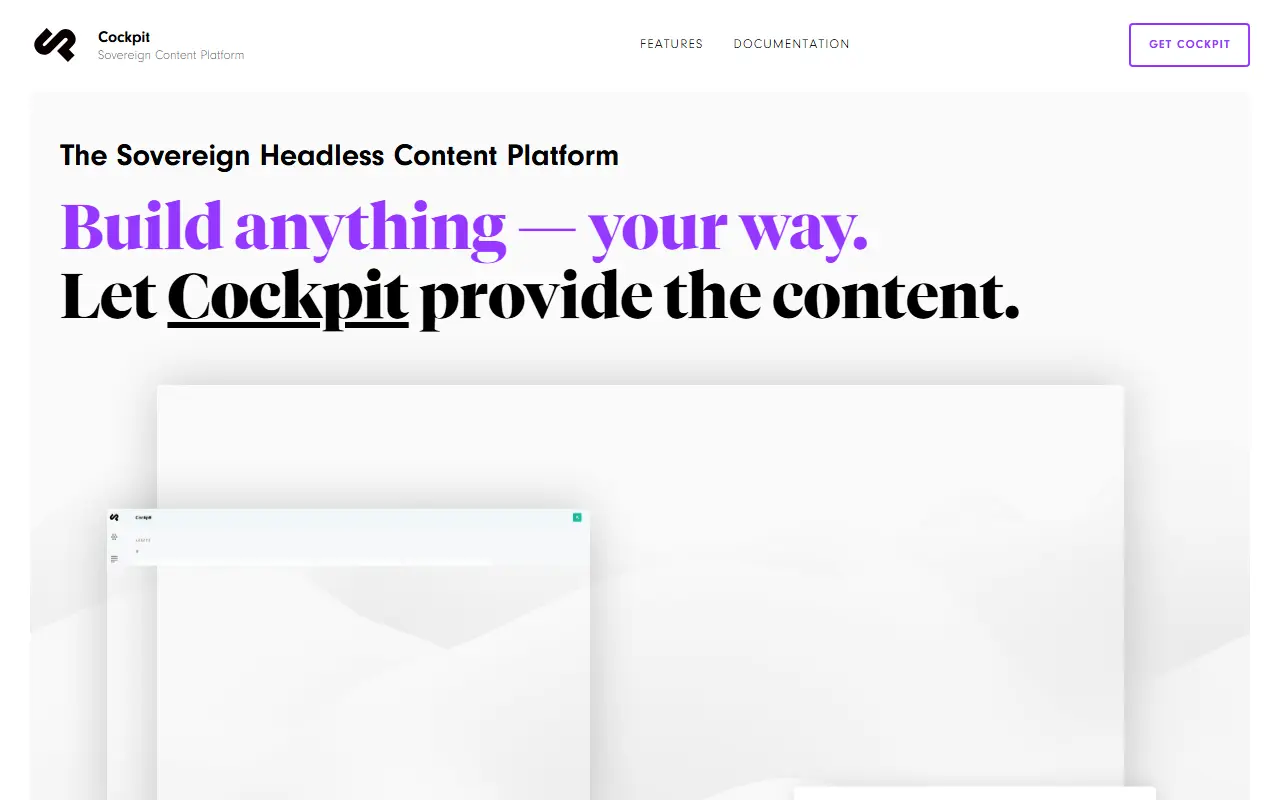
getcockpit.comCockpit CMS homepage screenshot

Cockpit is a headless content management system for developers who want to manage content in one place and deliver it to websites, mobile apps or IoT devices. It is frontend-agnostic, so it works with React, Vue, Flutter or anything else that can call an API, and it avoids vendor lock-in because you run it yourself and own the data. It is written in PHP.

Content is modeled with collections, singletons and trees using more than 20 field types, and exposed through REST and GraphQL APIs. The feature list includes asset management with image processing, video thumbnails and CDN integration, user management with roles, permissions, two-factor authentication and API tokens, and localized content with fallbacks. Extensibility comes from custom fields, addons, hooks and events, and spaces let one installation serve several sites or clients. Developer tools include a GraphQL playground, REST documentation and CLI commands.

Storage is SQLite by default or MongoDB. Requirements are PHP 8.3 with PDO and GD, Apache with mod_rewrite or Nginx, and a writable storage directory. The README recommends Docker for quick starts. The repository metadata lists the license as Other, so review the license file before commercial use.

Key features

  • Collections, singletons and trees with 20+ field types
  • REST and GraphQL APIs
  • Built-in multi-language content with fallback
  • Roles, permissions, 2FA and API tokens
  • Image processing and asset management
  • Spaces for multiple sites and clients
  • SQLite or MongoDB storage

DatoCMS alternatives: questions

What is the best open-source alternative to DatoCMS?
Strapi is the top-ranked open-source alternative to DatoCMS on Enlisted: An open-source headless CMS written in JavaScript and TypeScript that generates REST and GraphQL APIs from content models you design. Other strong options are Pages CMS, Sveltia CMS, Keystatic and SonicJS.
Are these DatoCMS alternatives free?
All 9 are open source, so the code is free to use under its licence, and all of them can be self-hosted on your own server or computer. 4 also offer a paid or managed cloud version if you'd rather not host it yourself.
How is this list of DatoCMS alternatives ranked?
By a score built from GitHub stars, star growth over the last 30 days and how recently the code changed. 8 of these projects shipped code in the last 30 days. Data is refreshed daily, and nobody can pay to move up.

People also look for alternatives to…

View all