
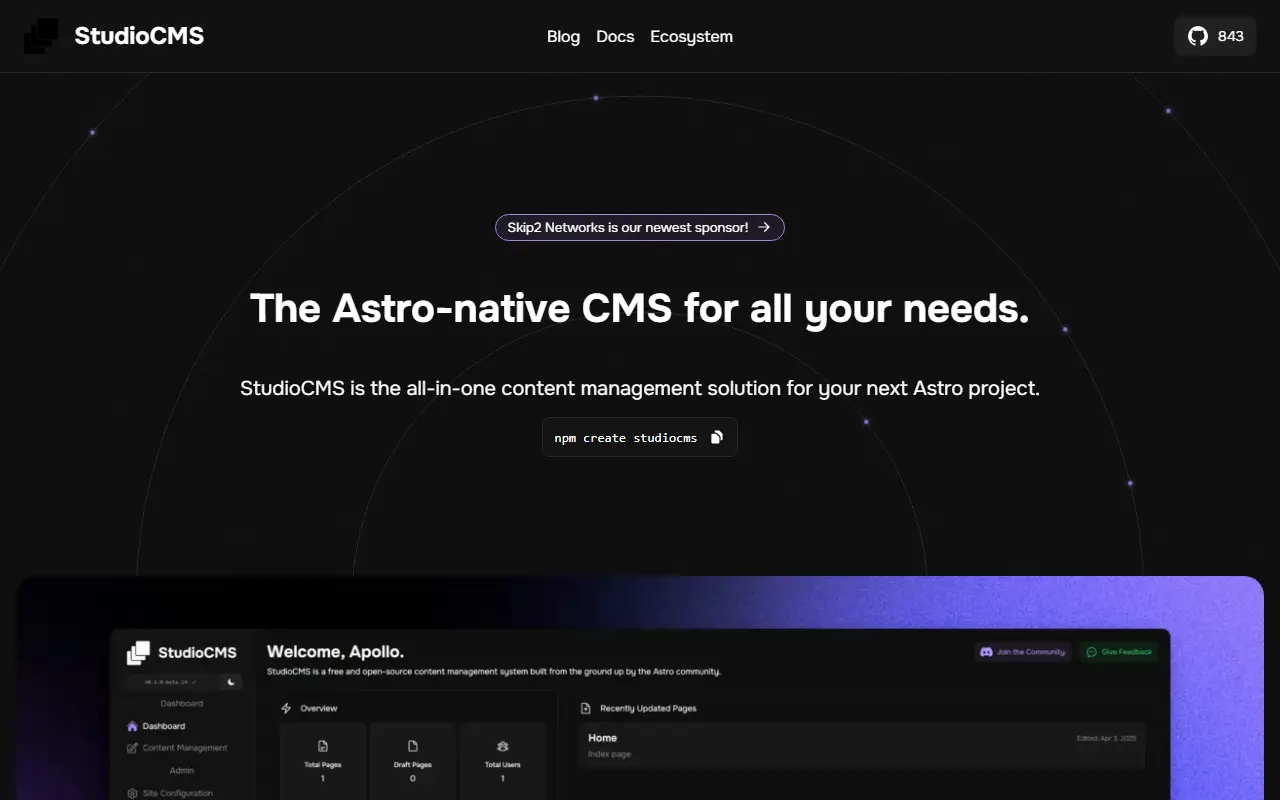
About StudioCMS
StudioCMS is a headless CMS designed specifically for the Astro ecosystem and built by members of its community. It runs as server-side rendering in Astro and ships as an Astro integration, so content management lives inside the same project as the site.
The repository is a monorepo with the core integration, development apps, authentication through OAuth, renderer plugins for HTML, Markdoc, Markdown, MDX and WYSIWYG content, a Cloudinary image service and a blog front-end. Storage options include libSQL and Turso, MySQL and PostgreSQL through Kysely, and shared utilities cover authentication, builds, configuration and a template language.
StudioCMS is written in TypeScript and licensed under MIT. Documentation on studiocms.dev explains how to get started, and since it is software you deploy with your Astro site, hosting is under your control.
Key features
- Native Astro integration
- Server-side rendered headless CMS
- Markdown, MDX, Markdoc and WYSIWYG renderers
- OAuth authentication plugin
- libSQL, MySQL and PostgreSQL storage
- Cloudinary image service plugin
- Blog front-end plugin
Good fit for
- →Content management for Astro sites
- →Headless blogs with an Astro front end
- Tags
- cms
- astro
- headless-cms
- typescript
- libsql
- postgresql
- mysql
- ssr
StudioCMS: questions and answers
- What is StudioCMS used for?
- StudioCMS is a server-side rendered headless CMS built natively for Astro, with libSQL, MySQL and PostgreSQL support and a plugin system. It is a good fit for content management for Astro sites and headless blogs with an Astro front end.
- Is StudioCMS open source?
- Yes. StudioCMS is open source under the MIT licence. Its source code is on GitHub at withstudiocms/studiocms and is written mainly in TypeScript.
- Is StudioCMS free?
- Yes. StudioCMS is open source, so the software itself is free to use.
- Can I self-host StudioCMS?
- Yes. StudioCMS can be self-hosted on your own server or infrastructure.
- What is StudioCMS an alternative to?
- StudioCMS is an open-source alternative to Storyblok, Contentstack and DatoCMS. Other open-source alternatives to Storyblok include Strapi, Alinea and SonicJS.
- Is StudioCMS actively maintained?
- Yes. The most recent commit to StudioCMS was on 1 October 2026. The project has 843 stars on GitHub.
Open-source alternatives to StudioCMS
See all
Strapi
CMS
🚀 Strapi is the leading open-source headless CMS. It’s 100% JavaScript/TypeScript, fully
OSSvs Contentstack★ 73k
Alinea
CMS
Content management, streamlined
MITvs Storyblok★ 855
SonicJS
CMS
SonicJS - The edge-native headless CMS for Cloudflare Workers. Sub-100ms response times, z
MITvs Contentstack★ 1.7k
Cockpit CMS
CMS
Cockpit Core - Content Platform
OSSvs Storyblok★ 750
Payload
CMS
Payload is the open-source, fullstack Next.js framework, giving you instant backend superp
MITvs Contentstack★ 45k
Keystatic
CMS
First class CMS experience, TypeScript API, Markdown & YAML/JSON based, no DB
MITvs Prismic★ 2.4k
SaaS alternatives to StudioCMS
See all
Storyblok
CMS
Headless CMS with a visual editor for component-based pages
SaaS
Contentstack
CMS
Enterprise headless CMS and digital experience platform
SaaS
DatoCMS
CMS
Headless CMS with a GraphQL API and image CDN
SaaS
Contentful
CMS
Headless CMS and content platform with APIs, structured content and localization
SaaS
Cosmic
CMS
API-first headless CMS with a hosted dashboard and media library
SaaS
Hygraph
CMS
GraphQL-native headless CMS with content federation
SaaS