7,363 open-source and SaaS tools, with GitHub stats refreshed every day.

11 alternatives ranked by real activity

Open-source Hygraph alternatives

A curated, ranked list of the 11 best open-source alternatives to Hygraph.

The best open-source alternative to Hygraph is Strapi. If that doesn't suit you, other good options are Payload, Directus, KeystoneJS and Webiny.

Hygraph alternatives are mainly CMS tools. 9 of them shipped code in the last 30 days, 10 can be self-hosted, and 7 use a permissive licence.

Last updated October 2, 2026 · ranked by GitHub stars, growth and recent commits

Strapi

An open-source headless CMS written in JavaScript and TypeScript that generates REST and GraphQL APIs from content models you design.

GitHub stars
73k
Last commit
yesterday
Latest release
v5.56.0
Self-hosted
Yes
Hosted version
Available
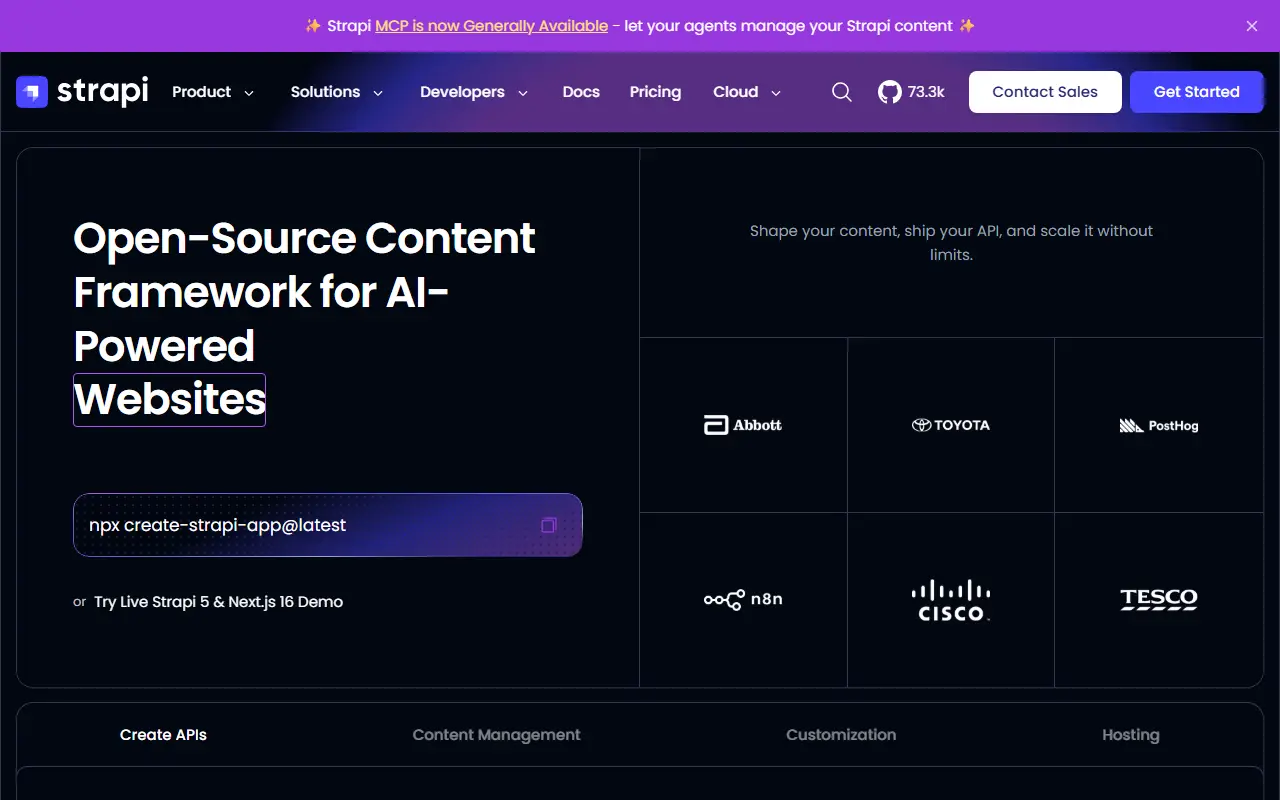
strapi.ioStrapi homepage screenshot

Strapi is a headless content management system. Developers define content models, and Strapi generates a complete API that a website, mobile app or other client can consume, while editors get a friendly admin interface for writing and managing content. It is written entirely in JavaScript and TypeScript on Node.js.

A visual Content-Type Builder lets you design structures without code, and every content type gets REST and GraphQL endpoints automatically. Granular roles and permissions, a media library, internationalization and draft and publish workflows are built in. It works with SQLite, PostgreSQL, MySQL and MariaDB, and offers a plugin system and a customizable admin dashboard. Requests pass through routes, middlewares, controllers and services, which is where backend customization happens. Strapi AI adds help with content modeling, media alt text and translations.

You can self-host Strapi on your own infrastructure or use Strapi Cloud, the managed service. Its license is listed as 'Other' in the repository metadata, so confirm the terms for any enterprise features. It suits teams building Jamstack or multi-channel sites that want a flexible, developer-first backend.

Key features

  • Visual Content-Type Builder
  • Auto-generated REST and GraphQL APIs
  • Granular roles and permissions
  • Media library with internationalization
  • Draft and publish workflow
  • Plugin system and customizable admin panel
  • SQLite, PostgreSQL, MySQL and MariaDB support

Pricing: Strapi Cloud has no free tier on this page: Starter is $35, Pro $90 and Business $450 per project per month. Custom limits go through sales.

Payload

An open-source, Next.js-native headless CMS and app framework that installs into an existing app folder and gives you a TypeScript backend with an admin panel.

GitHub stars
45k
Last commit
yesterday
Latest release
v3.90.2
Licence
MIT
Self-hosted
Yes
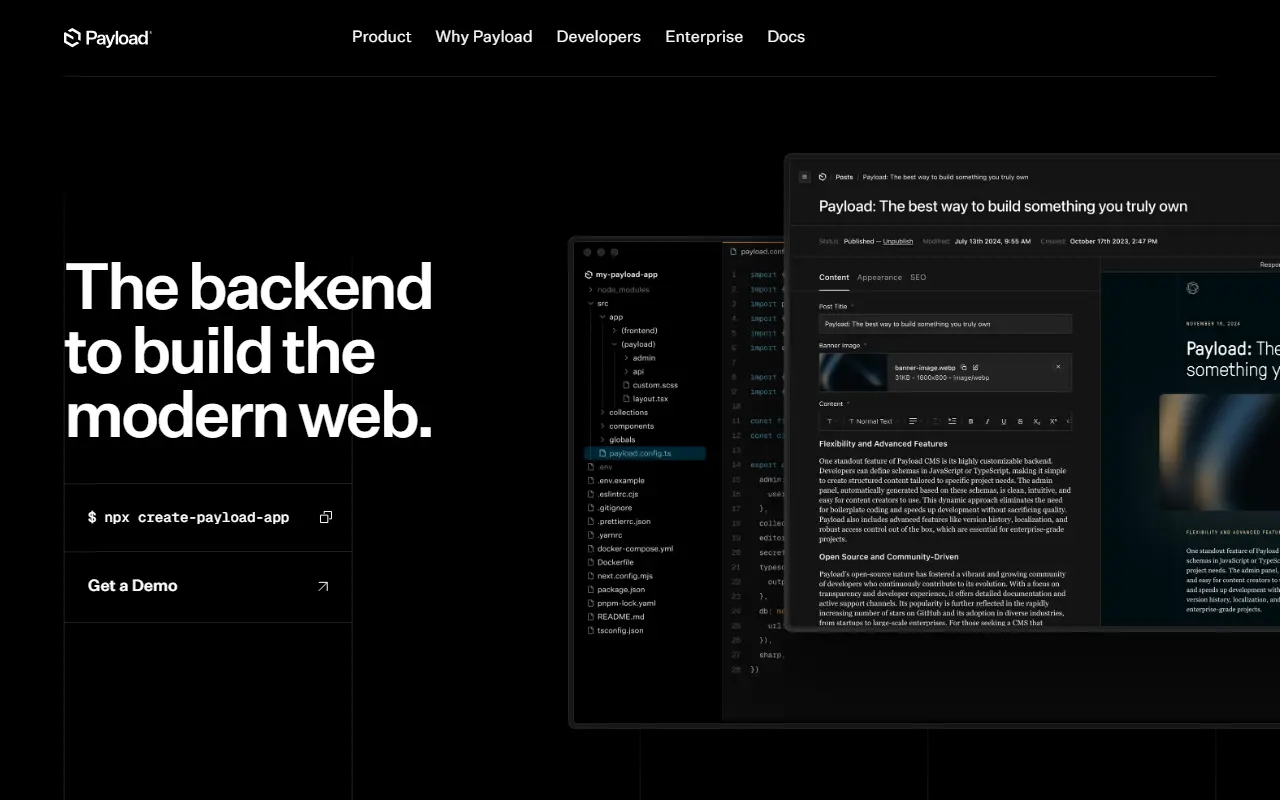
payloadcms.comPayload homepage screenshot

Payload is an open-source CMS and application framework built on Next.js. Rather than running as a separate service, it can be installed directly into an existing Next.js app folder, giving you a TypeScript backend and an admin panel in the same codebase. You can use it as a headless CMS or as the foundation for a full application.

Because the backend lives alongside the front end, you can query your database straight from React Server Components and deploy anywhere, including serverless platforms such as Vercel. Both the admin interface and backend logic are described as fully extensible, with GraphQL and REST access, support for MongoDB and PostgreSQL, and no dependence on another SaaS vendor. A website template demonstrates rich text blocks, on-demand revalidation and live preview.

Payload is MIT licensed and written in TypeScript. It suits development teams that already build with Next.js and React and want content management they fully control, as an alternative to hosted headless CMS products or to maintaining a traditional PHP-based system.

Key features

  • Installs inside an existing Next.js app
  • Auto-generated admin panel
  • TypeScript backend with GraphQL and REST
  • MongoDB and PostgreSQL support
  • Query data in React Server Components
  • Live preview and on-demand revalidation

Pricing: Free and open source under the MIT license.

Directus

A self-hostable data platform that wraps any SQL database with instant REST and GraphQL APIs, a no-code admin app, authentication and an MCP server.

GitHub stars
38k
Last commit
yesterday
Latest release
v12.4.1
Self-hosted
Yes
Hosted version
Available
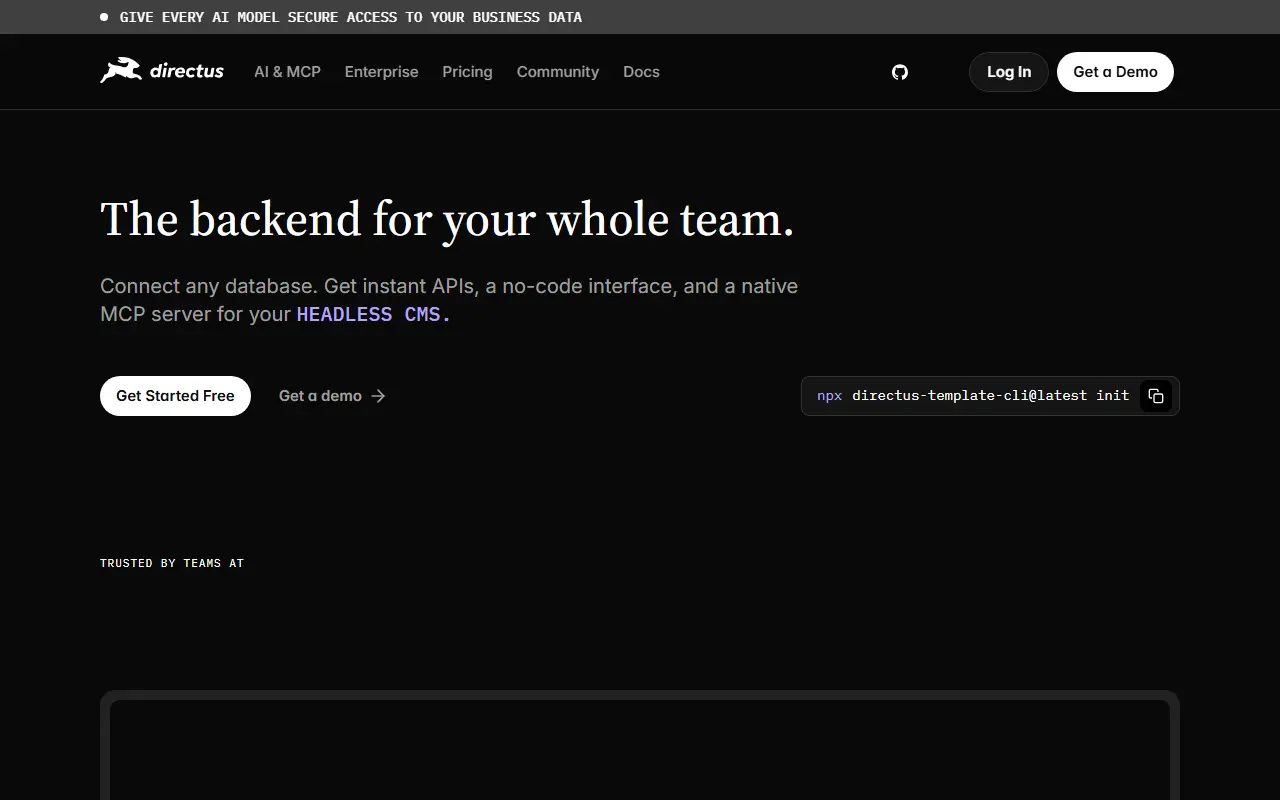
directus.comDirectus homepage screenshot

Directus is a collaborative backend and headless CMS that sits on top of an existing SQL database. You connect a database, and it generates production-ready REST and GraphQL APIs, leaving your schema exactly as built, along with a no-code interface where non-developers can manage content and data.

Beyond content management it provides authentication and access control, so the same install can power websites, apps, admin panels and internal tools. A native Model Context Protocol server gives AI assistants such as Claude, ChatGPT and Cursor secure access to business data. Supported databases include SQLite, MySQL, PostgreSQL and SQL Server, and the app is built with TypeScript and Vue. A template CLI, run through npx, can initialize a project quickly.

Directus can be self-hosted on servers you control, or run on the vendor's Directus Cloud. The repository license is listed as 'Other', so review the terms to see which uses are free. It suits teams that want an API and admin layer over data they already have, without writing a custom backend.

Key features

  • Instant REST and GraphQL APIs over any SQL database
  • No-code data and content interface
  • Authentication and role-based access
  • Native MCP server for AI assistants
  • Works with SQLite, MySQL, PostgreSQL and SQL Server
  • Project templates via npx CLI

Pricing: Core is free with 3 seats. Team is $599 per month billed monthly or $499 per month on an annual commitment; Enterprise is custom. Directus Cloud hosting is a $99 per month add-on, with a 14-day cloud trial.

KeystoneJS

A headless CMS and app framework for Node.js that generates a GraphQL API and an admin UI from a schema, built with TypeScript, GraphQL and React.

GitHub stars
10k
Last commit
5 days ago
Latest release
2026-08-31
Licence
MIT
Self-hosted
Yes
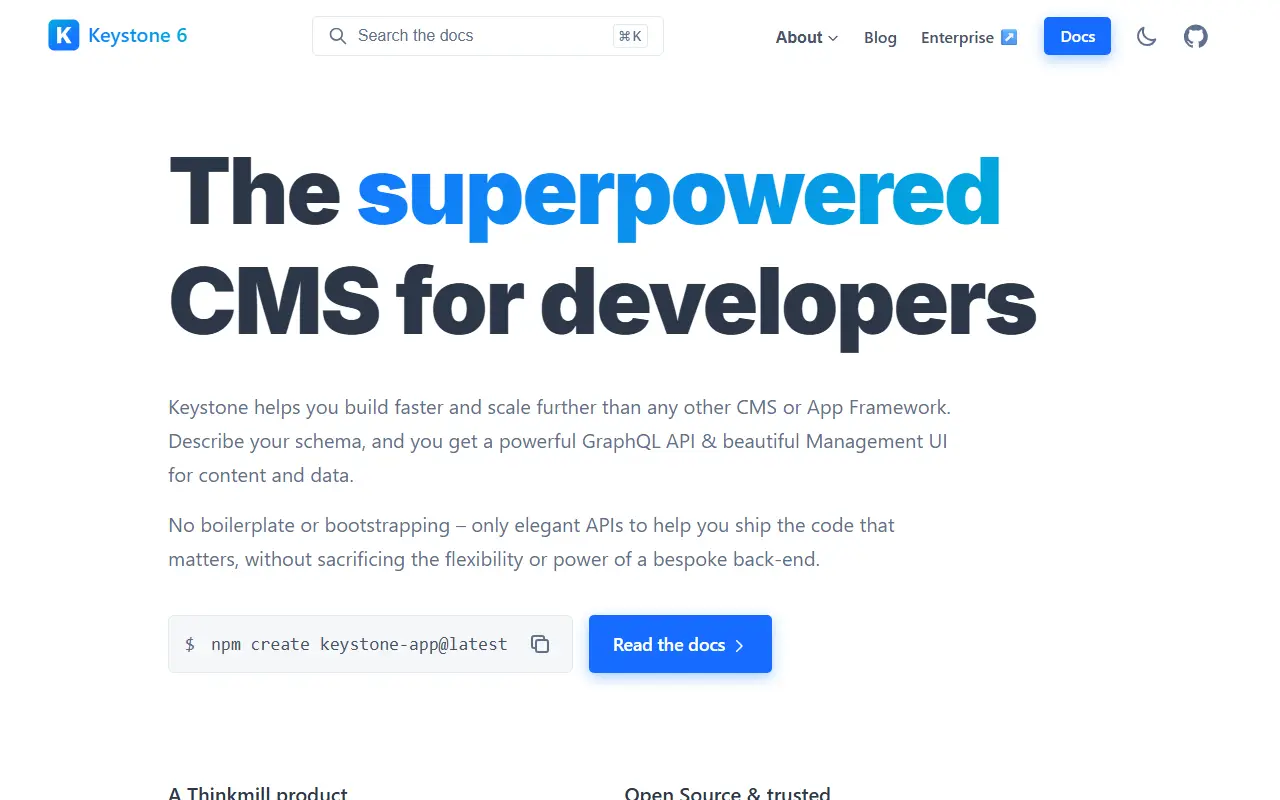
keystonejs.comKeystoneJS homepage screenshot

Keystone is a headless CMS and application framework for Node.js. You describe your schema in code, and it produces a GraphQL API and a management UI for your content and data, without boilerplate or bootstrapping, while still letting you extend the back end like a custom one.

Keystone 6 is published on npm under the @keystone-6 namespace, and its packages target the Node maintenance and active LTS versions. The documentation includes a Why Keystone page, a getting-started guide using the create-keystone-app CLI, examples, an API reference and practical guides. Keystone 5 is in maintenance mode and lives in a separate repository.

The project is written in TypeScript and licensed under MIT. You host it yourself on a Node.js server with a database of your choice, and it is used by developers who want a code-first CMS with a typed GraphQL API for websites, apps and internal tools.

Key features

  • Schema-driven GraphQL API
  • Generated admin management UI
  • Headless CMS for Node.js
  • create-keystone-app starter CLI
  • Type-safe TypeScript codebase
  • Examples, guides and API reference

Pricing: Free and open source under the MIT licence.

Webiny

A self-hosted, TypeScript-based content platform that runs on AWS serverless services, combining a headless CMS, website builder, file manager and multi-tenancy.

GitHub stars
8k
Last commit
yesterday
Latest release
v6.4.11
Self-hosted
Yes
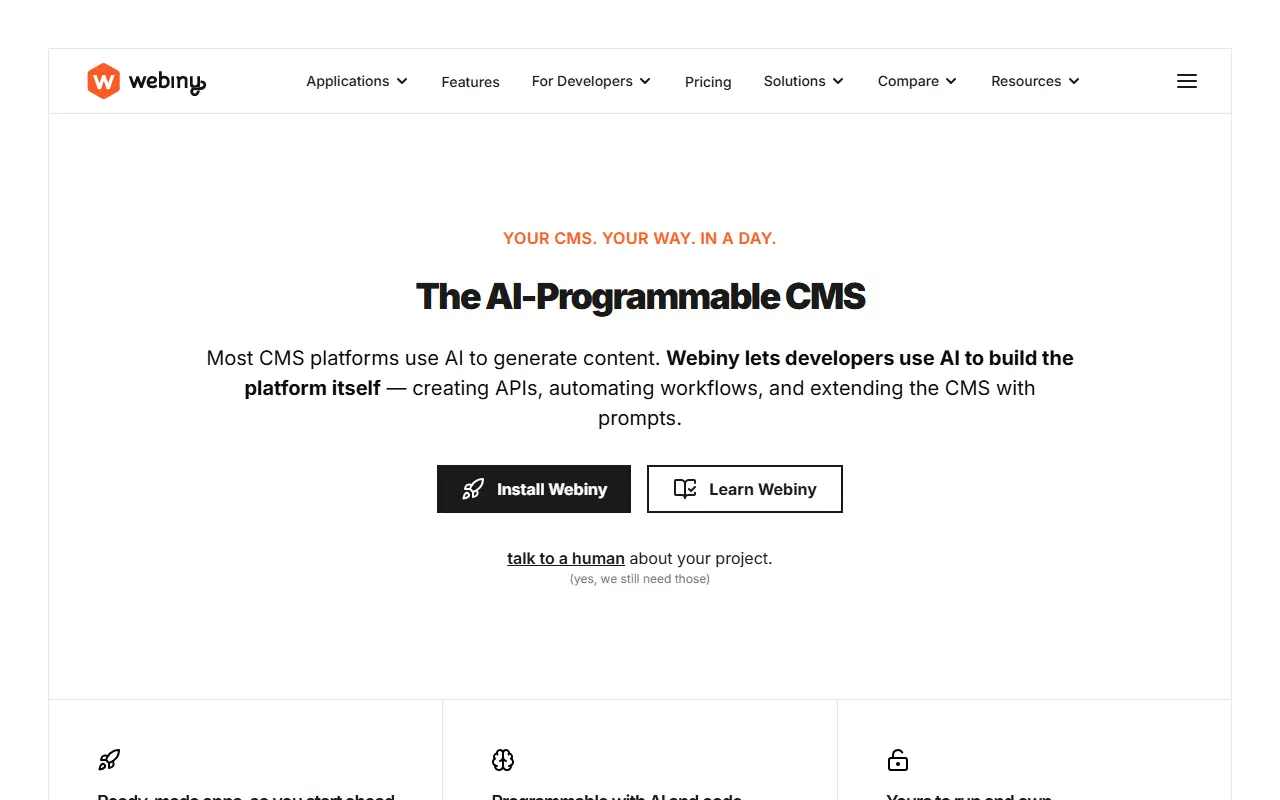
webiny.comWebiny homepage screenshot

Webiny is a content platform designed to be hosted in your own AWS account on serverless services. It is built as a TypeScript framework that developers extend with code, rather than a closed product configured only through a UI, and it runs on Lambda, DynamoDB, S3 and CloudFront with infrastructure provisioned by Pulumi in a single deploy command.

The platform includes a headless CMS with custom content models, a GraphQL API, field-level permissions, localization and versioning, plus a visual website builder with a Next.js SDK, a file manager for digital assets with CDN delivery, multi-step publishing workflows with approvals and scheduling, and native multi-tenancy that isolates data, users, assets and permissions from one deployment. The Webiny Framework adds lifecycle hooks, dependency injection and GraphQL schema extension, and an MCP server supports AI-assisted development.

It is aimed at developers at larger organizations, including SaaS companies that white-label it inside their products. The repository lists the licence as Other, so check the licence file for terms. It is self-hosted on AWS, so teams need AWS expertise and accept AWS costs for the underlying services.

Key features

  • Headless CMS with GraphQL API
  • Visual website builder with Next.js SDK
  • Digital asset file manager with CDN
  • Publishing workflows with approvals
  • Native multi-tenant isolation
  • TypeScript framework with lifecycle hooks
  • MCP server for AI-assisted development

Pricing: Community edition is free forever. Business starts at $79 per month (Small), with Medium at $299 and Large at $599; Enterprise is quoted on an annual subscription.

Sanity

Sanity is a headless CMS built around structured content, with an open-source React-based Studio and a hosted real-time content backend.

GitHub stars
6.3k
Last commit
yesterday
Latest release
v6.17.0
Licence
MIT
Self-hosted
No
Hosted version
Available
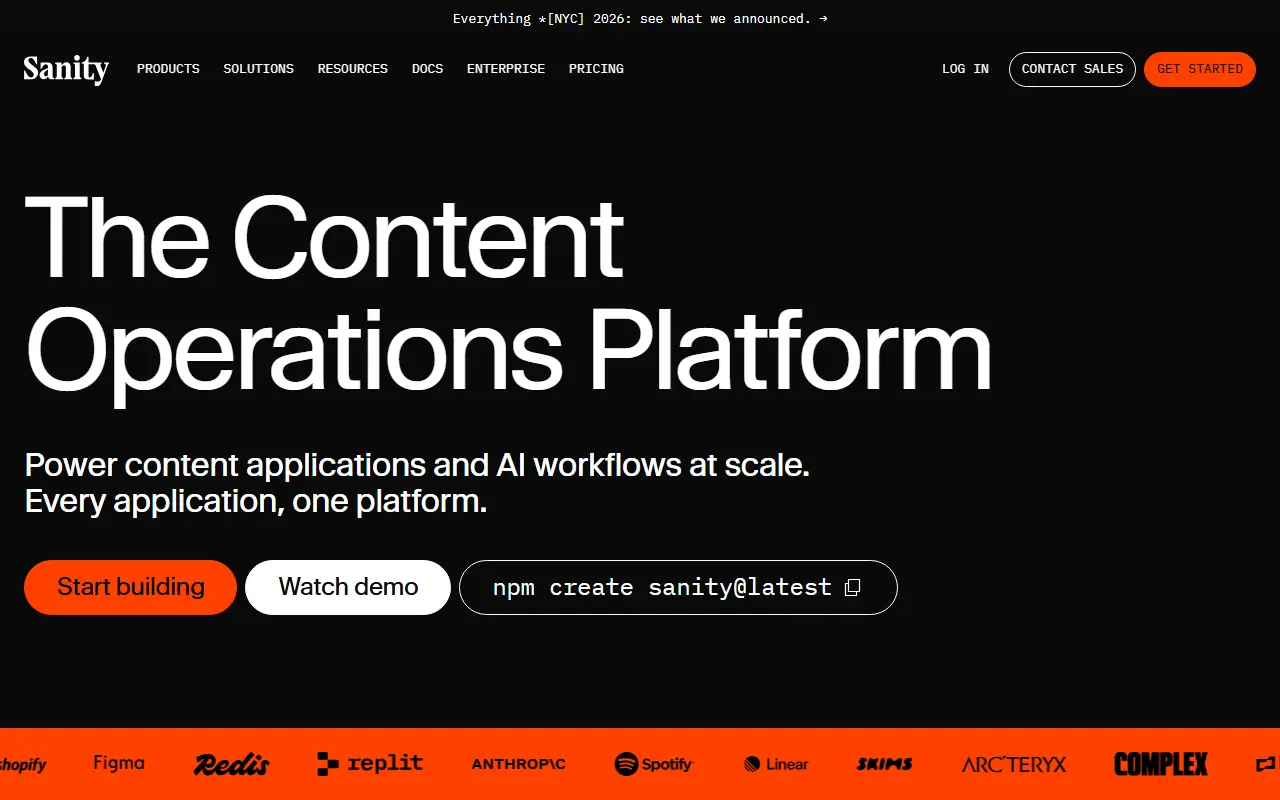
sanity.ioSanity homepage screenshot

Sanity is a headless content management platform for teams that treat content as structured data. Its open-source Sanity Studio is a React application that developers configure in code to build editing workspaces, while content is stored in Sanity's hosted backend and delivered to websites, mobile apps and other applications through APIs.

The vendor's site describes a wider product line: Content Lake as the data store, Live CDN for delivery, Content Releases, a Media Library, Functions, an App SDK, an MCP server and a Content Agent for AI-assisted content operations. Real-time editing is a long-standing trait of the Studio, according to the repository topics. Solutions are pitched at e-commerce, media and publishing, and SaaS teams.

The Studio code is MIT-licensed and can be deployed on any host you choose, but the content backend is operated by Sanity as a managed service, so a fully self-hosted setup is not available. A pricing page on the vendor's site lists the plans.

Key features

  • Configurable React-based Studio
  • Structured content modeling in code
  • Real-time collaborative editing
  • Hosted Content Lake with APIs
  • Content releases for planned publishing
  • MCP server for AI integrations

Pricing: Free plan for up to 20 seats. Growth costs $15 per seat per month with pay-as-you-go overages; Enterprise is custom. The Studio editor is open source.

Squidex

Open-source headless CMS and content hub built with ASP.NET Core, exposing a rich API with OData filters and Swagger definitions.

GitHub stars
2.5k
Last commit
yesterday
Latest release
7.24.0
Licence
MIT
Self-hosted
Yes
Hosted version
Available
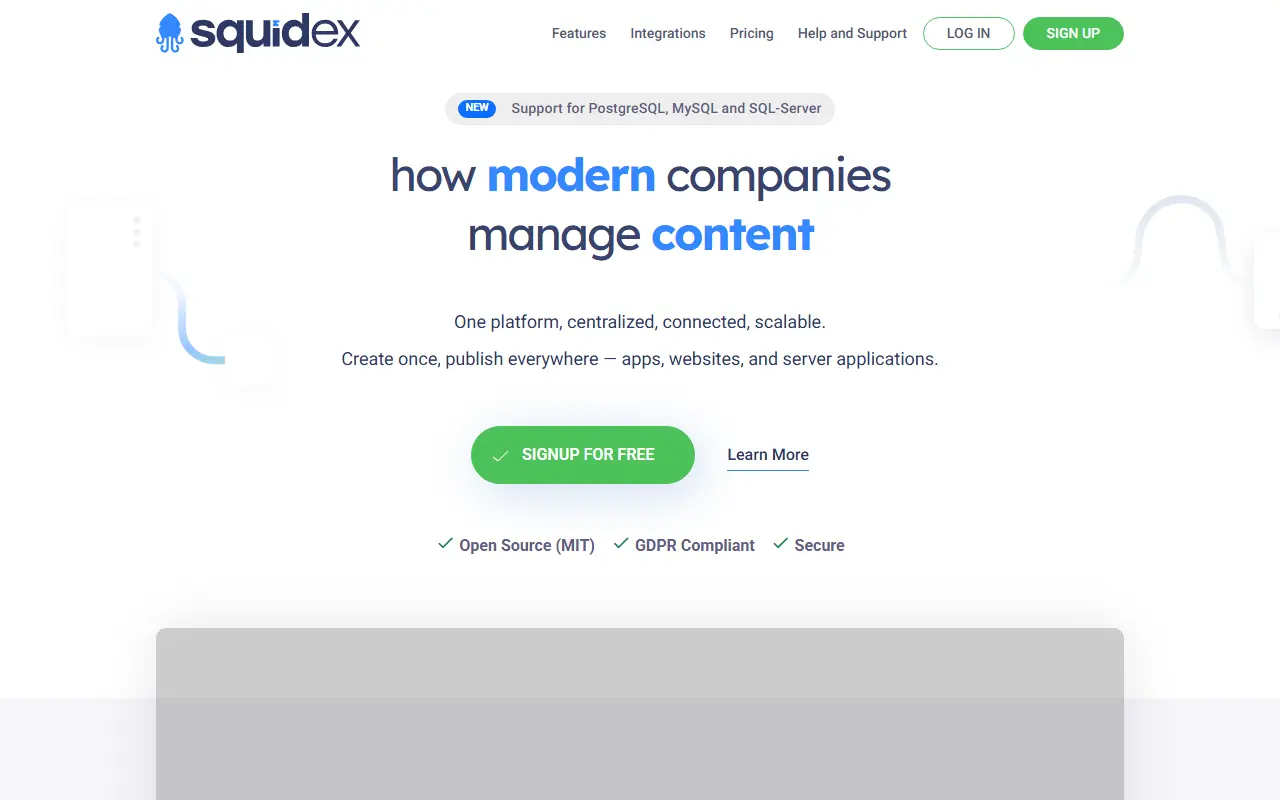
squidex.ioSquidex homepage screenshot

Squidex is an open-source headless CMS and content management hub. Unlike a traditional CMS, it provides an API-first back end and leaves the user interface to you, whether that is a website, a native app, or another server. It is built with ASP.NET Core and CQRS, tested on Windows and Linux, and released under the MIT license.

Its API supports OData filters and publishes Swagger definitions, making it easy to integrate with other tools. For storage it works with MongoDB, PostgreSQL, MySQL, or SQL Server. The project documents its roadmap on Trello and uses a community forum for feature requests, help, and bug reports.

Development requires Visual Studio Code or Visual Studio 2022, Node.js, and one of the supported databases. Squidex suits teams that need structured content with workflows and APIs to feed multiple channels, especially developers in the .NET ecosystem. A hosted version is offered on squidex.io.

Key features

  • Headless CMS with rich REST API
  • OData filtering and Swagger definitions
  • ASP.NET Core and CQRS architecture
  • Support for MongoDB, PostgreSQL, MySQL, and SQL Server
  • Content hub for multiple channels
  • Runs on Windows and Linux

Pricing: Cloud has a free Starter tier; Basic is €19, Professional €49 and Business €99 per month, with two months free on yearly billing. Managed Server is €80 and Managed Cluster €500 per month; self-hosting is free.

SonicJS

A TypeScript headless CMS designed for Cloudflare Workers, using D1, R2 and Hono, with an MCP server and an option to self-host with Docker.

GitHub stars
1.7k
Last commit
20 days ago
Latest release
v3.0.0-beta.28
Licence
MIT
Self-hosted
Yes
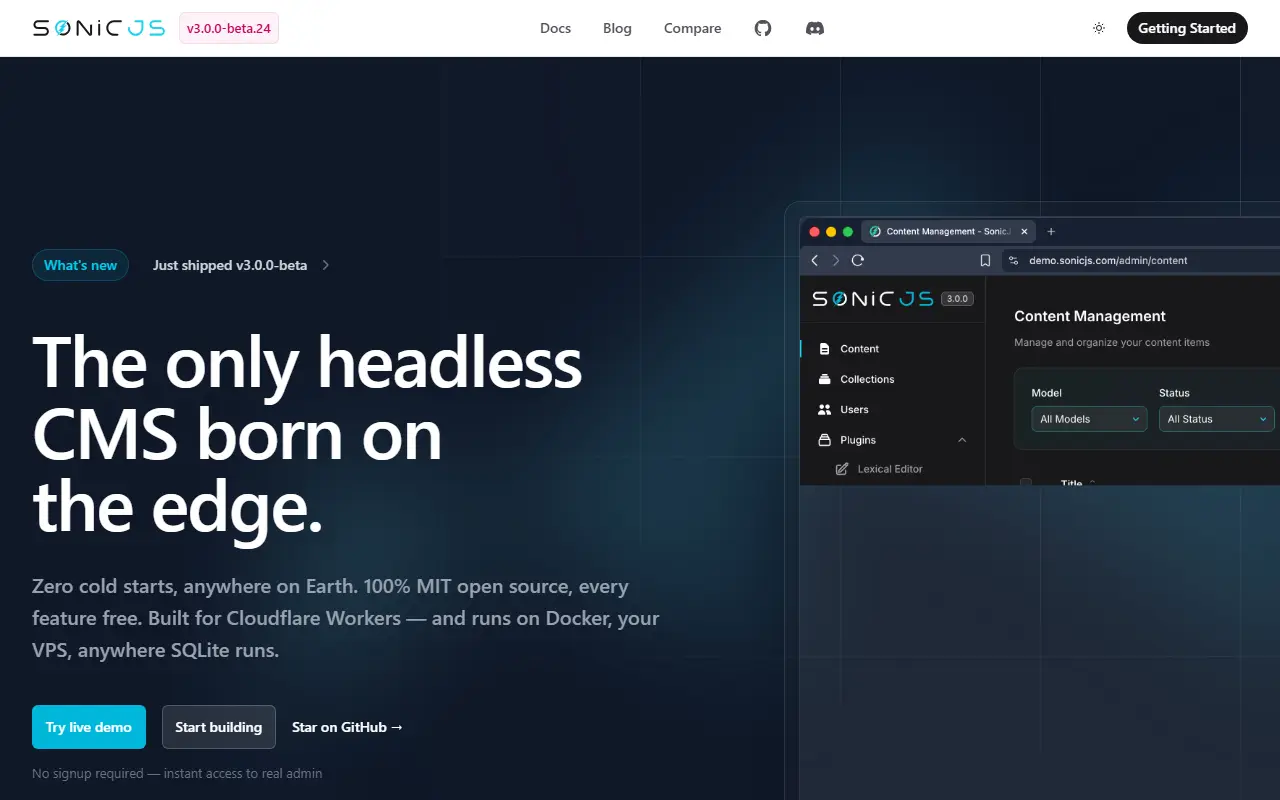
sonicjs.comSonicJS homepage screenshot

SonicJS is a headless CMS designed to run at the edge on Cloudflare Workers. Content is stored in Cloudflare D1 and R2, the API layer is built on Hono, and content models are defined as TypeScript code, from which SonicJS generates the REST API and an admin interface.

Beyond the REST API, it offers an optional GraphQL endpoint with a GraphiQL playground, a rich text editor based on TinyMCE, and an MCP server whose generated tools let AI coding assistants such as Claude Code, Cursor and VS Code read, create and publish content. Semantic search is also listed among its features. A create-sonicjs CLI scaffolds new projects, and local development uses Wrangler with hot reload.

The project is MIT licensed and states that every feature is free, with no enterprise-only tier. If you do not use Cloudflare, it can also run on any server with Docker and SQLite, and the self-hosting guide covers Docker Compose, Node.js and backups. Its topics tag it as an alternative to Strapi and Payload, making it a fit for JavaScript developers building Jamstack sites.

Key features

  • Schema-as-code content models in TypeScript
  • Auto-generated REST API and admin UI
  • Optional GraphQL endpoint with playground
  • MCP server for AI coding assistants
  • Runs on Cloudflare Workers, D1, and R2
  • Docker and SQLite self-hosting option

Pricing: SonicJS is free, MIT-licensed software with every feature included and no hosted service of its own. You pay only your own hosting, typically $0 to $5 per month on Cloudflare.

FireCMS

FireCMS is a React and TypeScript admin panel and headless CMS framework for Firebase and Firestore, available as a managed cloud or self-hosted.

GitHub stars
1.3k
Last commit
3 days ago
Latest release
v3.1.0
Self-hosted
Yes
Hosted version
Available
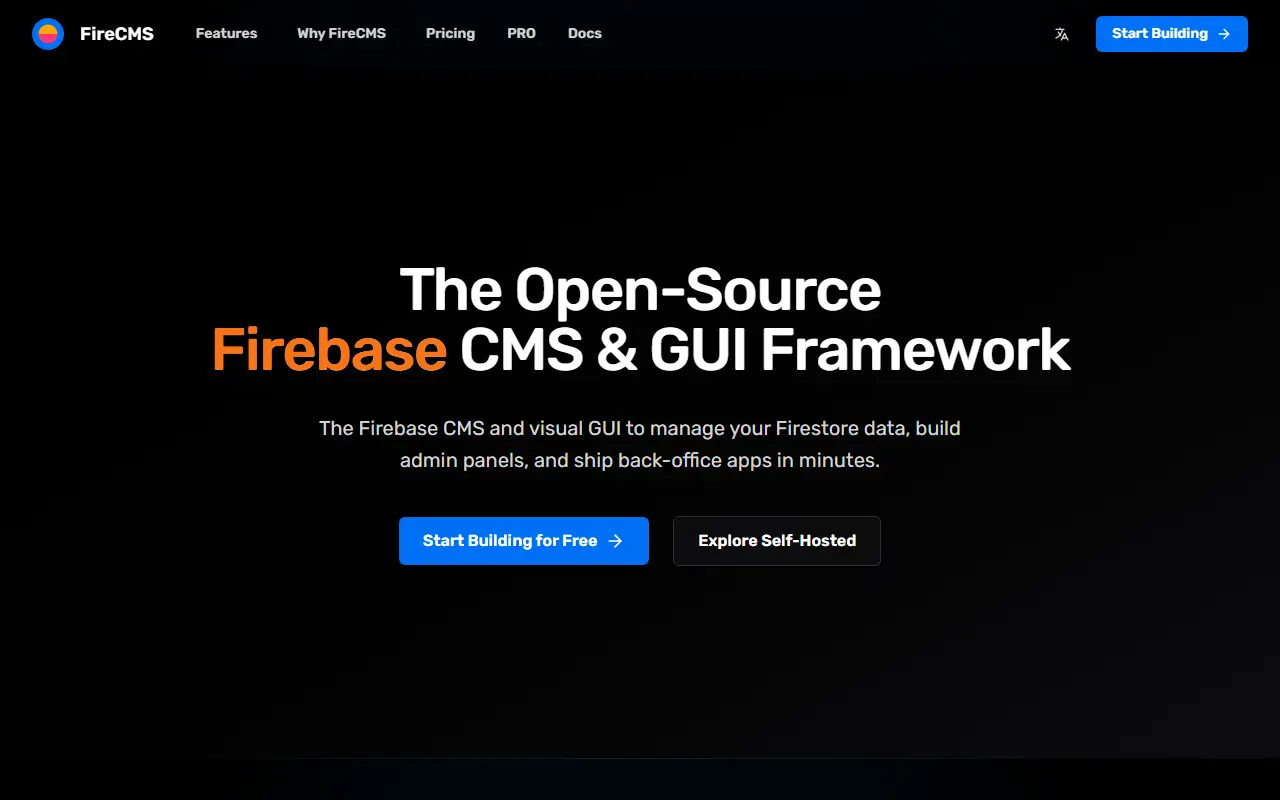
firecms.coFireCMS homepage screenshot

FireCMS is a developer-focused, open-source framework for building admin panels, back offices and headless CMS tools on top of Firebase and Firestore. It is built with React and TypeScript, connects natively to Firebase and also to MongoDB, and generates CRUD interfaces, forms and data management tools from the schema you define.

Highlights include real-time data with Firebase Auth and Storage, a visual schema editor that can infer schemas from existing collections, a Notion-style rich text editor with slash commands, and AI features such as autofilling fields, generating collections and querying data in natural language. The framework can be extended with custom components and plugins to fit particular workflows.

You can use FireCMS Cloud, a fully managed service where you connect your Firebase project, or self-host the framework with Community or PRO editions for full control. The README says the core is MIT licensed, while repository metadata lists the licence as other. It suits agencies and developers who already use Firebase and want an admin interface without building one from scratch.

Key features

  • Native Firebase and Firestore integration
  • Auto-generated CRUD interfaces from schemas
  • Visual schema editor
  • Notion-style rich text editor
  • AI-assisted field autofill and queries
  • Managed cloud or self-hosted options

Pricing: The Community edition is free and self-hosted. Cloud costs €9.99 per user per month after a 1-month trial; self-hosted PRO is €99 (about $119) per month for the first project; Enterprise is quoted on request.

Prime CMS

Prime is a free, MIT-licensed, self-hosted headless CMS with a GraphQL interface, built in TypeScript as an alternative to SaaS options like Contentful or Prismic.

GitHub stars
1.7k
Last commit
3 yr ago
Licence
MIT
Self-hosted
Yes

Prime is a standalone, self-hosted headless content management system with a GraphQL API, aimed at teams who want to run a headless CMS on their own infrastructure instead of a closed SaaS platform. It positions itself for cases where self-hosting is required but existing open-source options are missing key features found in commercial services.

Content is modeled using slices and groups of fields, with support for creating entirely custom field types, multiple languages, previewing drafts and releases before publishing, and planning and scheduling releases ahead of time. Access control covers both resources and users, and the README compares Prime's feature set directly against Prismic, Contentful and Strapi. Example integrations are provided for Gatsby and Next.js, along with an Apollo Link package and an official Docker container.

Prime is written in TypeScript using React, Ant Design, MobX State Tree, TypeORM, TypeGraphQL and GraphQL Modules. The README notes the project is currently in beta, with a one-click sandbox deploy button and video tutorials covering installation on Heroku and adding Cloudinary for asset storage. It is released under the MIT license.

Key features

  • Self-hosted headless CMS with GraphQL API
  • Custom content fields, slices and groups
  • Draft and release preview before publishing
  • Scheduled content releases
  • Resource and user access control
  • Gatsby and Next.js integration examples

Pricing: Free and open source under the MIT license. The project is currently in beta.

1 more Hygraph alternative

Hygraph alternatives: questions

What is the best open-source alternative to Hygraph?
Strapi is the top-ranked open-source alternative to Hygraph on Enlisted: An open-source headless CMS written in JavaScript and TypeScript that generates REST and GraphQL APIs from content models you design. Other strong options are Payload, Directus, KeystoneJS and Webiny.
Are these Hygraph alternatives free?
All 11 are open source, so the code is free to use under its licence, and 10 of them can be self-hosted on your own server or computer. 5 also offer a paid or managed cloud version if you'd rather not host it yourself.
How is this list of Hygraph alternatives ranked?
By a score built from GitHub stars, star growth over the last 30 days and how recently the code changed. 9 of these projects shipped code in the last 30 days. Data is refreshed daily, and nobody can pay to move up.

People also look for alternatives to…

View all