
 Agility CMS
 Kontent.ai
 Cosmic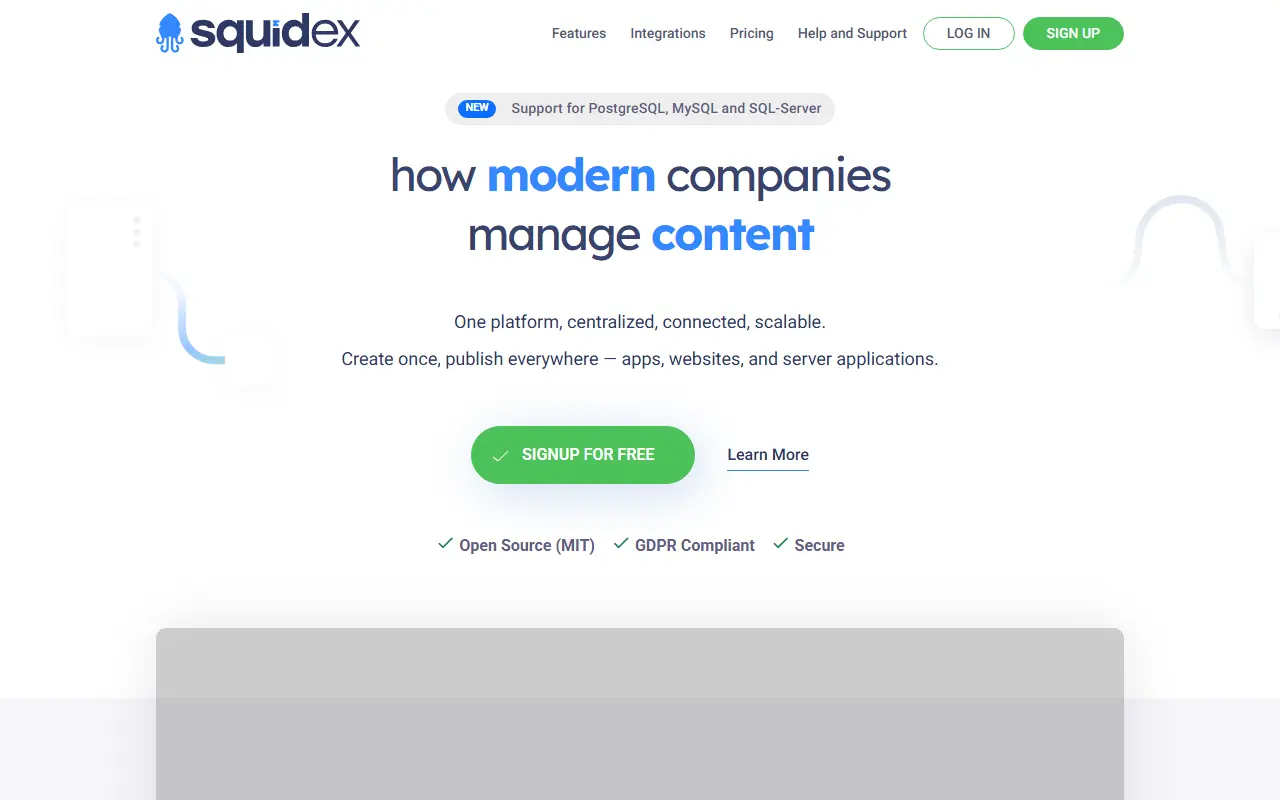
About Squidex
Squidex is an open-source headless CMS and content management hub. Unlike a traditional CMS, it provides an API-first back end and leaves the user interface to you, whether that is a website, a native app, or another server. It is built with ASP.NET Core and CQRS, tested on Windows and Linux, and released under the MIT license.
Its API supports OData filters and publishes Swagger definitions, making it easy to integrate with other tools. For storage it works with MongoDB, PostgreSQL, MySQL, or SQL Server. The project documents its roadmap on Trello and uses a community forum for feature requests, help, and bug reports.
Development requires Visual Studio Code or Visual Studio 2022, Node.js, and one of the supported databases. Squidex suits teams that need structured content with workflows and APIs to feed multiple channels, especially developers in the .NET ecosystem. A hosted version is offered on squidex.io.
Key features
- Headless CMS with rich REST API
- OData filtering and Swagger definitions
- ASP.NET Core and CQRS architecture
- Support for MongoDB, PostgreSQL, MySQL, and SQL Server
- Content hub for multiple channels
- Runs on Windows and Linux
Good fit for
- →Content back end for websites and mobile apps
- →Central content hub for .NET teams
- Tags
- headless-cms
- cms
- dotnet
- aspnet-core
- mongodb
- content-management
- api
- self-hosted
Squidex: questions and answers
- What is Squidex used for?
- Squidex is an open-source headless CMS and content hub built with ASP.NET Core, exposing a rich API with OData filters and Swagger definitions. It is a good fit for content back end for websites and mobile apps, and central content hub for .NET teams.
- Is Squidex open source?
- Yes. Squidex is open source under the MIT licence. Its source code is on GitHub at Squidex/squidex and is written mainly in C#.
- Is Squidex free?
- Yes. Squidex is open source, so the software itself is free to use. A managed cloud version is also available, with paid plans from €19 per month.
- Can I self-host Squidex?
- Yes. Squidex can be self-hosted on your own server or infrastructure.
- What is Squidex an alternative to?
- Squidex is an open-source alternative to Contentstack, Storyblok, Hygraph and Contentful. Other open-source alternatives to Contentstack include Strapi, Payload and Sanity.
- Is Squidex actively maintained?
- Yes. The most recent commit to Squidex was on 2 October 2026, and the latest release is 7.24.0, published on 28 September 2026. The project has 2.5k stars on GitHub.
Open-source alternatives to Squidex
See all
Strapi
CMS
🚀 Strapi is the leading open-source headless CMS. It’s 100% JavaScript/TypeScript, fully
OSSvs Contentstack★ 73k
Payload
CMS
Payload is the open-source, fullstack Next.js framework, giving you instant backend superp
MITvs Contentstack★ 45k
Sanity
CMS
Sanity Studio – Rapidly configure content workspaces powered by structured content
MITvs Contentstack★ 6.3k
KeystoneJS
CMS
The superpowered headless CMS for Node.js — built with GraphQL and React
MITvs Contentstack★ 10k
Directus
CMS
The flexible backend for all your projects 🐰 Turn your DB into a headless CMS, admin pane
OSSvs Contentstack★ 38k
Webiny
CMS
Open-source, self-hosted CMS platform on AWS serverless (Lambda, DynamoDB, S3). TypeScript
OSSvs Contentstack★ 8k
SaaS alternatives to Squidex
See all
Contentstack
CMS
Enterprise headless CMS and digital experience platform
SaaS
Storyblok
CMS
Headless CMS with a visual editor for component-based pages
SaaS
Hygraph
CMS
GraphQL-native headless CMS with content federation
SaaS
Contentful
CMS
Headless CMS and content platform with APIs, structured content and localization
SaaS
Xperience by Kentico
CMS
Enterprise .NET CMS and digital marketing platform from Kentico
SaaS
ButterCMS
CMS
Hosted headless CMS and blog engine with APIs for many frameworks
SaaS