
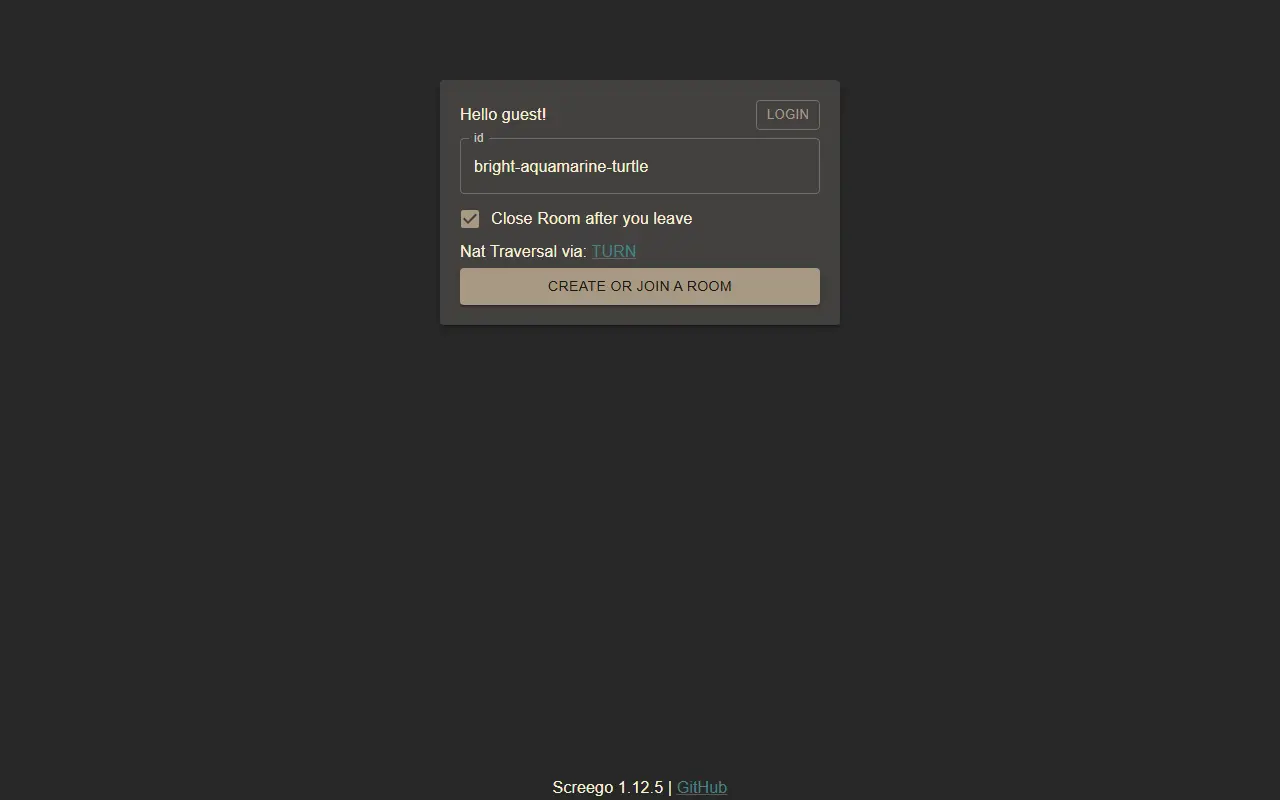
About Screego
Screego is a screen sharing tool built for developers. It grew out of the author's frustration that sharing code through corporate chat tools often meant lag or video too blurry to read. Screego focuses on doing one thing, sharing a screen with good quality and low latency, and is meant as an addition to existing software rather than a replacement.
It supports multi-user screen sharing, transfers streams securely over WebRTC, and aims for high resolution with low delay. An integrated TURN server helps connections get through NAT, and there is documentation on NAT traversal. Installation is simple, either through Docker or as a single binary, and configuration options are documented. A public demo instance lets you try it first.
Screego is written in Go, licensed under GPL-3.0 and follows semantic versioning. Teams that care about privacy can run it on their own server rather than sending screens through a third-party service. It suits pair programming, code reviews and demos where text must stay crisp.
Key features
- Multi-user screen sharing
- WebRTC secure streaming
- Low latency and high resolution
- Integrated TURN server
- Docker or single binary install
- Public demo instance
Good fit for
- →Pair programming and code reviews
- →Sharing code with readable quality
- →Privacy-focused screen sharing for teams
- Tags
- screen-sharing
- webrtc
- self-hosted
- developer-tools
- docker
- golang
- turn
- privacy
Screego: questions and answers
- What is Screego used for?
- Screego is a self-hosted screen sharing server for developers that streams over WebRTC with low latency and high resolution, plus a built-in TURN server. It is a good fit for pair programming and code reviews, sharing code with readable quality, and privacy-focused screen sharing for teams.
- Is Screego open source?
- Yes. Screego is open source under the GPL-3.0 licence. Its source code is on GitHub at screego/server and is written mainly in Go.
- Is Screego free?
- Yes. Screego is open source, so the software itself is free to use.
- Can I self-host Screego?
- Yes. Screego can be self-hosted on your own server or infrastructure.
- What is Screego an alternative to?
- Screego is an open-source alternative to Zoom and Tuple. Other open-source alternatives to Zoom include MiroTalk, edumeet and MiroTalk C2C.
- Is Screego actively maintained?
- Yes. The most recent commit to Screego was on 27 September 2026, and the latest release is v1.12.6, published on 27 September 2026. The project has 11k stars on GitHub.
Open-source alternatives to Screego
See all
MiroTalk
Video Conferencing
🚀 Open-source, self-hosted P2P WebRTC video conferencing for fast, private real-time comm
AGPL-3.0vs Zoom★ 4.8k
edumeet
Video Conferencing
edumeet - multiparty web-meetings using mediasoup and WebRTC
MITvs Zoom★ 1.3k
MiroTalk C2C
Video Conferencing
📹 Open-source, self-hosted WebRTC 1-to-1 video calling for private real-time communicatio
AGPL-3.0vs Zoom★ 513
MiroTalk SFU
Video Conferencing
🏆 Self-hosted, open-source WebRTC video conferencing platform for real-time communication
AGPL-3.0vs Zoom★ 3.1k
plugNmeet
Video Conferencing
The open-source, self-hosted video conferencing software. Scalable, customizable, and with
MITvs Zoom★ 564
Briefing
Video Conferencing
🔮 Secure direct video group chat
AGPL-3.0vs Whereby★ 1.6k
SaaS alternatives to Screego
See all
Zoom
Video Conferencing
Zoom is a communications platform for video meetings, team chat, phone, webinars, whiteboards and events, with apps for desktop and mobile.
SaaS
Tuple
Video Conferencing
Low-latency screen sharing built for remote pair programming
SaaS
Whereby
Video Conferencing
Browser-based video meetings with persistent rooms and no downloads
SaaS
Digital Samba
Video Conferencing
European video conferencing platform and API with privacy-focused hosting
SaaS
GoTo Meeting
Video Conferencing
Online meeting software with screen sharing and dial-in numbers
SaaS
Tencent Meeting
Video Conferencing
Tencent video conferencing app, also offered internationally as VooV Meeting
SaaS