 TrackMedia
 TrackRev

About ScienceLogic
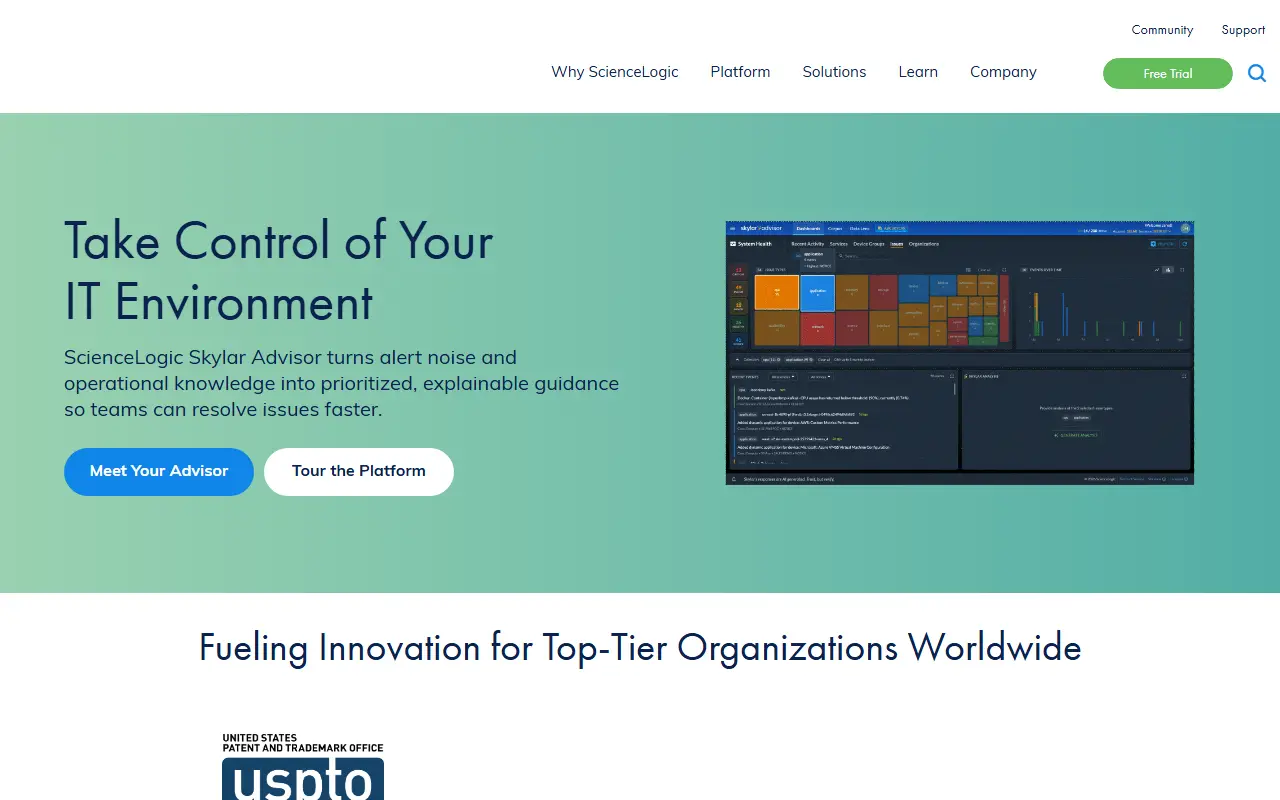
ScienceLogic markets an AI platform for IT operations built around the line 'Observe. Advise. Automate.' It is organised into named products: Skylar One for observability, Skylar Automation for workflows, Skylar AI as the intelligence layer, plus Skylar Compliance, Skylar Analytics, Skylar Advisor and Skylar One Studio.
Skylar One is described as the core observability offering. It connects data silos across hybrid and multi-vendor environments, discovers infrastructure and adds context to it, and is meant to speed up root cause analysis. The goal the vendor states is to consolidate fragmented tools into one service-aware view.
Skylar Automation is a low-code/no-code product for orchestrating workflows across IT systems, and the vendor links it to a path toward what it calls Autonomic IT. Solution pages are grouped by industry, by use case such as database, network and hybrid cloud observability, and by initiative such as reducing MTTR.
The platform can be deployed on premises, in the cloud, across hybrid environments or as ScienceLogic SaaS. A 14-day test drive of Skylar One is offered, and pricing is handled through a pricing page that lists no amounts in the sources.
Key features
- Unified visibility across hybrid and multi-vendor environments
- Low-code/no-code workflow automation across IT systems
- Discovers infrastructure and speeds up root cause analysis
- Brings infrastructure, topology and business-service context together
Good fit for
- Hybrid cloud monitoring
- Network observability
- Network configuration change management
- IT workflow automation
- Business service management
ScienceLogic: questions and answers
- What is ScienceLogic used for?
- ScienceLogic is an observability and IT operations platform that combines monitoring, automation and AI, deployed on premises, in the cloud or as SaaS. It is a good fit for hybrid cloud monitoring, network observability and network configuration change management.
- Is ScienceLogic open source?
- No. ScienceLogic is proprietary (closed-source) software. In the Monitoring & Observability category, open-source options include Keep, Prometheus and Grafana.
- Can I self-host ScienceLogic?
- Yes. Although ScienceLogic is closed source, it can be self-hosted on your own servers, and the vendor also offers a hosted version.
- What are some alternatives to ScienceLogic?
- ScienceLogic competes with LogicMonitor.
Open-source alternatives to ScienceLogic
See all
Keep
Monitoring & Observability
The open-source AIOps and alert management platform
OSSvs BigPanda★ 13k
Prometheus
Monitoring & Observability
The Prometheus monitoring system and time series database.
Apache-2.0vs Datadog★ 68k
Grafana
Monitoring & Observability
The open and composable observability and data visualization platform. Visualize metrics,
AGPL-3.0vs Datadog★ 78k
Netdata
Monitoring & Observability
The fastest path to AI-powered full stack observability, even for lean teams.
GPL-3.0vs Datadog★ 81k
Sentry
Monitoring & Observability
Developer-first error tracking and performance monitoring
OSSvs Rollbar★ 46k
SigNoz
Monitoring & Observability
SigNoz Cloud is a one-stop observability tool built on top of OpenTelemetry. Get APM, logs
OSSvs Datadog★ 33k
SaaS alternatives to ScienceLogic
See all
LogicMonitor
Monitoring & Observability
Agentless hybrid infrastructure monitoring with automated device discovery
SaaS
BigPanda
Monitoring & Observability
AIOps platform that correlates alerts from many tools into incidents
SaaS
ManageEngine Applications Manager
Monitoring & Observability
Application and infrastructure performance monitoring for on-premises and cloud
SaaS
Amazon CloudWatch
Monitoring & Observability
AWS service for metrics, logs, alarms and dashboards
SaaS
Azure Monitor
Monitoring & Observability
Azure service for collecting and analyzing metrics, logs and traces
SaaS
Groundcover
Monitoring & Observability
eBPF-based observability that keeps collected data inside the customer's cloud
SaaS