 TrackMedia
 TrackRev

About Rushstack
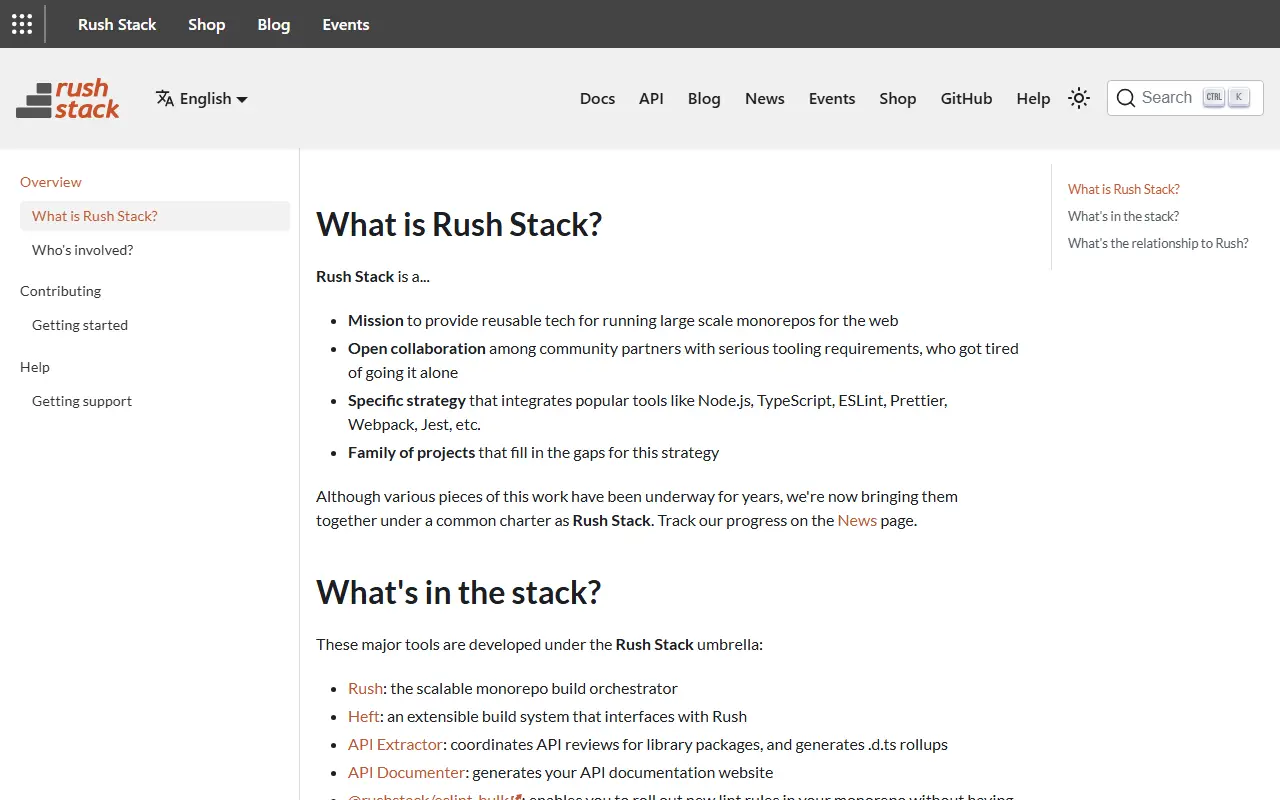
Rush Stack is a set of reusable tools for running large monorepos for the web. The site describes it as an open collaboration among partners with serious tooling requirements, and as a strategy that integrates popular tools such as Node.js, TypeScript, ESLint, Prettier, Webpack and Jest.
Rush is the scalable monorepo build orchestrator at its centre. It ensures deterministic installs using Yarn, PNPM or npm, builds projects in the right order, applies policies and manages publishing. Around it sit Heft, an extensible build system, API Extractor and API Documenter for API reviews and docs, and Lockfile Explorer for version conflicts.
There are also ESLint pieces: a bulk-suppression tool, a standard config and patch for large TypeScript monorepos, and a packlets plugin. Rundown helps optimise Node.js startup times and trace-import debugs module resolution. The stack components are optional extras that can be used with Rush.
Key features
- Heft build system that works with Rush
- API Extractor for API reviews and .d.ts rollups
- Lockfile Explorer for version conflicts
- Rundown to speed up Node.js startup
- Roll out lint rules without inline ignore comments
Good fit for
- Orchestrating builds in a monorepo
- Reviewing public API changes
- Rolling out lint rules gradually
- Investigating lockfile conflicts
Rushstack: questions and answers
- What is Rushstack used for?
- Rushstack is a family of Node.js and TypeScript tools for large web monorepos, including Rush, Heft, API Extractor and Lockfile Explorer. It is a good fit for orchestrating builds in a monorepo, reviewing public API changes and rolling out lint rules gradually.
- Is Rushstack open source?
- Yes. Rushstack is open source under a custom licence. Its source code is on GitHub at microsoft/rushstack and is written mainly in TypeScript.
- Is Rushstack free?
- Yes. Rushstack is open source, so the software itself is free to use under the terms of its own licence.
- Can I self-host Rushstack?
- Yes. Rushstack can be self-hosted on your own server or infrastructure.
- What is Rushstack an alternative to?
- Rushstack is an open-source alternative to Patchwork. Other open-source alternatives to Patchwork include Lerna, Turborepo and ERPNext.
- Is Rushstack actively maintained?
- Yes. The most recent commit to Rushstack was on 10 November 2026. The project has 6.5k stars on GitHub, with 10 added in the last 30 days.
Open-source alternatives to Rushstack
See all
Lerna
Open source
Lerna is a fast, modern build system for managing and publishing multiple JavaScript/TypeS
MITvs Patchwork★ 36k
Turborepo
Open source
Build system optimized for JavaScript and TypeScript, written in Rust
MITvs Patchwork★ 31k
ERPNext
ERP
Free and Open Source Enterprise Resource Planning (ERP)
GPL-3.0vs NetSuite★ 41k
Webpack
Open source
A bundler for javascript and friends. Packs many modules into a few bundled assets. Code S
MITvs Patchwork★ 66k
Discourse
Forums & Communities
A platform for community discussion. Free, open, simple.
GPL-2.0vs Reddit★ 48k
Spacemacs
Forums & Communities
A community-driven Emacs distribution - The best editor is neither Emacs nor Vim, it's Em
GPL-3.0vs IntelliJ IDEA★ 25k
SaaS alternatives to Rushstack
See all
Patchwork
Developer Tools
AI services for creating, deploying and instrumenting micro-frontends
SaaS
BeRoomie
Forums & Communities
App that connects people with rooms and roommates matching their lifestyle, schedule and budget
SaaS
Bettermode
Forums & Communities
Customizable community platform for customer, product and creator communities
SaaS
Bevy
Forums & Communities
Platform for running community-led events and chapters for companies
SaaS
Blab
Forums & Communities
Social app where creators host private, capped rooms of 8 to 100 fans, plus a shared community feed
SaaS
BuddyBoss
Forums & Communities
WordPress community and membership platform with social features and courses
SaaS