
About Patchwork
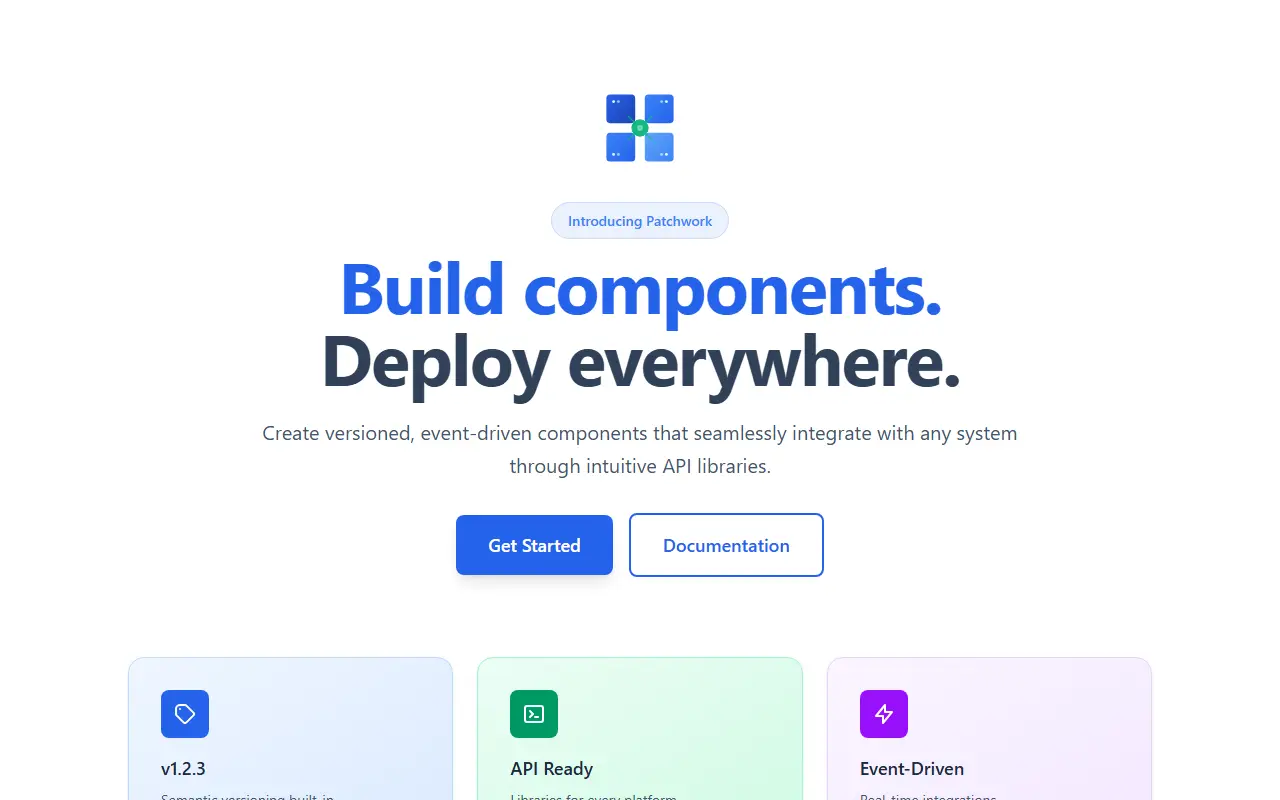
Patchwork is a developer platform for creating and distributing micro-frontend components. An AI-powered visual builder generates a component from a natural-language prompt, such as a pricing calculator or a user profile card, and you refine it by describing changes. Templates, events and dynamic data fields are defined without writing code, and each iteration is versioned with semantic versioning.
Components are embedded through API libraries for JavaScript, Python, Go, Java, Ruby, PHP, Rust and .NET, with TypeScript support and auto-completion. Each component emits events, such as loaded or interaction events, that flow to webhooks, Segment, Databricks and other analytics destinations, configured from a dashboard.
The site also publishes guides aimed at marketers and operators on embedding forms, widgets and integrations without waiting for engineering, such as adding lead capture forms without a developer, aimed at people who need to ship interactive pieces without waiting in an engineering queue.
Key features
- AI component builder from text prompts
- Semantic versioning of components
- Components that emit events
- API libraries for eight languages
- Webhooks and Segment integration
- Databricks event streaming
- Full TypeScript support
Good fit for
- Embedding lead forms without developer time
- Shipping a widget across several sites
- Streaming component events to analytics tools
Patchwork: questions and answers
- What is Patchwork used for?
- Patchwork is a platform where teams generate versioned components with an AI builder and embed them in any site or system through API libraries. It is a good fit for embedding lead forms without developer time, shipping a widget across several sites and streaming component events to analytics tools.
- Is Patchwork open source?
- No. Patchwork is proprietary (closed-source) software and can't be self-hosted. In the Developer Tools category, open-source options include Visual Studio Code, Zed and code-server.
- What are some alternatives to Patchwork?
- Other SaaS products in the Developer Tools category include AgentFast, HookSense and Hooksy.
Open-source alternatives to Patchwork
See all
Visual Studio Code
Developer Tools
Visual Studio Code
MITvs Sublime Text★ 194k
Zed
Developer Tools
Code at the speed of thought – Zed is a high-performance, multiplayer code editor from the
OSSvs Sublime Text★ 91k
code-server
Developer Tools
VS Code in the browser
MITvs Replit★ 80k
Tabby
Developer Tools
A terminal for a more modern age
MITvs Warp★ 75k
Alacritty
Developer Tools
A cross-platform, OpenGL terminal emulator.
Apache-2.0vs Warp★ 66k
Ghostty
Developer Tools
👻 Ghostty is a fast, feature-rich, and cross-platform terminal emulator that uses platfor
MITvs Warp★ 62k
SaaS alternatives to Patchwork
See all
AgentFast
Developer Tools
Boilerplate codebase for building AI agent applications
SaaS
HookSense
Developer Tools
Real-time webhook inspection and debugging with live request streaming, replay and signature verification
SaaS
Hooksy
Developer Tools
Simplifies creating and managing webhooks
SaaS
LandingGo
Developer Tools
Copy-paste Tailwind CSS landing page components for SaaS, e-commerce and AI sites
SaaS
Localdock
Developer Tools
Gives each local project its own address on your Mac, your Wi-Fi network or anywhere online
SaaS
Utilix
Developer Tools
Tooling platform that packages reusable capabilities as APIs, SDKs, CLIs and MCP servers for AI agents
SaaS