 TrackMedia
 TrackRev
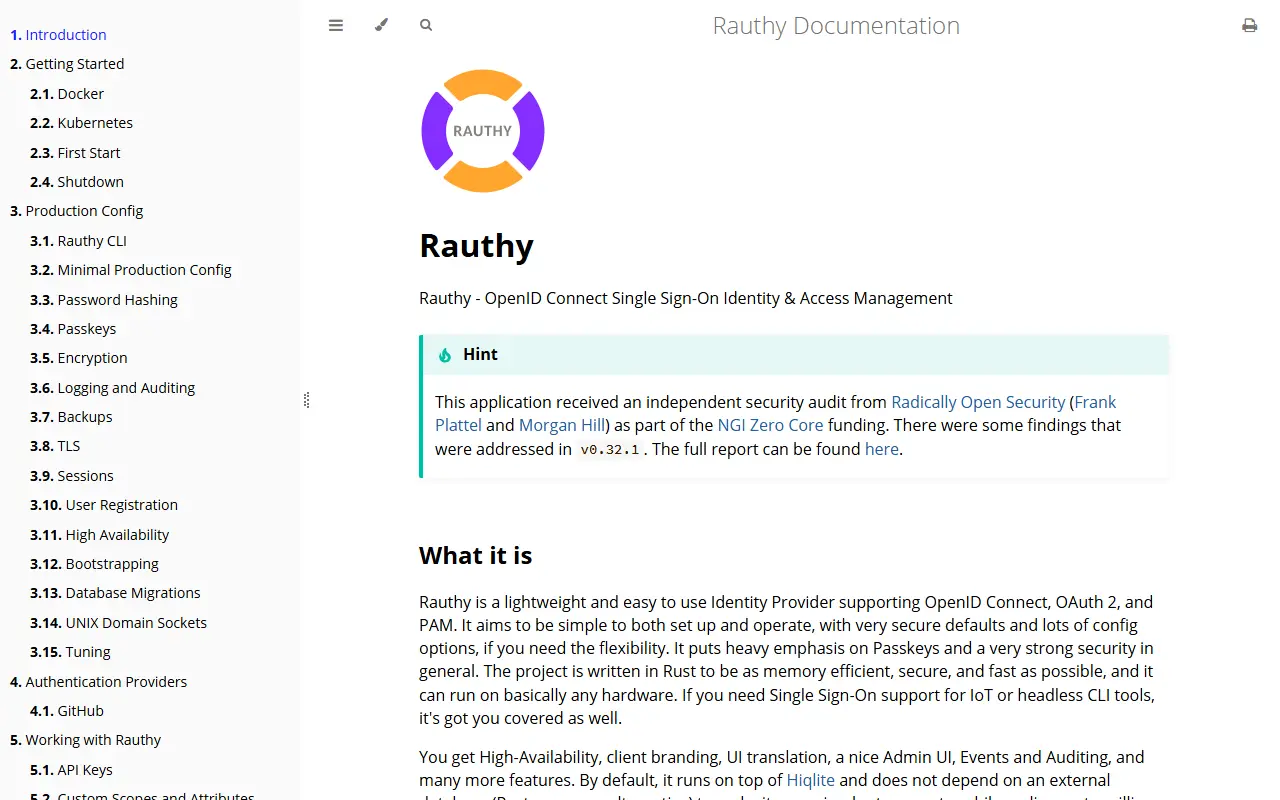
About Rauthy
Rauthy is an Identity Provider that handles OpenID Connect, OAuth 2 and PAM logins. It is written in Rust and aims to be simple to set up and operate, with secure defaults and many configuration options for people who need flexibility. Single sign-on for IoT devices and headless command-line tools is covered as well.
By default it runs on Hiqlite and needs no external database, with Postgres available as an alternative. The documentation positions it as an SSO solution comparable to Keycloak but with a smaller resource footprint, and says it can run on a Raspberry Pi. It includes high availability, client branding, UI translation, an admin UI, events and auditing.
Login options centre on FIDO 2 and WebAuthn: either a password plus a security key, or passkey-only accounts that need just an e-mail address. The project received an independent security audit by Radically Open Security as part of NGI Zero Core funding, with findings addressed in v0.32.1.
Key features
- OpenID Connect, OAuth 2 and PAM identity provider
- Passkey-only accounts without a password
- Runs without an external database by default
- High availability, branding, translations, admin UI, auditing
- Single sign-on for IoT and headless CLI tools
- New OIDC clients use ed25519 and S256 PKCE
Good fit for
- Single sign-on for internal apps
- Passwordless login with passkeys
- SSO for IoT or CLI tools
Rauthy: questions and answers
- What is Rauthy used for?
- Rauthy is a Rust identity provider for single sign-on, supporting OpenID Connect, OAuth 2 and PAM, with an emphasis on passkeys and secure defaults. It is a good fit for single sign-on for internal apps, passwordless login with passkeys and SSO for IoT or CLI tools.
- Is Rauthy open source?
- Yes. Rauthy is open source under the Apache-2.0 licence. Its source code is on GitHub at sebadob/rauthy and is written mainly in Rust.
- Is Rauthy free?
- Yes. Rauthy is open source, so the software itself is free to use.
- Can I self-host Rauthy?
- Yes. Rauthy can be self-hosted on your own server or infrastructure.
- What is Rauthy an alternative to?
- Rauthy is an open-source alternative to Auth0, Microsoft Entra ID and OneLogin. Other open-source alternatives to Auth0 include Keycloak, Authentik and WSO2 Identity Server.
- Is Rauthy actively maintained?
- Yes. The most recent commit to Rauthy was on 12 November 2026, and the latest release is v0.37.2, published on 19 October 2026. The project has 1.4k stars on GitHub, with 71 added in the last 30 days.
Open-source alternatives to Rauthy
See all
Keycloak
Auth & Identity
Open Source Identity and Access Management For Modern Applications and Services
Apache-2.0vs Auth0★ 38k
Authentik
Auth & Identity
The authentication glue you need.
OSSvs Auth0★ 26k
WSO2 Identity Server
Auth & Identity
Welcome to the WSO2 Identity Server source code! For info on working with the WSO2 Identit
Apache-2.0vs Auth0★ 889
Casdoor
Auth & Identity
An open-source Agent-first Identity and Access Management (IAM) /LLM MCP & agent gateway a
Apache-2.0vs Auth0★ 15k
VoidAuth
Auth & Identity
Single Sign-On for Your Self-Hosted Universe
AGPL-3.0vs Auth0★ 2.9k
ZITADEL
Auth & Identity
ZITADEL - Identity infrastructure, simplified for you.
AGPL-3.0vs Auth0★ 16k
SaaS alternatives to Rauthy
See all
Auth0
Auth & Identity
Auth0 is an authentication and authorization platform that lets developers add login, single sign-on and access control to apps with SDKs and quickstarts.
SaaS
Microsoft Entra ID
Auth & Identity
Microsoft cloud identity service for SSO, MFA and conditional access, formerly Azure AD
SaaS
OneLogin
Auth & Identity
Cloud single sign-on and MFA for workforce identity, from One Identity
SaaS
Duo Security
Auth & Identity
Cisco's multi-factor authentication and device trust service for workforces
SaaS
HYPR
Auth & Identity
Passwordless and phishing-resistant MFA for workforce and customers
SaaS
Okta
Auth & Identity
Cloud identity platform for workforce single sign-on, multifactor authentication and lifecycle management
SaaS