
About PISA
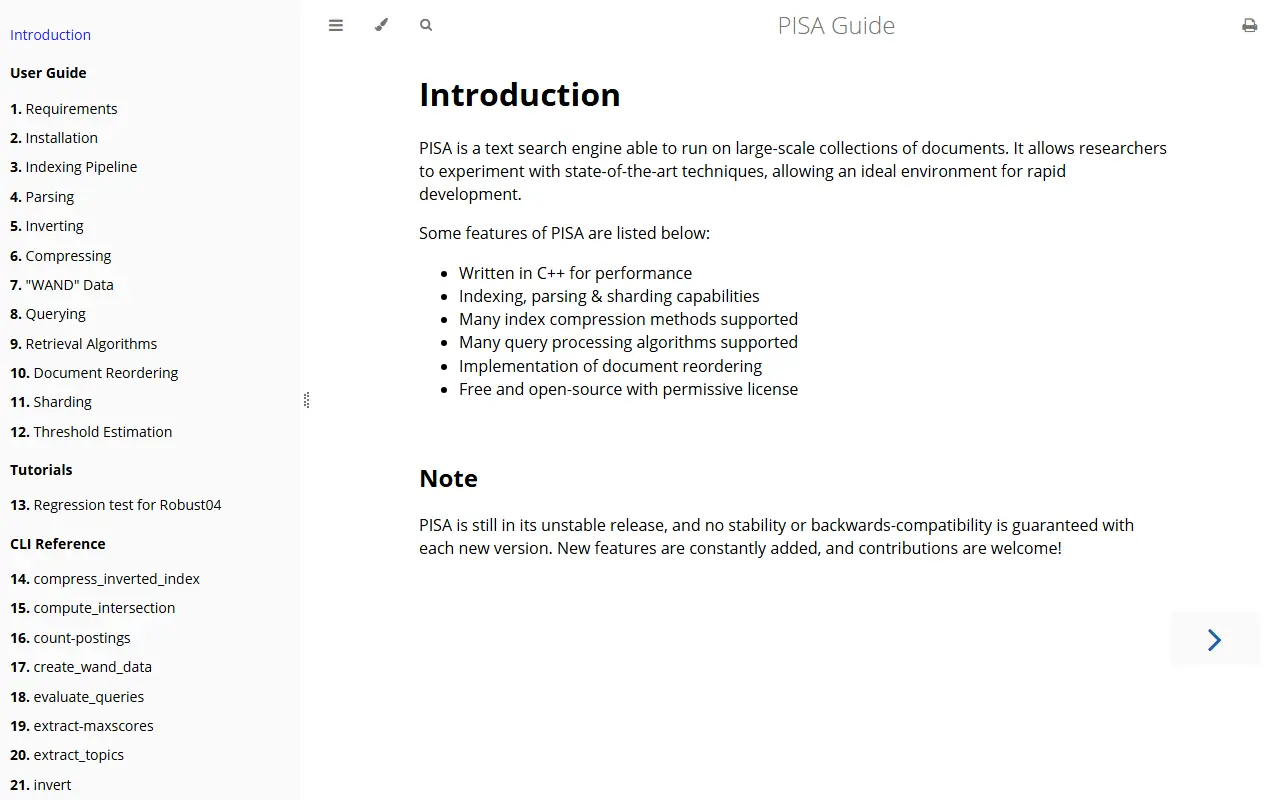
PISA, short for Performant Indexes and Search for Academia, is a text search engine that can run on large-scale document collections. It is aimed at researchers who want to experiment with state-of-the-art indexing and query processing techniques in an environment designed for rapid development.
Given a text collection, PISA builds an inverted index, which stores a list of documents for each term, and then searches it, with the index held in main memory at query time. It supports Boolean AND and OR queries and ranked retrieval, and offers parsing, indexing and sharding, many index compression methods, many query processing algorithms and document reordering. Documentation is published as an online book.
PISA is written in C++ for performance, licensed under the permissive Apache-2.0 licence, and has a community Slack workspace. It is built and run locally, so it is a research toolkit rather than a hosted service. It suits information retrieval researchers and students who want to benchmark or study indexing techniques.
Key features
- Inverted index construction
- Many index compression methods
- Many query processing algorithms
- Document reordering
- Parsing, indexing, and sharding tools
- Documentation published as a book
Good fit for
- →Information retrieval research experiments
- →Benchmarking index compression techniques
- →Teaching how search engines work
- Built with
- C++
- Tags
- search-engine
- inverted-index
- information-retrieval
- cpp
- research
- indexing
- query-processing
- academic
PISA: questions and answers
- What is PISA used for?
- PISA is a C++ text search engine and toolkit for researchers to experiment with index compression, query processing and document reordering on large collections. It is a good fit for information retrieval research experiments, benchmarking index compression techniques and teaching how search engines work.
- Is PISA open source?
- Yes. PISA is open source under the Apache-2.0 licence. Its source code is on GitHub at pisa-engine/pisa and is written mainly in C++.
- Is PISA free?
- Yes. PISA is open source, so the software itself is free to use.
- What are some alternatives to PISA?
- Similar open-source tools in the Search category include OpenSSE, Typesense and ZincSearch. SaaS products in the same category include Baidu, Bing and Brave Search.
- Is PISA actively maintained?
- Yes. The most recent commit to PISA was on 20 September 2026, and the latest release is v0.10.0, published on 9 December 2024. The project has 1.1k stars on GitHub.
Open-source alternatives to PISA
See all
OpenSSE
Search
Open Sketch Search Engine- 3D object retrieval based on sketch image as input
OSS★ 966
Typesense
Search
Typesense is an open-source search engine for fast, typo-tolerant site and app search, wit
GPL-3.0vs Algolia★ 27k
ZincSearch
Search
ZincSearch . A lightweight alternative to elasticsearch that requires minimal resources, w
OSSvs Elastic★ 18k
Manticore Search
Search
Open-source search database for full-text, vector, and hybrid search with real-time indexi
GPL-3.0vs Elastic★ 12k
RediSearch
Search
A query and indexing engine for Redis, providing secondary indexing, full-text search, vec
OSSvs Elastic★ 6.2k
Apache Solr
Search
Apache Solr open-source search software
Apache-2.0vs Elastic★ 1.7k
SaaS alternatives to PISA
See all
Baidu
Search
Chinese-language web search engine
SaaS
Bing
Search
Microsoft web search engine with image search and Copilot answers
SaaS
Brave Search
Search
Search engine running on Brave's own web index with a privacy focus
SaaS
dtSearch
Search
Desktop and enterprise full-text search engine for large document sets
SaaS
DuckDuckGo
Search
Privacy-focused web search engine that does not track searches
SaaS
Ecosia
Search
Search engine that funds tree planting from advertising revenue
SaaS