 TrackMedia
 TrackRev

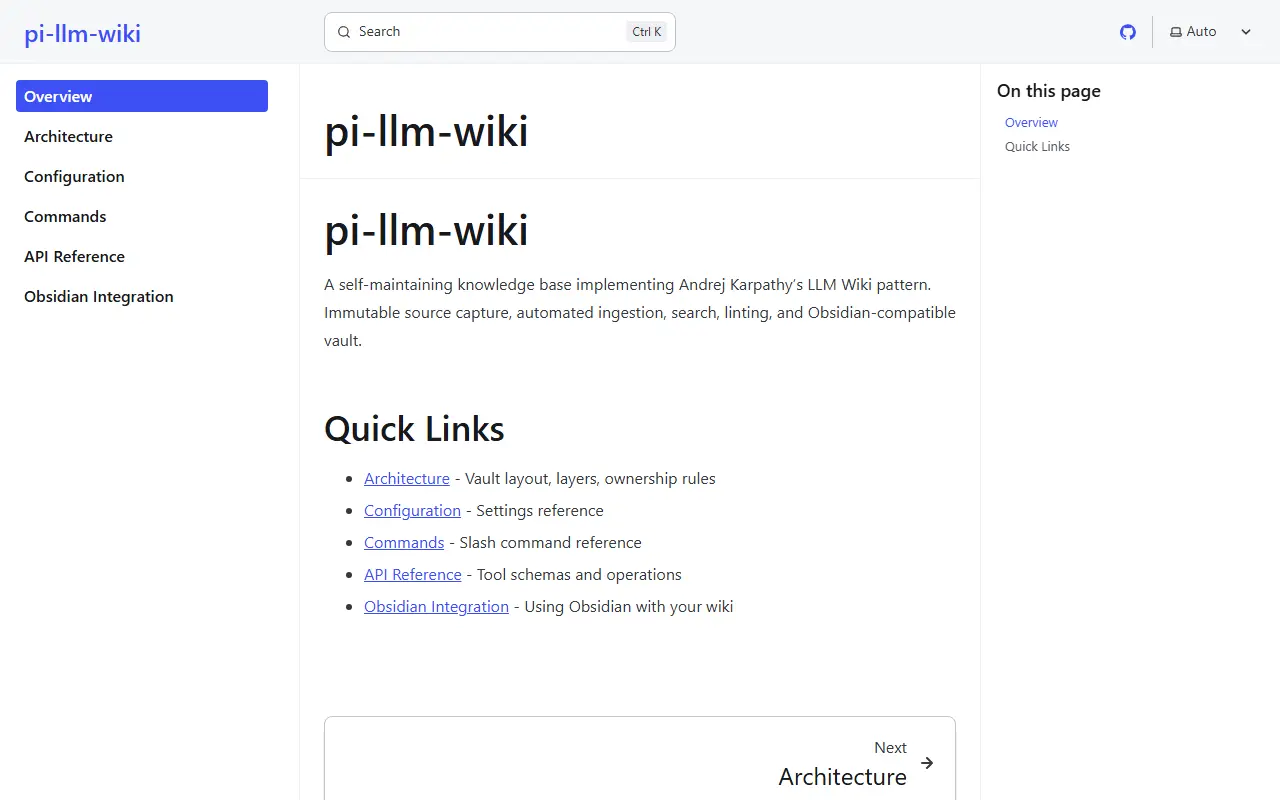
About pi-llm-wiki
pi-llm-wiki, published by Zosma AI, is a self-maintaining, Obsidian-compatible knowledge base for the pi coding agent that follows Andrej Karpathy's LLM Wiki pattern. It turns raw sources such as URLs, PDFs, Markdown, JSON and XML into a durable, interlinked wiki that an LLM maintains and that grows more useful over time.
It has native support for Open Knowledge Format (OKF) version 0.2, aimed at portable knowledge rather than closed app-specific exports. It creates OKF documents with canonical frontmatter, standard Markdown links and stable source citations, reads both legacy and OKF pages so existing vaults keep working, and generates deterministic indexes and logs from authoritative pages. The same knowledge model is available from pi or the oh-my-pi host through slash commands, and from MCP clients such as Claude Code, Codex, Cursor, Windsurf, Zed and Cline through a packaged stdio server.
You can start with a new OKF vault or point it at an existing Obsidian vault and adopt the format gradually. The package is written in TypeScript and licensed under MIT, and the README is available in many languages.
Key features
- LLM-maintained interlinked wiki
- Ingests URLs, PDFs, Markdown, JSON and XML
- Open Knowledge Format v0.2 support
- Obsidian-compatible vaults
- MCP stdio server for many clients
- Slash commands in pi and oh-my-pi
Good fit for
- Building a personal knowledge base with an AI agent
- Portable AI memory across tools
pi-llm-wiki: questions and answers
- What is pi-llm-wiki used for?
- pi-llm-wiki is an extension for the pi coding agent that builds a self-maintaining, Obsidian-compatible wiki from raw sources using the Open Knowledge Format. It is a good fit for building a personal knowledge base with an AI agent and portable AI memory across tools.
- Is pi-llm-wiki open source?
- Yes. pi-llm-wiki is open source under the MIT licence. Its source code is on GitHub at zosmaai/pi-llm-wiki and is written mainly in TypeScript.
- Is pi-llm-wiki free?
- Yes. pi-llm-wiki is open source, so the software itself is free to use.
- What are some alternatives to pi-llm-wiki?
- Similar open-source tools in the AI Tools category include Obsidian Second Brain, LLM Wiki and LobeHub. SaaS products in the same category include kapa.ai, Truffle and Aera Browser.
- Is pi-llm-wiki actively maintained?
- Yes. The most recent commit to pi-llm-wiki was on 10 November 2026, and the latest release is v0.12.5, published on 1 October 2026. The project has 627 stars on GitHub, with 19 added in the last 30 days.
Open-source alternatives to pi-llm-wiki
See all
Obsidian Second Brain
AI Tools
Persistent memory for Claude Code and 6 other CLI agents, stored as plain markdown in your
MIT★ 5.3k
LLM Wiki
AI Tools
LLM-compiled knowledge bases for any AI agent. Parallel multi-agent research, thesis-drive
MIT★ 1.5k
LobeHub
AI Tools
🤯 LobeHub is your Chief Agent Operator, organizing your agents into 7×24 operations by hi
OSSvs ChatGPT★ 85k
Gemini CLI
AI Tools
An open-source AI agent that brings the power of Gemini directly into your terminal.
Apache-2.0vs Claude Code★ 109k
Cline
AI Tools
Autonomous coding agent as an SDK, IDE extension, or CLI assistant.
Apache-2.0vs GitHub Copilot★ 72k
Skill Seekers
AI Tools
Convert documentation websites, GitHub repositories, and PDFs into Claude AI skills with a
MIT★ 15k
SaaS alternatives to pi-llm-wiki
See all
kapa.ai
AI Tools
AI assistant that answers questions from product docs and support content
SaaS
Truffle
AI Tools
Answers plain-English questions in Slack or Teams by reading your code, docs and tools and showing the source
SaaS
Aera Browser
AI Tools
Browser-based AI that runs scheduled, long-running workflows and connects your tools through MCP
SaaS
Agent Media
AI Tools
Create UGC-style videos from AI agents, CLI, MCP, API or a web app
SaaS
Agent One
AI Tools
No-code platform to build and host custom AI chatbots from instructions and uploaded documents
SaaS
AI Detector
AI Tools
API that detects AI-generated text, images, audio and video, including deepfakes
SaaS