
About Perses
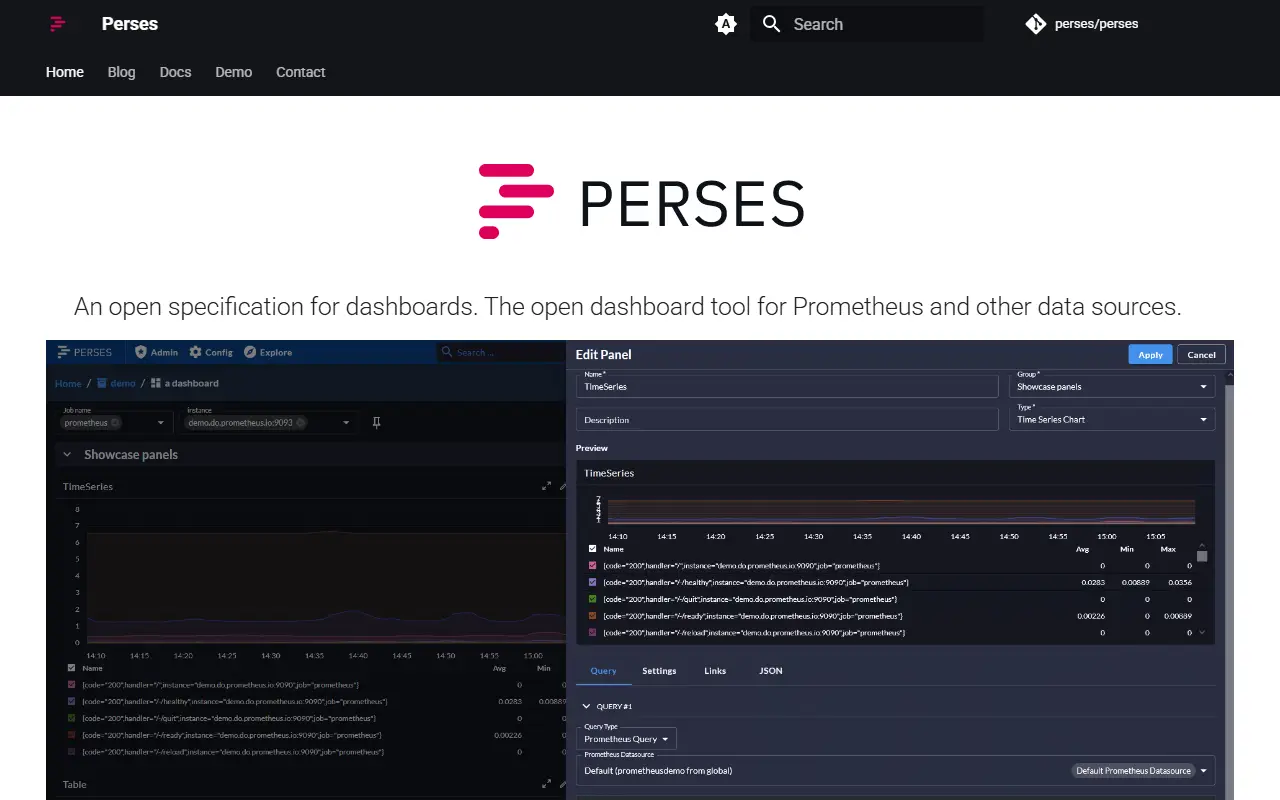
Perses is a dashboard tool for displaying observability data and is a Cloud Native Computing Foundation sandbox project. It currently supports Prometheus metrics, Tempo traces, Loki logs, and Pyroscope profiling, bringing the four observability pillars together in one interface, with more data sources planned. It is written in Go and released under the Apache-2.0 license.
Beyond the tool itself, the project aims to define an open specification for dashboards to make them portable between observability tools. It provides npm packages so developers can embed Perses visualizations in their own applications, and it is designed for dashboards as code and for being integrated with GitOps workflows.
Documentation and a demo are available at perses.dev. Perses suits platform and SRE teams who want a vendor-neutral, standards-oriented dashboard solution, especially those already using Prometheus-compatible tools and looking for an alternative to proprietary dashboard formats.
Key features
- Dashboards for Prometheus metrics
- Tempo traces, Loki logs, and Pyroscope profiles
- Open dashboard specification
- Embeddable npm visualization packages
- CNCF sandbox project
- Dashboards as code
Good fit for
- →Vendor-neutral observability dashboards
- →Embedding charts into internal tools
- Built with
- Go
- Tags
- observability
- dashboards
- prometheus
- cncf
- tempo
- loki
- monitoring
- go
Perses: questions and answers
- What is Perses used for?
- Perses is a CNCF sandbox dashboard tool for observability data, supporting Prometheus metrics, Tempo traces, Loki logs, and Pyroscope profiles with an open dashboard specification. It is a good fit for vendor-neutral observability dashboards and embedding charts into internal tools.
- Is Perses open source?
- Yes. Perses is open source under the Apache-2.0 licence. Its source code is on GitHub at perses/perses and is written mainly in Go.
- Is Perses free?
- Yes. Perses is open source, so the software itself is free to use.
- Can I self-host Perses?
- Yes. Perses can be self-hosted on your own server or infrastructure.
- What are some alternatives to Perses?
- Similar open-source tools in the Monitoring & Observability category include Grafana, Prometheus and Thanos. SaaS products in the same category include Amazon CloudWatch, Axiom and AppDynamics.
- Is Perses actively maintained?
- Yes. The most recent commit to Perses was on 2 October 2026, and the latest release is v0.54.0, published on 29 July 2026. The project has 2.5k stars on GitHub.
Open-source alternatives to Perses
See all
Grafana
Monitoring & Observability
The open and composable observability and data visualization platform. Visualize metrics,
AGPL-3.0vs Datadog★ 77k
Prometheus
Monitoring & Observability
The Prometheus monitoring system and time series database.
Apache-2.0vs Datadog★ 66k
Thanos
Monitoring & Observability
Highly available Prometheus setup with long term storage capabilities. A CNCF Incubating p
Apache-2.0★ 14k
Cortex
Monitoring & Observability
A horizontally scalable, highly available, multi-tenant, long term Prometheus.
Apache-2.0★ 5.9k
Sloth
Monitoring & Observability
🦥 Easy and simple Prometheus SLO (service level objectives) generator
Apache-2.0★ 2.6k
SigNoz
Monitoring & Observability
SigNoz Cloud is a one-stop observability tool built on top of OpenTelemetry. Get APM, logs
OSSvs Datadog★ 32k
SaaS alternatives to Perses
See all
Amazon CloudWatch
Monitoring & Observability
AWS service for metrics, logs, alarms and dashboards
SaaS
Axiom
Monitoring & Observability
Cloud service for ingesting, storing and querying logs, traces and event data
SaaS
AppDynamics
Monitoring & Observability
Cisco application performance monitoring that maps technical metrics to business impact
SaaS
Azure Monitor
Monitoring & Observability
Azure service for collecting and analyzing metrics, logs and traces
SaaS
Chronosphere
Monitoring & Observability
Cloud-native observability platform for metrics, traces and logs with cost controls
SaaS
Clawwatcher
Monitoring & Observability
Observability for OpenClaw agents with token and cost tracking and anomaly alerts
SaaS