
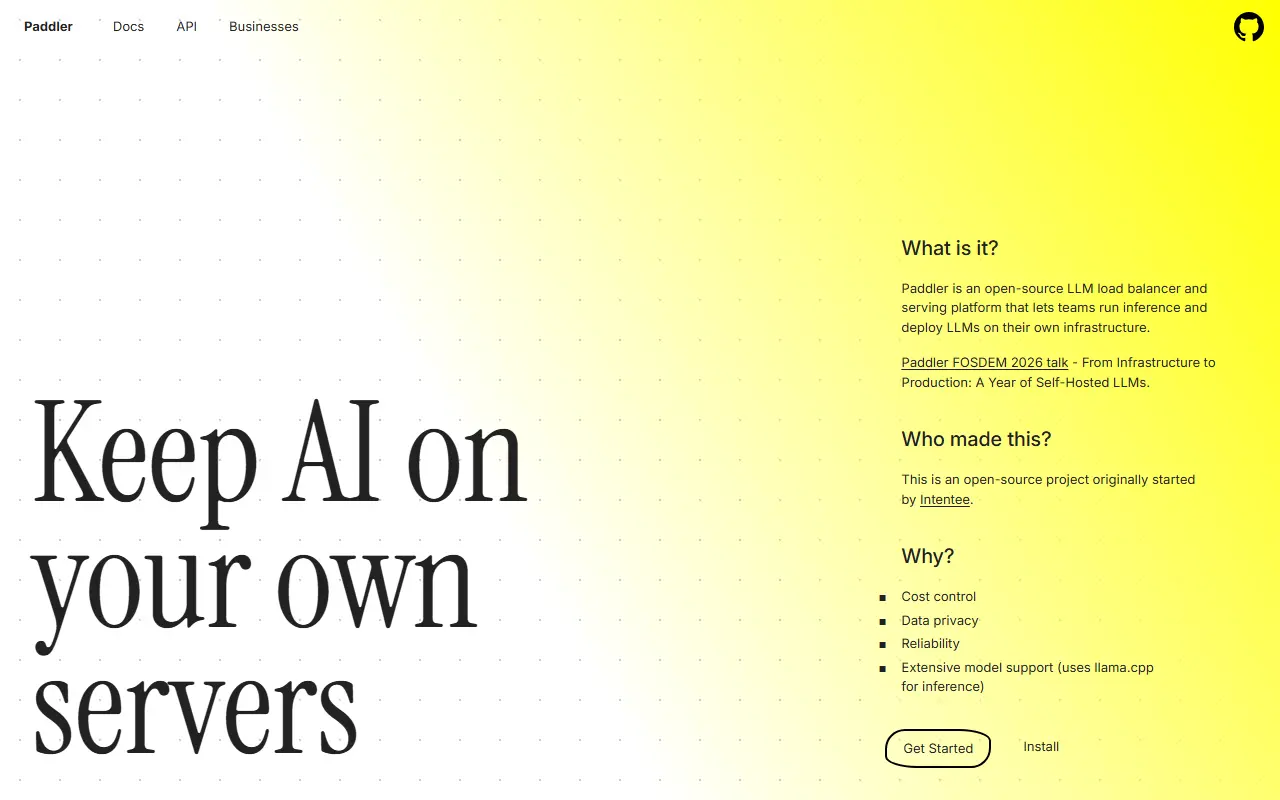
About Paddler
Paddler is an open-source load balancer and serving platform for large language models and vision-language models that you run on your own infrastructure. It lets teams run inference, deploy and scale models without sending data to a closed-source model provider, which helps with privacy, reliability and predictable costs.
It uses a built-in llama.cpp engine for inference and applies load balancing designed for LLM requests. Agents can be added dynamically, so it can work with autoscaling tools, and request buffering allows scaling up from zero hosts. Models can be swapped at runtime, and a web admin panel provides management, monitoring and testing, along with observability metrics. It runs on CPU and GPU.
Paddler ships as a single binary written in Rust and is licensed under Apache-2.0. The README positions it as a simpler alternative to projects such as llm-d and Docker Model Runner, with fewer moving parts and deployments built around the ggml ecosystem. It targets product teams needing embeddings and inference, LLMOps teams, and organizations with strict compliance needs.
Key features
- LLM-aware load balancing
- Built-in llama.cpp inference engine
- Dynamic agents for autoscaling integration
- Request buffering to scale from zero
- Runtime model swapping
- Web admin panel with metrics
Good fit for
- →Serving private LLMs across several servers
- →Keeping sensitive data off third-party APIs
- →Replacing per-token pricing with fixed infrastructure
- Built with
- Rust
- Tags
- llm
- load-balancer
- llama-cpp
- inference
- llmops
- self-hosted
- rust
- ai-infrastructure
- apache-2.0
Paddler: questions and answers
- What is Paddler used for?
- Paddler is an open-source load balancer and serving platform for self-hosted LLMs, built on llama.cpp and delivered as a single Rust binary. It is a good fit for serving private LLMs across several servers, keeping sensitive data off third-party APIs and replacing per-token pricing with fixed infrastructure.
- Is Paddler open source?
- Yes. Paddler is open source under the Apache-2.0 licence. Its source code is on GitHub at intentee/paddler and is written mainly in Rust.
- Is Paddler free?
- Yes. Paddler is open source, so the software itself is free to use.
- Can I self-host Paddler?
- Yes. Paddler can be self-hosted on your own server or infrastructure; there is no official hosted version.
- What are some alternatives to Paddler?
- Similar open-source tools in the AI Infrastructure category include Ollama, llama.cpp and SGLang. SaaS products in the same category include Cloudflare Workers AI, AI Stats and api-hub.ai.
- Is Paddler actively maintained?
- Yes. The most recent commit to Paddler was on 1 October 2026, and the latest release is v4.1.0, published on 19 July 2026. The project has 1.7k stars on GitHub.
Open-source alternatives to Paddler
See all
Ollama
AI Infrastructure
Get up and running with Kimi, GLM, MiniMax, DeepSeek, gpt-oss, Qwen, Gemma and other model
MITvs ChatGPT★ 182k
llama.cpp
AI Infrastructure
LLM inference in C/C++
MITvs OpenAI API Platform★ 130k
SGLang
AI Infrastructure
SGLang is a high-performance serving framework for large language models and multimodal mo
Apache-2.0vs Amazon Bedrock★ 37k
Langfuse
AI Infrastructure
Trace, evaluate, and improve AI agents with one open platform. Use production data to unde
OSSvs Weights & Biases★ 35k
Pezzo
AI Infrastructure
🕹️ Open-source, developer-first LLMOps platform designed to streamline prompt design, ver
Apache-2.0vs Weights & Biases★ 3.3k
Dify
AI Infrastructure
Build Agentic workflows, RAG pipelines, with rich AI model and tool support on one collabo
OSSvs Gumloop★ 158k
SaaS alternatives to Paddler
See all
Cloudflare Workers AI
AI Infrastructure
Serverless inference service for running AI models on Cloudflare's network
SaaSAI Stats
AI Infrastructure
Database of AI models plus an OpenAI-compatible gateway with usage, pricing and reliability monitoring
SaaS
api-hub.ai
AI Infrastructure
Single API for accessing many AI models behind one endpoint
SaaS
Arize AI
AI Infrastructure
Observability and evaluation platform for machine learning models and LLM applications
SaaS
Braintrust
AI Infrastructure
Evaluation and observability platform for building and testing AI applications
SaaS
Cohere
AI Infrastructure
Enterprise AI platform offering language models, embeddings and retrieval for businesses
SaaS