
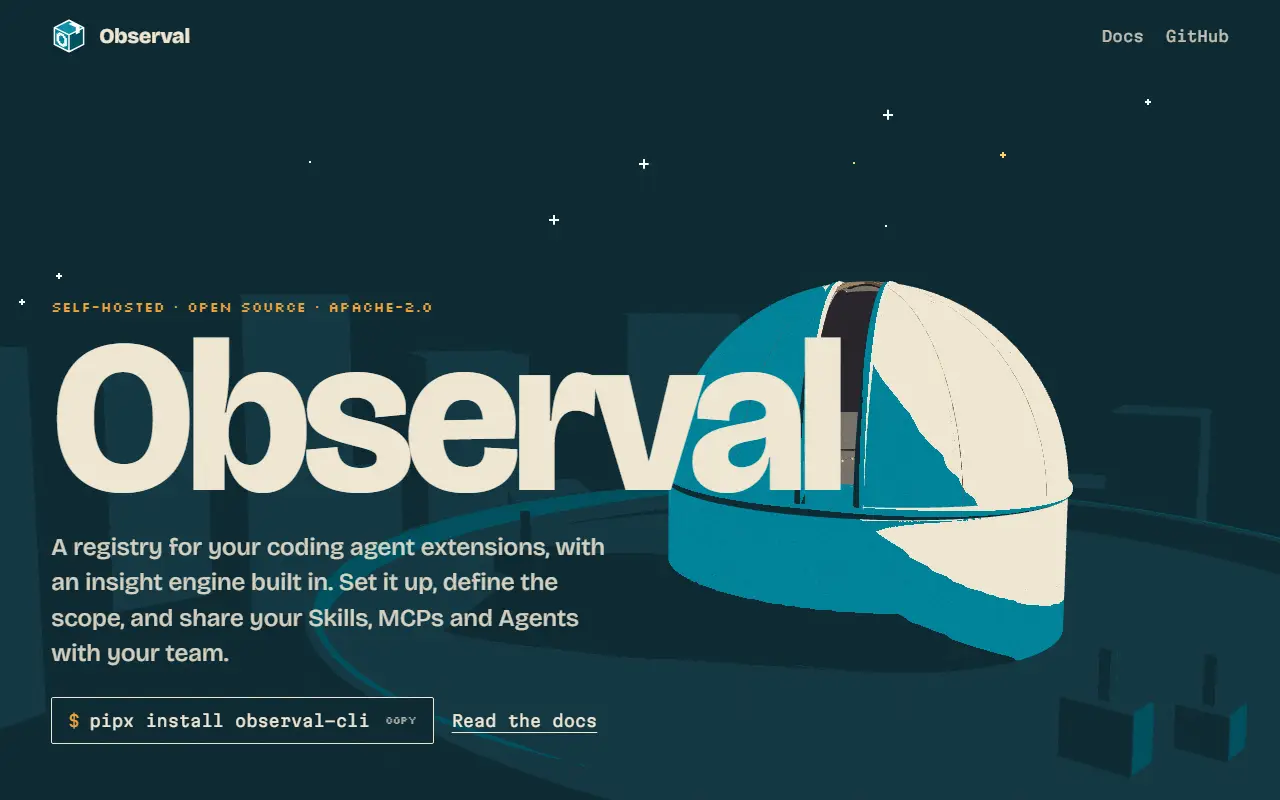
About Observal
Observal is a self-hosted registry for the extensions that coding agents use. It serves as the central control layer and record-keeping system for in-house AI components, letting you set up the service, define scope and share skills, MCP servers and agents with your peers.
A built-in insight engine adds analytics on how those components are used. Repository topics name Claude Code, Cursor, Kiro, Codex and Antigravity as agents it works with, and list a CLI tool, a playground, insights and a registry. The README opens with a large ASCII banner and an explanation of what problem it solves for organizations managing many agent components. It is written in Python.
Observal is licensed under Apache-2.0 and runs on infrastructure you control. It suits engineering teams and platform groups that want to govern, version and share agent skills and MCP servers internally instead of passing files around.
Key features
- Registry for skills, MCPs and agents
- System of record for internal AI components
- Built-in insight and analytics engine
- Scoped sharing across a team
- Works with Claude Code, Cursor and Codex
- CLI tool and playground
Good fit for
- →Sharing agent skills across an engineering team
- →Governing internal MCP servers
- Built with
- Python
- Tags
- agent-registry
- mcp
- skills
- ai-agents
- self-hosted
- analytics
- claude-code
- python
Observal: questions and answers
- What is Observal used for?
- Observal is a self-hosted registry and insight engine for coding agent extensions such as skills, MCP servers and agents, shared across a team. It is a good fit for sharing agent skills across an engineering team and governing internal MCP servers.
- Is Observal open source?
- Yes. Observal is open source under the Apache-2.0 licence. Its source code is on GitHub at Observal/Observal and is written mainly in Python.
- Is Observal free?
- Yes. Observal is open source, so the software itself is free to use.
- Can I self-host Observal?
- Yes. Observal can be self-hosted on your own server or infrastructure; there is no official hosted version.
- What are some alternatives to Observal?
- Similar open-source tools in the AI Infrastructure category include Ktx, Langflow and PrivateGPT. SaaS products in the same category include AgentGov, Amazon Bedrock and AnyRouter.
- Is Observal actively maintained?
- Yes. The most recent commit to Observal was on 2 October 2026, and the latest release is v1.13.1, published on 5 September 2026. The project has 4k stars on GitHub.
Open-source alternatives to Observal
See all
Ktx
AI Infrastructure
ktx is an executable context layer for data and analytics agents 🐙 Allow Claude Code, Cod
Apache-2.0★ 1.6k
Langflow
AI Infrastructure
Langflow is a powerful tool for building and deploying AI-powered agents and workflows.
MITvs Gumloop★ 155k
PrivateGPT
AI Infrastructure
Complete API layer for private AI applications on local models: RAG, skills, tools, MCP, t
Apache-2.0vs ChatGPT★ 58k
Yuxi
AI Infrastructure
可私有部署的多租户知识智能体平台,统一知识库、知识图谱、多智能体执行、MCP/Skills、沙盒与权限管理。
MIT★ 7.3k
OpenConnector
AI Infrastructure
Open-source auth gateway connecting 1500+ SaaS providers to AI agents through SDK, CLI, MC
Apache-2.0★ 5.9k
Inkeep Agents
AI Infrastructure
Create AI Agents in a No-Code Visual Builder or TypeScript SDK with full 2-way sync. For s
OSS★ 1.4k
SaaS alternatives to Observal
See all
AgentGov
AI Infrastructure
Open source platform for AI agent tracing and EU AI Act compliance with audit trails and risk documentation
SaaS
Amazon Bedrock
AI Infrastructure
Managed AWS service for building generative AI apps with models from several providers
SaaS
AnyRouter
AI Infrastructure
Unified LLM gateway that routes coding agents and MCP servers through a single endpoint
SaaS
api-hub.ai
AI Infrastructure
Single API for accessing many AI models behind one endpoint
SaaS
Apiframe
AI Infrastructure
One API for AI image, video and music generation across multiple model providers
SaaS
Azure AI Foundry
AI Infrastructure
Microsoft platform for building, evaluating and deploying AI apps and agents on Azure
SaaS