
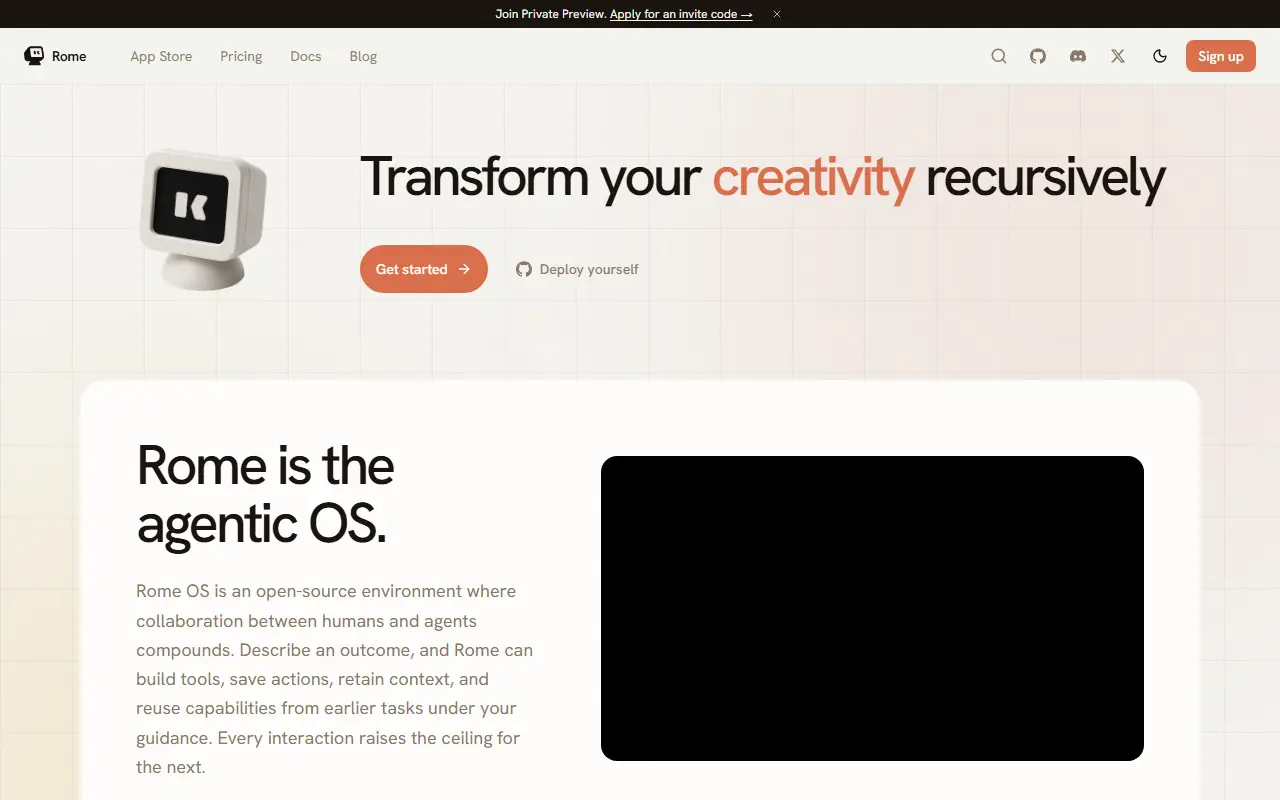
About Rome
Rome describes itself as an agentic OS for humans and agents. Instead of scaling only models, it focuses on the environment an agent works in: tools, workflows, memory and interfaces. It is a guardrailed space where people and agents collaborate, agents build their own harnesses and standard procedures under guidance, and capabilities that prove themselves are kept so later work builds on them.
It also positions itself as an open-source alternative to Grok Bot and Meta's Muse, with persistent agents, scheduled tasks and custom apps. You can run it yourself with a single Docker script that pulls the published image and starts a dashboard bound to localhost on port 7663, with state kept in named Docker volumes so upgrades preserve data. First-run onboarding is open to whoever reaches it first, so exposing it beyond the machine requires an explicit bind option. Telemetry export is off unless an OpenTelemetry endpoint is set.
Rome Cloud, currently a preview, provisions a private Rome environment for each user. The code is written in TypeScript and licensed under MIT, and the topics reference Claude Code and Codex alongside self-hosting and workflow automation.
Key features
- Agent environment with guardrails
- Persistent agents and scheduled tasks
- Custom apps built with agents
- Docker one-script install
- State stored in Docker volumes
- Optional Rome Cloud preview
Good fit for
- →Running persistent personal AI agents
- →Self-hosted alternative to hosted agent bots
- Built with
- TypeScript
- Tags
- agent-os
- ai-agents
- self-hosted
- workflow-automation
- claude-code
- docker
- typescript
Rome: questions and answers
- What is Rome used for?
- Rome is an open-source agent operating system where humans and AI agents collaborate in a guardrailed environment, runnable in Docker or in a cloud preview. It is a good fit for running persistent personal AI agents.
- Is Rome open source?
- Yes. Rome is open source under the MIT licence. Its source code is on GitHub at rome-os/rome and is written mainly in TypeScript.
- Is Rome free?
- Yes. Rome is open source, so the software itself is free to use. A managed cloud version is also available, with paid plans from $20 per month.
- Can I self-host Rome?
- Yes. Rome can be self-hosted on your own server or infrastructure.
- What is Rome an alternative to?
- Rome is an open-source alternative to Grok. Other open-source alternatives to Grok include LobeHub, AnythingLLM and LibreChat.
- Is Rome actively maintained?
- Yes. The most recent commit to Rome was on 2 October 2026. The project has 673 stars on GitHub.
Open-source alternatives to Rome
See all
LobeHub
AI Tools
🤯 LobeHub is your Chief Agent Operator, organizing your agents into 7×24 operations by hi
OSSvs ChatGPT★ 83k
AnythingLLM
AI Tools
Stop renting your intelligence. Own it with AnythingLLM. Everything you need for a powerfu
MITvs ChatGPT★ 67k
LibreChat
AI Tools
Enhanced ChatGPT Clone: Features Agents, MCP, Skills, DeepSeek, Anthropic, AWS, OpenAI, Re
MITvs ChatGPT★ 45k
Big-AGI
AI Tools
AI suite powered by state-of-the-art models and providing advanced AI/AGI functions. Inclu
MITvs ChatGPT★ 7.1k
Open WebUI
AI Tools
Run AI on your own terms. Connect any model, extend with code, and protect what matters wi
OSSvs ChatGPT★ 154k
Cherry Studio
AI Tools
AI productivity studio with smart chat, autonomous agents, and 300+ assistants. Unified ac
AGPL-3.0vs ChatGPT★ 52k
SaaS alternatives to Rome
See all
Grok
AI Tools
xAI's chat assistant with live web and X post search, image generation and reasoning
SaaS
AgentGov
AI Infrastructure
Open source platform for AI agent tracing and EU AI Act compliance with audit trails and risk documentation
SaaS
Amazon Bedrock
AI Infrastructure
Managed AWS service for building generative AI apps with models from several providers
SaaS
Azure AI Foundry
AI Infrastructure
Microsoft platform for building, evaluating and deploying AI apps and agents on Azure
SaaSBallast
AI Infrastructure
Durable runtime for AI agents with a visual workflow canvas, human approval steps and per-step cost tracking
SaaS
BlazeDocs
AI Infrastructure
Converts PDFs and scans into structured Markdown and tables for analysis and automation
SaaS