
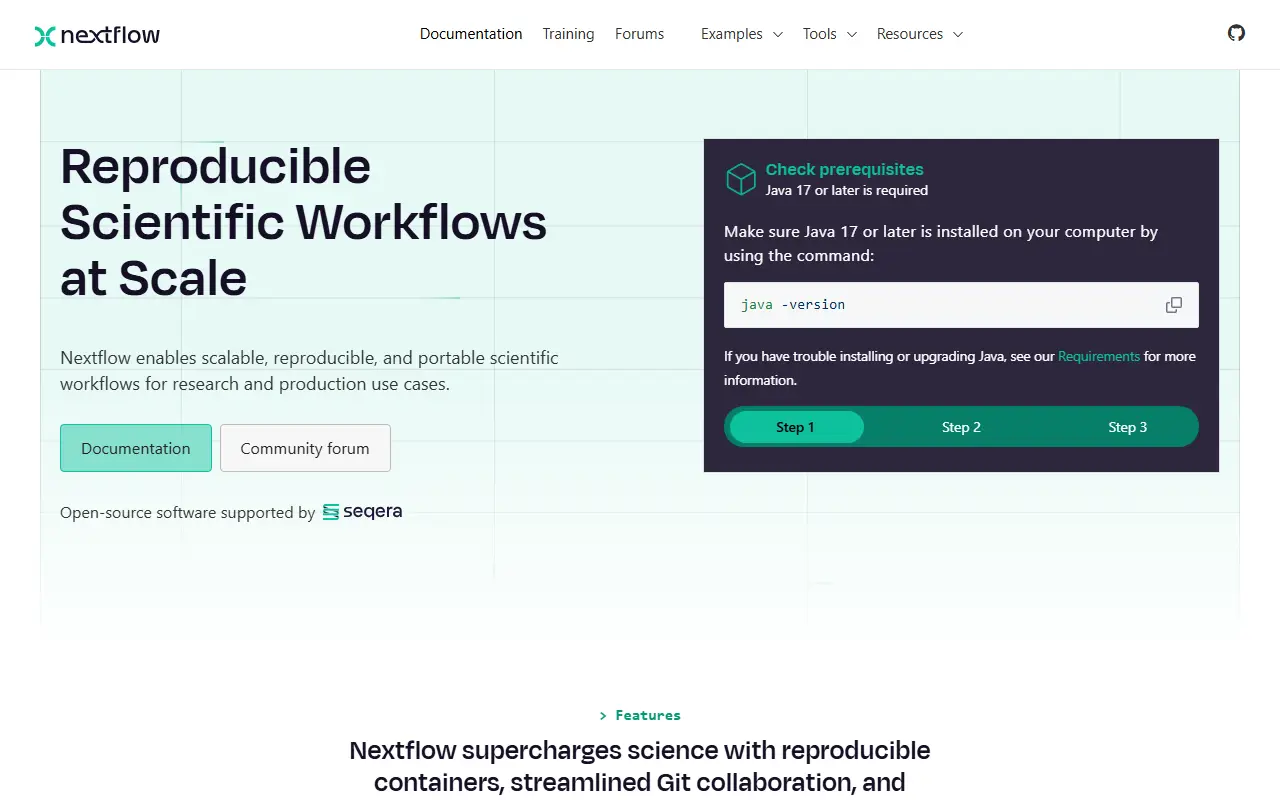
About Nextflow
Nextflow is a workflow system for building scalable, portable and reproducible computational pipelines. It is based on the dataflow programming model, which simplifies writing parallel and distributed pipelines by letting you concentrate on how data and computation flow rather than on coordination details. The project's topics highlight bioinformatics and reproducible research as core areas.
The same pipeline can run on a local machine, on HPC schedulers such as Slurm and SGE, on AWS Batch, Azure Batch and Google Cloud Batch, or on Kubernetes. Software dependencies can be managed with Conda, Spack, Docker, Podman, Singularity and other tools, so a workflow can be moved between environments without rewriting it. The engine is implemented in Groovy.
Installation is a single command that produces an executable, and it is also available through Bioconda. The community around it includes a forum, Slack, regular meetings and the nf-core project, which collects high-quality shared workflows. Nextflow is released under the Apache 2.0 license and is developed by Seqera, which also offers a managed way to run it.
Key features
- Dataflow-based pipeline language
- Runs on local, HPC, cloud and Kubernetes backends
- Container support for Docker, Podman and Singularity
- Conda and Spack dependency management
- Reproducible, portable workflow definitions
- Community pipelines through nf-core
Good fit for
- →Bioinformatics analysis pipelines
- →Moving research workflows between cluster and cloud
- Tags
- workflow-engine
- pipeline
- bioinformatics
- hpc
- reproducible-research
- dataflow
- groovy
- kubernetes
Nextflow: questions and answers
- What is Nextflow used for?
- Nextflow is a workflow language and engine for building scalable, portable and reproducible data pipelines, widely used in bioinformatics. It is a good fit for bioinformatics analysis pipelines, and moving research workflows between cluster and cloud.
- Is Nextflow open source?
- Yes. Nextflow is open source under the Apache-2.0 licence. Its source code is on GitHub at nextflow-io/nextflow and is written mainly in Groovy.
- Is Nextflow free?
- Yes. Nextflow is open source, so the software itself is free to use. A managed cloud version is also available.
- Can I self-host Nextflow?
- Yes. Nextflow can be self-hosted on your own server or infrastructure.
- What are some alternatives to Nextflow?
- Similar open-source tools in the Data Pipelines & ETL category include Pachyderm, Azkaban and Airflow. SaaS products in the same category include Alation, Alteryx and Amazon EMR.
- Is Nextflow actively maintained?
- Yes. The most recent commit to Nextflow was on 2 October 2026, and the latest release is v26.04.6, published on 9 July 2026. The project has 3.5k stars on GitHub.
Open-source alternatives to Nextflow
See all
Pachyderm
Data Pipelines & ETL
Data-Centric Pipelines and Data Versioning
Apache-2.0vs Databricks★ 6.3k
Azkaban
Data Pipelines & ETL
Azkaban workflow manager.
Apache-2.0★ 4.5k
Airflow
Data Pipelines & ETL
Apache Airflow - A platform to programmatically author, schedule, and monitor workflows
Apache-2.0vs Astronomer★ 47k
Apache Spark
Data Pipelines & ETL
Apache Spark - A unified analytics engine for large-scale data processing
Apache-2.0vs Databricks★ 44k
Kafka
Data Pipelines & ETL
Apache Kafka - A distributed event streaming platform
Apache-2.0vs Striim★ 34k
Kestra
Data Pipelines & ETL
Event Driven Orchestration & Scheduling Platform for Mission Critical Applications
Apache-2.0vs AWS Step Functions★ 29k
SaaS alternatives to Nextflow
See all
Alation
Data Pipelines & ETL
Data catalog and governance platform for finding and understanding enterprise data
SaaS
Alteryx
Data Pipelines & ETL
Analytics automation platform for data prep, blending and predictive workflows
SaaS
Amazon EMR
Data Pipelines & ETL
Managed big data platform on AWS for running Spark, Hive, Presto and other frameworks
SaaS
Amazon Kinesis
Data Pipelines & ETL
AWS services for collecting, processing and analyzing real-time streaming data
SaaS
Astronomer
Data Pipelines & ETL
Managed Apache Airflow platform for orchestrating data pipelines
SaaS
Atlan
Data Pipelines & ETL
Active metadata platform and data catalog for discovery and governance
SaaS