 TrackMedia
 TrackRev

 Micro.blog
 Acast
 Spreaker
 Captivate
 Simplecast
 Megaphone
 Spotify for Creators
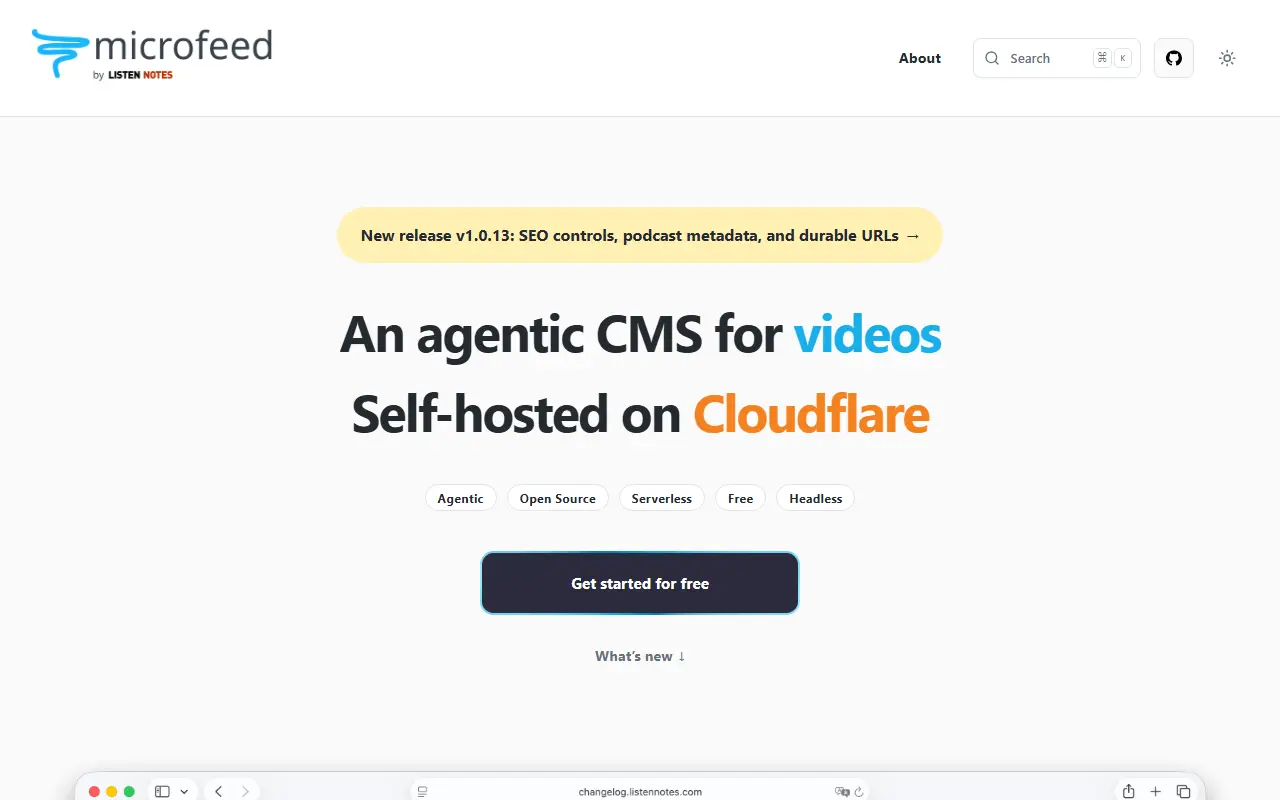
About Microfeed
microfeed is a lightweight content management system that runs on Cloudflare, aimed at technical individuals who want their own CMS without operating servers. You can publish audio, video, photos, documents, blog posts and external links to a feed that is available as a web page, RSS and JSON, so it also works as a podcast host.
Content can be managed in the built-in admin dashboard or by an AI agent through the official @microfeed/cli, which is why it describes itself as an agentic CMS. It is built on Cloudflare services including Workers, D1, R2, Queues and Zero Trust, according to the repository topics, and also functions as a headless CMS with an API. The code is TypeScript.
microfeed is licensed under AGPL-3.0 and deployed to your own Cloudflare account, so there is no separate vendor-hosted version. It suits creators, podcasters and developers who want a serverless, low-maintenance place to publish content.
Key features
- Publish audio, video, photos and documents
- Web, RSS and JSON feeds
- Built-in admin dashboard
- CLI for AI agent management
- Runs serverless on Cloudflare
- Headless API access
Good fit for
- Podcast hosting on Cloudflare
- Personal blog and media feed
- Agent-managed content publishing
Microfeed: questions and answers
- What is Microfeed used for?
- microfeed is a lightweight CMS you host on your own Cloudflare account to publish podcasts, blogs, photos, videos and documents as web, RSS and JSON feeds. It is a good fit for podcast hosting on Cloudflare, personal blog and media feed, and agent-managed content publishing.
- Is Microfeed open source?
- Yes. Microfeed is open source under the AGPL-3.0 licence. Its source code is on GitHub at microfeed/microfeed and is written mainly in TypeScript.
- Is Microfeed free?
- Yes. Microfeed is open source, so the software itself is free to use.
- Can I self-host Microfeed?
- Yes. Microfeed can be self-hosted on your own server or infrastructure; there is no official hosted version.
- What is Microfeed an alternative to?
- Microfeed is an open-source alternative to Buzzsprout, Libsyn, Transistor and Mixcloud. Other open-source alternatives to Buzzsprout include Castopod.
- Is Microfeed actively maintained?
- Yes. The most recent commit to Microfeed was on 7 October 2026, and the latest release is v1.0.13, published on 22 September 2026. The project has 4.1k stars on GitHub, with 25 added in the last 30 days.
Open-source alternatives to Microfeed
See all
Castopod
Media & Streaming
Castopod is an open-source hosting platform made for podcasters who want engage and intera
AGPL-3.0vs Buzzsprout★ 882
Ghost
CMS
Independent technology for modern publishing, memberships, subscriptions and newsletters.
MITvs Substack★ 56k
Publii
CMS
The most intuitive Static Site CMS designed for SEO-optimized and privacy-focused websites
GPL-3.0vs Mobirise★ 7.4k
Hugo
CMS
The world’s fastest framework for building websites.
Apache-2.0vs Squarespace★ 90k
Known
CMS
A social publishing platform.
OSSvs Medium★ 1.1k
WriteFreely
CMS
A clean, Markdown-based publishing platform made for writers. Write together and build a c
AGPL-3.0vs Medium★ 5.3k
SaaS alternatives to Microfeed
See all
Buzzsprout
Media & Streaming
Beginner-friendly podcast hosting with stats, directory submission and a free tier
SaaS
Libsyn
Media & Streaming
One of the earliest podcast hosting services, with distribution and statistics
SaaS
Transistor
Media & Streaming
Podcast hosting for multiple shows with private feeds, analytics and embeds
SaaS
Mixcloud
Media & Streaming
Streaming platform for DJ mixes, radio shows and podcasts
SaaS
SoundCloud
Media & Streaming
Audio platform where independent artists upload, share and monetize tracks
SaaS
Podbean
Media & Streaming
Podcast hosting platform with distribution, monetization and a mobile app
SaaS