
 Poshmark
 Vinted
 Spryker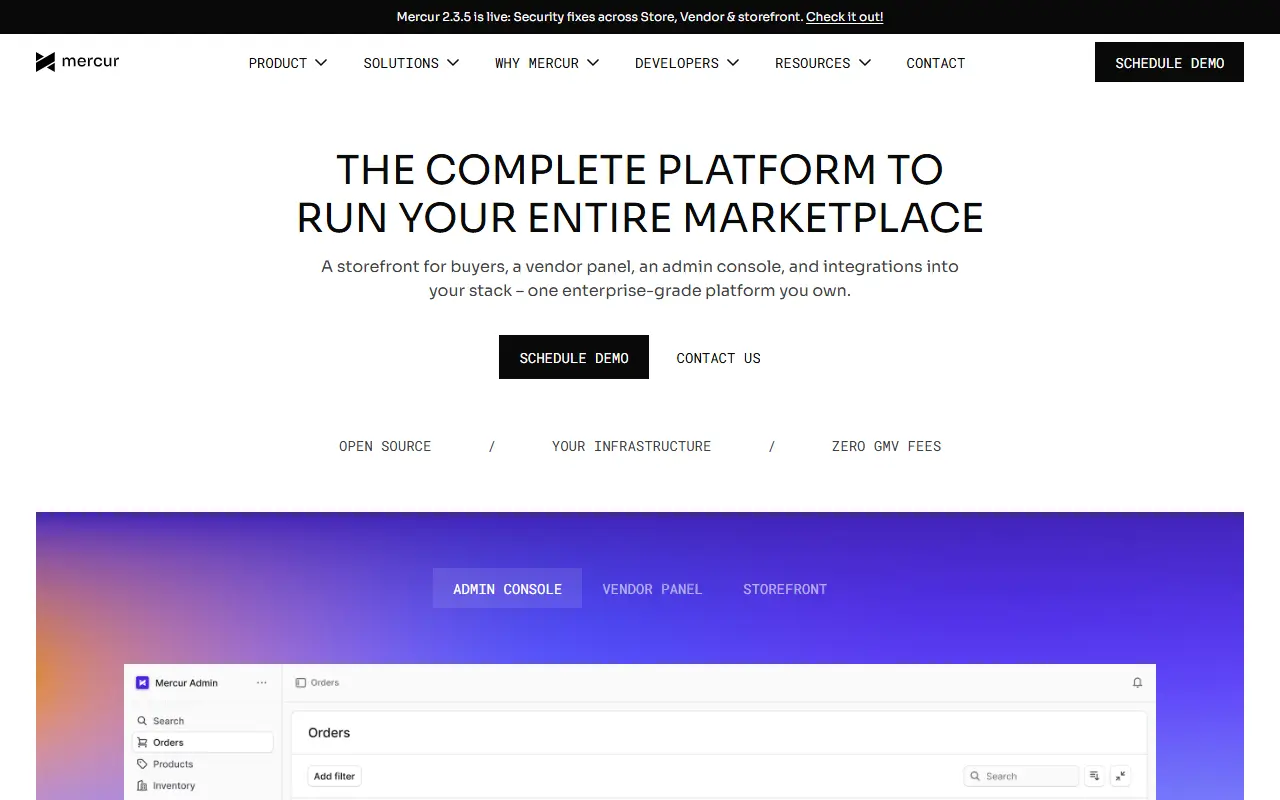
About Mercur
Mercur is an open-source, headless platform for building multi-vendor marketplaces and is presented as an alternative to Mirakl. It adds vendor onboarding, multi-vendor catalogs, offers, commissions, and automated payouts on top of a commerce core. The topics point to Medusa as that core. It is written in TypeScript and released under the MIT license.
The platform supports B2C, B2B, and hybrid marketplaces and includes a storefront, a vendor panel, an admin console, and integrations. The README stresses ownership: you self-host on your own infrastructure with full source access, and there is no percentage of gross merchandise value, no per-transaction fee, and no vendor lock-in.
Documentation, a live demo, and a Discord community are available. Mercur suits teams launching a marketplace who want to avoid both a revenue-sharing SaaS platform and a from-scratch build, and who have the engineering capacity to operate and customize the system.
Key features
- Vendor onboarding and management
- Multi-vendor catalogs and offers
- Commission rules and automated payouts
- Storefront, vendor panel, and admin console
- B2C, B2B, and hybrid marketplace support
- Built on Medusa commerce core
Good fit for
- →Launching a multi-vendor marketplace
- →Replacing a revenue-sharing marketplace SaaS
- Built with
- TypeScript
- Tags
- marketplace
- multi-vendor
- ecommerce
- medusa
- headless-commerce
- typescript
- payouts
- self-hosted
Mercur: questions and answers
- What is Mercur used for?
- Mercur is an open-source headless platform for building multi-vendor marketplaces with vendor onboarding, commissions, payouts, a storefront, and an admin console, built on Medusa. It is a good fit for launching a multi-vendor marketplace and replacing a revenue-sharing marketplace SaaS.
- Is Mercur open source?
- Yes. Mercur is open source under the MIT licence. Its source code is on GitHub at mercurjs/mercur and is written mainly in TypeScript.
- Is Mercur free?
- Yes. Mercur is open source, so the software itself is free to use.
- Can I self-host Mercur?
- Yes. Mercur can be self-hosted on your own server or infrastructure.
- What is Mercur an alternative to?
- Mercur is an open-source alternative to Etsy, eBay, Faire and Shopee. Other open-source alternatives to Etsy include GrandNode 2, Shuup and Bagisto.
- Is Mercur actively maintained?
- Yes. The most recent commit to Mercur was on 2 October 2026, and the latest release is v2.3.5, published on 17 September 2026. The project has 1.8k stars on GitHub.
Open-source alternatives to Mercur
See all
GrandNode 2
E-commerce
E-commerce platform built with ASP.NET Core using MongoDB for NoSQL storage
GPL-3.0vs BigCommerce★ 1.3k
Shuup
E-commerce
E-Commerce Platform
OSSvs BigCommerce★ 2.4k
Bagisto
E-commerce
Open Source eCommerce & Multi-Vendor Marketplace Platform Built with Laravel for Enterpris
MITvs BigCommerce★ 28k
Spree Commerce
E-commerce
Open Source Platform for DTC, B2B Commerce, Marketplaces & Omnichannel. REST APIs, TypeScr
BSD-3-Clausevs BigCommerce★ 16k
Medusa
E-commerce
The world's most flexible commerce platform for agents and developers
OSSvs BigCommerce★ 37k
Aimeos
E-commerce
Integrated online shop based on Laravel and the Aimeos e-commerce framework for ultra-fast
MITvs BigCommerce★ 5.5k
SaaS alternatives to Mercur
See all
Etsy
E-commerce
Marketplace for handmade, vintage and craft goods with seller tools
SaaS
eBay
E-commerce
Online marketplace for auctions and fixed-price listings
SaaS
Faire
E-commerce
Wholesale marketplace connecting independent retailers and brands
SaaS
Shopee
E-commerce
Ecommerce marketplace and seller platform covering Southeast Asia and Taiwan
SaaS
Lazada
E-commerce
Southeast Asian online marketplace and seller platform owned by Alibaba
SaaS
Mercado Libre
E-commerce
Latin American ecommerce marketplace with payments and logistics services
SaaS