
About Kiro
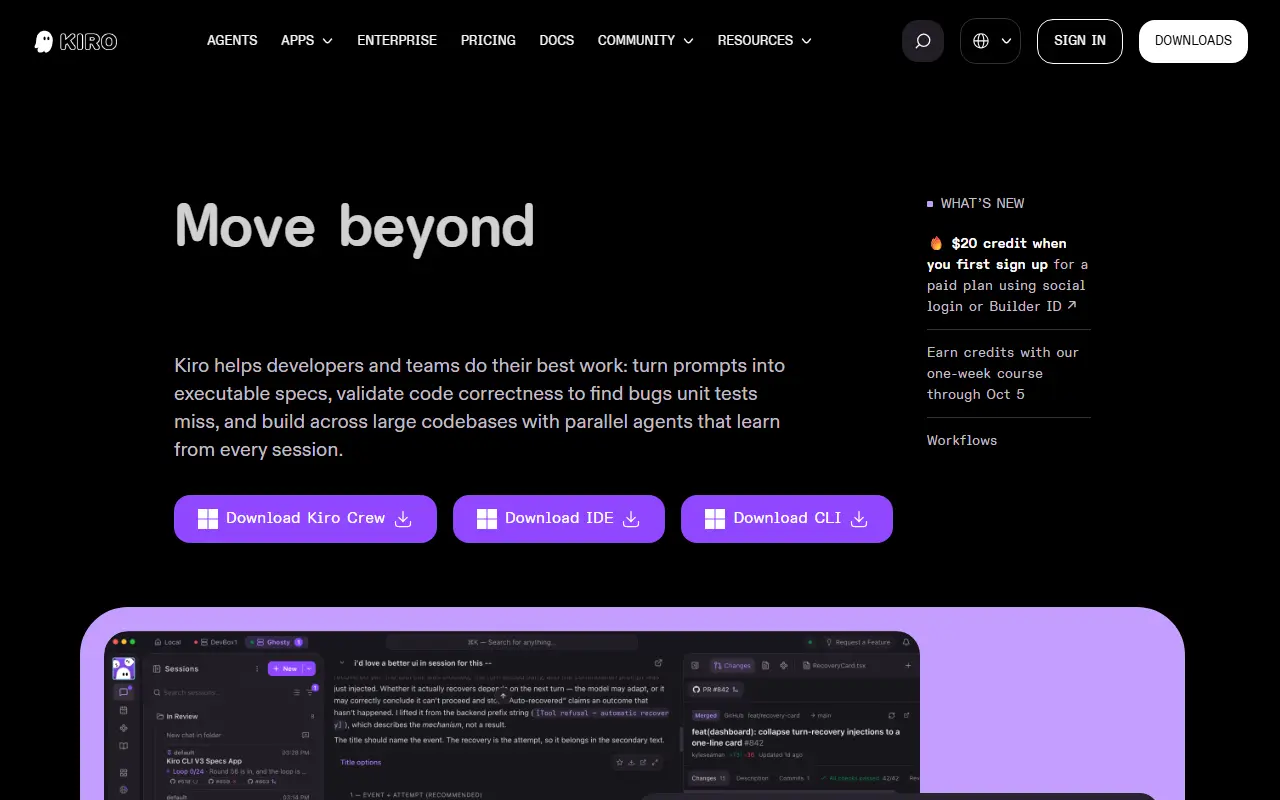
Kiro is an AI development tool from AWS built around spec-driven development. Instead of generating code directly from a loose prompt, it converts a request into requirements, an architectural design and a sequence of tasks, and then implements those tasks, with the aim of producing maintainable code that matches what was specified.
Correctness checking is a stated focus. Before writing code, Kiro applies automated reasoning to look for contradictions or gaps in the requirements, and afterward it verifies behavior with property-based tests that assert rules which must hold across all inputs, similar to fuzz testing. Work can be planned with specs and carried out by parallel agents on a local machine or in the cloud, and a CLI is available for terminal use.
Kiro is a commercial product with downloads for the IDE and a Kiro Crew offering for teams. It runs on credit-based paid plans, with a pricing page, free sign-up options and promotional credits mentioned on the homepage.
Key features
- Spec-driven development from prompts
- Requirements, design and task generation
- Parallel agents running locally or in cloud
- Property-based tests for edge cases
- Automated reasoning checks on requirements
- Terminal CLI for cloud sessions
Good fit for
- →Turning feature ideas into structured specs
- →Working across large codebases with agents
- →Finding bugs that unit tests miss
- Tags
- agentic-ide
- spec-driven-development
- ai-coding
- aws
- property-based-testing
- cli
- developer-tools
Kiro: questions and answers
- What is Kiro used for?
- Kiro is an agentic IDE and CLI from AWS that turns prompts into specs, designs and tasks, then implements them with parallel agents and property-based tests. It is a good fit for turning feature ideas into structured specs, working across large codebases with agents and finding bugs that unit tests miss.
- Is Kiro free?
- Yes. Kiro has a free plan, and paid plans start at $20 per seat per month.
- Is Kiro open source?
- No. Kiro is proprietary (closed-source) software and can't be self-hosted. Open-source alternatives to Kiro include OpenCode, Kilo Code and Aider.
- What are some alternatives to Kiro?
- Kiro competes with Cursor, Trae and Google Antigravity. For open-source options, see Enlisted's ranked list of open-source Kiro alternatives.
Open-source alternatives to Kiro
See all
OpenCode
AI Tools
The open source coding agent.
MITvs Claude Code★ 211k
Kilo Code
AI Tools
Kilo is the all-in-one agentic engineering platform. Build, ship, and iterate faster with
MITvs Cursor★ 27k
Aider
AI Tools
aider is AI pair programming in your terminal
Apache-2.0vs Claude Code★ 49k
Cline
AI Tools
Autonomous coding agent as an SDK, IDE extension, or CLI assistant.
Apache-2.0vs GitHub Copilot★ 70k
Continue
AI Tools
open-source coding agent
Apache-2.0vs GitHub Copilot★ 36k
Zed
Developer Tools
Code at the speed of thought – Zed is a high-performance, multiplayer code editor from the
OSSvs Sublime Text★ 91k
SaaS alternatives to Kiro
See all
Cursor
AI Tools
AI-first code editor with chat, multi-file edits and autonomous coding agents
SaaS
Trae
AI Tools
AI-powered IDE from ByteDance with chat and agent features
SaaS
Google Antigravity
AI Tools
Agent-first coding environment from Google built around Gemini models
SaaS
GitHub Copilot
AI Tools
GitHub Copilot is an AI coding assistant and agent that works in editors, the terminal, on desktop and on GitHub, from issue to pull request.
SaaS
Augment Code
AI Tools
AI coding assistant for large codebases with context-aware chat and agents
SaaS
Claude Code
AI Tools
Anthropic coding agent for the terminal, IDEs and web that edits code and runs commands
SaaS