 TrackMedia
 TrackRev
About Indigo
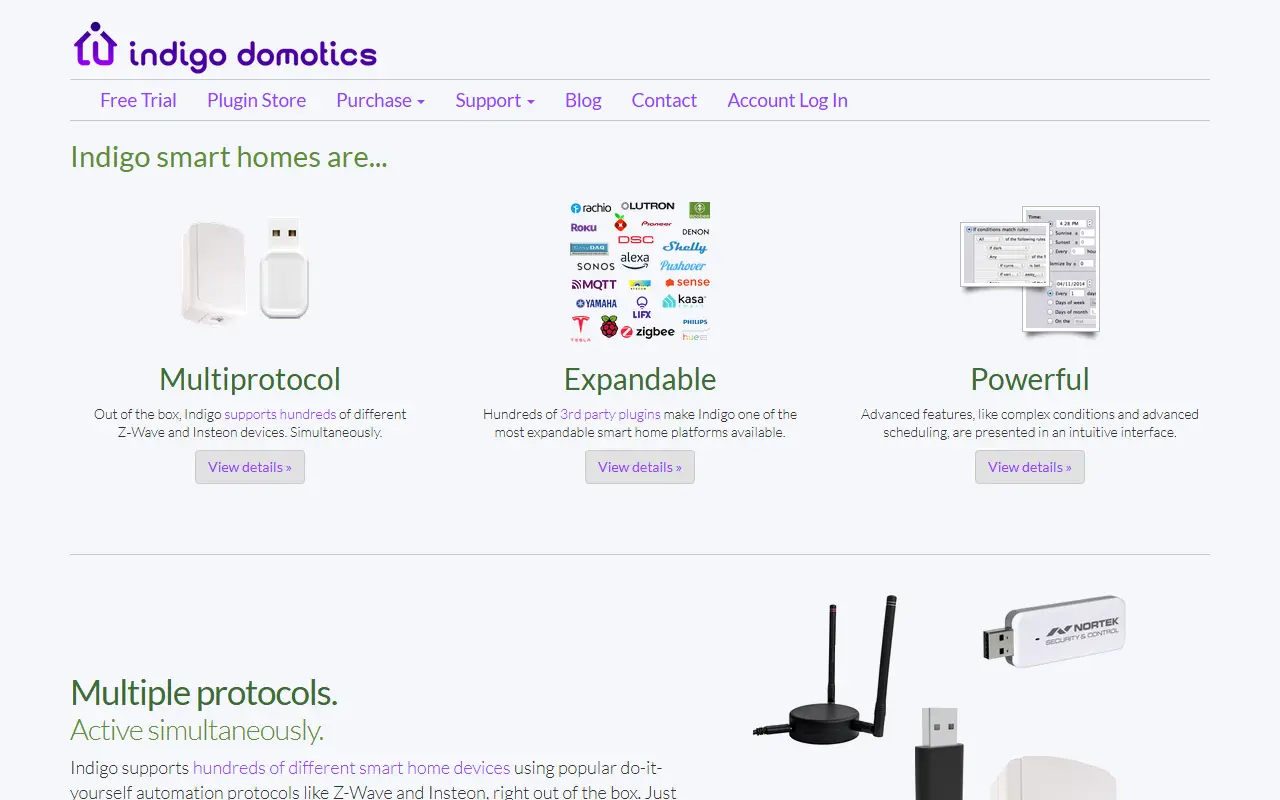
Indigo, from Indigo Domotics, is smart home software that runs on a Mac and acts as the hub for a do-it-yourself setup. Out of the box it supports hundreds of smart home devices over protocols such as Z-Wave and Insteon, and you can use them together. You pick your hardware interfaces and start adding devices. Built-in options cover weather data, iCal integration, relay cards, timers and notifications.
Support is extended through a Plugin Store with hundreds of third-party plugins, covering security systems, weather data, home theater parts, energy monitoring, sprinklers and thermostats. Siri support is available through third-party plugins. Triggers and conditions can be hierarchical for complex logic, custom graphical control pages let you design the interface, and scripting uses Python.
A new licence is USD 199.95 and includes a one-year Up-to-Date subscription. The licence is a modified perpetual one: you can keep using the version you bought, or any released during the free subscription period, without paying again. Renewing the subscription brings later releases.
Key features
- Hundreds of Z-Wave and Insteon devices supported
- Third-party plugins from the Plugin Store
- Custom graphical control pages
- Complex scheduling and triggering logic
- Hierarchical conditions for fine-tuning
- Python scripting for advanced automation
Good fit for
- smart home automation
- multi-protocol device control
- home scheduling
- security and energy integration
Indigo: questions and answers
- What is Indigo used for?
- Indigo is a Mac-based smart home hub that supports Z-Wave and Insteon devices, third-party plugins, advanced scheduling, Python scripting and Alexa control. It is a good fit for smart home automation, multi-protocol device control and home scheduling.
- How much does Indigo cost?
- Paid plans for Indigo start at $64.95 per year, and there is no free plan. A free trial is available.
- Is Indigo open source?
- No. Indigo is proprietary (closed-source) software. Open-source alternatives to Indigo include Domoticz, Home Assistant and ESPHome.
- What are some alternatives to Indigo?
- Indigo competes with Hubitat Elevation, Homey and Apple Home. For open-source options, see Enlisted's ranked list of open-source Indigo alternatives.
Open-source alternatives to Indigo
See all
Domoticz
Home Automation & IoT
Free open source home automation system for Linux, Windows, Raspberry Pi. Supports Z-Wave,
GPL-3.0vs Apple Home★ 3.8k
Home Assistant
Home Automation & IoT
:house_with_garden: Open source home automation that puts local control and privacy first.
Apache-2.0vs SmartThings★ 92k
ESPHome
Home Automation & IoT
ESPHome is a system to control your ESP32, ESP8266, BK72xx, RP2040 by simple yet powerful
OSSvs Tuya Smart★ 12k
Tasmota
Home Automation & IoT
Alternative firmware for ESP8266 and ESP32 based devices with easy configuration using web
GPL-3.0vs Tuya Smart★ 25k
openHAB
Home Automation & IoT
Core framework of openHAB
EPL-2.0vs SmartThings★ 1.2k
OpenRemote
Home Automation & IoT
100% open-source IoT Platform - Integrate your devices, add intelligence, build custom app
OSSvs Losant★ 2.1k
SaaS alternatives to Indigo
See all
Hubitat Elevation
Home Automation & IoT
Local-processing smart home hub and platform with rule automation
SaaS
Homey
Home Automation & IoT
Smart home hub and app that connects devices across many protocols
SaaS
Apple Home
Home Automation & IoT
Apple app for controlling HomeKit and Matter smart home devices
SaaS
SmartThings
Home Automation & IoT
Samsung smart home app and platform for controlling connected devices
SaaS
Vera (by Ezlo)
Home Automation & IoT
Smart home automation hub and cloud services for controlling connected devices
SaaS
ISY
Home Automation & IoT
Home automation and energy management controller
SaaS