 TrackMedia
 TrackRev

About Getting Started
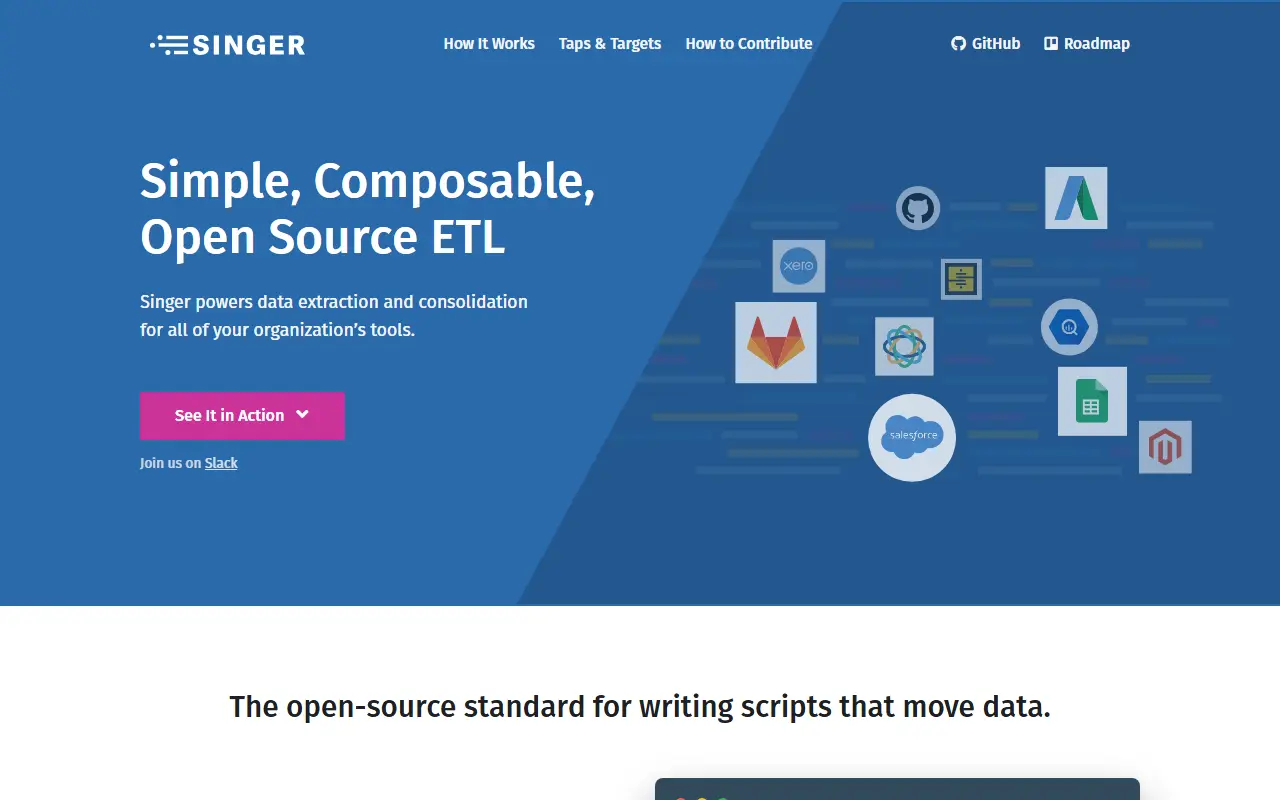
Singer defines how data extraction scripts, called taps, and data loading scripts, called targets, talk to each other. Because the format is shared, any tap can be paired with any target to move data from a source to a destination.
Taps and targets are small applications chained with Unix pipes, so no daemon or complicated plugin system is needed. They exchange JSON, which makes them easy to write in any programming language, and JSON Schema can describe richer types when a strict structure is needed.
The site shows two commands that pull exchange rate data into a CSV file. Its taps list covers many sources, including PostgreSQL, MySQL, Salesforce, Stripe, HubSpot and Google Analytics, and its targets include CSV, Google BigQuery and Google Sheets. A page explains how to develop a new tap.
Key features
- Taps pull data from a source into a JSON stream
- Targets load data into files, APIs or databases
- JSON messages usable from any programming language
- State kept between runs for incremental extraction
- Two-command example exports exchange rates to CSV
- Moves data between databases, web APIs, files and queues
Good fit for
- Syncing SaaS data to a warehouse
- Exporting API data to CSV
- Incremental data extraction
Getting Started: questions and answers
- What is Getting Started used for?
- Getting Started is an open-source standard for scripts that move data, where extraction scripts called taps pipe JSON to loading scripts called targets. It is a good fit for syncing SaaS data to a warehouse, exporting API data to CSV and incremental data extraction.
- Is Getting Started open source?
- Yes. Getting Started is open source. Its source code is on GitHub at singer-io/getting-started.
- Is Getting Started free?
- Yes. Getting Started is open source, so the software itself is free to use.
- Can I self-host Getting Started?
- Yes. Getting Started can be self-hosted on your own server or infrastructure.
- What is Getting Started an alternative to?
- Getting Started is an open-source alternative to Astronomer. Other open-source alternatives to Astronomer include Meltano, Airflow and Airbyte.
- Is Getting Started actively maintained?
- The most recent commit to Getting Started was on 8 August 2025. The project has 1.4k stars on GitHub, with 2 added in the last 30 days.
Open-source alternatives to Getting Started
See all
Meltano
Data Pipelines & ETL
Meltano: the declarative code-first data integration engine that powers your wildest data
MITvs Estuary★ 2.7k
Airflow
Data Pipelines & ETL
Apache Airflow - A platform to programmatically author, schedule, and monitor workflows
Apache-2.0vs Astronomer★ 47k
Airbyte
Data Pipelines & ETL
Airbyte is the open-source data movement platform. Run ELT pipelines across 700+ connector
OSSvs Fivetran★ 22k
Dagster
Data Pipelines & ETL
An orchestration platform for the development, production, and observation of data assets.
Apache-2.0vs Astronomer★ 16k
Kestra
Data Pipelines & ETL
Event Driven Orchestration & Scheduling Platform for Mission Critical Applications
Apache-2.0vs AWS Step Functions★ 30k
Apache Spark
Data Pipelines & ETL
Apache Spark - A unified analytics engine for large-scale data processing
Apache-2.0vs Databricks★ 44k
SaaS alternatives to Getting Started
See all
Astronomer
Data Pipelines & ETL
Managed Apache Airflow platform for orchestrating data pipelines
SaaS
Portable
Data Pipelines & ETL
ELT tool with 1500+ prebuilt connectors, custom development, and premium customer support
SaaS
Etlworks
Data Pipelines & ETL
Data integration platform supporting ETL, ELT, CDC, EDI, APIs, files, queues, and IoT
SaaS
Xplenty
Data Pipelines & ETL
Low-code data pipeline platform for ETL, ELT, and Reverse ETL
SaaS
Alteryx
Data Pipelines & ETL
Analytics automation platform for data prep, blending and predictive workflows
SaaS
AWS Glue
Data Pipelines & ETL
Serverless data integration service on AWS for ETL jobs and data catalogs
SaaS