
About Fava
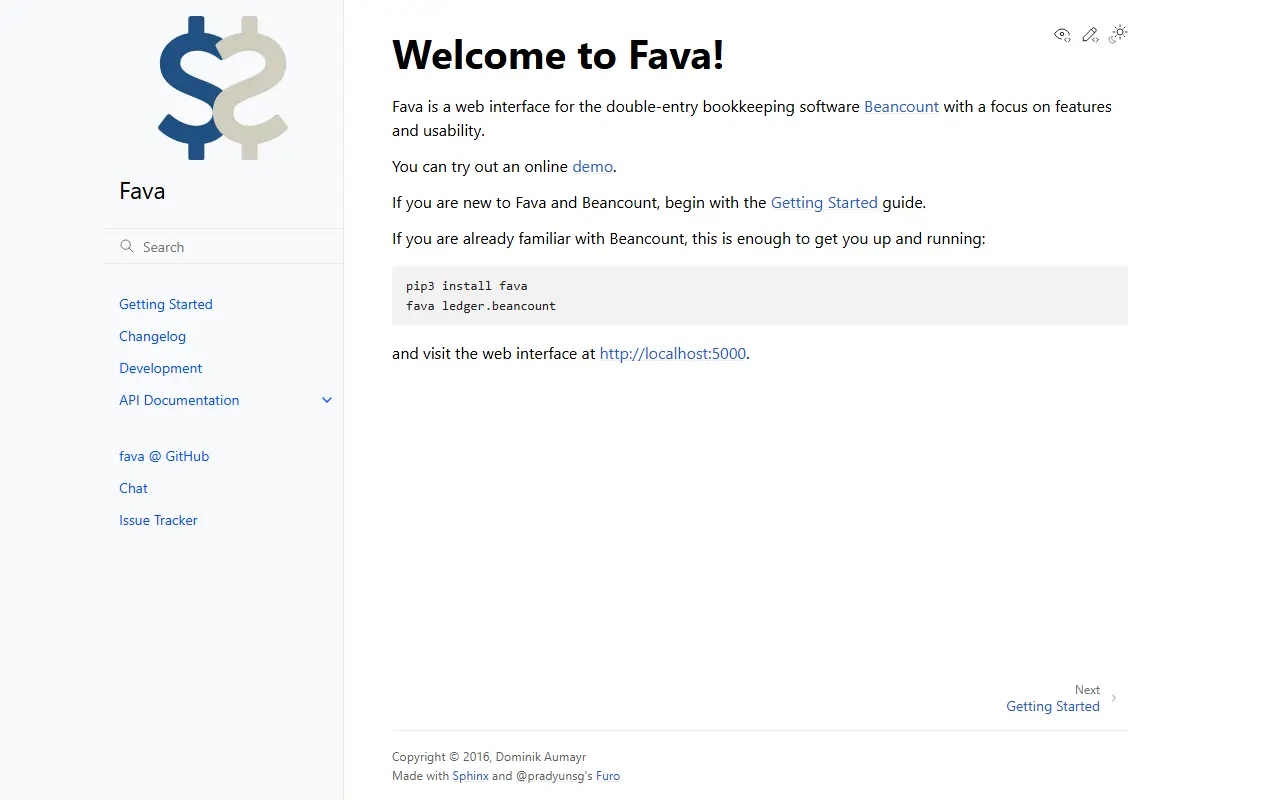
Fava is a web interface for Beancount, a double-entry bookkeeping tool that keeps your accounts in plain text files. Fava focuses on features and usability: it reads your ledger and presents it in a browser so you can view reports and explore your finances without working only from the command line.
If you already know Beancount, getting started is short. You install Fava with pip, point it at your Beancount file with the fava command, and open the interface at localhost on port 5000. New users are directed to a Getting Started guide, and there is an online demo to try first. The documentation also covers the Python API and extension points.
The project is written in Python and licensed under MIT. It ships a changelog, development notes and API documentation for modules such as the core, beans, plugins and extension system, and it offers a chat room and an issue tracker for support. It is a good fit for people who already keep their accounts in Beancount and want a visual front end.
Key features
- Web interface for Beancount ledgers
- Runs locally with a single command
- Online demo available
- Extension system for custom features
- Python API documentation
Good fit for
- →Reviewing plain-text accounts in a browser
- →Personal finance tracking with Beancount
- Built with
- Python
- Tags
- beancount
- plaintext-accounting
- accounting
- bookkeeping
- ledger
- python
- web-interface
- personal-finance
Fava: questions and answers
- What is Fava used for?
- Fava is a web interface for the Beancount double-entry accounting system, built to make plain-text bookkeeping easier to explore. It is a good fit for reviewing plain-text accounts in a browser and personal finance tracking with Beancount.
- Is Fava open source?
- Yes. Fava is open source under the MIT licence. Its source code is on GitHub at beancount/fava and is written mainly in Python.
- Is Fava free?
- Yes. Fava is open source, so the software itself is free to use.
- Can I self-host Fava?
- Yes. Fava can be self-hosted on your own server or infrastructure; there is no official hosted version.
- What is Fava an alternative to?
- Fava is an open-source alternative to Quicken and YNAB. Other open-source alternatives to Quicken include Beancount, Paisa and Firefly III.
- Is Fava actively maintained?
- Yes. The most recent commit to Fava was on 2 October 2026. The project has 2.6k stars on GitHub.
Open-source alternatives to Fava
See all
Beancount
Finance & Accounting
Beancount: Double-Entry Accounting from Text Files.
GPL-2.0vs Quicken★ 6k
Paisa
Finance & Accounting
Paisa – Personal Finance Manager. https://paisa.fyi demo: https://demo.paisa.fyi
AGPL-3.0vs YNAB★ 3.2k
Firefly III
Finance & Accounting
Firefly III: a personal finances manager
AGPL-3.0vs YNAB★ 25kezBookkeeping
Finance & Accounting
ezBookkeeping is an open source, powerful, self-hosted personal finance app that is easy t
MITvs YNAB★ 5.7k
hledger
Finance & Accounting
Robust, fast, intuitive plain text accounting tool with CLI, TUI and web interfaces.
GPL-3.0vs Quicken★ 4.7k
Actual Budget
Finance & Accounting
A local-first personal finance app
MITvs YNAB★ 29k
SaaS alternatives to Fava
See all
Quicken
Finance & Accounting
Personal finance and budgeting app with account aggregation
SaaS
YNAB
Finance & Accounting
Zero-based budgeting app that assigns every dollar a job
SaaS
Account & Expense Manager
Finance & Accounting
Mobile app for budgeting, tracking expenses and managing personal finances
SaaS
Budget Copain
Finance & Accounting
Budgeting app with real-time expense tracking for managing personal finances
SaaS
Commas: Net Worth Tracker
Finance & Accounting
Privacy-first iPhone app for tracking your net worth over time
SaaS
Copilot Money
Finance & Accounting
Personal finance app for budgeting and spending tracking on Apple devices
SaaS