 TrackMedia
 TrackRev

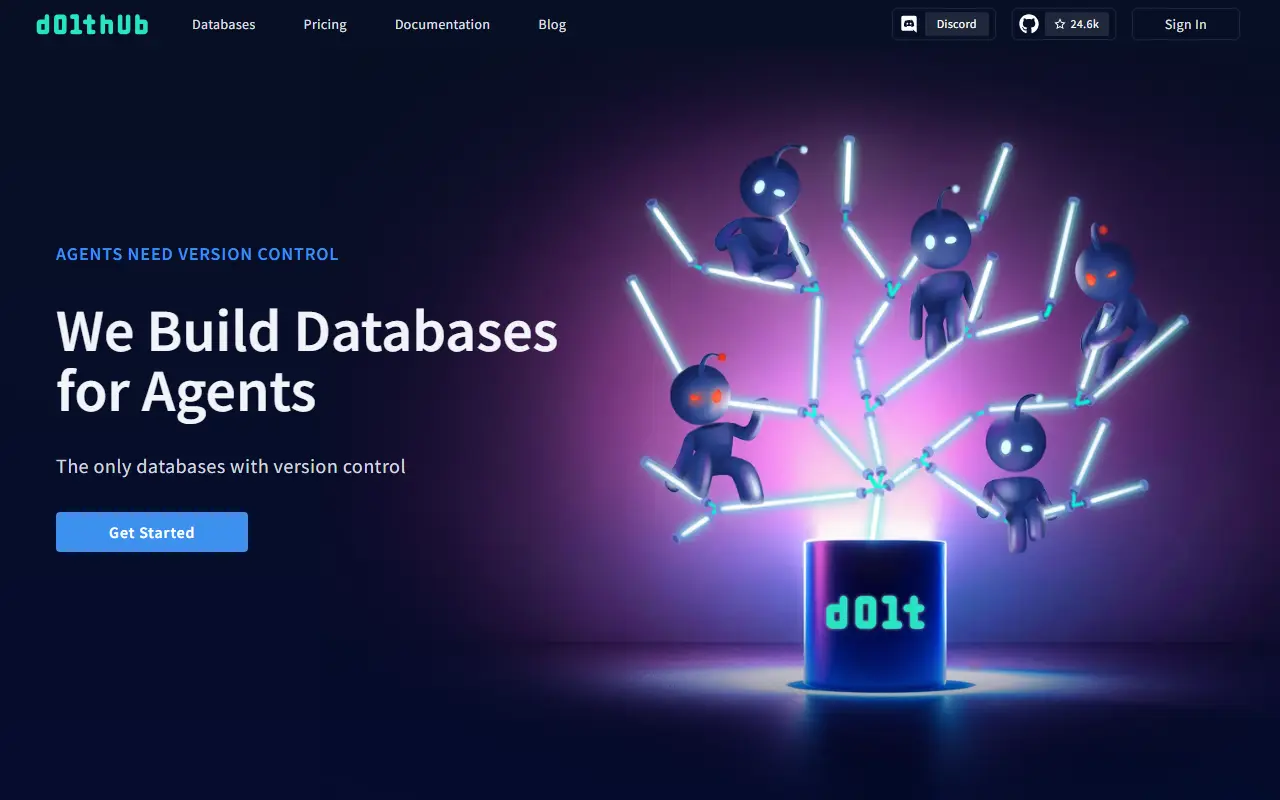
About Dolt
Dolt is a SQL database that can be versioned like a Git repository. You can fork it, clone it, branch it, merge changes, and push or pull updates, and you connect to it as you would any MySQL database to read and modify schema and data. In the maintainers' words, Git versions files while Dolt versions tables.
Version control features are exposed in SQL through system tables, functions and procedures, and there is also a Git-like command line interface for importing CSV files, committing changes, pushing to a remote and merging a teammate's work. Typical uses include auditing data changes, collaborating on datasets, and experimenting on a branch without touching production. It is written in Go.
The ecosystem includes DoltHub, a place to share Dolt databases with free hosting of public data; DoltLab, a self-hosted version of DoltHub; and Hosted Dolt, a managed server. Doltgres is a PostgreSQL-compatible variant in beta. Dolt is Apache-2.0 licensed, with a Discord community and public roadmap.
Key features
- Git-style fork, branch and merge for tables
- MySQL-compatible SQL interface
- Version control through SQL tables and procedures
- Git-like command line interface
- DoltHub for sharing databases
- Doltgres variant for PostgreSQL
Good fit for
- Versioned datasets for collaboration
- Auditing and rolling back data changes
- Branching databases for testing
Dolt: questions and answers
- What is Dolt used for?
- Dolt is a MySQL-compatible SQL database with Git-style version control, letting you fork, clone, branch, merge, push and pull tables the way you would a code repository. It is a good fit for versioned datasets for collaboration, auditing and rolling back data changes, and branching databases for testing.
- Is Dolt open source?
- Yes. Dolt is open source under the Apache-2.0 licence. Its source code is on GitHub at dolthub/dolt and is written mainly in Go.
- Is Dolt free?
- Yes. Dolt is open source, so the software itself is free to use. A managed cloud version is also available.
- Can I self-host Dolt?
- Yes. Dolt can be self-hosted on your own server or infrastructure.
- What are some alternatives to Dolt?
- Similar open-source tools in the Databases category include TiDB, CockroachDB and pgrust. SaaS products in the same category include Cloudflare D1, Oracle Autonomous Database and SingleStore.
- Is Dolt actively maintained?
- Yes. The most recent commit to Dolt was on 12 November 2026, and the latest release is v2.7.3, published on 11 November 2026. The project has 25k stars on GitHub, with 252 added in the last 30 days.
Open-source alternatives to Dolt
See all
TiDB
Databases
TiDB is built for agentic workloads that grow unpredictably, with ACID guarantees and nati
Apache-2.0vs Amazon Aurora★ 41k
CockroachDB
Databases
CockroachDB — the cloud native, distributed SQL database designed for high availability, e
OSSvs Google Cloud Spanner★ 33k
pgrust
Databases
Postgres rewritten in Rust, now faster than Postgres and Clickhouse
AGPL-3.0vs Proven★ 5.8k
DuckDB
Databases
DuckDB is an analytical in-process SQL database management system
MITvs MotherDuck★ 43k
ClickHouse
Databases
ClickHouse is a fast open-source column-oriented database management system that allows ge
Apache-2.0vs Snowflake★ 51k
etcd
Databases
Distributed reliable key-value store for the most critical data of a distributed system
Apache-2.0vs Azure App Configuration★ 53k
SaaS alternatives to Dolt
See all
Cloudflare D1
Databases
Serverless SQLite-based database for Cloudflare Workers
SaaS
Oracle Autonomous Database
Databases
Self-managing cloud database from Oracle with automated tuning, patching and scaling
SaaS
SingleStore
Databases
Distributed SQL database for real-time analytics and transactional workloads
SaaS
Vertica
Databases
Columnar analytical database for data warehousing and in-database machine learning
SaaS
Aerospike
Databases
Real-time NoSQL database for low-latency, high-throughput applications
SaaS
Amazon Athena
Databases
Serverless interactive query service for analyzing data in Amazon S3 with SQL
SaaS