 TrackMedia
 TrackRev

About Dagu
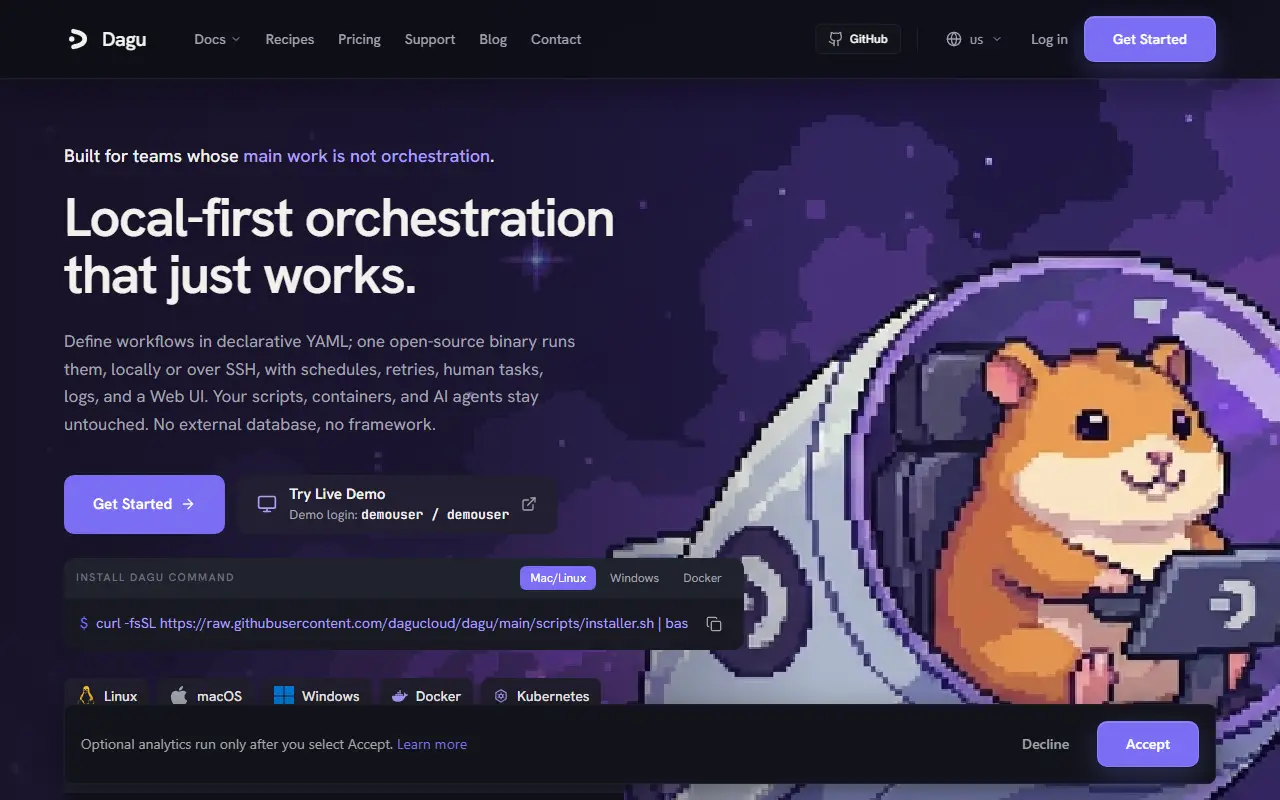
Dagu is a local-first workflow orchestrator for operations teams and internal automation. It is distributed as one executable that includes a web interface, requires neither a separate database nor a message queue, and works on Linux, macOS and Windows. It is aimed at teams whose main work is not orchestration, who just need dependable scheduling for existing scripts.
Workflows are directed acyclic graphs written in declarative YAML, keeping workflow definitions separate from business logic. Steps can invoke shell commands, containers, Kubernetes Jobs or commands on remote hosts over SSH, and Dagu Actions add further step types. It adds scheduling, retries, human approval tasks and run history, turning ad hoc scripts and runbooks into production workflows. Topics also mention MCP, AI agents and durable execution.
Dagu is written in Go and licensed under GPL-3.0. The project positions it as an alternative to Airflow, cron and job schedulers for people who want something lighter. A live demo, documentation, CLI and API references are available, and it can run on modest hardware.
Key features
- Single binary with built-in web UI
- Declarative YAML workflow definitions
- Shell, Docker, Kubernetes and SSH steps
- Scheduling, retries and run history
- Human approval tasks
- No external database required
Good fit for
- Replacing cron jobs with visible workflows
- Lightweight alternative to Airflow
- Operational runbook automation
Dagu: questions and answers
- What is Dagu used for?
- Dagu is a self-hostable workflow engine that runs YAML-defined DAGs of scripts, containers and SSH commands, shipped as one executable with a web UI. It is a good fit for replacing cron jobs with visible workflows and operational runbook automation.
- Is Dagu open source?
- Yes. Dagu is open source under the GPL-3.0 licence. Its source code is on GitHub at dagucloud/dagu and is written mainly in Go.
- Is Dagu free?
- Yes. Dagu is open source, so the software itself is free to use. Paid plans are also available, starting at $50 per month.
- Can I self-host Dagu?
- Yes. Dagu can be self-hosted on your own server or infrastructure.
- What is Dagu an alternative to?
- Dagu is an open-source alternative to AWS Step Functions and Google Cloud Workflows. Other open-source alternatives to AWS Step Functions include Temporal, Conductor OSS and Inngest.
- Is Dagu actively maintained?
- Yes. The most recent commit to Dagu was on 12 November 2026, and the latest release is v2.26.0, published on 7 November 2026. The project has 4.6k stars on GitHub, with 256 added in the last 30 days.
Open-source alternatives to Dagu
See all
Temporal
Workflow Automation
Temporal service
MITvs AWS Step Functions★ 24k
Conductor OSS
Workflow Automation
Conductor is an event driven agentic workflow engine providing durable and highly resilien
Apache-2.0vs AWS Step Functions★ 32k
Inngest
Workflow Automation
The leading workflow orchestration platform. Run stateful step functions and AI workflows
OSSvs AWS Step Functions★ 6k
Kestra
Data Pipelines & ETL
Event Driven Orchestration & Scheduling Platform for Mission Critical Applications
Apache-2.0vs AWS Step Functions★ 30k
Argo Workflows
CI/CD & DevOps
Workflow Engine for Kubernetes
Apache-2.0vs AWS Step Functions★ 17k
n8n
Workflow Automation
n8n is a workflow automation platform that uniquely combines AI capabilities with business
OSSvs Zapier★ 210k
SaaS alternatives to Dagu
See all
AWS Step Functions
Workflow Automation
Serverless workflow orchestration service for coordinating AWS services
SaaS
Google Cloud Workflows
Workflow Automation
Serverless service for orchestrating Google Cloud services and HTTP APIs in workflows
SaaS
Amazon EventBridge
Workflow Automation
Serverless event bus for routing events between AWS services, SaaS apps and custom applications
SaaS
Azure Logic Apps
Workflow Automation
Azure service for building workflows that connect cloud and on-premises systems
SaaSActRun AI
Workflow Automation
AI agent that turns plain-English requests into tasks across email, Slack, Stripe, files and browser
SaaS
Albato
Workflow Automation
No-code automation platform connecting business apps with prebuilt integrations
SaaS