7,363 open-source and SaaS tools, with GitHub stats refreshed every day.

5 alternatives ranked by real activity

Open-source Google Cloud Workflows alternatives

A curated, ranked list of the 5 best open-source alternatives to Google Cloud Workflows.

The best open-source alternative to Google Cloud Workflows is Conductor OSS. If that doesn't suit you, other good options are Kestra, Temporal, Inngest and Dagu.

Google Cloud Workflows alternatives are mainly workflow automation tools, but some are also data pipeline & ETL tools. 5 of them shipped code in the last 30 days, 5 can be self-hosted, and 3 use a permissive licence.

Last updated October 3, 2026 · ranked by GitHub stars, growth and recent commits

Conductor OSS

Conductor is an open-source durable execution engine for microservice workflows and AI agents, originally built at Netflix.

GitHub stars
32k
Last commit
today
Latest release
v3.32.5
Licence
Apache-2.0
Self-hosted
Yes
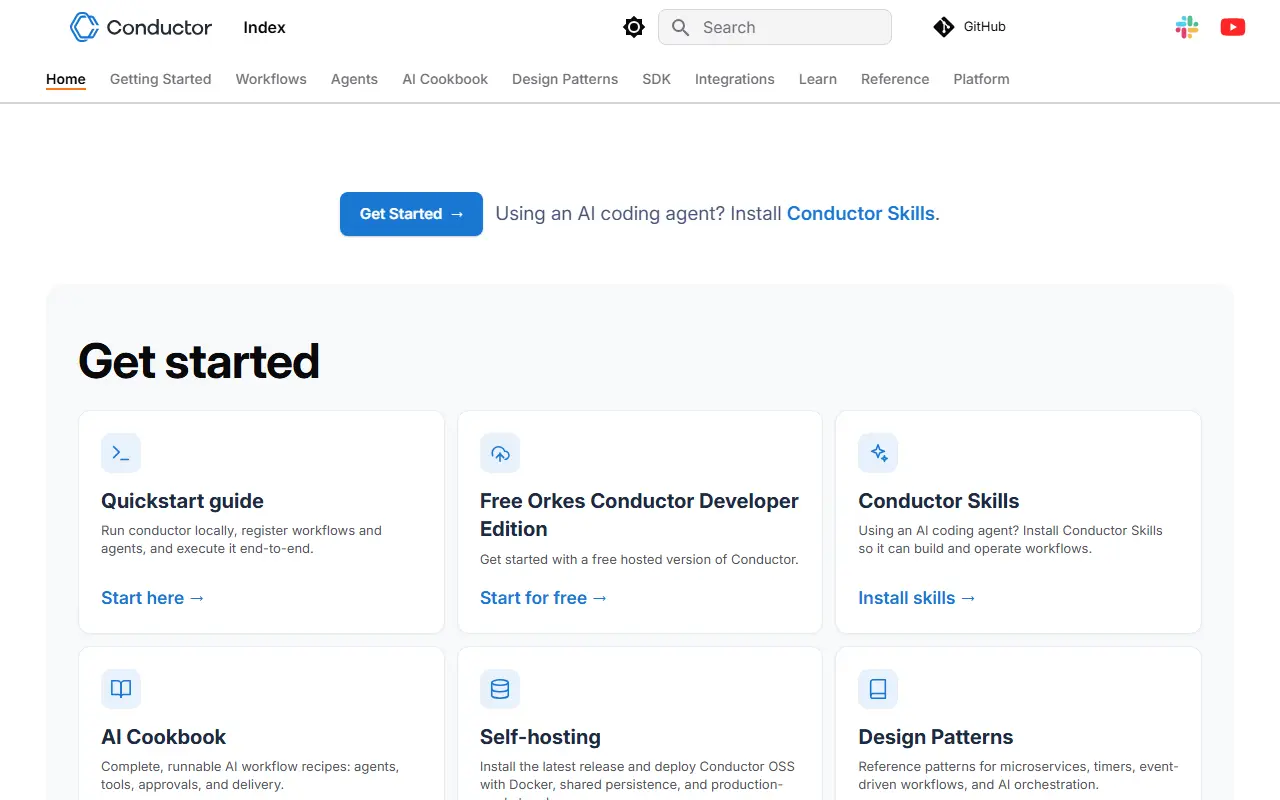
docs.conductor-oss.orgConductor OSS homepage screenshot

Conductor is an event-driven workflow engine that makes microservice and AI agent execution durable. It treats choices made at runtime, including loops, branches, parallel fan-out, tool calls, approval steps, retries and cancellation, as durable, inspectable executions. The project began at Netflix and is now maintained by Orkes and the community. It is written in Java with a JavaScript UI and released under the Apache-2.0 license.

Every step is persisted, so a workflow can continue after a crash, a restart or a network outage, and retries and timeouts are configurable. Orchestration is kept as a versioned graph while workers and built-in tasks perform the business logic. For AI use, it provides native LLM tasks, MCP tool calling, human approval steps and vector workflows for retrieval-augmented generation. A quickstart needs Node.js and Java 21 or later, serves a UI on port 8080, and a Docker image is also available.

Key features

  • Durable execution with persisted workflow steps
  • Versioned, inspectable orchestration graphs
  • Configurable retries and timeouts
  • Native LLM tasks and MCP tool calling
  • Human approval steps in workflows
  • Built-in web UI and Docker image

Pricing: Free and open source under the Apache-2.0 license.

Read more about Conductor OSSWebsite GitHub

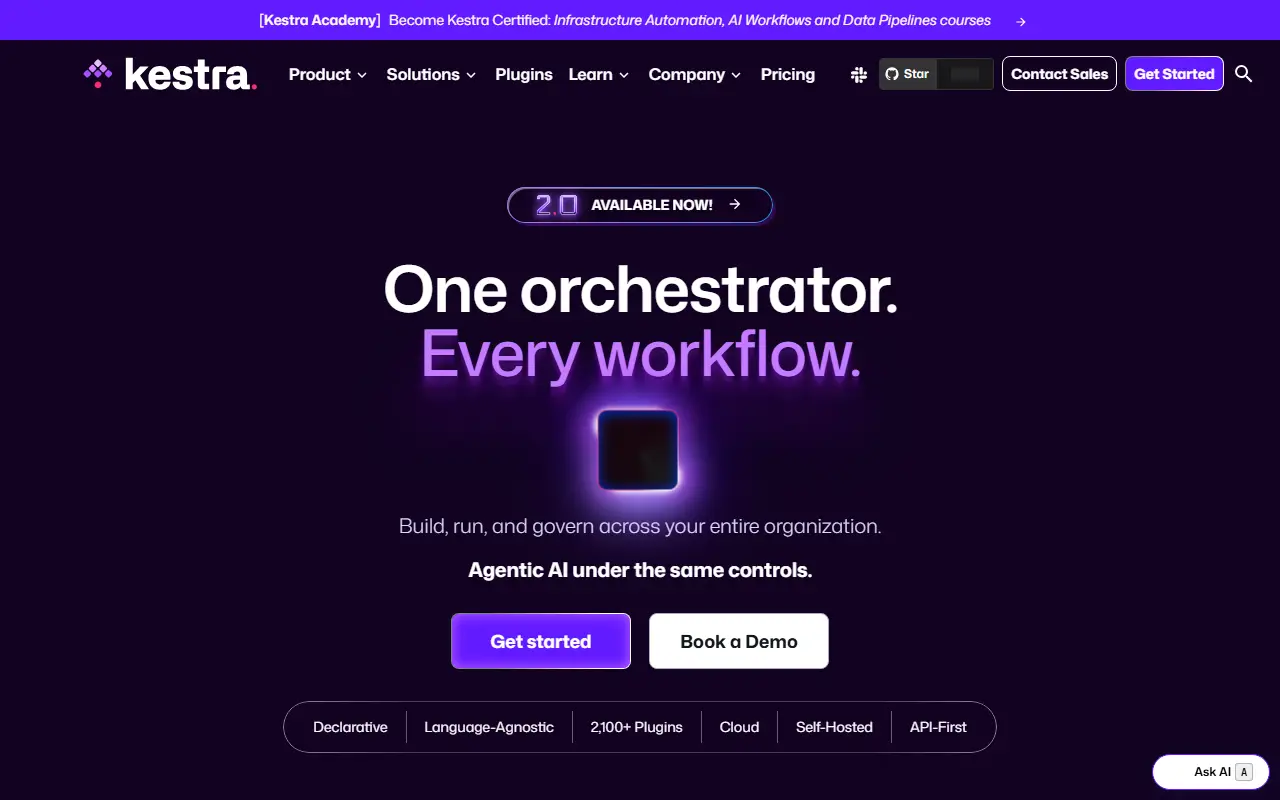
Kestra

An open-source, event-driven orchestration and scheduling platform where data, AI and infrastructure workflows are defined declaratively in YAML and managed from a UI.

GitHub stars
29k
Last commit
today
Latest release
v2.0.4
Licence
Apache-2.0
Self-hosted
Yes
go.kestra.ioKestra homepage screenshot

Kestra is an orchestration platform, open source, for data pipelines, AI workflows and infrastructure automation. It brings scheduled and event-triggered automation together under one declarative interface that does not depend on a programming language, applying infrastructure-as-code practices to pipelines so that reliable workflows can be defined in a few lines of YAML.

Workflows can be built in the UI, written by a built-in AI Copilot, or generated from coding agents such as Claude Code and Cursor using agent skills, and everything can be kept as code with Git integration even when it was authored visually. A large plugin ecosystem connects it to external systems, and key concepts cover tasks, triggers and flows. The project is written in Java, with topics covering orchestration, high availability, pipeline-as-code and DevOps, and the 2.0 release adds new capabilities.

Kestra is Apache-2.0 licensed and can be self-hosted, with a quick start that gets a first workflow running in minutes. It targets data engineers, platform teams and automation developers who want an alternative to schedulers such as Airflow with a more declarative style.

Key features

  • Declarative YAML workflow definitions
  • Scheduled and event-driven triggers
  • Visual editor and AI Copilot
  • Git version control integration
  • Large plugin ecosystem
  • Agent skills for coding agents

Pricing: Free and open source under the Apache-2.0 license.
Read more about KestraWebsite GitHub

Temporal

Temporal is a durable execution platform whose server runs application workflows resiliently, retrying failed operations automatically.

GitHub stars
23k
Last commit
today
Latest release
v1.32.0
Licence
MIT
Self-hosted
Yes
Hosted version
Available
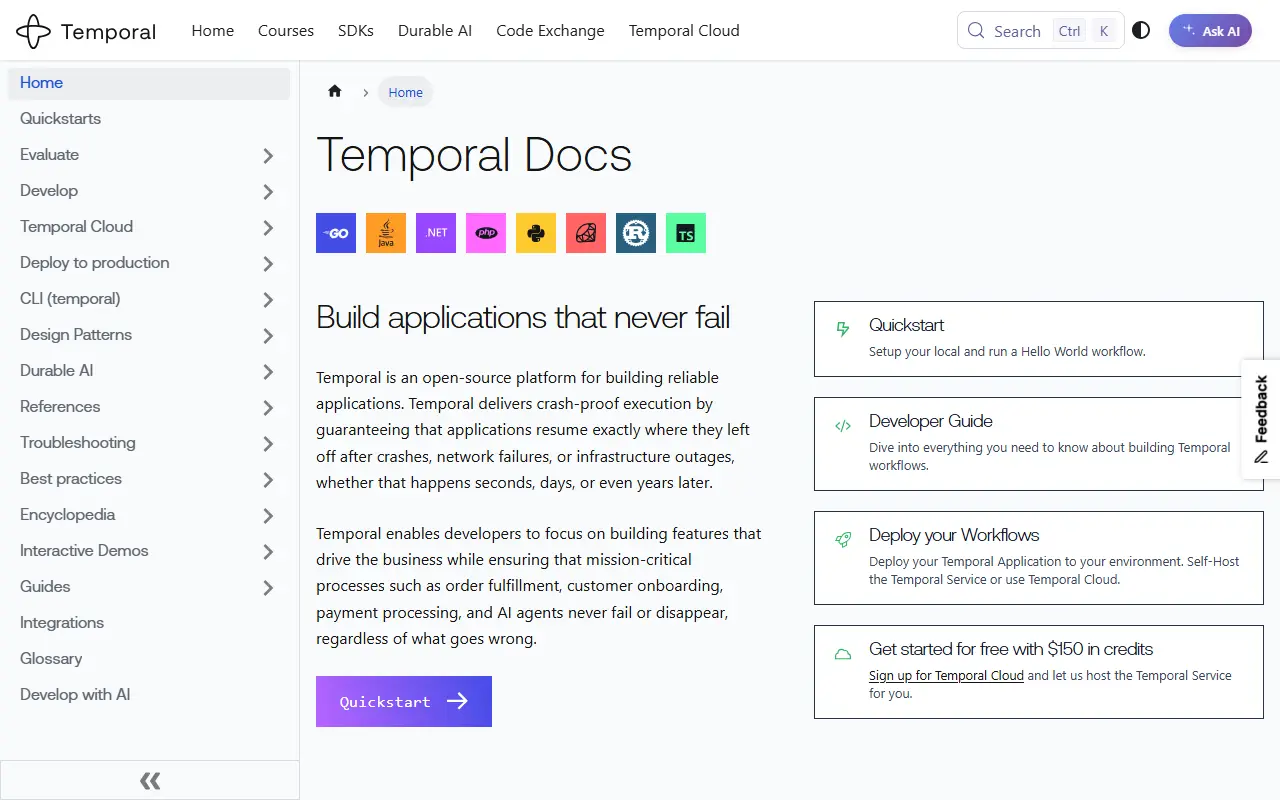
docs.temporal.ioTemporal homepage screenshot

Temporal is a durable execution platform that helps developers create scalable applications while keeping both productivity and reliability. The Temporal server runs units of application logic called Workflows, handling intermittent failures and retrying failed operations automatically. It started as a fork of Uber's Cadence and is developed by Temporal Technologies, a company founded by Cadence's creators. The server is written in Go and released under the MIT license.

This repository contains the source of the server only. To implement Workflows, Activities and Workers you use one of the supported language SDKs. The getting started guide shows how to download and run a pre-built image with its dependencies locally, try samples written for Go or Java, interact with the server through the Temporal CLI, and watch workflows in the Web UI at port 8233. Repository topics cover workflow engines, distributed cron, microservice orchestration and durable execution.

Key features

  • Durable execution of long-running workflows
  • Automatic retries for failed operations
  • SDKs for writing Workflows and Activities
  • Temporal CLI for interacting with the server
  • Web UI for viewing running workflows
  • Distributed cron-style scheduling

Pricing: Server is free and open source under the MIT license; a managed cloud service is also offered by Temporal Technologies.

Read more about TemporalWebsite GitHub

Inngest

Inngest is a workflow orchestration platform for durable step functions and AI workflows, runnable on its cloud platform or a self-hosted server.

GitHub stars
5.9k
Last commit
today
Latest release
v1.45.1
Self-hosted
Yes
Hosted version
Available
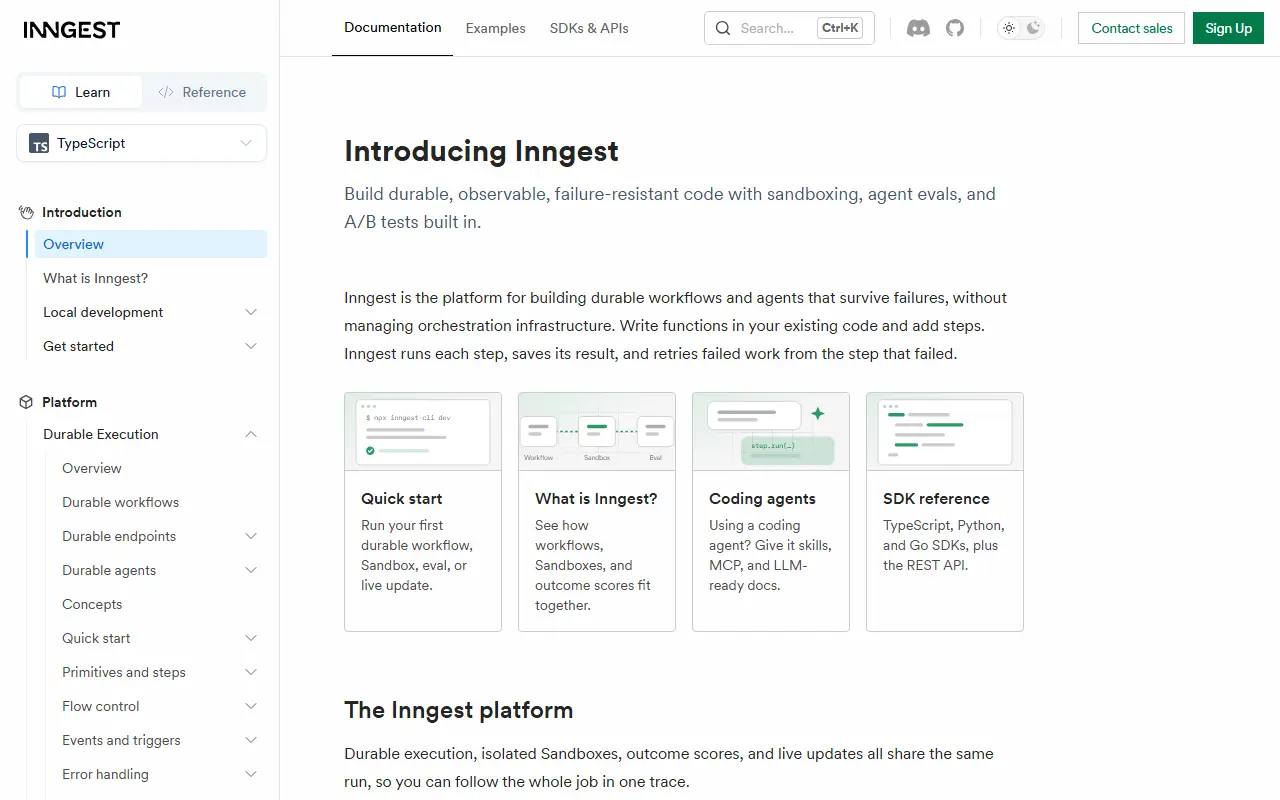
inngest.comInngest homepage screenshot

Inngest is a workflow orchestration platform built around durable functions. These functions replace separate queues, state management and scheduling so developers can write reliable step functions and background jobs without managing the underlying infrastructure.

An Inngest function has three parts. Triggers are events, cron schedules or webhook events, flow control configures how runs are queued and executed through concurrency, throttling, debouncing, rate limiting and prioritization, and steps are the building blocks that can retry on error and run for months. You write functions with a language SDK, test them with the Inngest Dev Server, deploy them to your own infrastructure and sync them with the Inngest Platform or a self-hosted server, which then calls them securely over HTTPS when events arrive.

Inngest is written in Go. Its quick starts cover Next.js, Node.js and Python, and the documentation includes project architecture and self-hosting guides. The repository lists its licence as other, so check the terms before running it yourself.

Key features

  • Durable step functions with automatic retries
  • Event, cron and webhook triggers
  • Concurrency, throttling and rate limiting controls
  • Local Dev Server with dashboard
  • SDKs for several languages
  • Cloud platform or self-hosted server
Read more about InngestWebsite GitHub

Dagu

Dagu is a self-hostable workflow engine that runs YAML-defined DAGs of scripts, containers and SSH commands, shipped as one executable with a web UI.

GitHub stars
4.2k
Last commit
today
Latest release
v2.18.1
Licence
GPL-3.0
Self-hosted
Yes
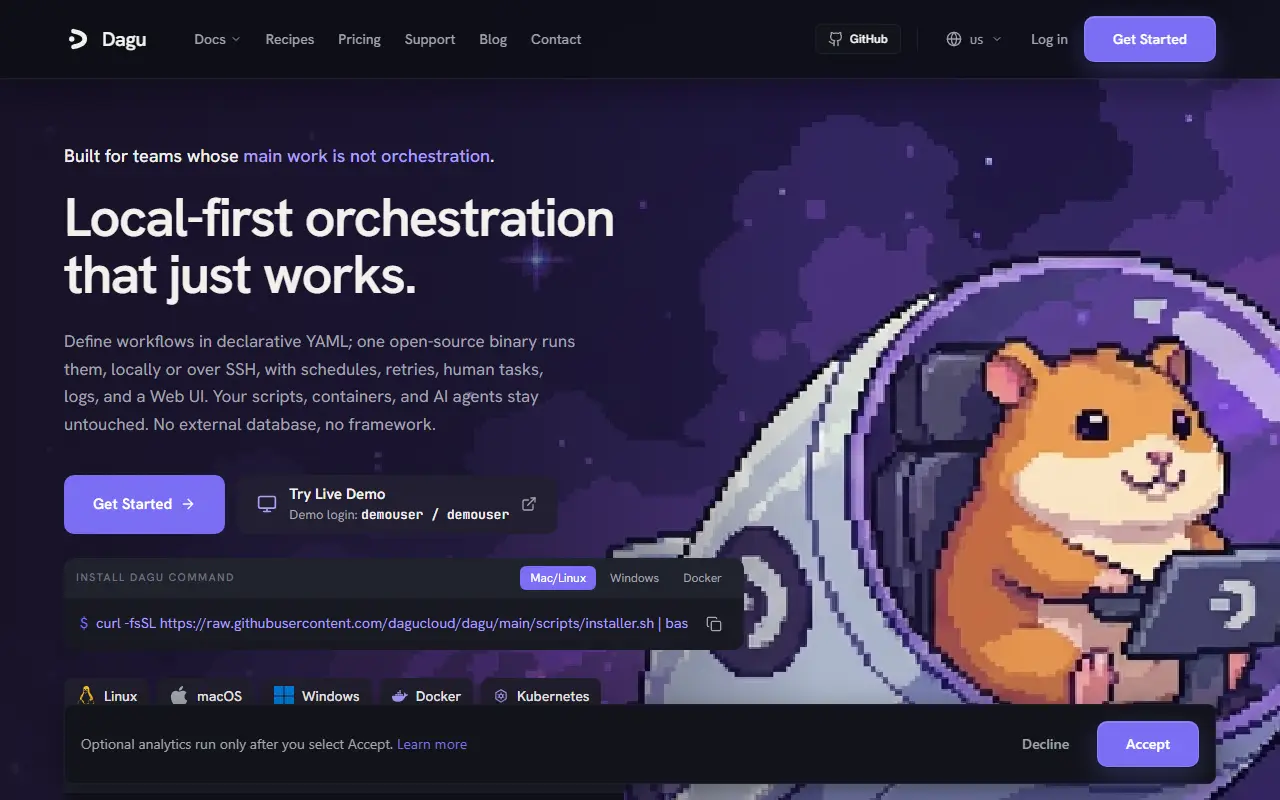
dagu.shDagu homepage screenshot

Dagu is a local-first workflow orchestrator for operations teams and internal automation. It is distributed as one executable that includes a web interface, requires neither a separate database nor a message queue, and works on Linux, macOS and Windows. It is aimed at teams whose main work is not orchestration, who just need dependable scheduling for existing scripts.

Workflows are directed acyclic graphs written in declarative YAML, keeping workflow definitions separate from business logic. Steps can invoke shell commands, containers, Kubernetes Jobs or commands on remote hosts over SSH, and Dagu Actions add further step types. It adds scheduling, retries, human approval tasks and run history, turning ad hoc scripts and runbooks into production workflows. Topics also mention MCP, AI agents and durable execution.

Dagu is written in Go and licensed under GPL-3.0. The project positions it as an alternative to Airflow, cron and job schedulers for people who want something lighter. A live demo, documentation, CLI and API references are available, and it can run on modest hardware.

Key features

  • Single binary with built-in web UI
  • Declarative YAML workflow definitions
  • Shell, Docker, Kubernetes and SSH steps
  • Scheduling, retries and run history
  • Human approval tasks
  • No external database required

Pricing: The Community edition is free and self-hosted. Team costs $50 per month for 3 server licenses and Pro $150 per month for 15; Enterprise is custom. A 14-day license trial is available.

Read more about DaguWebsite GitHub

Google Cloud Workflows alternatives: questions

What is the best open-source alternative to Google Cloud Workflows?
Conductor OSS is the top-ranked open-source alternative to Google Cloud Workflows on Enlisted: Conductor is an open-source durable execution engine for microservice workflows and AI agents, originally built at Netflix. Other strong options are Kestra, Temporal, Inngest and Dagu.
Are these Google Cloud Workflows alternatives free?
All 5 are open source, so the code is free to use under its licence, and all of them can be self-hosted on your own server or computer. 2 also offer a paid or managed cloud version if you'd rather not host it yourself.
How is this list of Google Cloud Workflows alternatives ranked?
By a score built from GitHub stars, star growth over the last 30 days and how recently the code changed. 5 of these projects shipped code in the last 30 days. Data is refreshed daily, and nobody can pay to move up.

People also look for alternatives to…

View all