
About Cuber
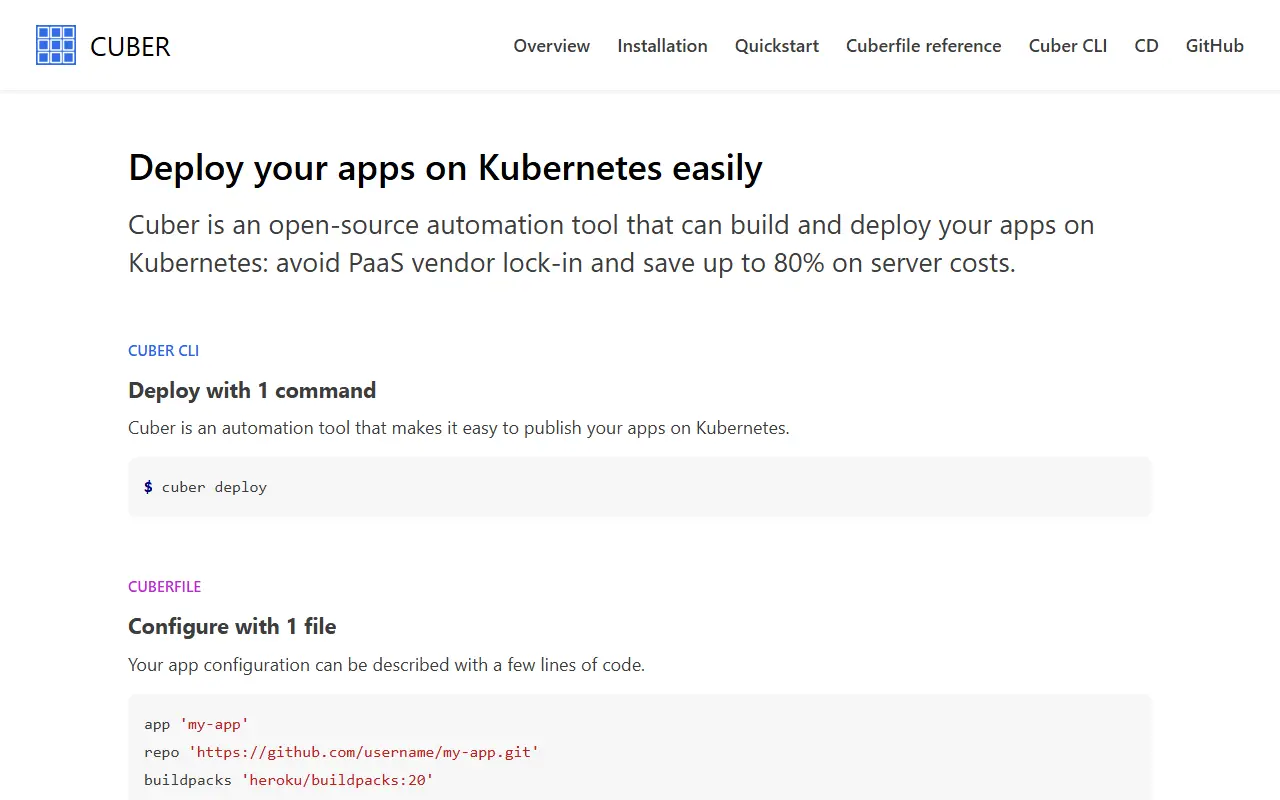
Cuber is an automation tool, written in Ruby, that builds and deploys applications written in any language or framework onto Kubernetes. It targets teams that want the cost control and cloud choice of running on bare Kubernetes but would rather not manage the many manifests and configuration steps involved, offering a workflow closer to a PaaS.
Deployment is driven by a short configuration file called a Cuberfile and a single cuber deploy command that packages the app and rolls it out to a cluster. A CLI also lets you monitor application status. The README positions Kubernetes as a cheaper, lock-in-free option compared with a managed PaaS such as Heroku, and says the tool grew out of several years of production use at Pushpad.
Cuber is released under Apache-2.0 and runs from your own machine or CI, requiring Ruby, git, Docker, the pack buildpack CLI and kubectl. It is a self-managed tool rather than a hosted service: you bring your own Kubernetes cluster from whichever cloud provider you choose.
Key features
- Single Cuberfile configuration for each app
- One-command deploy to any Kubernetes cluster
- Buildpack-based packaging for any language
- Status monitoring through CLI commands
- Works across different cloud providers
Good fit for
- →Teams leaving Heroku for cheaper infrastructure
- →Deploying apps to a self-managed Kubernetes cluster
- Tags
- kubernetes
- deployment
- paas
- devops
- buildpacks
- ruby
- docker
- continuous-delivery
Cuber: questions and answers
- What is Cuber used for?
- Cuber is an Apache-licensed Ruby CLI that packages apps with buildpacks and deploys them to any Kubernetes cluster from a short Cuberfile. It is a good fit for teams leaving Heroku for cheaper infrastructure and deploying apps to a self-managed Kubernetes cluster.
- Is Cuber open source?
- Yes. Cuber is open source under the Apache-2.0 licence. Its source code is on GitHub at cuber-cloud/cuber-gem and is written mainly in Ruby.
- Is Cuber free?
- Yes. Cuber is open source, so the software itself is free to use.
- What is Cuber an alternative to?
- Cuber is an open-source alternative to Heroku and Scalingo. Other open-source alternatives to Heroku include Kubero, Dokku and Tsuru.
- Is Cuber actively maintained?
- The most recent commit to Cuber was on 12 April 2026, and the latest release is v1.14.0, published on 12 April 2026. The project has 712 stars on GitHub.
Open-source alternatives to Cuber
See all
Kubero
Hosting & PaaS
A free and self-hosted PaaS alternative to Heroku / Netlify / Coolify / Vercel / Dokku / P
GPL-3.0vs Heroku★ 4.4k
Dokku
Hosting & PaaS
A docker-powered PaaS that helps you build and manage the lifecycle of applications
MITvs Heroku★ 32k
Tsuru
Hosting & PaaS
Open source and extensible Platform as a Service (PaaS).
BSD-3-Clausevs Heroku★ 5.3k
Convox
Hosting & PaaS
Private PaaS built on native AWS services for maximum privacy and minimum upkeep
OSSvs Heroku★ 1.9k
Coolify
Hosting & PaaS
Self-hosting platform with superpowers. Deploy apps, databases & 280+ services to your
Apache-2.0vs Heroku★ 62k
Dokploy
Hosting & PaaS
Open-source self-hostable Platform as a Service (PaaS) that simplifies the deployment and
OSSvs Heroku★ 38k
SaaS alternatives to Cuber
See all
Heroku
Hosting & PaaS
Heroku is a cloud platform as a service where developers deploy, run and scale applications on managed containers, with managed data services and AI add-ons.
SaaS
Scalingo
Hosting & PaaS
French PaaS with Heroku-style git deploys on European infrastructure
SaaS
Qovery
Hosting & PaaS
Platform that deploys and manages applications on a team's own cloud accounts
SaaS
Octopus Deploy
CI/CD & DevOps
Release management and deployment automation across many environments
SaaS
AWS CodePipeline
CI/CD & DevOps
Managed AWS service that automates build, test and deploy release pipelines
SaaS
Blacksmith
CI/CD & DevOps
Faster GitHub Actions runners billed per minute, with build caching
SaaS