 TrackMedia
 TrackRev

About Cerebrium
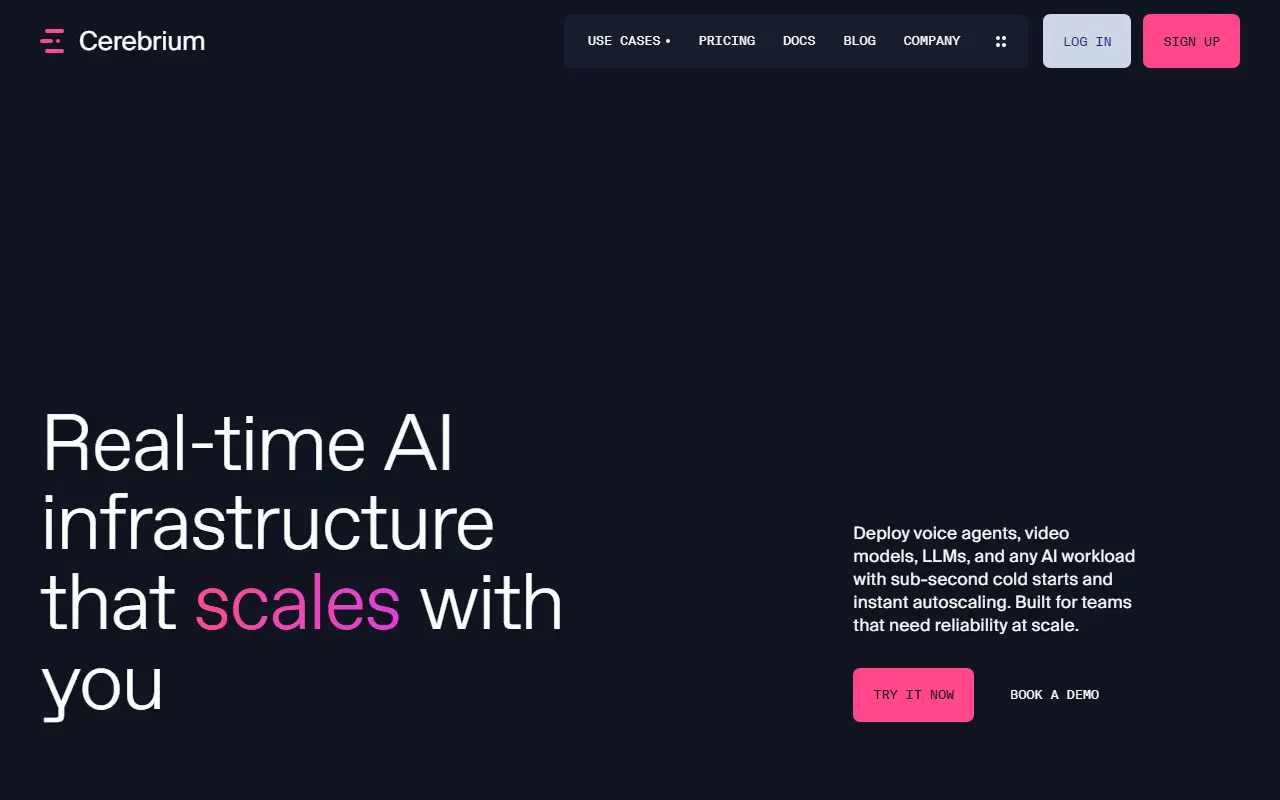
Cerebrium runs a team's AI code on GPUs it manages, so there is no capacity planning or reservation to handle. The vendor describes it as infrastructure for real-time AI such as voice agents, video models and large language models, and says containers start in seconds, helped by memory and GPU snapshotting.
Users do not need to rewrite their application: the site says to point it at an entry point or a Dockerfile and it runs the app as it is, versioned and reproducible. Each request is visible through logs, metrics, scaling events and system performance. The listed regions are us-east-1, eu-west-2, eu-north-1 and ap-south-1.
Billing is per second of compute. Prices are listed per GPU type, from the T4 up to the B200, with CPU, memory and storage priced separately. The Hobby plan is free plus compute, and the Standard plan costs $100 per month plus compute, with unlimited seats and apps. It is a hosted proprietary service with a free tier to start.
Key features
- Fast container starts using memory and GPU snapshots
- Runs existing code or a Dockerfile unchanged
- Per-request logs, metrics and scaling events
- Billing measured in seconds of compute time
- GPUs across several clouds and regions
- Command-line runs on chosen hardware
Good fit for
- Hosting LLM inference
- Voice agents
- Image and video models
- Running training scripts on GPUs
Cerebrium: questions and answers
- What is Cerebrium used for?
- Cerebrium is a serverless GPU platform for running AI workloads such as LLMs, voice agents and video models, with per-second billing and autoscaling. It is a good fit for hosting LLM inference, voice agents, and image and video models.
- Is Cerebrium open source?
- No. Cerebrium is proprietary (closed-source) software. In the AI Infrastructure category, open-source options include beta9, BentoML and llama.cpp.
- What are some alternatives to Cerebrium?
- Cerebrium competes with Baseten.
Open-source alternatives to Cerebrium
See all
beta9
AI Infrastructure
Ultrafast serverless GPU inference, sandboxes, and background jobs
AGPL-3.0vs Modal★ 1.9k
BentoML
AI Infrastructure
The easiest way to serve AI apps and models - Build Model Inference APIs, Job queues, LLM
Apache-2.0vs Amazon SageMaker★ 8.9k
llama.cpp
AI Infrastructure
LLM inference in C/C++
MITvs OpenAI API Platform★ 134k
SGLang
AI Infrastructure
SGLang is a high-performance serving framework for large language models and multimodal mo
Apache-2.0vs Amazon Bedrock★ 39k
MLC LLM
AI Infrastructure
Universal LLM Deployment Engine with ML Compilation
Apache-2.0★ 23k
Instill Core
AI Infrastructure
🔮 Instill Core is a full-stack AI infrastructure tool for data, model and pipeline orches
OSSvs Unstructured★ 2.3k
SaaS alternatives to Cerebrium
See all
Baseten
AI Infrastructure
Inference platform for deploying and scaling AI models in production
SaaS
Cloudflare Workers AI
AI Infrastructure
Serverless inference service for running AI models on Cloudflare's network
SaaS
Anyscale
AI Infrastructure
Managed platform for running Ray workloads for AI training and serving
SaaS
Together AI
AI Infrastructure
Cloud platform for running, fine-tuning and training open and custom AI models
SaaS
Amazon Bedrock
AI Infrastructure
Managed AWS service for building generative AI apps with models from several providers
SaaS
Fireworks AI
AI Infrastructure
Inference platform for running and fine-tuning generative AI models at low latency
SaaS