
About Bencher
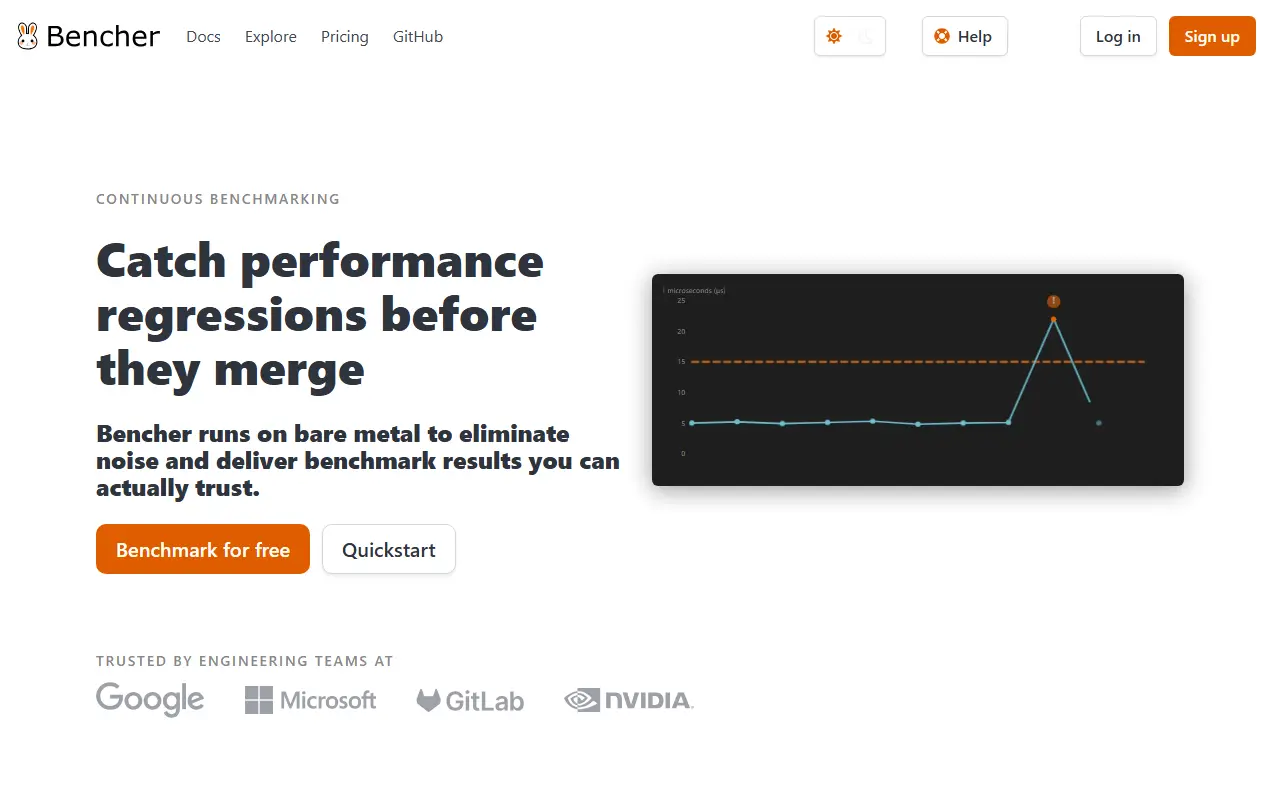
Bencher is a continuous benchmarking platform for teams where performance matters, such as database, compiler, browser, runtime, networking and cryptography projects. It runs your existing benchmarks on the same bare-metal hardware both locally and in CI, tracks results over time and can fail a pull request when it detects a performance regression.
The README argues that shared CI runners are noisy and local benchmark runs are hard to reproduce, so real regressions get lost or alerts get ignored. Bencher addresses this with dedicated bare-metal runners, a GitHub Action for integration, and a workflow of running benchmarks and tracking the results over time.
It works with the benchmark harness you already use rather than requiring a new one. The code is written in Rust and is public on GitHub with a license listed as Other, and a hosted service is available at bencher.dev.
Key features
- Benchmarking on dedicated bare-metal runners
- Same environment locally and in CI
- Tracks results over time
- Fails pull requests on regressions
- GitHub Action integration
- Works with existing benchmark harnesses
Good fit for
- →Catching performance regressions in pull requests
- →Performance-critical libraries and runtimes
- Built with
- Rust
- Tags
- benchmarking
- performance
- ci-cd
- rust
- regression-testing
- devops
- github-actions
Bencher: questions and answers
- What is Bencher used for?
- Bencher is a continuous benchmarking platform that runs benchmarks on dedicated bare metal and tracks results to catch performance regressions in pull requests. It is a good fit for catching performance regressions in pull requests, and performance-critical libraries and runtimes.
- Is Bencher open source?
- Yes. Bencher is open source under a custom licence. Its source code is on GitHub at bencherdev/bencher and is written mainly in Rust.
- Is Bencher free?
- Yes. Bencher is open source, so the software itself is free to use under the terms of its own licence. A managed cloud version is also available, with paid plans from $100 per month.
- Can I self-host Bencher?
- Yes. Bencher can be self-hosted on your own server or infrastructure.
- What are some alternatives to Bencher?
- Similar open-source tools in the Testing & QA category include github-action-benchmark, k6 and Locust. SaaS products in the same category include AlwaysQA, Chromatic and Codecov.
- Is Bencher actively maintained?
- Yes. The most recent commit to Bencher was on 2 October 2026, and the latest release is v0.6.13, published on 28 September 2026. The project has 909 stars on GitHub.
Open-source alternatives to Bencher
See all
github-action-benchmark
Testing & QA
GitHub Action for continuous benchmarking to keep performance
MIT★ 1.3k
k6
Testing & QA
A modern load testing tool, using Go and JavaScript
AGPL-3.0vs OpenText LoadRunner★ 32k
Locust
Testing & QA
Write scalable load tests in plain Python 🚗💨
MITvs OpenText LoadRunner★ 28k
ClusterFuzzLite
Testing & QA
ClusterFuzzLite - Simple continuous fuzzing that runs in CI.
Apache-2.0★ 537
Apache JMeter
Testing & QA
Apache JMeter open-source load testing tool for analyzing and measuring the performance of
Apache-2.0vs OpenText LoadRunner★ 9.6k
Gatling
Testing & QA
Modern Load Testing as Code
Apache-2.0vs OpenText LoadRunner★ 7k
SaaS alternatives to Bencher
See all
AlwaysQA
Testing & QA
AI QA agent that tests signup, login, checkout and other user flows in a real browser
SaaS
Chromatic
Testing & QA
Visual testing and review service for Storybook components
SaaS
Codecov
Testing & QA
Code coverage reporting and test analytics that comments on pull requests
SaaS
Coveralls
Testing & QA
Hosted code coverage tracking that reports on commits and pull requests
SaaS
loader.io
Testing & QA
Cloud load testing service for web apps and APIs from SendGrid
SaaS
Qase
Testing & QA
Test management system for manual and automated testing
SaaS