
 Google Cloud Identity Platform
 Kinde
Kinde LoginRadius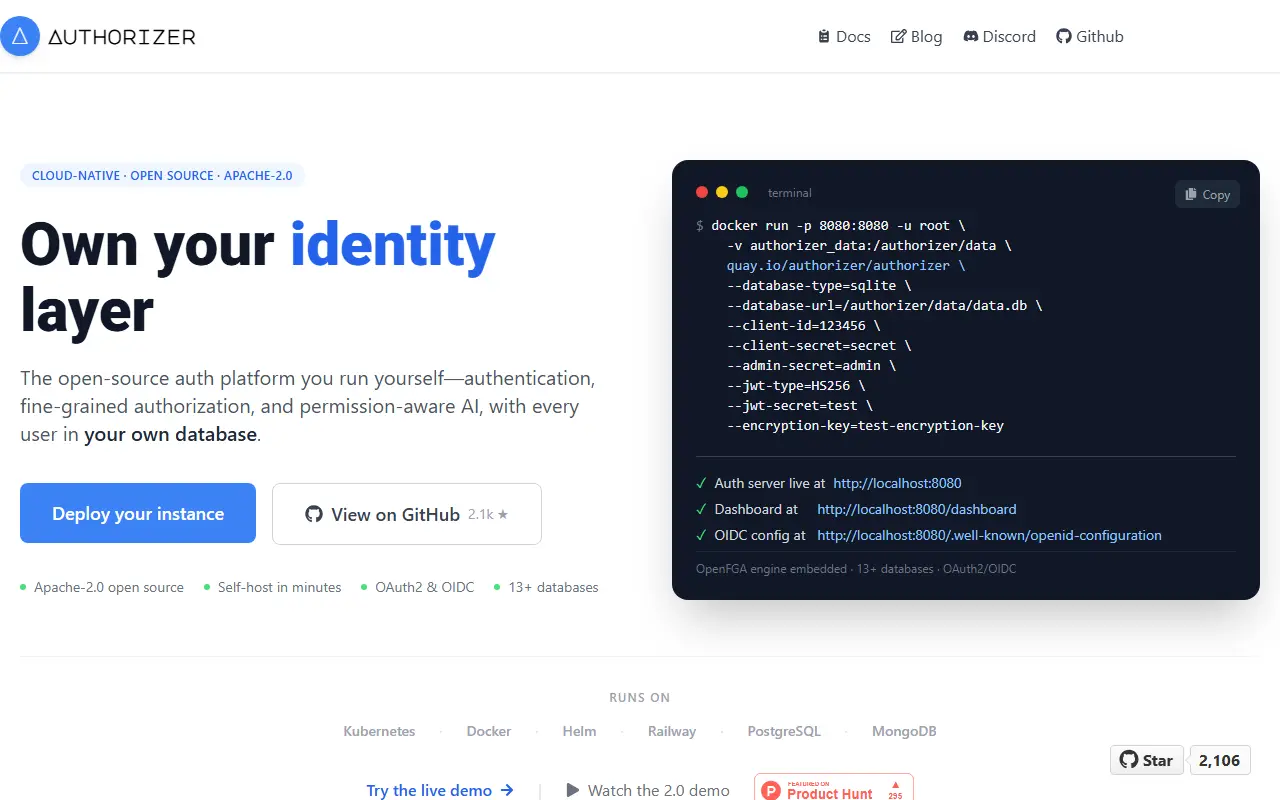
About Authorizer
Authorizer is an open-source authentication and authorization server written in Go that you can host yourself. Its pitch is that you bring your own database and stay in control of user data. It supports more than 13 backends, including Postgres, MySQL, SQLite, SQL Server, MariaDB, Cassandra, ScyllaDB, MongoDB, ArangoDB, DynamoDB, and Couchbase. It is released under the Apache-2.0 license.
From one place it offers OAuth 2.0 and OpenID Connect, social login, multi-factor authentication, magic links, role-based access control, webhooks, and email templates, and it ships with a built-in login page and an admin panel. Version 2 is configured entirely through command-line arguments and does not read .env files or operating system environment variables.
You can run it as a Docker image or micro-service in your own infrastructure, or deploy it quickly on Railway. It suits developers who want a hosted-auth style experience without lock-in and with a choice of database.
Key features
- OAuth 2.0 and OpenID Connect provider
- Social login and magic links
- Multi-factor authentication
- Role-based access control
- Built-in login page and admin panel
- 13+ database backends
- Webhooks and email templates
Good fit for
- →Adding auth to an app without vendor lock-in
- →Centralized login for several services
- Tags
- authentication
- authorization
- oauth2
- oidc
- mfa
- rbac
- self-hosted
- go
Authorizer: questions and answers
- What is Authorizer used for?
- Authorizer is a self-hosted authentication and authorization server with OAuth2/OIDC, social login, MFA, magic links, and RBAC that works with more than a dozen database backends. It is a good fit for adding auth to an app without vendor lock-in and centralized login for several services.
- Is Authorizer open source?
- Yes. Authorizer is open source under the Apache-2.0 licence. Its source code is on GitHub at authorizerdev/authorizer and is written mainly in Go.
- Is Authorizer free?
- Yes. Authorizer is open source, so the software itself is free to use.
- Can I self-host Authorizer?
- Yes. Authorizer can be self-hosted on your own server or infrastructure.
- What is Authorizer an alternative to?
- Authorizer is an open-source alternative to Auth0, Amazon Cognito, Stytch and Clerk. Other open-source alternatives to Auth0 include SuperTokens, Logto and ZITADEL.
- Is Authorizer actively maintained?
- Yes. The most recent commit to Authorizer was on 29 September 2026, and the latest release is 2.4.1, published on 3 September 2026. The project has 2.1k stars on GitHub.
Open-source alternatives to Authorizer
See all
SuperTokens
Auth & Identity
Open Source User Authentication. Build fast, maintain control, with reasonable pricing.
OSSvs Auth0★ 15k
Logto
Auth & Identity
🧑🚀 Authentication and authorization infrastructure for SaaS and AI apps, built on OIDC
MPL-2.0vs Auth0★ 15k
ZITADEL
Auth & Identity
ZITADEL - Identity infrastructure, simplified for you.
AGPL-3.0vs Auth0★ 15k
Authgear
Auth & Identity
Open source Auth0/Keycloak alternative. Passkeys, SSO, MFA, passwordless, biometric login.
Apache-2.0vs Auth0★ 2.1k
Hanko
Auth & Identity
Open source, privacy-first, and built to scale. Hanko is the fastest way you integrate pas
OSSvs Auth0★ 9k
Hexclave
Auth & Identity
Deploy your frontend, backend, and database together with Hexclave Deploy. Automatic scali
OSSvs Auth0★ 6.9k
SaaS alternatives to Authorizer
See all
Auth0
Auth & Identity
Auth0 is an authentication and authorization platform that lets developers add login, single sign-on and access control to apps with SDKs and quickstarts.
SaaS
Amazon Cognito
Auth & Identity
AWS user pools and identity federation for app sign-up and sign-in
SaaS
Stytch
Auth & Identity
Authentication and authorization APIs for passwordless login, MFA and B2B SSO
SaaS
Clerk
Auth & Identity
Drop-in sign-in, user management and organization components for web apps
SaaS
Descope
Auth & Identity
Drag-and-drop authentication flows with passwordless login and SSO
SaaS
FusionAuth
Auth & Identity
Customer identity platform for login, MFA and SSO, self-hosted or cloud
SaaS