#1
An open-source backend platform offering auth, databases, storage, functions, messaging, realtime and hosting, available as a managed cloud or self-hosted with Docker.
- GitHub stars
- 58k
- Last commit
- today
- Latest release
- 2.7.2
- Licence
- BSD-3-Clause
- Self-hosted
- Yes
- Hosted version
- Available
appwrite.io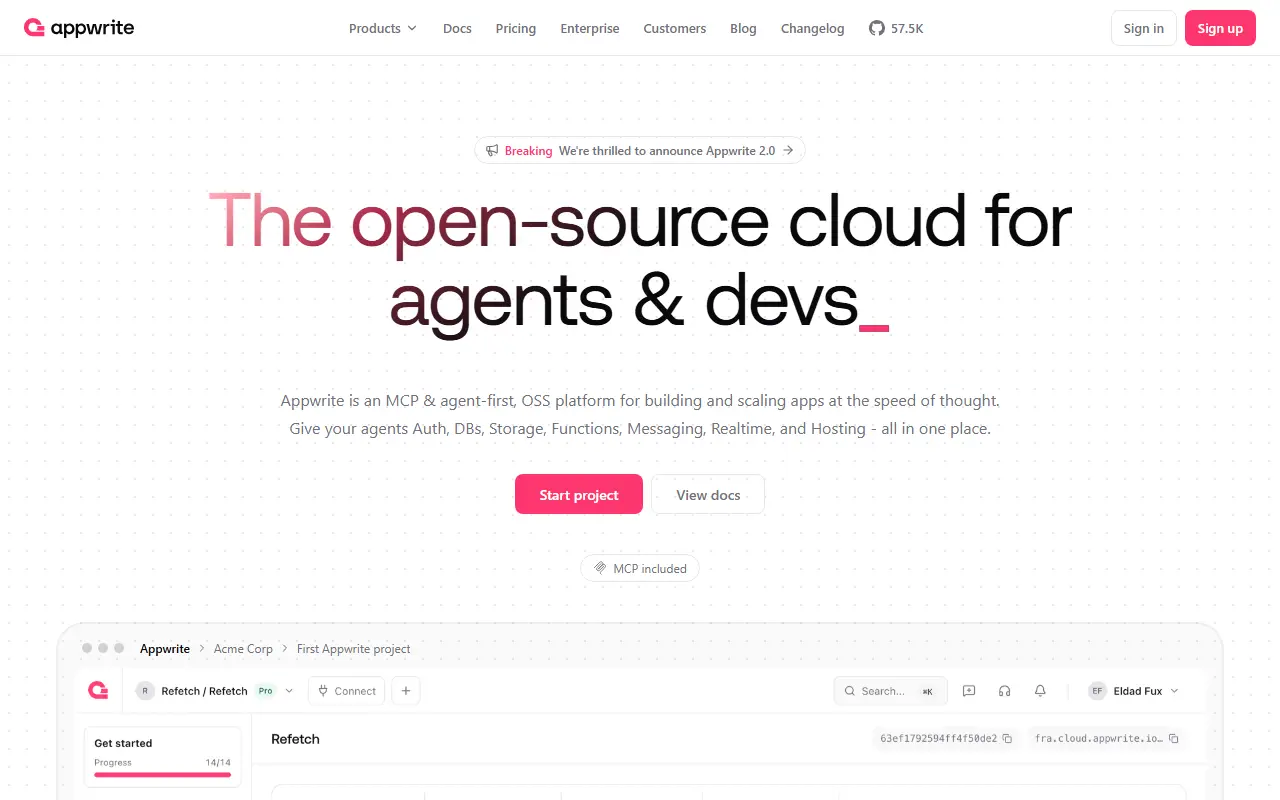
Appwrite is an open-source platform for building and scaling web, mobile and AI apps. It bundles the backend services most apps need, namely auth, databases, storage, functions, messaging, realtime and hosting, and presents them as an agent-friendly cloud with MCP support. It can run as a managed cloud platform or be self-hosted on infrastructure you control.
Auth supports email, SMS, OAuth, anonymous sessions and magic URLs. Databases can be modeled and queried through Appwrite itself or backed by managed PostgreSQL and MySQL. Storage keeps files with compression, encryption, image transformations and permission controls, and Functions run serverless code in isolated runtimes triggered by events. Sites deploys static, SSR and CSR frontends from Git with previews, and Messaging sends email, SMS and push notifications.
Developers integrate through client and server SDKs, including Flutter, Swift, React Native and JavaScript, or let coding agents such as Cursor, Claude Code and Codex operate a live project through a hosted MCP server. Appwrite is BSD-3-Clause licensed and written mainly in PHP, with Docker-based self-hosting for Unix and Windows.
Key features
- Auth with email, SMS, OAuth and magic URLs
- Databases including managed PostgreSQL and MySQL
- File storage with encryption and image transformations
- Serverless functions in isolated runtimes
- Messaging via email, SMS and push
- Realtime updates and static or SSR site hosting
- Hosted MCP server and client and server SDKs
Pricing: A free plan and a Pro plan exist, but the captured page does not show their prices. Dedicated databases start at $10 a month each and go up to $960 a month; serverless databases have no fixed fee.
#2
Keycloak is an open-source identity and access management server that adds single sign-on, user management and authorization to applications.
- GitHub stars
- 38k
- Last commit
- yesterday
- Latest release
- 26.8.2
- Licence
- Apache-2.0
- Self-hosted
- Yes
keycloak.org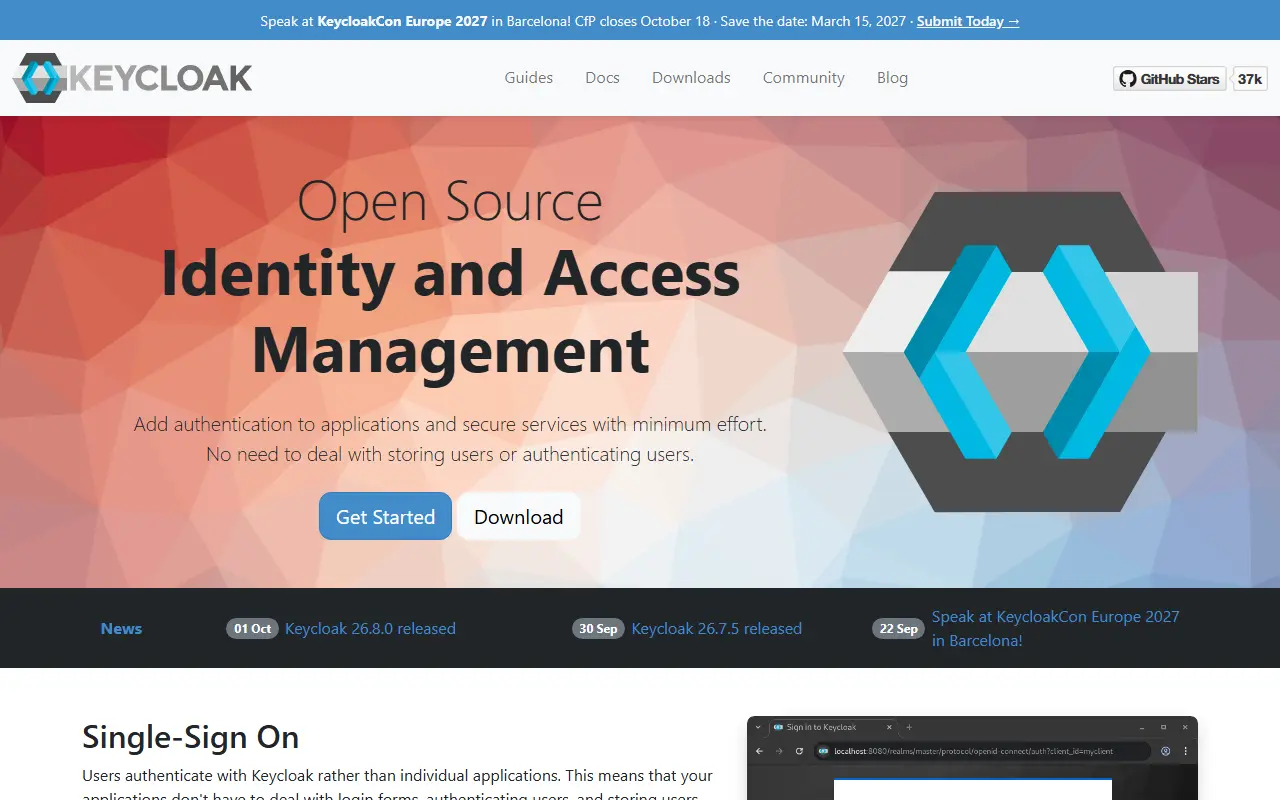
Keycloak is an open-source identity and access management server. It lets application teams add authentication and secure services without building their own login system, since Keycloak handles storing users and authenticating them. The project is written in Java, released under the Apache-2.0 license and governed under the Cloud Native Computing Foundation code of conduct.
Keycloak supports standard protocols such as OpenID Connect and SAML, and offers user federation, strong authentication, user management and fine-grained authorization. You can run it from the downloadable distribution using a start-dev command, or use the official Docker image published on Quay for containers and Kubernetes setups. The project provides documentation, a user mailing list and community channels for help, along with guidance for building and testing from source.
Key features
- Single sign-on with OpenID Connect and SAML
- User federation with external directories
- Strong and multi-step authentication options
- Central user and account management
- Fine-grained authorization policies
- Docker image and standalone distribution
Pricing: Free and open source under the Apache-2.0 license; you host and operate it yourself.
#3
An open-source backend packaged as a single Go executable, with an embedded SQLite database, realtime subscriptions, user and file management and an admin dashboard.
- GitHub stars
- 62k
- Last commit
- 18 days ago
- Latest release
- v0.40.6
- Licence
- MIT
- Self-hosted
- Yes
pocketbase.io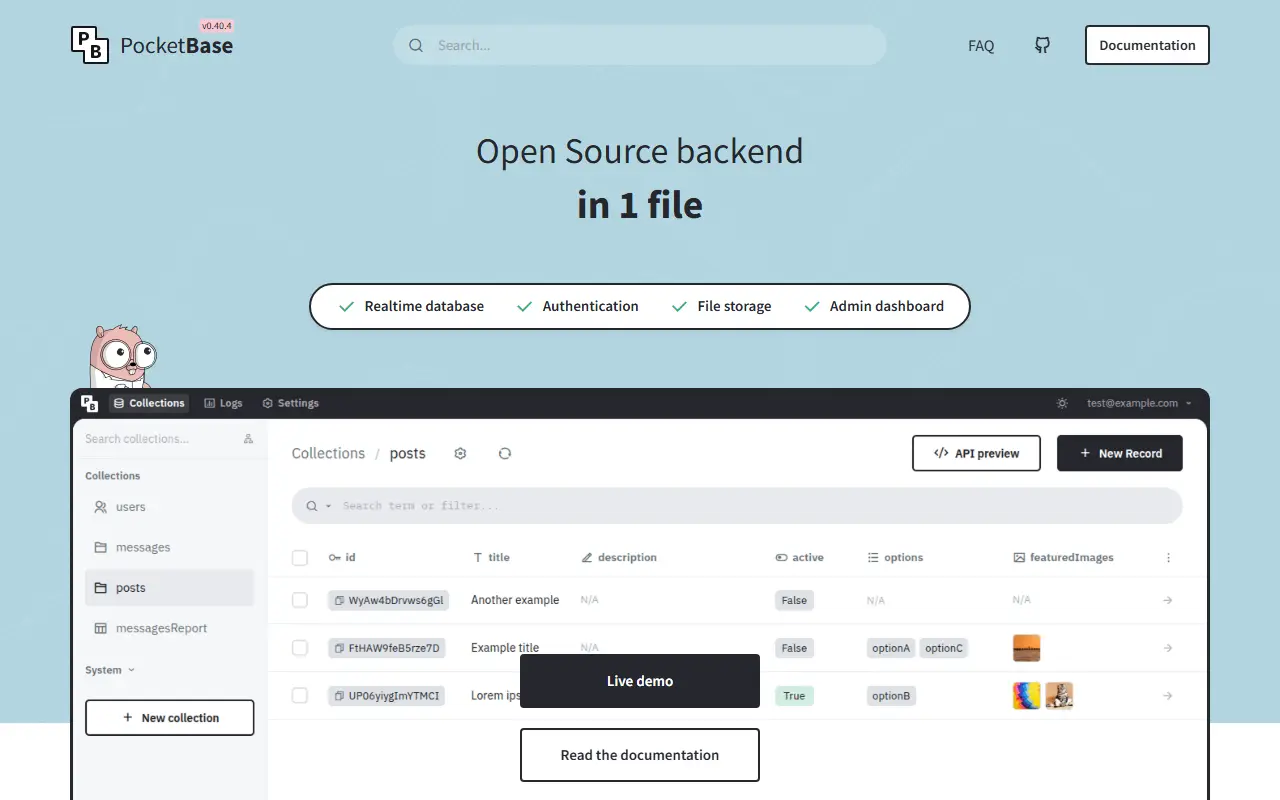
PocketBase is an open-source backend written in Go that ships as one file. It bundles an embedded SQLite database with realtime subscriptions, built-in management of users and files, a convenient admin dashboard and a simple REST-style API, which makes it quick to stand up a backend for a small web or mobile project.
You can use it as a standalone application by downloading the prebuilt executable for your platform and running its serve command, or you can extend it as a Go library to add custom routes and logic. The prebuilt binaries come with a JavaScript VM plugin enabled for scripting. Official SDK clients exist for JavaScript, covering browsers, Node.js and React Native, and for Dart, covering web, mobile, desktop and CLI.
PocketBase is MIT licensed. The maintainers warn that it is still under active development and that backward compatibility is not guaranteed before version 1.0.0, so upgrades deserve some care. It suits solo developers and small teams who want a simple, self-contained backend without managing a database server separately.
Key features
- Embedded SQLite database with realtime subscriptions
- Built-in user authentication and file management
- Admin dashboard for managing data
- REST-style API for client access
- Official JavaScript and Dart SDKs
- Single executable that can also extend as a Go library
Pricing: Free and open source under the MIT license.
#4
A self-hosted single sign-on and multi-factor authentication portal that protects web applications, certified for OpenID Connect and ready for post-quantum cryptography.
- GitHub stars
- 30k
- Last commit
- yesterday
- Latest release
- v4.39.28
- Licence
- Apache-2.0
- Self-hosted
- Yes
authelia.com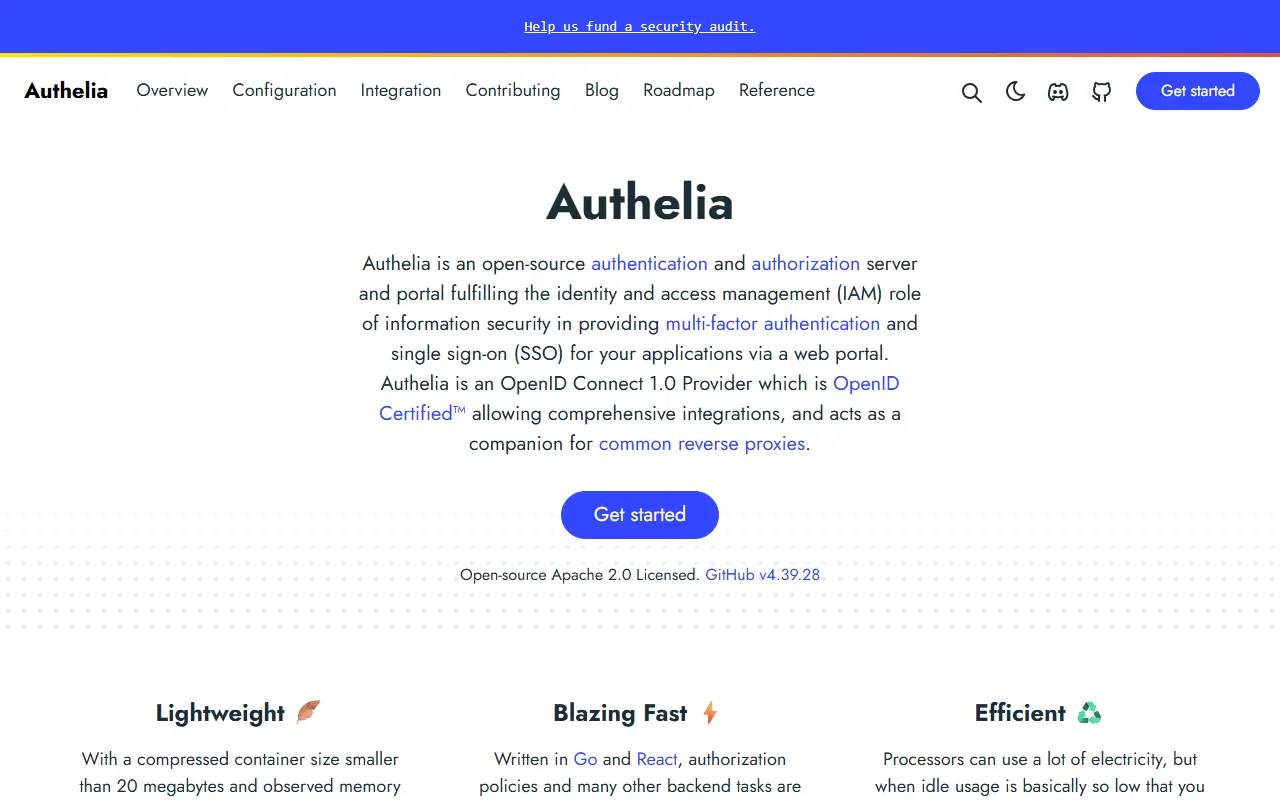
Authelia is an open-source authentication and authorization server that provides single sign-on and multi-factor authentication for web applications. It sits in front of your services, usually alongside a reverse proxy, so users sign in once at a portal and are checked against policies before reaching an app.
Supported factors and backends include TOTP, push notifications, two-factor methods and LDAP, according to its topics, and it is described as OpenID Certified and ready for post-quantum cryptography. It is written in Go and runs well as a small container, with documentation for Docker and Kubernetes deployments. Self-hosters often use it to add a consistent login and second factor to tools that have weak or no authentication of their own.
Authelia is licensed under Apache-2.0. As an authentication component, it is meant to be run on your own infrastructure, and it suits home labs, small organizations and teams wanting a lightweight identity layer without a heavier enterprise identity platform.
Key features
- Single sign-on portal for web apps
- Multi-factor authentication including TOTP
- Push notification verification
- LDAP user backend support
- OpenID Connect support
- Docker and Kubernetes deployment
Pricing: Free and open source under the Apache-2.0 license.
#5
An open-source identity provider for single sign-on that supports SAML, OAuth2 and OIDC, LDAP and RADIUS, built for self-hosting from home labs to large clusters.
- GitHub stars
- 26k
- Last commit
- yesterday
- Latest release
- version/2026.8.5
- Self-hosted
- Yes
goauthentik.io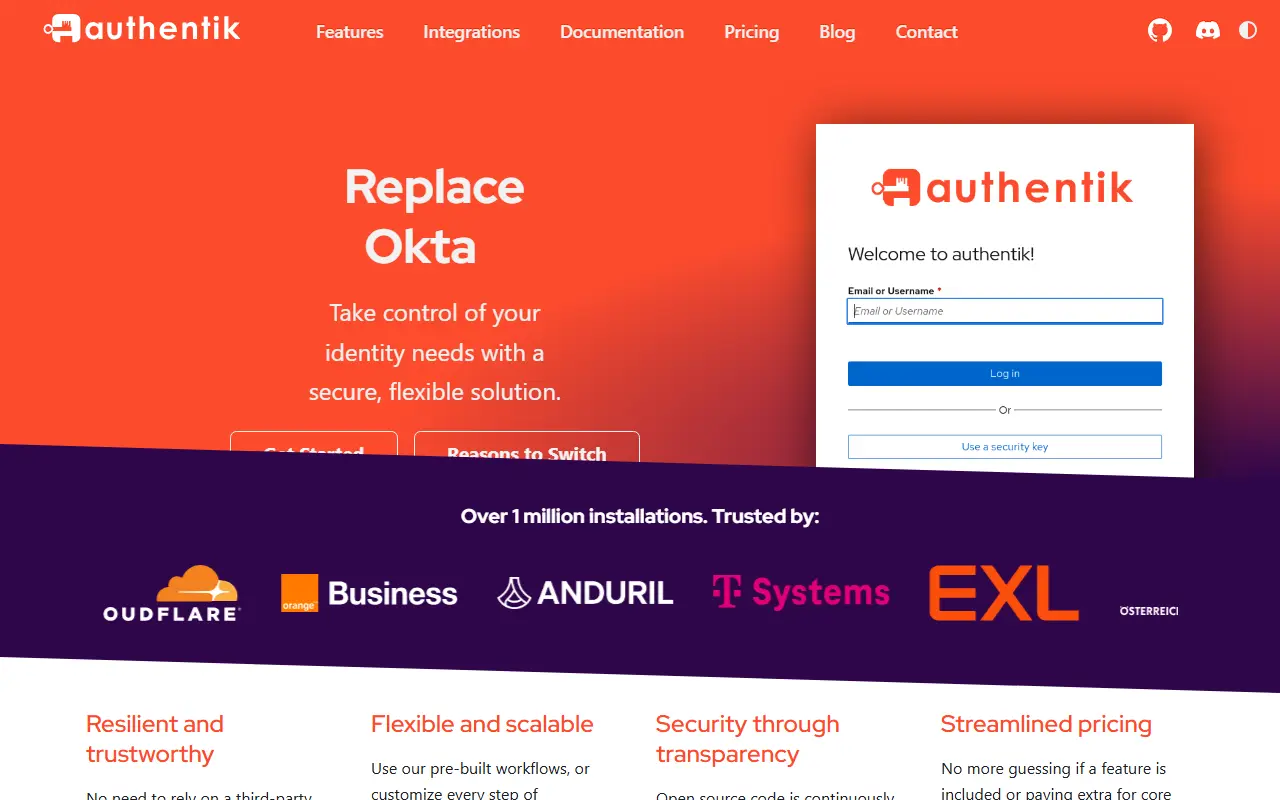
authentik is an open-source Identity Provider for modern single sign-on. It supports SAML, OAuth2 and OpenID Connect, LDAP, RADIUS and more, and is designed for self-hosting at any scale, from a small lab to production clusters. A reverse-proxy mode also lets it protect applications that lack native SSO support.
The project positions its enterprise offering as a way for organizations to replace incumbent identity providers (Okta, Auth0, Entra ID or Ping Identity) in large-scale identity management. For installation, Docker Compose is recommended for small and test setups, a Helm chart for Kubernetes suits larger setups, and official templates exist for AWS CloudFormation and a one-click DigitalOcean Marketplace app.
The codebase is mostly Python with Kubernetes tooling, and the license is listed as 'Other' on GitHub because it mixes open-source and enterprise components, so check which features fall under which terms. authentik is a common choice for self-hosters and companies who want to centralize logins across internal tools without paying per-user fees to a hosted identity vendor.
Key features
- SAML and OAuth2/OIDC provider
- LDAP and RADIUS support
- Reverse-proxy authentication for apps
- Docker Compose and Helm chart installs
- AWS CloudFormation and DigitalOcean templates
- Enterprise edition for large deployments
Pricing: The open-source edition is free. Enterprise costs $5 per user per month billed annually, plus $0.02 per external user; Enterprise Plus starts at $20k per year. No hosted version is offered.
#6
A self-hostable data platform that wraps any SQL database with instant REST and GraphQL APIs, a no-code admin app, authentication and an MCP server.
- GitHub stars
- 39k
- Last commit
- today
- Latest release
- v12.6.1
- Self-hosted
- Yes
- Hosted version
- Available
directus.com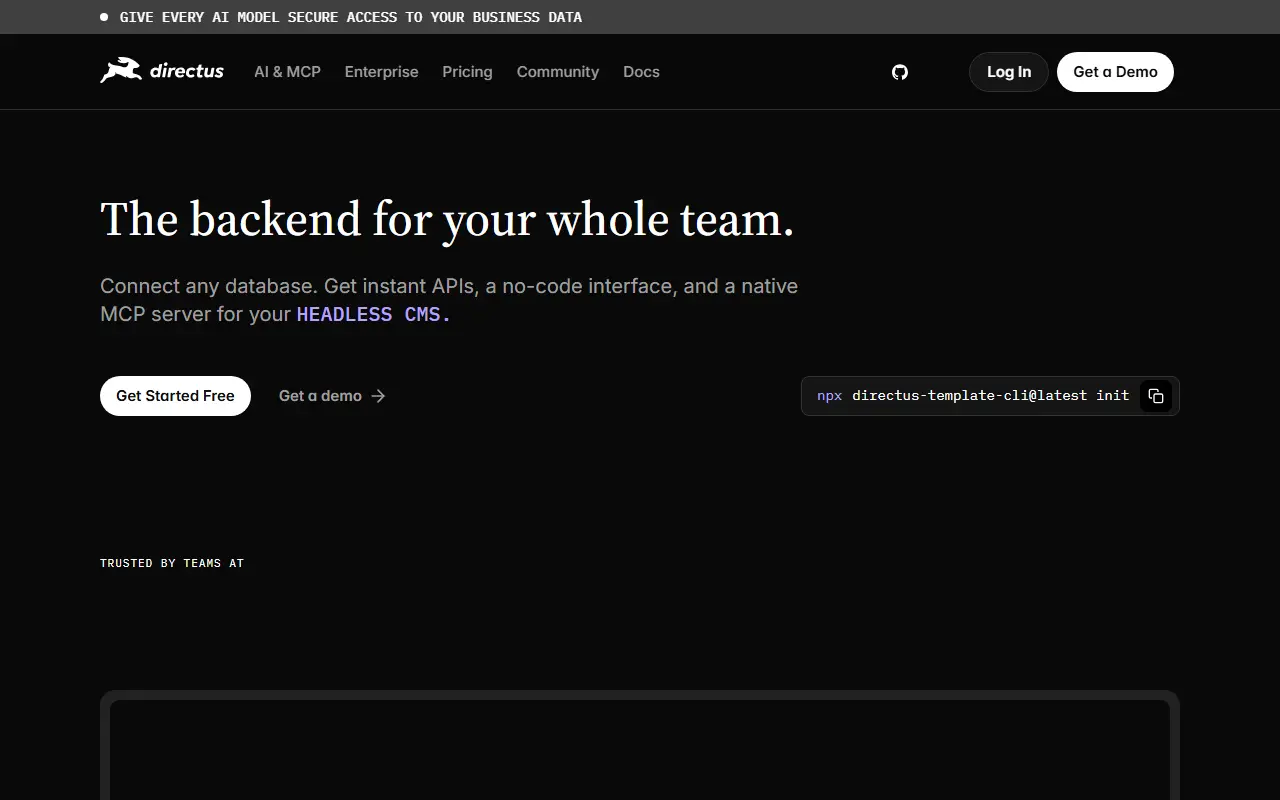
Directus is a collaborative backend and headless CMS that sits on top of an existing SQL database. You connect a database, and it generates production-ready REST and GraphQL APIs, leaving your schema exactly as built, along with a no-code interface where non-developers can manage content and data.
Beyond content management it provides authentication and access control, so the same install can power websites, apps, admin panels and internal tools. A native Model Context Protocol server gives AI assistants such as Claude, ChatGPT and Cursor secure access to business data. Supported databases include SQLite, MySQL, PostgreSQL and SQL Server, and the app is built with TypeScript and Vue. A template CLI, run through npx, can initialize a project quickly.
Directus can be self-hosted on servers you control, or run on the vendor's Directus Cloud. The repository license is listed as 'Other', so review the terms to see which uses are free. It suits teams that want an API and admin layer over data they already have, without writing a custom backend.
Key features
- Instant REST and GraphQL APIs over any SQL database
- No-code data and content interface
- Authentication and role-based access
- Native MCP server for AI assistants
- Works with SQLite, MySQL, PostgreSQL and SQL Server
- Project templates via npx CLI
Pricing: Core is free with 3 seats. Team is $599 per month billed monthly or $499 per month on an annual commitment; Enterprise is custom. Directus Cloud hosting is a $99 per month add-on, with a 14-day cloud trial.
#7
An open-source identity and access management platform written in Go, providing single sign-on, OAuth, OIDC, SAML, MFA and a web console for users and applications.
- GitHub stars
- 15k
- Last commit
- 2 days ago
- Latest release
- v4.27.1
- Licence
- Apache-2.0
- Self-hosted
- Yes
casdoor.ai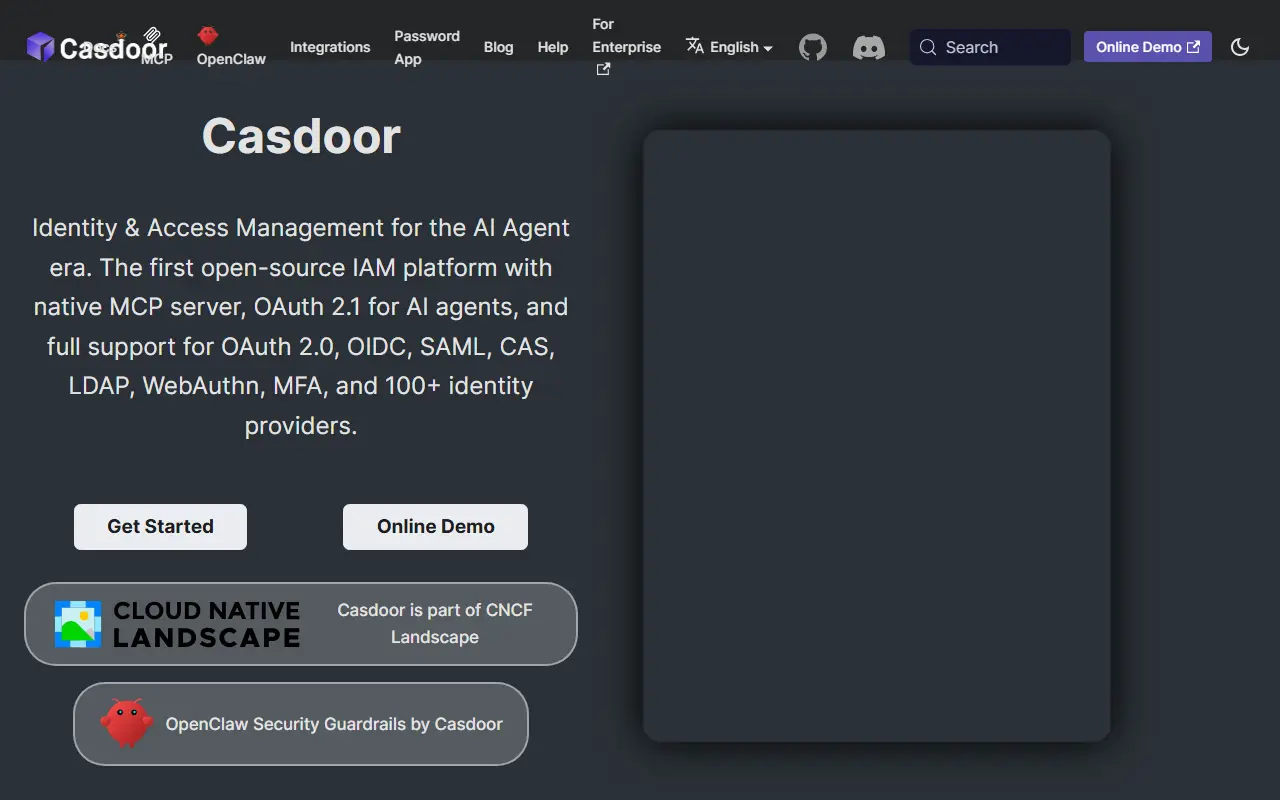
Casdoor is a self-hosted identity and access management platform with a web console. It acts as a single sign-on and authentication server, so applications can delegate login to it instead of implementing their own user management, sessions and password handling.
Supported protocols include OIDC, OAuth 2.0, SAML 2.0, LDAP, CAS and SCIM 2.0, alongside WebAuthn, TOTP and MCP, and it can connect to identity providers such as Google Workspace, Microsoft Entra ID and GitHub. Sign-in options include passwords, email or SMS codes, WebAuthn and Face ID, plus any social providers you enable. The admin console covers users, tokens, organizations, providers and applications, and settings change without a redeploy or config file.
Casdoor is written in Go and licensed under Apache-2.0. A quick trial runs on SQLite with sample data and needs no separate database or config file. Its newer positioning emphasizes AI agents, with an MCP and agent gateway for LLM tooling, and hosted demo instances are available for trying it before installing.
Key features
- Single sign-on and authentication server
- OIDC, OAuth 2.0 and SAML support
- LDAP, CAS and SCIM integration
- WebAuthn, TOTP and MFA
- Social and enterprise identity providers
- Web console for users and organizations
- MCP and agent gateway features
Pricing: Free and open source under the Apache-2.0 licence.
#8
An open-source identity and access management platform with SSO, MFA, passkeys, OIDC, SAML, SCIM and native multi-tenancy, available self-hosted or as a cloud service.
- GitHub stars
- 16k
- Last commit
- yesterday
- Latest release
- v4.20.2
- Licence
- AGPL-3.0
- Self-hosted
- Yes
- Hosted version
- Available
zitadel.com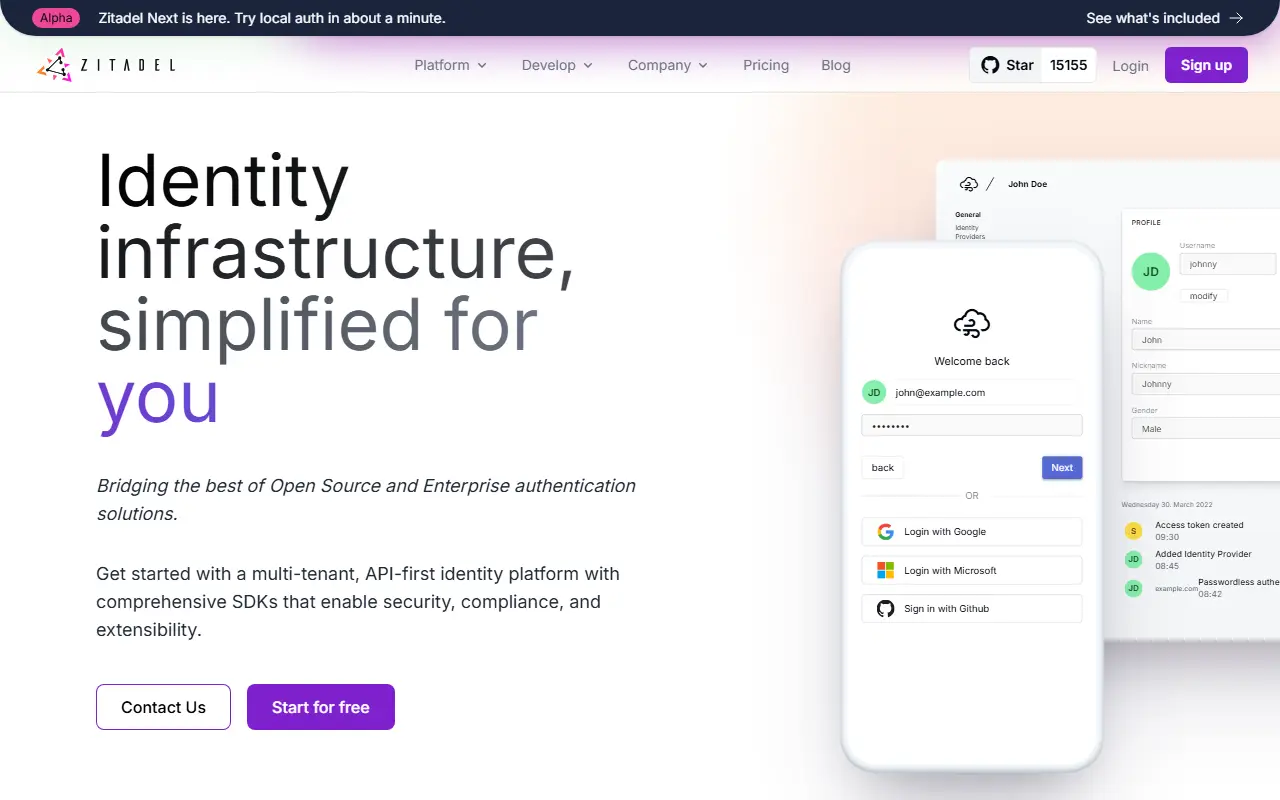
ZITADEL is an identity and access management platform, open source, for teams that need more than basic login. It targets SaaS products, B2B platforms and self-hosted IAM stacks, and bundles single sign-on, multi-factor authentication, passkeys, OIDC, SAML and SCIM in an API-first design, with an emphasis on a mature multi-tenancy model.
A comparison table in the README sets it against FusionAuth, Keycloak and Auth0 or Okta on points such as open-source status, self-hosting, infrastructure-level tenants, native B2B organizations and a comprehensive event-stream audit trail. Topics list standards and features including OAuth 2, OpenID Connect, FIDO2, 2FA and passkeys. The positioning is that you can own the identity layer without vendor lock-in while still getting a polished product.
ZITADEL is written in Go and licensed under AGPL-3.0, with a website, chat, docs and blog. You can run it yourself or use the vendor's managed cloud. It suits developers and security teams building multi-tenant applications who want a self-hostable alternative to commercial identity providers.
Key features
- Single sign-on with OIDC and SAML
- Multi-factor authentication and passkeys
- SCIM user provisioning support
- Native multi-tenancy with B2B organizations
- Event-stream audit trail
- API-first, self-hostable design
Pricing: Free cloud plan for 100 daily active users. Pro costs $100 per month and includes 25,000 daily active users; Enterprise is custom and can run on your own infrastructure.
#9
Open-source identity infrastructure that adds sign-in, enterprise SSO and role-based access control to SaaS and AI products, using OIDC and OAuth 2.1 standards.
- GitHub stars
- 15k
- Last commit
- yesterday
- Latest release
- v1.46.0
- Licence
- MPL-2.0
- Self-hosted
- Yes
- Hosted version
- Available
logto.io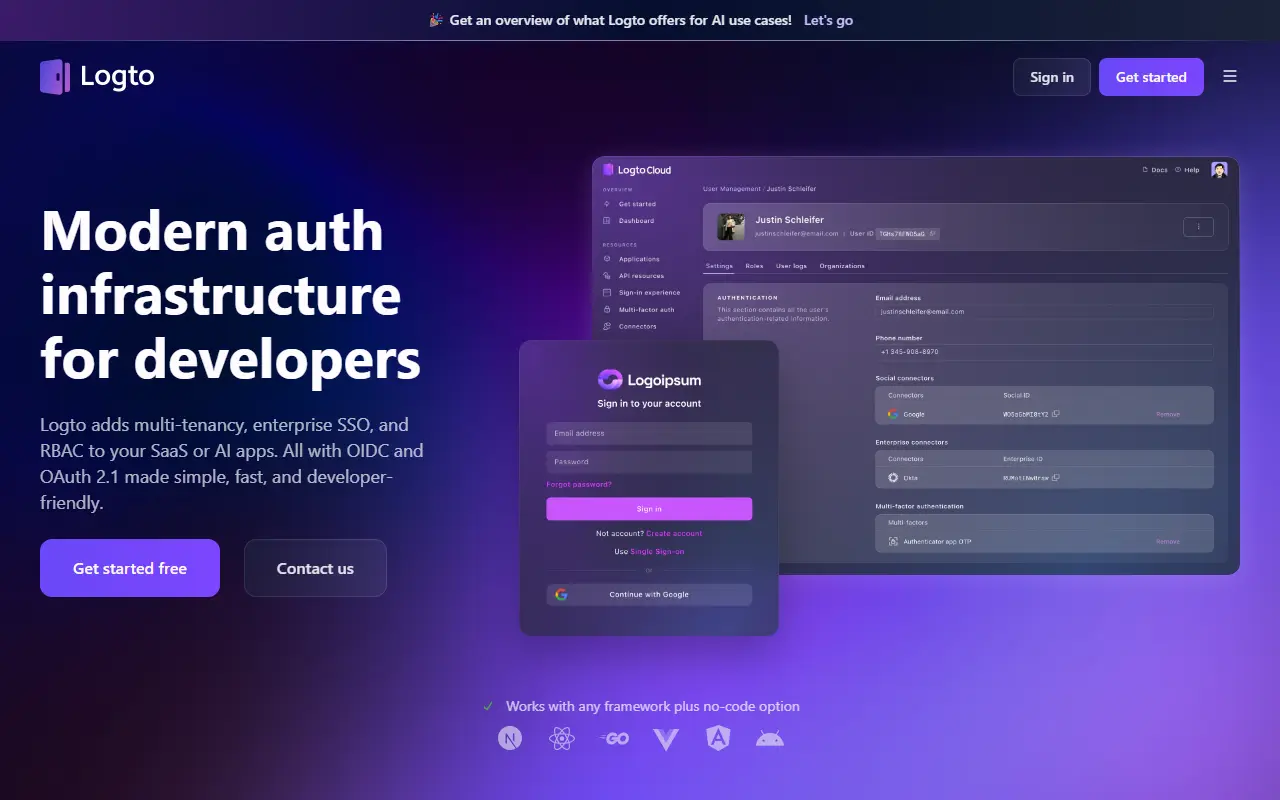
Logto is an open-source identity platform that handles sign-in, sign-up and access control so product teams do not have to build them from scratch. It is built on OpenID Connect and OAuth 2.1, with SAML also supported, and is aimed at SaaS products and AI or agent-based platforms that need production-ready authentication.
Out of the box it provides multi-tenancy and organizations with member invites and role-based access, enterprise SSO, and prebuilt sign-in flows with a customizable interface. Sign-in options include social login, passwordless methods, MFA and Google One Tap, and it can connect to external identity providers such as Google, Azure AD and Okta. SDKs cover more than 30 frameworks, among them React, Next.js, Angular, Vue, Flutter, Go and Python.
The core is licensed under MPL-2.0 and can be self-hosted by following the OSS installation guide or run locally for development. Logto Cloud offers the same product as a fully managed service. The project also advertises support for the Model Context Protocol and agent-style AI architectures.
Key features
- OIDC, OAuth 2.1 and SAML support
- Multi-tenancy with organization RBAC
- Enterprise single sign-on
- Prebuilt, customizable sign-in flows
- Social login, passwordless and MFA
- SDKs for over 30 frameworks
- Machine-to-machine access for APIs and CLIs
Pricing: Free cloud plan for up to 50,000 MAU. Pro starts at $24 per month plus token usage and add-ons; Enterprise is quoted, and self-hosting is available.
#10
An open-source authentication provider offering login, session management, MFA and multi-tenancy through frontend and backend SDKs and a Java core service.
- GitHub stars
- 15k
- Last commit
- 7 days ago
- Latest release
- v12.5.0
- Self-hosted
- Yes
- Hosted version
- Available
supertokens.com
SuperTokens is an open-source authentication provider positioned as an alternative to Auth0, Firebase Auth and AWS Cognito. It adds secure login and session management to your apps, with SDKs for popular languages and frameworks such as Node.js, Go, Python, React and React Native.
Its architecture has three building blocks: a frontend SDK that manages session tokens and renders login UI widgets, a backend SDK that provides the APIs for sign-up, sign-in, sign-out and session refreshing, and the SuperTokens Core, an HTTP service in Java that implements the authentication logic and database operations used by the backend SDK. The feature list spans passwordless and social sign-in, email and phone with password, session handling, MFA, multi-tenant organizations with enterprise SSO, user roles, authentication between microservices, and a dashboard for managing users.
You can self-host the core to keep user data in your own database, or use the vendor's managed offering. The repository's license is listed as 'Other' on GitHub, because enterprise features sit under a separate license, so check which features you need. It suits teams that want to own authentication without building it from scratch.
Key features
- Email-password, passwordless and social login
- Session management with token refresh
- Multi-factor authentication support
- Multi-tenancy and enterprise SSO
- User roles and microservice authentication
- User management dashboard
Pricing: Self-hosting is free at any scale. The managed cloud is free below 5K monthly active users, then $0.02 per active user per month, plus optional paid add-ons.
9 more Descope alternatives
- View tool
Open source, privacy-first, and built to scale. Hanko is the fastest way you integrate pas
OSSvs Auth0★ 9.1k
- View tool

Nhost
Backend as a Service
The Open Source Firebase Alternative with GraphQL.
MITvs Firebase★ 9.4k
- View tool
Deploy your frontend, backend, and database together with Hexclave Deploy. Automatic scali
OSSvs Auth0★ 6.9k
- View tool
Open source Auth0/Keycloak alternative. Passkeys, SSO, MFA, passwordless, biometric login.
Apache-2.0vs Auth0★ 2.2k
- View tool

Supabase Auth
Auth & Identity
A JWT based API for managing users and issuing JWT tokens
MITvs Auth0★ 2.6k
- View tool

Authorizer
Auth & Identity
Your data, your control. Fully open source, authentication and authorization. No lock-ins.
Apache-2.0vs Auth0★ 2.1k
- View tool

Ory Kratos
Auth & Identity
Headless cloud-native authentication and identity management written in Go. Scales to a bi
Apache-2.0vs Auth0★ 14k
- View tool

WSO2 Identity Server
Auth & Identity
Welcome to the WSO2 Identity Server source code! For info on working with the WSO2 Identit
Apache-2.0vs Auth0★ 889
- View tool
🔥Authing - IDaaS/IAM solution that can Auth to web, mobile and agent applications.
MITvs Descope★ 864
Descope alternatives: questions
- What is the best open-source alternative to Descope?
- Appwrite is the top-ranked open-source alternative to Descope on Enlisted: An open-source backend platform offering auth, databases, storage, functions, messaging, realtime and hosting, available as a managed cloud or self-hosted with Docker. Other strong options are Keycloak, PocketBase, Authelia and Authentik.
- What are the best commercial alternatives to Descope?
- WorkOS, Scalekit, Kinde, Frontegg and Stytch are among the hosted, closed-source alternatives to Descope listed on Enlisted, which lists 22 in total. Compare their pricing and features on each tool page.
- Are these Descope alternatives free?
- All 19 are open source, so the code is free to use under its licence, and all of them can be self-hosted on your own server or computer. 13 also offer a paid or managed cloud version if you'd rather not host it yourself.
- How is this list of Descope alternatives ranked?
- By a score built from GitHub stars, star growth over the last 30 days and how recently the code changed. 17 of these projects shipped code in the last 30 days. Data is refreshed daily, and nobody can pay to move up.
 TrackMedia
 TrackRev