 TrackMedia
 TrackRev

 Localazy
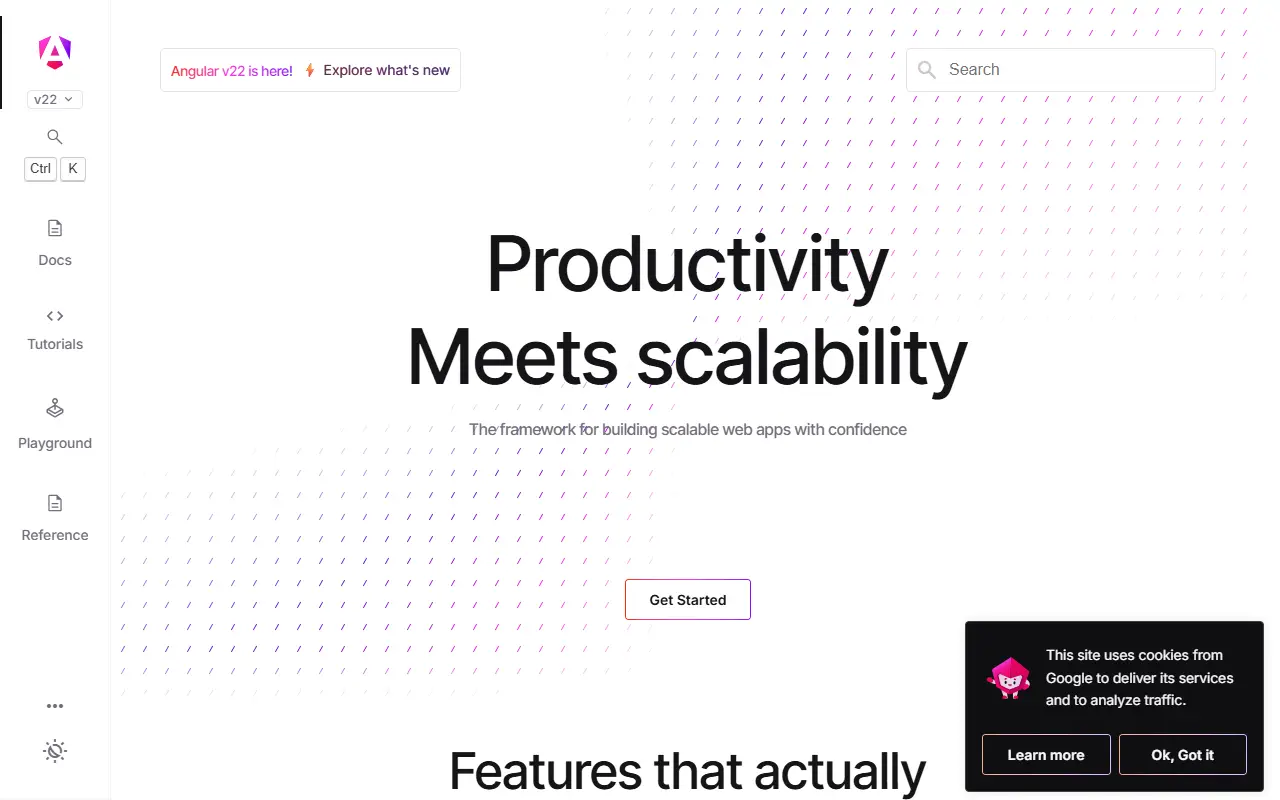
About Angular
Angular is a development platform for building mobile and desktop web applications with TypeScript or JavaScript. Google maintains it, and the docs at angular.dev describe a broad set of tools, APIs and libraries meant to scale with both team size and codebase size.
The platform bundles first-party pieces for components, dependency injection, routing, forms and signals-based reactivity. It supports server-side rendering, static site generation and full DOM hydration. The homepage also highlights control flow and deferrable views, and it points to an Angular MCP server and AI resources.
Tooling includes the Angular CLI, which scaffolds a project with ng new and runs it with ng serve, Angular DevTools for debugging, a language service for editors, and ng update, which applies automated code changes for breaking changes. Setup needs Node.js, and the CLI is installed with npm.
Key features
- Signals for fine-grained reactive state
- Server-side rendering, static generation and hydration
- Routing with guards, data resolution and lazy loading
- Dependency injection for sharing code across components
- Standardised forms with validation
- ng update applies automated code transformations
- DevTools with component and dependency injection tree views
- Language service for editors
Good fit for
- Large single-page web apps
- Server-rendered or statically generated sites
- Progressive web apps
Angular: questions and answers
- What is Angular used for?
- Angular is Google's MIT-licensed TypeScript web framework, shipping routing, forms, signals, server-side rendering and a CLI in one platform. It is a good fit for large single-page web apps, server-rendered or statically generated sites and progressive web apps.
- Is Angular open source?
- Yes. Angular is open source under the MIT licence. Its source code is on GitHub at angular/angular and is written mainly in TypeScript.
- Is Angular free?
- Yes. Angular is open source, so the software itself is free to use.
- Can I self-host Angular?
- Yes. Angular can be self-hosted on your own server or infrastructure.
- What is Angular an alternative to?
- Angular is an open-source alternative to Localazy. Other open-source alternatives to Localazy include Tolgee, Lingo.dev and Intlayer.
- Is Angular actively maintained?
- Yes. The most recent commit to Angular was on 17 November 2026, and the latest release is v22.2.6, published on 12 November 2026. The project has 102k stars on GitHub, with 539 added in the last 30 days.
Open-source alternatives to Angular
See all
Tolgee
Localization
Developer & translator friendly web-based localization platform
OSSvs Crowdin★ 4.2k
Lingo.dev
Localization
Open-source localization engineering tools. Connects to Lingo.dev localization engineering
Apache-2.0vs Lokalise★ 5.4k
Intlayer
Localization
Per-component Internationalisation solution for JS application. Type-Safe. Translate with
Apache-2.0vs Locize★ 866
Weblate
Localization
Web based localization tool with tight version control integration.
GPL-3.0vs Crowdin★ 6.2k
GNU Emacs
Developer Tools
Mirror of GNU Emacs
GPL-3.0vs Sublime Text★ 5.3k
Pontoon
Localization
Mozilla's Localization Platform
BSD-3-Clausevs Transifex★ 1.7k