#1
An open-source project management platform for issues, sprint cycles, roadmaps, docs and triage, positioned as an alternative to Jira, Linear, Monday and ClickUp.
- GitHub stars
- 62k
- Last commit
- yesterday
- Latest release
- v1.4.3
- Licence
- AGPL-3.0
- Self-hosted
- Yes
- Hosted version
- Available
plane.so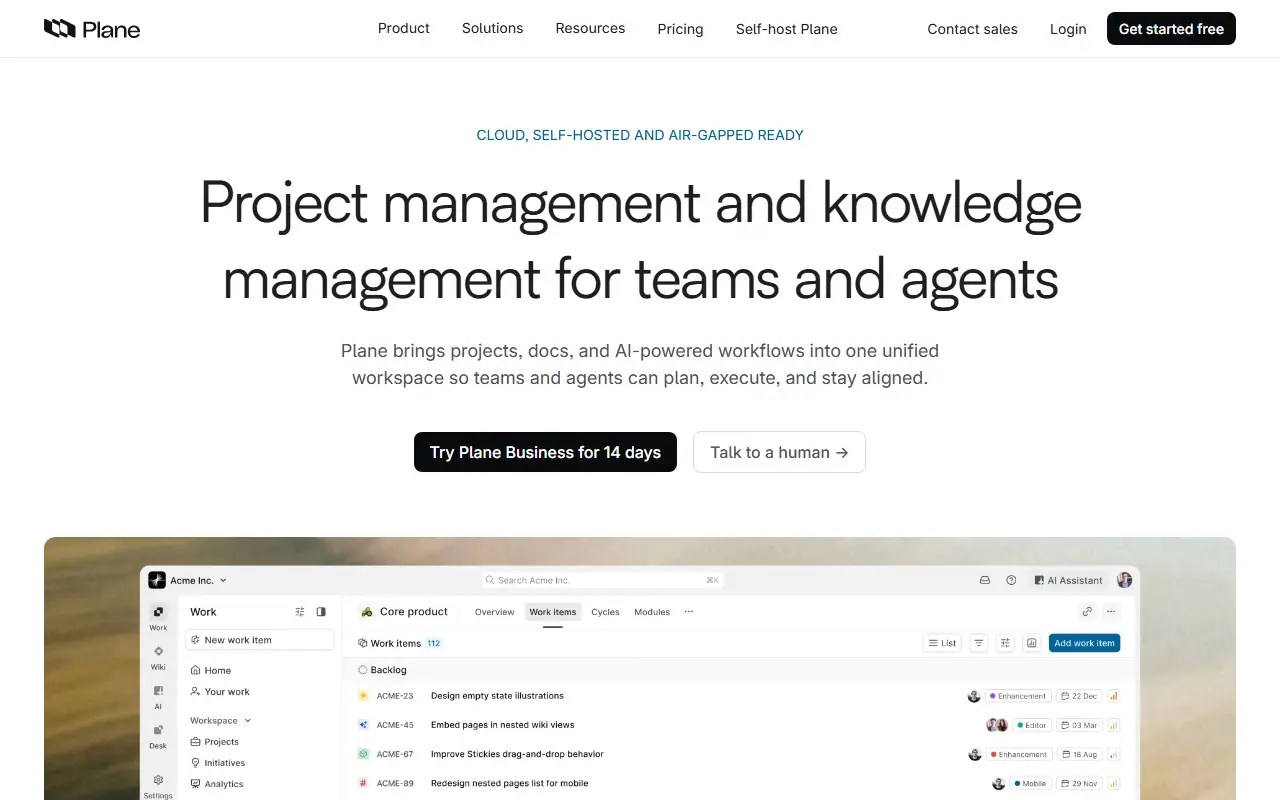
Plane is an open-source project management tool for tracking issues, running sprints and managing product roadmaps. It is positioned as an alternative to Jira, Linear, Monday and ClickUp, and aims to keep the tool itself from getting in the way of the work.
The platform covers task and issue tracking, cycles for sprints, product roadmaps, documentation and a triage flow for incoming work, and topics also mention kanban boards and product management. It is built with a React and TypeScript front end and a Django and Python back end, using PostgreSQL and Redis, and it is packaged for Docker deployments.
You can start with a free account on Plane Cloud, the hosted option, or self-host Plane on your own servers using the deployment guides for full control over data and infrastructure. The code is AGPL-3.0 licensed. It suits teams moving off Jira or Linear who want an open codebase and the choice between a managed service and their own hardware.
Key features
- Issue tracking with kanban boards
- Sprint cycles and roadmaps
- Triage flow for incoming work
- Built-in docs and wikis
- Plane Cloud or self-hosted deployment
- Docker-based installation guides
Pricing: Free plan for up to 12 users. Pro is $6 and Business $13 per seat per month; Enterprise Grid is quoted on request. Paid plans have a two-week trial and Plane can be self-hosted.
#2
OpenProject is open-source project management software for agile planning, Gantt charts, issue tracking and time tracking, positioned as a Jira alternative.
- GitHub stars
- 17k
- Last commit
- yesterday
- Latest release
- v17.9.7
- Licence
- GPL-3.0
- Self-hosted
- Yes
- Hosted version
- Available
openproject.org
OpenProject is a web-based project management application for teams and organizations that value transparency, flexibility and control over their data. It covers projects, portfolios, products, tasks, bugs, agile workflows, roadmaps and team collaboration in one platform, and it is built with Ruby and Angular under the GPL-3.0 license.
Key capabilities include agile boards with Kanban and Scrum, project planning and scheduling with Gantt charts, product and release planning, bug tracking, and time tracking with cost reporting and budgeting. Collaboration tools cover wikis, forums, news, and meeting agendas and minutes. Integrations are listed for Nextcloud, XWiki, GitHub and GitLab, among others.
The project presents itself as an open-source alternative to Jira and Asana, along with tools such as MS Project, Monday and YouTrack. It can be self-hosted, which suits organizations with data sovereignty requirements. A free Community Edition is available to download, a 14-day free trial exists, and an Enterprise Edition adds support and add-ons in the cloud or on-premises.
Key features
- Agile boards for Kanban and Scrum
- Gantt chart planning and scheduling
- Roadmaps and release planning
- Time tracking, cost reporting and budgets
- Bug tracking and issue management
- Wikis, forums and meeting minutes
Pricing: The Community edition is free. Paid Enterprise plans cost 5.95 (Basic), 10.95 (Professional) or 15.95 (Premium) euros per user per month with user minimums; Corporate is on request. 14-day free trial.
#3
A self-hosted file sync, sharing and collaboration platform that stores files, contacts and calendars on a server you choose, extensible with hundreds of apps.
- GitHub stars
- 37k
- Last commit
- yesterday
- Latest release
- v33.0.11
- Licence
- AGPL-3.0
- Self-hosted
- Yes
- Hosted version
- Available
nextcloud.com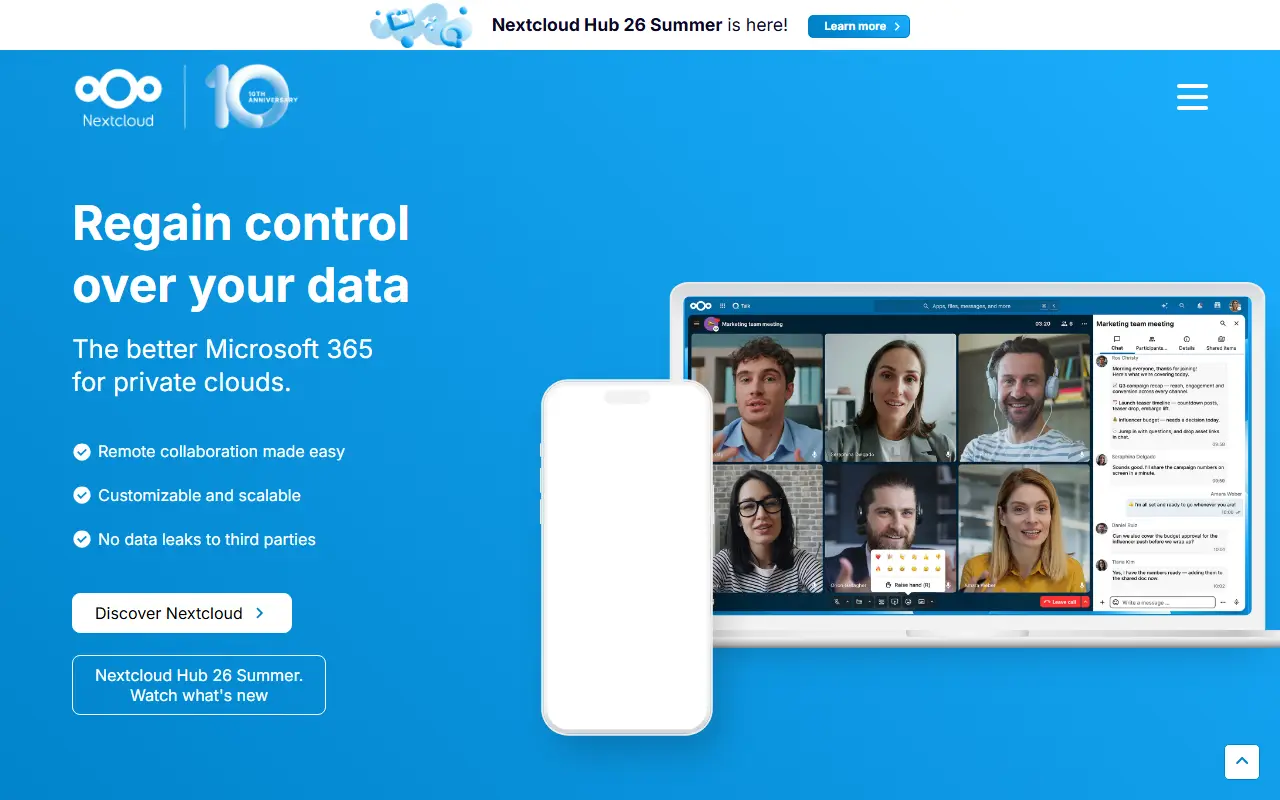
Nextcloud Server is a platform for keeping your files, contacts, calendars and other data on a server of your choosing. Content is synchronized across your devices, can be shared with other people for viewing or collaboration, and stays under your control rather than with a large cloud provider. It grew out of the ownCloud lineage.
Functionality can be expanded through hundreds of apps in its App Store, including Calendar, Contacts, Mail and Video Chat. Security measures include encryption mechanisms, a public bug bounty program and two-factor authentication. There are several ways to get a Nextcloud: sign up with a provider, install the server yourself on your own hardware or with a ready-to-use appliance, buy a device that comes with it preinstalled, or find a service provider to host it for you.
The server is written in PHP and JavaScript under the AGPL-3.0 license. Nextcloud GmbH also offers an Enterprise edition aimed at public sector, education and company users. It suits households, schools and organizations that want to replace commercial cloud storage and office suites with something they run themselves.
Key features
- File storage and sync across devices
- Contacts and calendar hosting
- Sharing and collaboration controls
- App Store with hundreds of apps
- Two-factor authentication and encryption
- Self-install, appliance or provider-hosted options
Pricing: Nextcloud Enterprise Standard starts at 42€ per user per year, with subscriptions from 100 users and 31.50€ from 250 users. Nextcloud One managed hosting is offered for smaller teams.
#4
A customizable team communications platform with real-time chat and video, aimed at organizations with strict data protection needs and offered self-hosted, cloud or air-gapped.
- GitHub stars
- 46k
- Last commit
- today
- Latest release
- 9.0.0
- Self-hosted
- Yes
- Hosted version
- Available
rocket.chat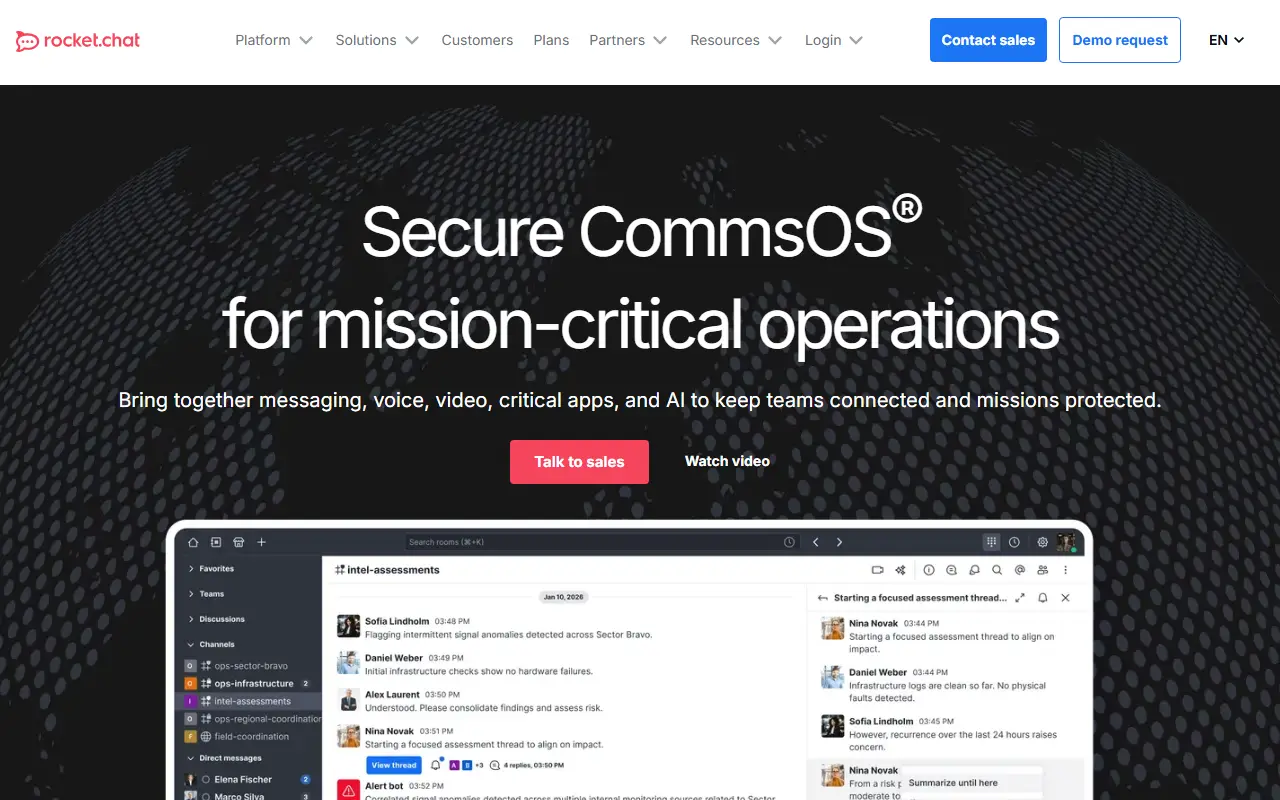
Rocket.Chat is a communications platform written in TypeScript for teams and organizations that care about data protection. It supports real-time conversations between colleagues, with partner companies, and with customers or citizens, and its topics place it in the same space as Slack, with WebRTC for calls and meetings.
The product emphasizes control over where and how it runs. Deployment options include self-hosted servers, a managed cloud and fully air-gapped environments, with a scalable architecture and performance monitoring for workspace administration. Security and sovereignty features, including identity management, are a core part of the pitch, and the platform is built to be highly customizable, so organizations can adapt it to their own workflows and integrations.
The repository's license is listed as 'Other' on GitHub, although the topics reference an MIT-licensed community core, so confirm which components fall under which terms before relying on it commercially. It suits government bodies, enterprises and regulated industries that want a Slack-style tool they can host themselves.
Key features
- Real-time team messaging and channels
- Video conferencing built on WebRTC
- Self-hosted, cloud and air-gapped deployment
- Scalable architecture with performance monitoring
- Identity and security controls for data sovereignty
- Highly customizable platform
Pricing: Rocket.Chat does not publish prices. Commercial, Government and Defense plans are quoted through its sales team, with on-premise and air-gapped deployment options.
#5
A self-hosted, open-core collaboration platform combining team chat, automated workflows, voice calls, screen sharing and AI integrations.
- GitHub stars
- 40k
- Last commit
- yesterday
- Latest release
- v12.0.2
- Self-hosted
- Yes
- Hosted version
- Available
mattermost.com
Mattermost is an open-core collaboration platform you host yourself, covering team chat, workflow automation, voice calls, screen sharing and AI integrations. This repository is the primary source for core development of the platform. The server is built with Go and React, ships as one Linux binary and depends on PostgreSQL. GitHub lists the license as 'Other'.
Each month, on the 16th, a newly compiled release is published under the MIT license. You can deploy Mattermost on-premises or try it in the cloud. The project highlights use cases such as DevSecOps, incident resolution and IT service desk, and it offers native clients for Android, iOS, Windows, macOS and Linux in addition to the web interface.
Installation options include Docker, Ubuntu, a tar archive, Kubernetes, Helm and an Omnibus package. Developers can build integrations through APIs, webhooks, slash commands, Apps and plugins, and the repository links product and developer documentation, security bulletins and contribution guides. It suits engineering, security and operations teams that want controlled, self-managed team messaging.
Key features
- Team chat with channels and threads
- Built-in workflow automation
- Voice calling and screen sharing
- Integration with AI tools
- Single Linux binary with PostgreSQL
- Native mobile and desktop apps
- APIs, webhooks, slash commands and plugins
Pricing: Mattermost does not publish prices. Professional, Enterprise and Enterprise Advanced are quoted through sales; a limited-use edition and a 1-hour trial environment are offered for evaluation.
#6
Huly is an all-in-one platform with project management, chat, CRM, HR and recruiting, positioned as a Linear and Jira alternative; this repository is frozen and no longer maintained.
- GitHub stars
- 28k
- Last commit
- 4 days ago
- Latest release
- v0.7.426
- Licence
- EPL-2.0
- Self-hosted
- Yes
huly.io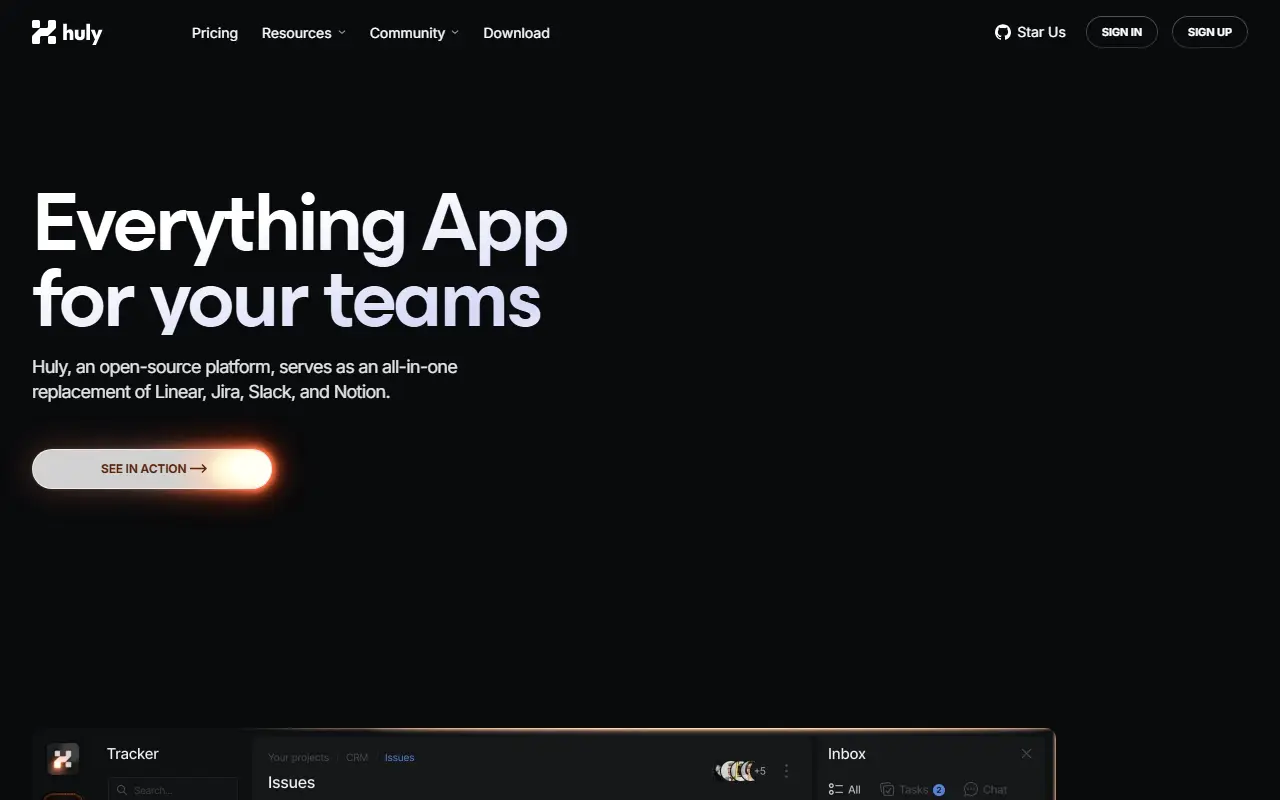
Huly is an open-source platform meant to replace several tools at once, including Linear, Jira, Slack, Notion and Motion. Under the hood the Huly Platform is a framework for developing business applications such as CRM systems, and this repository includes applications for chat, project management, CRM, HR management and applicant tracking, with team and issue management covered too.
There are two important notices. First, the repository is frozen and no longer actively maintained, with development continuing in the Platform-Collective/platform repository. Second, the managed Huly service was shut down since nobody is funding its hosting any more. The remaining option is to self-host Huly or use another hosted provider, and the README points to a backup and restore guide and a community for migration help.
The code is written in TypeScript and licensed under EPL-2.0. Other teams have built products on top of the platform. Anyone interested in Huly today should look at the successor repository for current source code, issues and releases rather than relying on this one.
Key features
- Project and issue management
- Built-in team chat
- Integrated CRM module
- HR management and applicant tracking
- Framework for building business apps
- Self-hosting with backup and restore guide
Pricing: Plans differ by storage and call traffic with unlimited users on every tier. Common is free; Rare, Epic and Legendary are paid monthly tiers with 100GB, 1TB and 10TB of storage, and a custom plan is available on request.
#7
An open-source video conferencing platform that runs in the browser and mobile apps, usable as a standalone service or embedded in your own web application.
- GitHub stars
- 30k
- Last commit
- today
- Latest release
- stable/jitsi-meet_11248
- Licence
- Apache-2.0
- Self-hosted
- Yes
- Hosted version
- Available
jitsi.org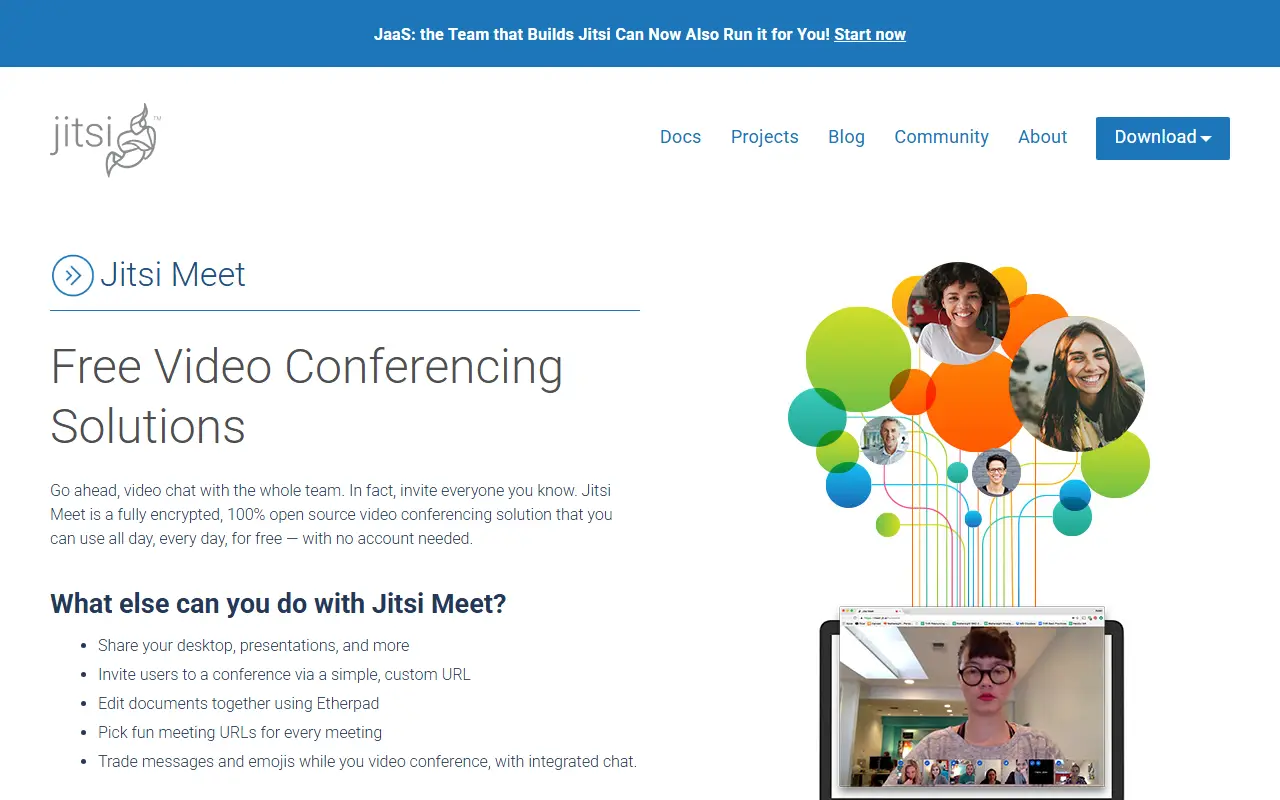
Jitsi Meet is a collection of open-source projects for hosting video conferences. It works in all current browsers and has Android and iOS apps, and it can be used as a ready-made service or embedded into other web applications through web and native SDKs. It is built on WebRTC with a selective forwarding unit to scale to larger meetings.
Meetings offer HD audio and video, content sharing, raised hands and reactions, chat with private conversations, polls and virtual backgrounds. The hosted service at meet.jit.si is free to use, and the README says you can start a meeting after signing in with an account from a major provider. Mobile users can use the browser or the full-featured apps, which are also available from F-Droid, and open beta programs let early adopters test features.
If you prefer control over your data, Jitsi can be deployed on your own infrastructure, with documentation for running your own instance. Jitsi Meet is Apache-2.0 licensed and written in TypeScript. It suits organizations, schools and communities that want an alternative to proprietary meeting software.
Key features
- Browser-based meetings with no install
- Android and iOS apps
- Screen and content sharing
- Chat, polls, reactions and raised hands
- Virtual background support
- Web and native SDKs for embedding
Pricing: Free and open source under Apache-2.0; the public meet.jit.si service is free to use.
#8
WeKan is an open-source, self-hostable kanban board app for personal and team task tracking, built with Meteor and licensed under MIT.
- GitHub stars
- 21k
- Last commit
- yesterday
- Latest release
- v13.06
- Licence
- MIT
- Self-hosted
- Yes
wekan.fi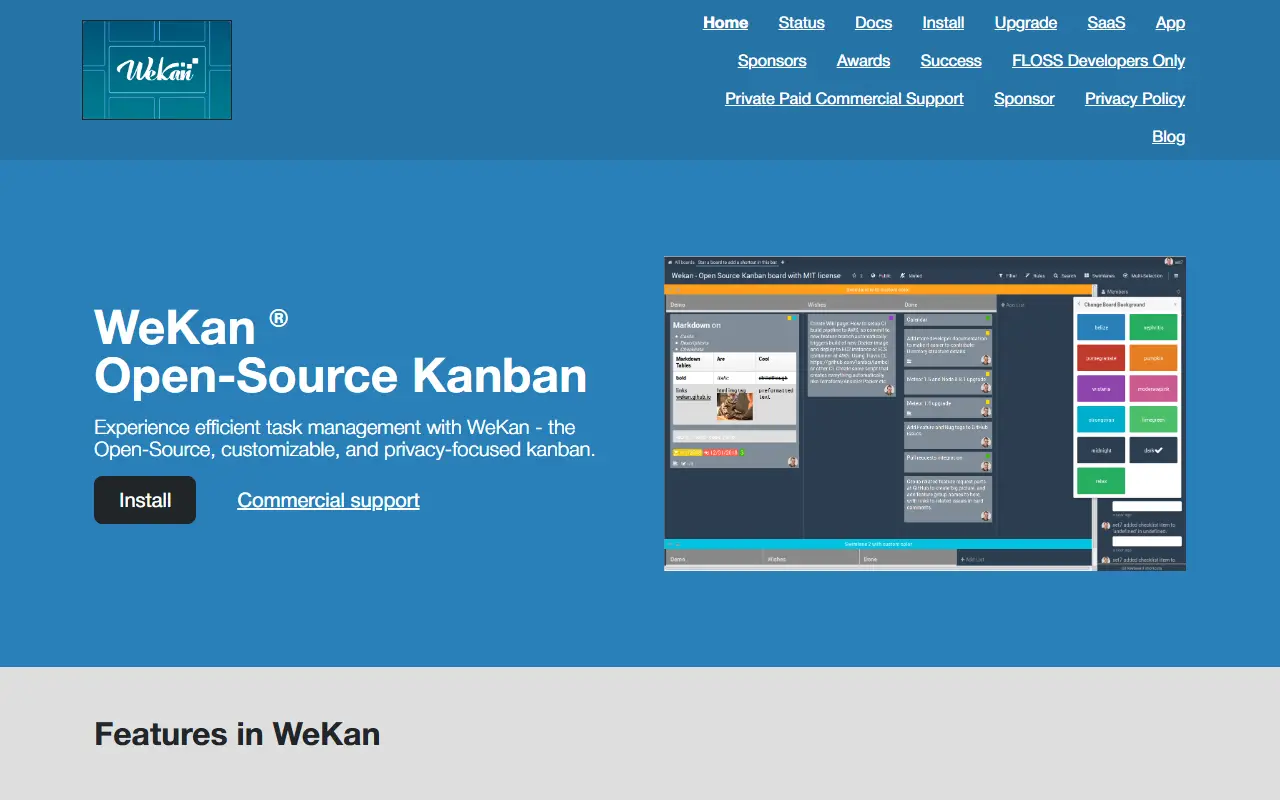
WeKan is a collaborative kanban board application. Cards move across lists on a board, giving a visual overview of where work stands, whether the board is a personal to-do list, a holiday plan shared with friends or a team project. It is free software under the MIT license and is built with the Meteor JavaScript framework.
Because it can be self-hosted, an organization can keep its data on its own server instead of relying on a third party. Installation options include Docker images, a docker-compose file, Snap packages and Sandstorm. The project states that it collects no telemetry, boards update in real time, and the interface is translated by volunteers through Transifex.
Bugs and feature requests go through GitHub issues, while the maintainers point people who need help to a commercial support offering. The Docker latest tag follows the newest release, which makes it straightforward to track updates.
Key features
- Kanban boards with lists and cards
- Real-time collaboration between users
- Self-hosting with Docker, Snap or Sandstorm
- Community-translated interface
- No telemetry collection
- Built with Meteor and JavaScript
Pricing: Free and open source under the MIT license; paid commercial support is available from the maintainers.
#9
Web and desktop client for the Matrix network, offering encrypted chat, rooms and collaboration built on the Matrix JS SDK.
- GitHub stars
- 14k
- Last commit
- 2 days ago
- Latest release
- v1.12.34
- Licence
- AGPL-3.0
- Self-hosted
- Yes
- Hosted version
- Available
element.io
Element Web is a client for Matrix, the open protocol for decentralized messaging. It is the web and desktop application formerly known as Vector and Riot, and it lets people join rooms, chat in teams and communities, and collaborate across Matrix servers rather than inside a single vendor's network.
The client is built with TypeScript on top of the Matrix JS SDK. The README defines support tiers for browsers, covering recent versions of Chrome, Firefox, Edge and Safari on desktop, best-effort handling for ESR and extended-stable releases, and community support for mobile web. For phones and tablets the maintainers recommend the native Element X apps for Android and iOS.
It is released under the AGPL-3.0 license and is typically served from your own web host or used through the hosted app from the vendor, Element. Related products such as Element Call and the Enterprise Server Suite are mentioned as part of the wider Element offering. Changes are tracked on GitHub with regular release cycles.
Key features
- Matrix web client for rooms and chat
- Desktop app built from the same code
- Built on the Matrix JS SDK
- Documented browser support tiers
- Works alongside Element X mobile apps
Pricing: Element Enterprise is priced per seat per month and Sovereign per deployment, but no prices are published; buyers are directed to talk to an expert.
#10
CryptPad is an open-source, end-to-end encrypted collaboration suite where documents sync in real time and the server cannot read their content.
- GitHub stars
- 8.1k
- Last commit
- 3 days ago
- Latest release
- 2026.10.1
- Licence
- AGPL-3.0
- Self-hosted
- Yes
- Hosted version
- Available
cryptpad.org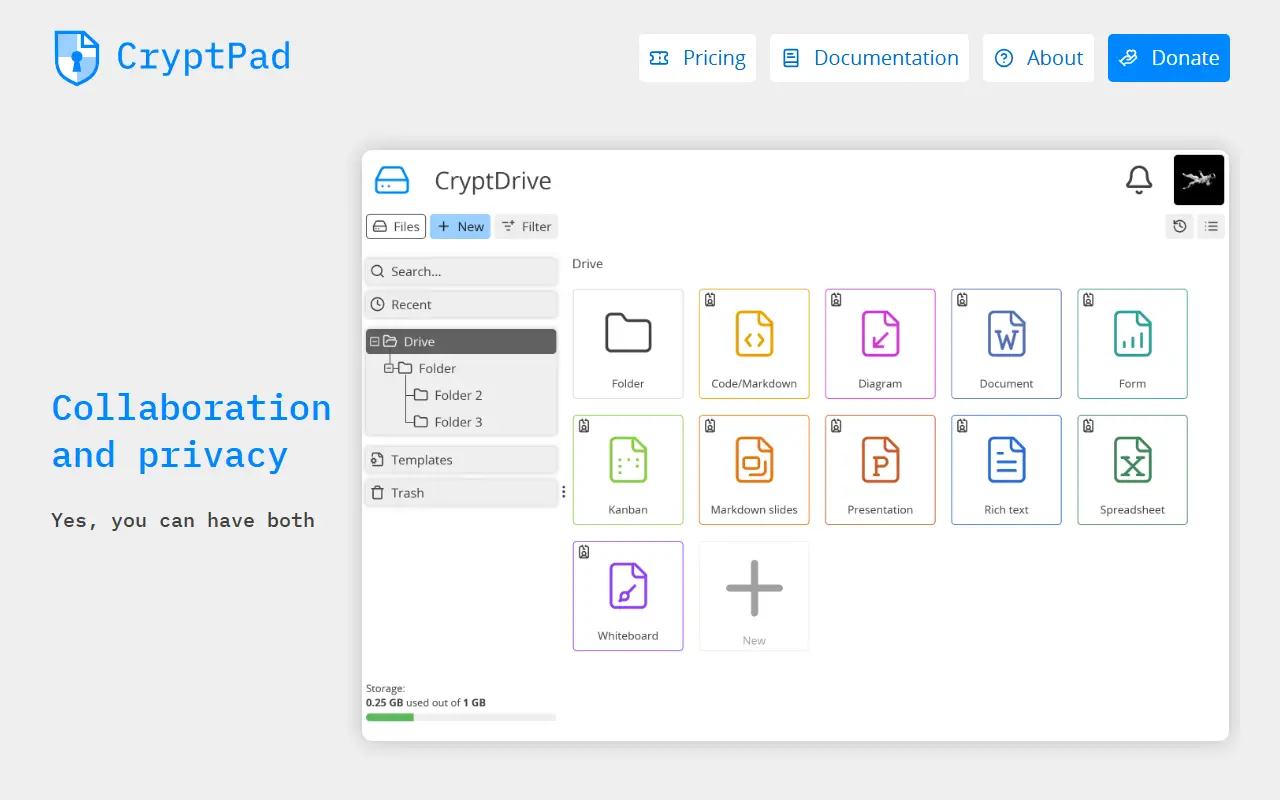
CryptPad is an open-source collaboration suite with end-to-end encryption. Documents are synchronized between collaborators in real time, and because user data is encrypted, an attacker who breaches the server cannot read the stored content. Administrators who run unmodified code and the service itself also cannot see what users store.
The encryption happens in the browser before data is sent to the server or to collaborators. The README is candid about a limit of this model: the code that does the encrypting is delivered by the host server, as on any website, so users must trust the administrator to keep the server secure. Repository topics mention collaborative editing, real-time work and the ChainPad algorithm.
CryptPad is written in JavaScript and licensed under AGPL-3.0. A developer guide covers setting up a local instance, and an admin guide covers production deployments. Official Docker images for AMD64 and ARM64 are published with every release, and a Dockerfile and docker-compose.yml are included in the repository.
Key features
- End-to-end encrypted documents
- Real-time collaborative editing
- Encryption performed in the browser
- Official Docker images for AMD64 and ARM64
- Admin guide for production installs
Pricing: Free accounts are available on public instances, and the software can be self-hosted. Paid plans on CryptPad.fr run €5 to €100 per month; managed own-instance plans start at €3,000 per year.
6 more Stackfield alternatives
Commercial Stackfield alternatives
Hosted, closed-source products that compete with Stackfield.
- View tool

Basecamp
Project Management
Project management and team communication with to-dos, message boards and schedules
SaaS
- View tool

monday.com
Project Management
Work management platform with customizable boards, automations and dashboards
SaaS
- View tool
Team messenger with channels, video calls, to-dos and file sharing
SaaS
- View tool

ClickUp
Project Management
ClickUp is an all-in-one work platform that combines tasks, docs, goals, chat, whiteboards and AI in a single app for teams.
SaaS
- View tool
Work management with Gantt charts, request forms and cross-team workflows
SaaS
- View tool
Asana is a work management platform where teams and AI agents plan, automate and track projects, tasks and workflows.
SaaS
- View tool
Trello is a visual task and project tool built on boards, lists and cards, with an inbox, planner, automation and Power-Ups for connecting other apps.
SaaS
- View tool
Notion is an AI-enabled workspace for notes, docs, wikis and projects, with agents, meeting notes and search across connected apps.
SaaS
- View tool
Slack is a team messaging platform with channels, huddles, canvases, workflows and AI features, now part of Salesforce.
SaaS
- View tool
Confluence is Atlassian's team workspace for writing, organizing and sharing documentation and knowledge, with AI help for drafting, summarizing and finding answers.
SaaS
- View tool
Microsoft Teams is Microsoft's workspace for chat, video meetings and file collaboration, closely tied to Microsoft 365.
SaaS
- View tool

Tresorit
File Storage & Sharing
End-to-end encrypted cloud storage and file sharing for businesses
SaaS
Stackfield alternatives: questions
- What is the best open-source alternative to Stackfield?
- Plane is the top-ranked open-source alternative to Stackfield on Enlisted: An open-source project management platform for issues, sprint cycles, roadmaps, docs and triage, positioned as an alternative to Jira, Linear, Monday and ClickUp. Other strong options are OpenProject, Nextcloud, Rocket.Chat and Mattermost.
- What are the best commercial alternatives to Stackfield?
- Basecamp, monday.com, Flock, ClickUp and Wrike are among the hosted, closed-source alternatives to Stackfield listed on Enlisted, which lists 12 in total. Compare their pricing and features on each tool page.
- Are these Stackfield alternatives free?
- All 16 are open source, so the code is free to use under its licence, and all of them can be self-hosted on your own server or computer. 9 also offer a paid or managed cloud version if you'd rather not host it yourself.
- How is this list of Stackfield alternatives ranked?
- By a score built from GitHub stars, star growth over the last 30 days and how recently the code changed. 13 of these projects shipped code in the last 30 days. Data is refreshed daily, and nobody can pay to move up.
 TrackMedia
 TrackRev





