#1
A self-hostable no-code database platform that puts a spreadsheet-style interface and auto-generated APIs on top of SQL databases, positioned as an Airtable alternative.
- GitHub stars
- 66k
- Last commit
- yesterday
- Latest release
- 2026.10.1
- Self-hosted
- Yes
- Hosted version
- Available
nocodb.com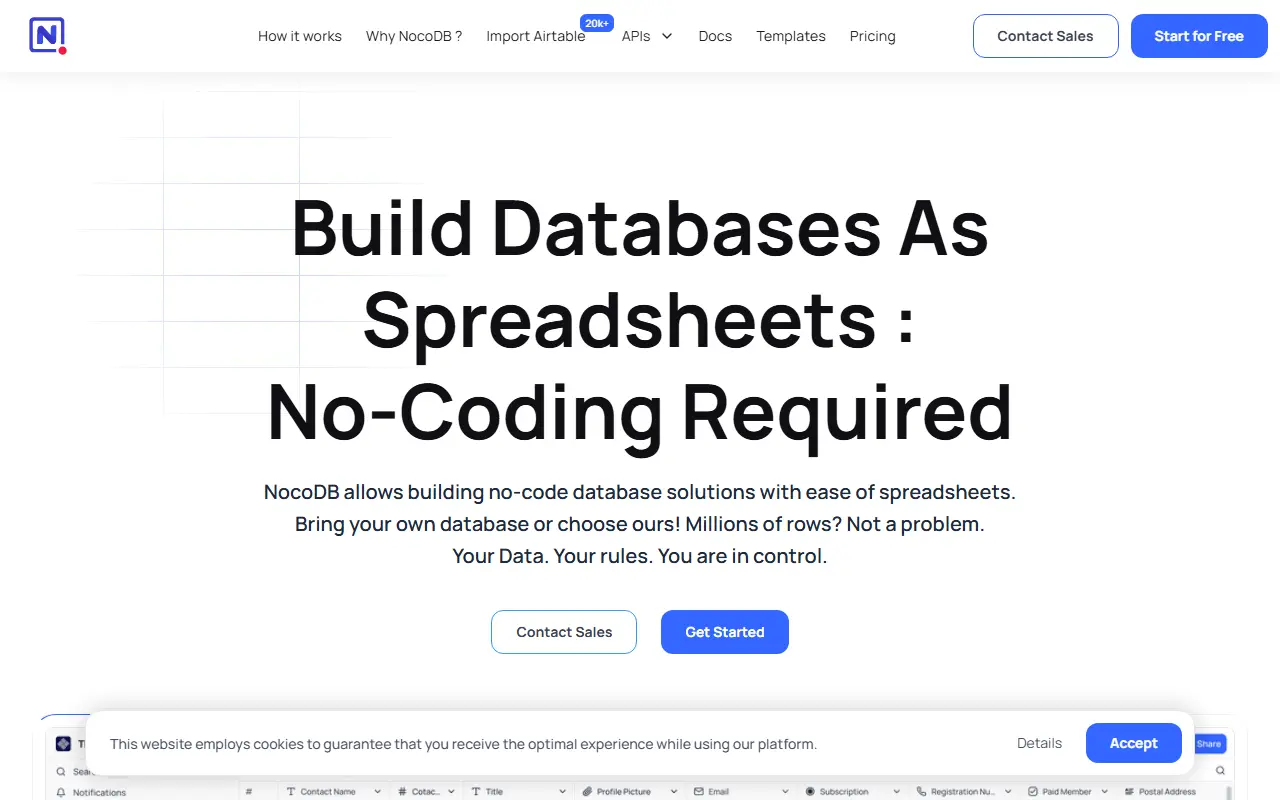
NocoDB is a no-code database platform presented as a free, self-hostable alternative to Airtable. It gives relational databases a spreadsheet-like interface, so people who do not write SQL can create tables, add records and build views, while developers keep a real database underneath.
Its topics point to automatically generated REST APIs documented with Swagger, with PostgreSQL and SQLite among the supported databases. Installation is flexible: you can run it with Docker backed by SQLite or PostgreSQL, or use the auto-upstall script, which sets up a production-style stack with PostgreSQL, Redis and a Traefik gateway through Docker Compose, handles SSL certificates and renewal, and upgrades the install when you run it again. Prebuilt binaries for macOS and Linux are meant only for quick local testing.
The license is listed as 'Other', so check the repository terms before commercial redistribution. NocoDB also runs a hosted service for teams that would rather not manage a server, and it suits groups who want Airtable-style workflows while keeping data in their own database.
Key features
- Spreadsheet-style interface over SQL databases
- Auto-generated REST APIs with Swagger docs
- Works with PostgreSQL and SQLite
- Docker and Docker Compose installation
- One-command production installer with SSL
- Prebuilt binaries for quick local testing
Pricing: Cloud Free covers up to 3 users. Paid plans start at $12 per seat per month billed annually (Plus), then Business $24 and Scale $45. Self-hosted Community is free; Enterprise is custom.
#2
A self-hostable data platform that wraps any SQL database with instant REST and GraphQL APIs, a no-code admin app, authentication and an MCP server.
- GitHub stars
- 39k
- Last commit
- today
- Latest release
- v12.6.1
- Self-hosted
- Yes
- Hosted version
- Available
directus.com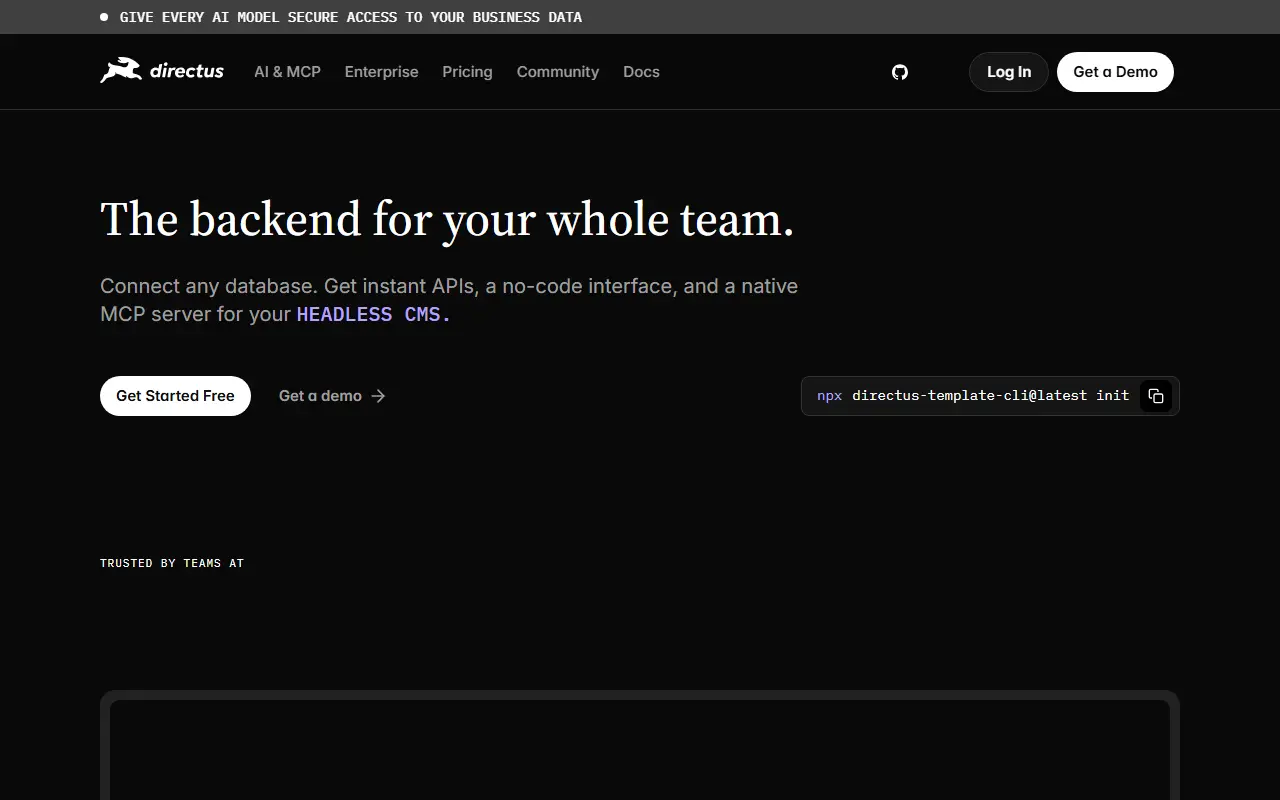
Directus is a collaborative backend and headless CMS that sits on top of an existing SQL database. You connect a database, and it generates production-ready REST and GraphQL APIs, leaving your schema exactly as built, along with a no-code interface where non-developers can manage content and data.
Beyond content management it provides authentication and access control, so the same install can power websites, apps, admin panels and internal tools. A native Model Context Protocol server gives AI assistants such as Claude, ChatGPT and Cursor secure access to business data. Supported databases include SQLite, MySQL, PostgreSQL and SQL Server, and the app is built with TypeScript and Vue. A template CLI, run through npx, can initialize a project quickly.
Directus can be self-hosted on servers you control, or run on the vendor's Directus Cloud. The repository license is listed as 'Other', so review the terms to see which uses are free. It suits teams that want an API and admin layer over data they already have, without writing a custom backend.
Key features
- Instant REST and GraphQL APIs over any SQL database
- No-code data and content interface
- Authentication and role-based access
- Native MCP server for AI assistants
- Works with SQLite, MySQL, PostgreSQL and SQL Server
- Project templates via npx CLI
Pricing: Core is free with 3 seats. Team is $599 per month billed monthly or $499 per month on an annual commitment; Enterprise is custom. Directus Cloud hosting is a $99 per month add-on, with a 14-day cloud trial.
#3
An open-source low-code platform for building admin panels, internal tools and dashboards that connect to more than 25 databases and any API.
- GitHub stars
- 41k
- Last commit
- today
- Latest release
- v2.7.0
- Licence
- Apache-2.0
- Self-hosted
- Yes
- Hosted version
- Available
appsmith.com
Appsmith is an open-source low-code platform for building custom internal applications such as dashboards, admin panels, customer 360 views, IT automation and service management tools. It aims to simplify building, deploying and maintaining these apps, which otherwise tend to be tedious to code from scratch.
You assemble interfaces visually and connect them to data through integrations with more than 25 databases and any REST or GraphQL API, with JavaScript available where you need custom logic. Topics also point to CRUD generation, workflows and automation. The front end is built with React and TypeScript, and the server side is mostly Java.
You can sign up for Appsmith Cloud or install it on your own machine, with Docker as the recommended method, plus Kubernetes and an AWS AMI. The code is Apache-2.0 licensed. It is a common choice for engineering teams that want to ship internal tools quickly without maintaining a bespoke front-end codebase.
Key features
- Visual builder for internal tools
- Integrates with 25+ databases and any API
- JavaScript for custom logic
- Admin panels, dashboards and CRUD apps
- Docker, Kubernetes and AWS AMI installation
- Cloud or self-hosted deployment
Pricing: Free for up to 5 cloud users. Business is $15 per user per month with a 15-day trial; Enterprise is listed at $2,500 per month for 100 users. The open-source Community edition is free.
#4
An open-source platform for building internal tools, dashboards and workflows visually or from prompts, with an MCP server so coding agents can build apps.
- GitHub stars
- 41k
- Last commit
- today
- Latest release
- v3.20.257-lts
- Licence
- AGPL-3.0
- Self-hosted
- Yes
- Hosted version
- Available
tooljet.com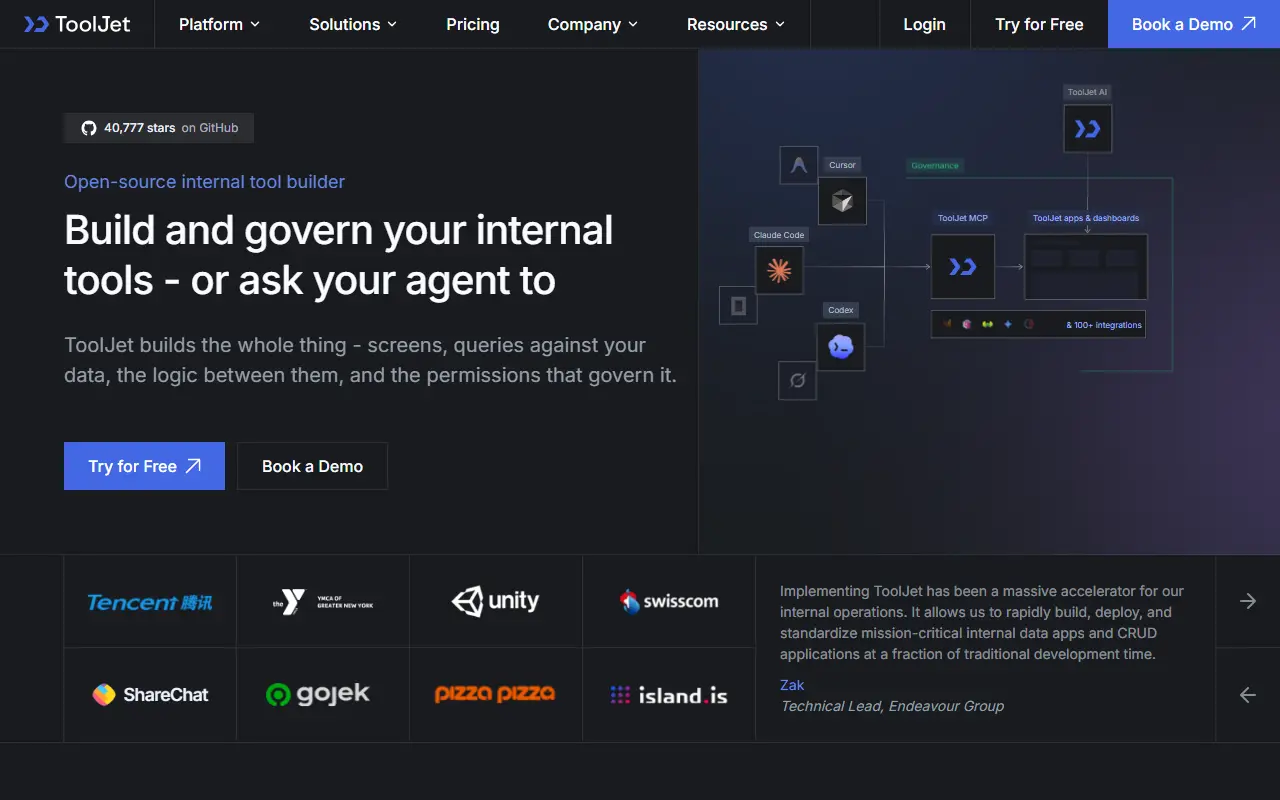
ToolJet is an open-source platform for creating internal software, including admin panels, dashboards and operational apps that sit on top of your existing databases, APIs and SaaS systems. Apps are assembled visually in a builder, so teams can ship tools without writing a full front end.
AI plays a large role. ToolJet AI turns a text description into pages, queries and components, and a Model Context Protocol server lets coding agents such as Claude Code and Codex build and modify ToolJet apps directly. Agents work against the platform's real component and data contracts, so the output is an ordinary ToolJet app that the team can keep editing in the visual builder with the same permissions, environments and version history. Workflows and AI agents are part of the offering.
You can self-host ToolJet or use ToolJet Cloud, and the open-source foundation is AGPL-3.0 licensed with a JavaScript and TypeScript codebase. It targets teams that need internal software quickly and want an open-source option with a managed alternative.
Key features
- Visual builder for internal tools and dashboards
- AI generation of pages, queries and components
- MCP server for coding agents
- Permissions, environments and version history
- Workflows and AI agents
- Self-hosted or ToolJet Cloud
Pricing: A free plan covers 2 builders. Paid plans are priced per builder per month: Basic $29, Pro $99 and Team $249 on monthly billing, with 20% off annually; Enterprise is custom.
#5
An open-source, model-agnostic operations platform for building AI agents, automations and internal apps that connect to your business systems.
- GitHub stars
- 28k
- Last commit
- yesterday
- Latest release
- v4.0.0
- Self-hosted
- Yes
- Hosted version
- Available
budibase.com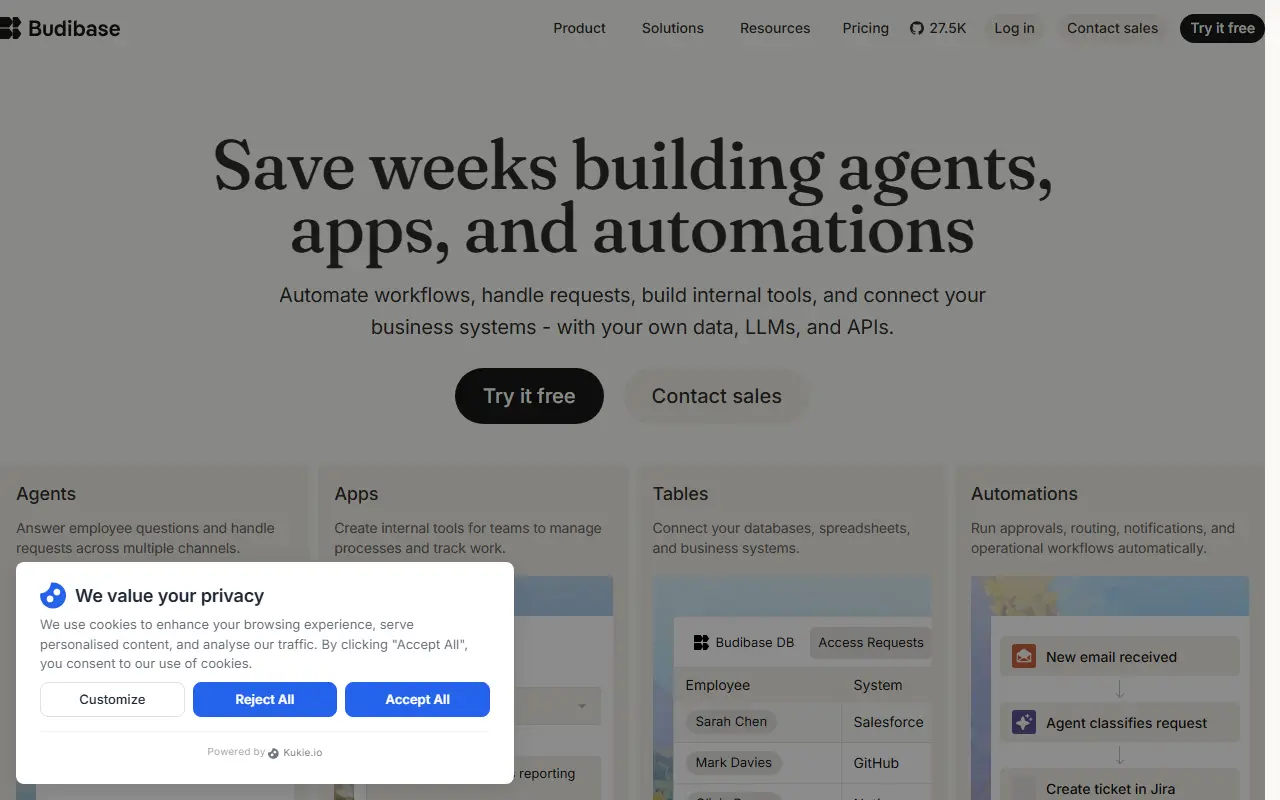
Budibase is an open-source operations platform for building AI agents, automations and apps that run internal processes. It is model agnostic and describes itself as saving engineers many hours when building these tools, while handling security concerns. Topics place it in the low-code and no-code internal tools space, with CRUD apps and an SQL GUI.
The idea is to run requests, approvals and workflows on one platform instead of stitching several tools together. Staff constantly ask questions, request sign-offs and flag problems, and Budibase agents interpret those requests and carry out the work: creating records, sending approvals to the right people, updating apps and alerting teams. You connect the business systems your operations already rely on, and the platform also supports building data applications over databases and REST APIs.
You can use Budibase Cloud, where the vendor hosts it, or host it yourself with Docker, Kubernetes or DigitalOcean. The repository is written in TypeScript, and its license is listed as 'Other' on GitHub, so check the terms for enterprise features. It suits operations and engineering teams that want internal tools and AI automation without building everything from scratch.
Key features
- AI agents that run workflows
- Internal app builder for CRUD tools
- Automations connecting business systems
- Works with any AI model
- Self-host with Docker or Kubernetes
- Budibase Cloud hosting
Pricing: The open-source edition is free to self-host. Cloud plans are Pro $19, Premium $49 and Business $299 per month, each with a 14-day trial; Enterprise is custom and quoted through sales.
#6
A spreadsheet-style AI workspace backed by real PostgreSQL, where data, automated AI workflows and custom apps live together, hosted in the cloud or self-hosted.
- GitHub stars
- 22k
- Last commit
- yesterday
- Latest release
- release.2026-11-10T05-38-53Z.3830
- Self-hosted
- Yes
- Hosted version
- Available
teable.ai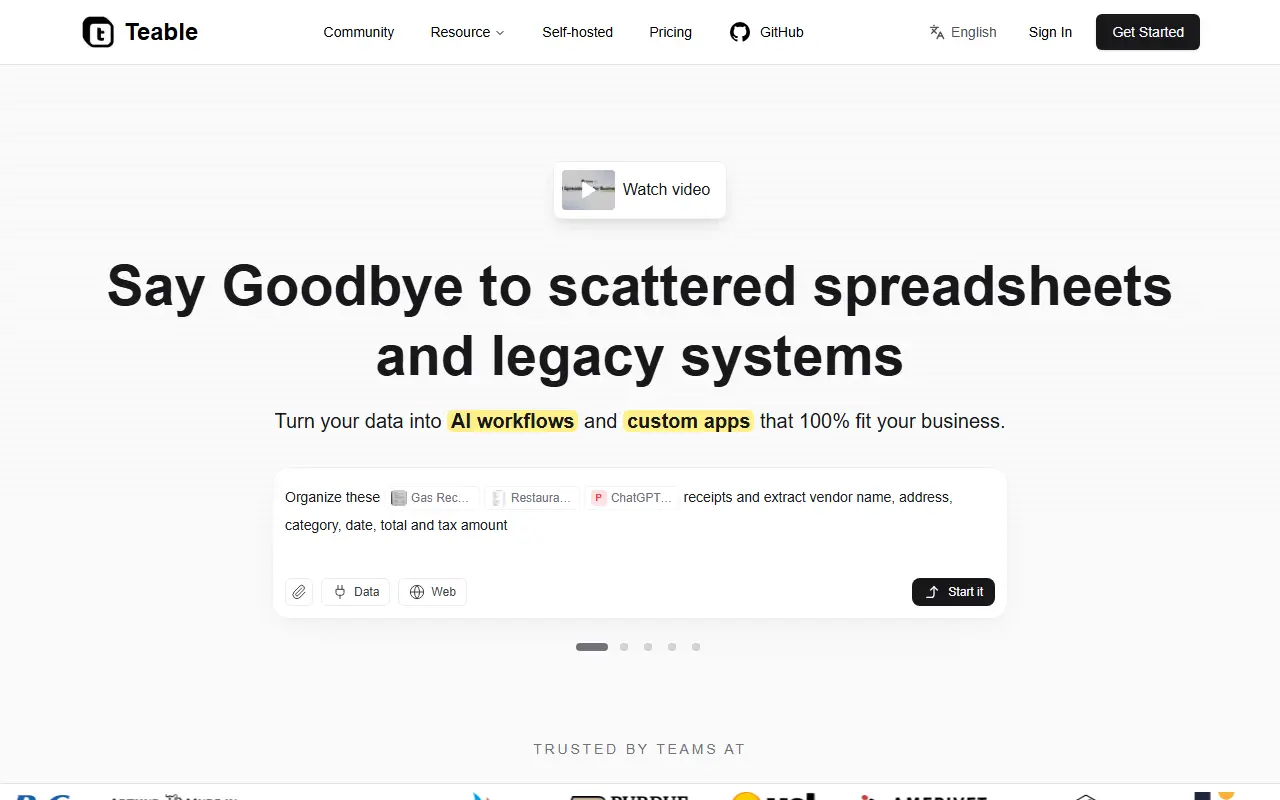
Teable pitches itself as an AI spreadsheet for business. On the surface it behaves like a simple spreadsheet, but underneath it stores data in real PostgreSQL, so teams get an Airtable-style experience on a database they can inspect. Topics tag it as an Airtable alternative, a no-code app builder and an internal tool platform.
The idea is to bring data management, AI workflows and app building into one place, with agents that work inside your live data and processes instead of on exported copies. The self-hosted distribution bundles several platforms together: a sandbox where each AI session runs in its own isolated container that exists only while the session lasts, a lightweight deployment platform for the apps your team builds, an AI chat and an App Builder.
You can try Teable on the hosted cloud at teable.ai, or follow the deployment guide to run a standalone install in minutes or the complete AI platform on your own machines. The code is written in TypeScript, and its license is listed as 'Other' on GitHub, so read the repository terms before commercial redistribution. It suits operations and business teams that want a spreadsheet front end with database-grade foundations.
Key features
- Spreadsheet interface over real PostgreSQL
- AI chat and agent workflows on live data
- Isolated container sandbox per AI session
- App Builder for custom internal apps
- App deployment platform for published apps
- Cloud-hosted or fully self-hosted
Pricing: Free plan for individuals. Pro costs $24 and Business $36 per seat per month, or $13 and $20 per seat per month when billed yearly.
#7
Baserow is a no-code platform for building databases, automations, apps and AI agents, positioned as an open-source Airtable alternative.
- GitHub stars
- 6.3k
- Last commit
- today
- Latest release
- 2.4.2
- Self-hosted
- Yes
- Hosted version
- Available
baserow.io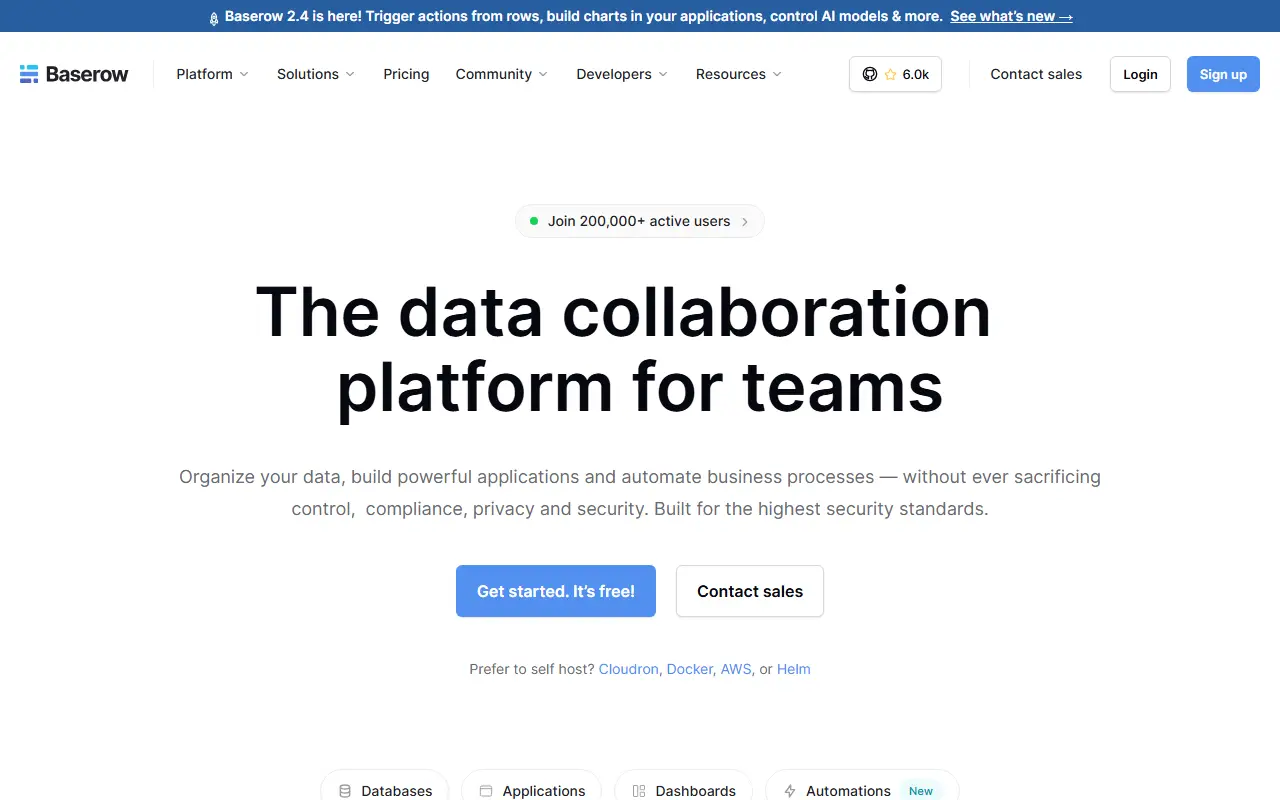
Baserow is an open-source, no-code platform that combines a spreadsheet-style database with automations, application building, dashboards and AI agents. It targets teams that want to structure data and build internal tools without writing code, and its repository is tagged as an Airtable alternative.
Capabilities include an AI Assistant that creates databases and workflows from natural-language instructions, an API-first design with a REST API, and extensibility for connecting to existing tools. The README states that the cloud service meets GDPR, HIPAA and SOC 2 Type II compliance requirements. The backend is written in Python and uses PostgreSQL for storage.
Baserow is available as a managed cloud service and as a self-hosted installation, which suits organizations that need to keep data on their own servers. The repository license is listed as 'Other' on GitHub, reflecting the open-source core alongside separately licensed premium and enterprise features, so check the terms for the features you need.
Key features
- Spreadsheet-style online database
- No-code app and automation builder
- AI Assistant for natural-language setup
- REST API with API-first design
- Dashboards over table data
- Cloud and self-hosted deployment
Pricing: Free plan with 3,000 rows per workspace. Premium costs $12 and Advanced $22 per user per month, or $10 and $18 billed yearly; Enterprise is on request.
#8
Relational spreadsheet that mixes spreadsheet flexibility with database structure, available as a self-hosted server or hosted service.
- GitHub stars
- 12k
- Last commit
- yesterday
- Latest release
- v1.7.22
- Licence
- Apache-2.0
- Self-hosted
- Yes
- Hosted version
- Available
getgrist.com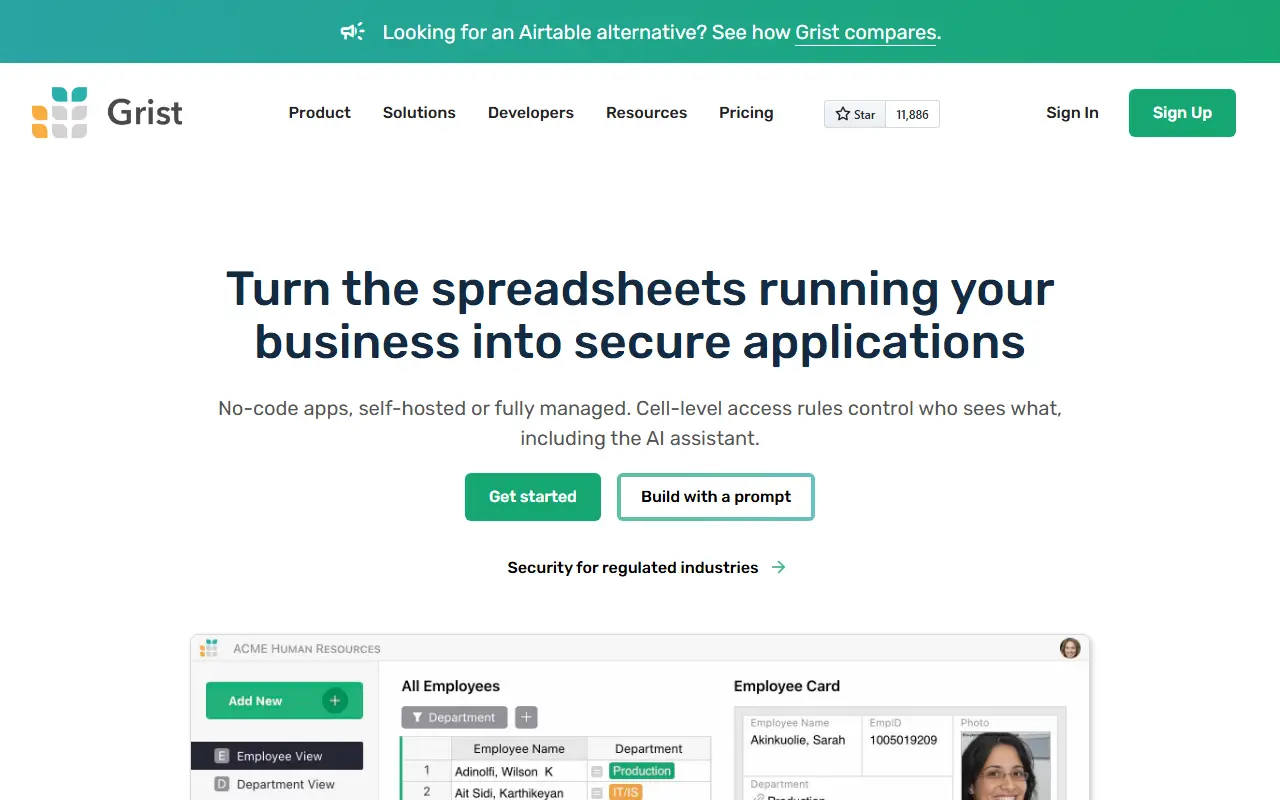
Grist is a relational spreadsheet that aims to combine the flexibility of a spreadsheet with the robustness of a database. Columns behave as they do in a database, with a name and a type, while users still write formulas and arrange data in a familiar grid. This repository, grist-core, is the Community edition that you can run as a server for hosting spreadsheets.
Two sibling projects exist: grist-desktop, an app for Linux, macOS and Windows that edits spreadsheets stored locally, and grist-static, a fully in-browser build that shows spreadsheets on a website without a back end. You can try the core with Docker or the desktop app. A list of extra features that are not in grist-core is maintained for people comparing the editions.
All three repositories are open source under the Apache License 2.0. Grist Labs, an NYC-based company, develops the project, with significant contributions from French government organizations ANCT and DINUM, and sells an edition with additional features. It also runs free and paid hosted services at getgrist.com. Help is available on Discord and a community forum.
Key features
- Typed, database-style spreadsheet columns
- Spreadsheet formulas and grid editing
- Self-hosted Community edition server
- Desktop app for local spreadsheets
- In-browser build via grist-static
- Docker-based deployment
Pricing: Free plan for small documents. Pro is $10 and Business $30 per user per month ($8 and $24 billed annually) with a 30-day trial; Enterprise is quoted. A free self-hosted Community edition exists.
#9
An API-oriented low-code platform that offers a collaborative visual database and spreadsheet interface, positioned as an open-source Airtable alternative.
- GitHub stars
- 16k
- Last commit
- 2 mo ago
- Latest release
- v1.14.0-beta
- Licence
- AGPL-3.0
- Self-hosted
- Yes
- Hosted version
- Available
aitable.ai
APITable is an open-source low-code platform centered on APIs, used to build collaborative apps and presented as an alternative to Airtable. The company also runs a cloud-hosted AI version at aitable.ai, which is the quickest way to try it, and a Gitpod demo and one-click self-hosted deployment are offered too.
The feature list covers realtime collaboration using operational transformation so several people can edit together, automatic forms, an API-first panel, unlimited cross-table links, row and column permissions, and embedding of tables elsewhere. It has a fast database-spreadsheet interface with a custom rendering engine and a database-native architecture. The stack includes TypeScript, Next.js and React on the front end, with NestJS and Spring components, and the project ships in several languages.
You can install APITable in a local or cloud environment, with a developer guide for contributors. It is AGPL-3.0 licensed and at a beta release. It suits teams that want an Airtable-style workspace with an API and the option to host it themselves.
Key features
- Spreadsheet-style visual database
- Realtime collaborative editing
- Automatic form generation
- Unlimited cross-table links
- Row and column permissions
- Embeddable tables and API access

A self-hosted, spreadsheet-like interface for viewing, editing, querying and collaborating on PostgreSQL data without writing code.
- GitHub stars
- 5.2k
- Last commit
- 2 days ago
- Latest release
- 0.12.0
- Licence
- GPL-3.0
- Self-hosted
- Yes
- Hosted version
- Available
mathesar.org
Mathesar is a web application that gives PostgreSQL databases a familiar spreadsheet-like interface. People of any technical skill level can view, edit, query and collaborate on data without writing code, and it works directly with existing databases, schemas and tables rather than adding extra abstractions.
The README outlines workflows such as connecting a database, adding collaborators, linking tables together, viewing a record alongside its related records, building and filling out forms, and saving queries as Explorations. Access control is based on native PostgreSQL roles and privileges, so permissions are managed in the database itself and your data never leaves your servers.
Mathesar is self-hosted, can be deployed in minutes and is often positioned as an open-source Airtable-style alternative for Postgres data. It is licensed under GPL-3.0, built with Svelte, Python and Django, and maintained by the Mathesar Foundation, a nonprofit. A managed Mathesar Cloud option is linked from the project.
Key features
- Spreadsheet-like editing of PostgreSQL tables
- Saved queries called Explorations
- Links between tables and related records
- Forms for data entry
- Collaborators with Postgres role-based access
- Works with existing databases and schemas
Pricing: Free and open source under GPL-3.0; Mathesar Cloud is offered as a hosted option.
2 more Stackby alternatives
Stackby alternatives: questions
- What is the best open-source alternative to Stackby?
- NocoDB is the top-ranked open-source alternative to Stackby on Enlisted: A self-hostable no-code database platform that puts a spreadsheet-style interface and auto-generated APIs on top of SQL databases, positioned as an Airtable alternative. Other strong options are Directus, Appsmith, ToolJet and Budibase.
- What are the best commercial alternatives to Stackby?
- Ninox, Ragic, SmartSuite, Airtable and Quickbase are among the hosted, closed-source alternatives to Stackby listed on Enlisted, which lists 22 in total. Compare their pricing and features on each tool page.
- Are these Stackby alternatives free?
- All 12 are open source, so the code is free to use under its licence, and all of them can be self-hosted on your own server or computer. 10 also offer a paid or managed cloud version if you'd rather not host it yourself.
- How is this list of Stackby alternatives ranked?
- By a score built from GitHub stars, star growth over the last 30 days and how recently the code changed. 9 of these projects shipped code in the last 30 days. Data is refreshed daily, and nobody can pay to move up.
 TrackMedia
 TrackRev