#1
Postal is an open-source mail delivery platform for sending and receiving email, comparable to Sendgrid, Mailgun or Postmark but run on your own servers.
- GitHub stars
- 17k
- Last commit
- 2 days ago
- Latest release
- 3.3.7
- Licence
- MIT
- Self-hosted
- Yes
postalserver.io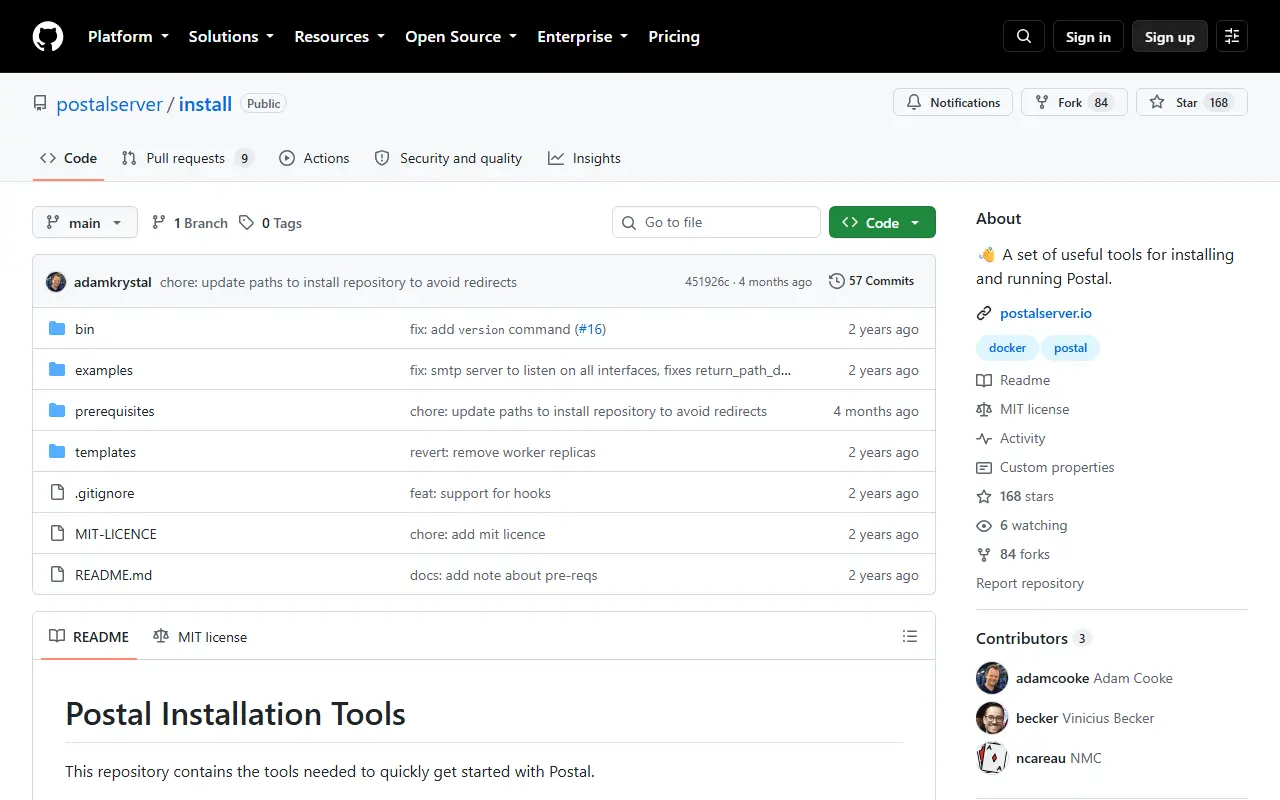
Postal is a complete mail server for websites and web servers that handles both outgoing and incoming email. The project describes it as an open-source take on services such as Sendgrid, Mailgun and Postmark, ready to run on your own servers rather than rented as a hosted API.
It is written in Ruby and released under the MIT license. The project provides documentation with installation instructions, an FAQ and features list, a separate repository of installation tools, and community support through GitHub Discussions and Discord. Repository topics list Ruby, mail, SMTP and mail server.
Because it is self-hosted, Postal suits teams that want control over their own email delivery infrastructure instead of relying on a hosted provider, such as websites that send transactional messages.
Key features
- Outgoing and incoming email handling
- Self-hosted alternative to Sendgrid and Mailgun
- SMTP mail server written in Ruby
- Installation tools and documentation
- Community support on Discord
Pricing: Free and open source under the MIT license.
#2
Mail-in-a-Box turns a fresh Ubuntu server into a complete self-hosted mail server with webmail, DNS, spam filtering and automatic TLS.
- GitHub stars
- 15k
- Last commit
- 5 days ago
- Latest release
- v77
- Licence
- CC0-1.0
- Self-hosted
- Yes
mailinabox.email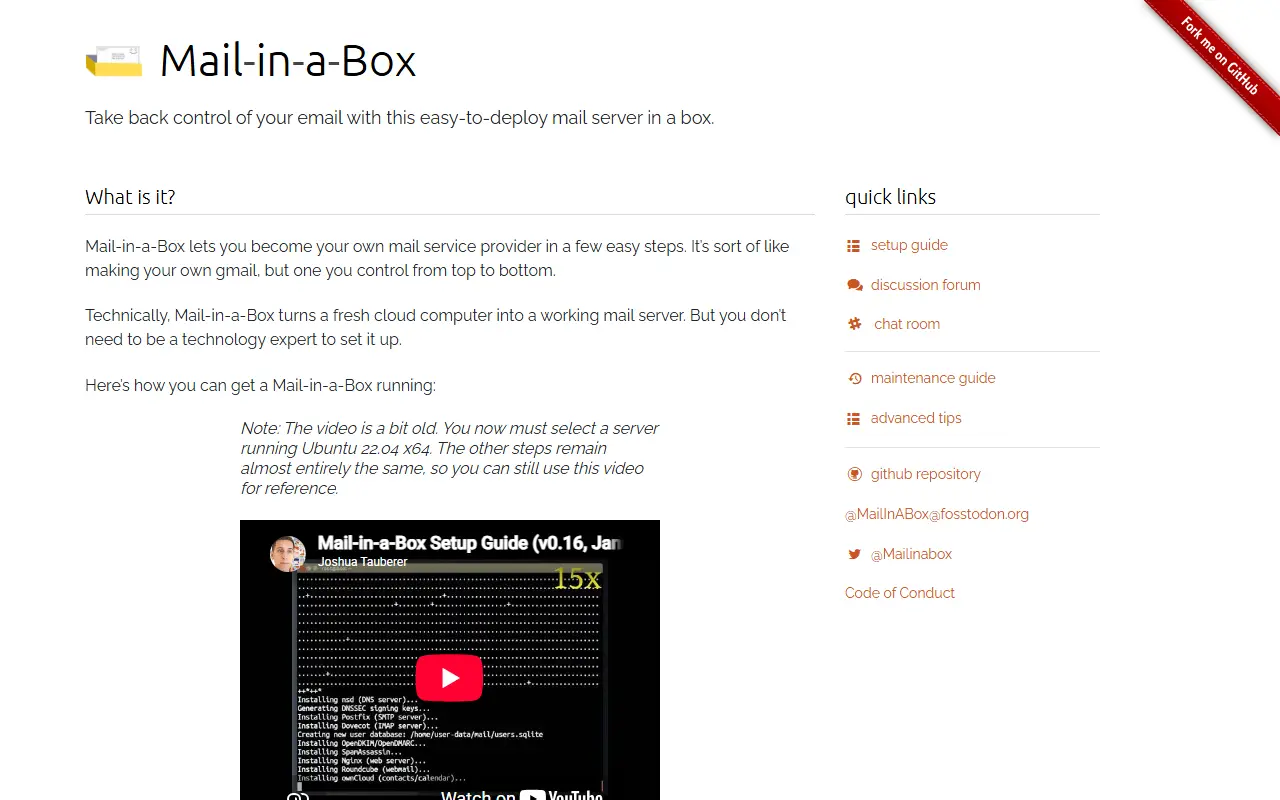
Mail-in-a-Box helps individuals take back control of their email by providing a one-click, easy-to-deploy mail server in a box. It turns a fresh Ubuntu 22.04 LTS 64-bit machine into a working mail server by installing and configuring the required components. There are no user-configurable setup options, so it is designed to just work.
The installed components include Postfix for SMTP, Dovecot for IMAP, Nextcloud for CardDAV and CalDAV, z-push for Exchange ActiveSync, and Roundcube webmail. It adds spam filtering with SpamAssassin and greylisting with Postgrey, DNS with SPF, DKIM, DMARC, DNSSEC, DANE TLSA, MTA-STS and SSHFP records set automatically, and TLS certificates from Let's Encrypt. Backups use duplicity, with ufw, fail2ban and munin for protection and monitoring.
Project goals include making a good mail server easy to deploy, promoting decentralization and privacy, and keeping configuration automated, auditable and idempotent. It deliberately does not aim to be customizable by power users. Mail-in-a-Box is written in Python, released into the public domain under CC0-1.0, and has a Code of Conduct for contributors.
Key features
- One-click mail server on Ubuntu 22.04
- Postfix SMTP and Dovecot IMAP
- Roundcube webmail and Nextcloud contacts
- Automatic SPF, DKIM, DMARC and DNSSEC setup
- Let's Encrypt TLS certificate provisioning
- Backups, fail2ban and health monitoring
Pricing: Free and open source, released under CC0-1.0.
#3
An open-source email platform for transactional email, campaigns and workflow automation, offered as a self-hostable alternative to SendGrid and Mailgun.
- GitHub stars
- 5.6k
- Last commit
- 2 days ago
- Latest release
- v0.18.0
- Licence
- AGPL-3.0
- Self-hosted
- Yes
- Hosted version
- Available
useplunk.com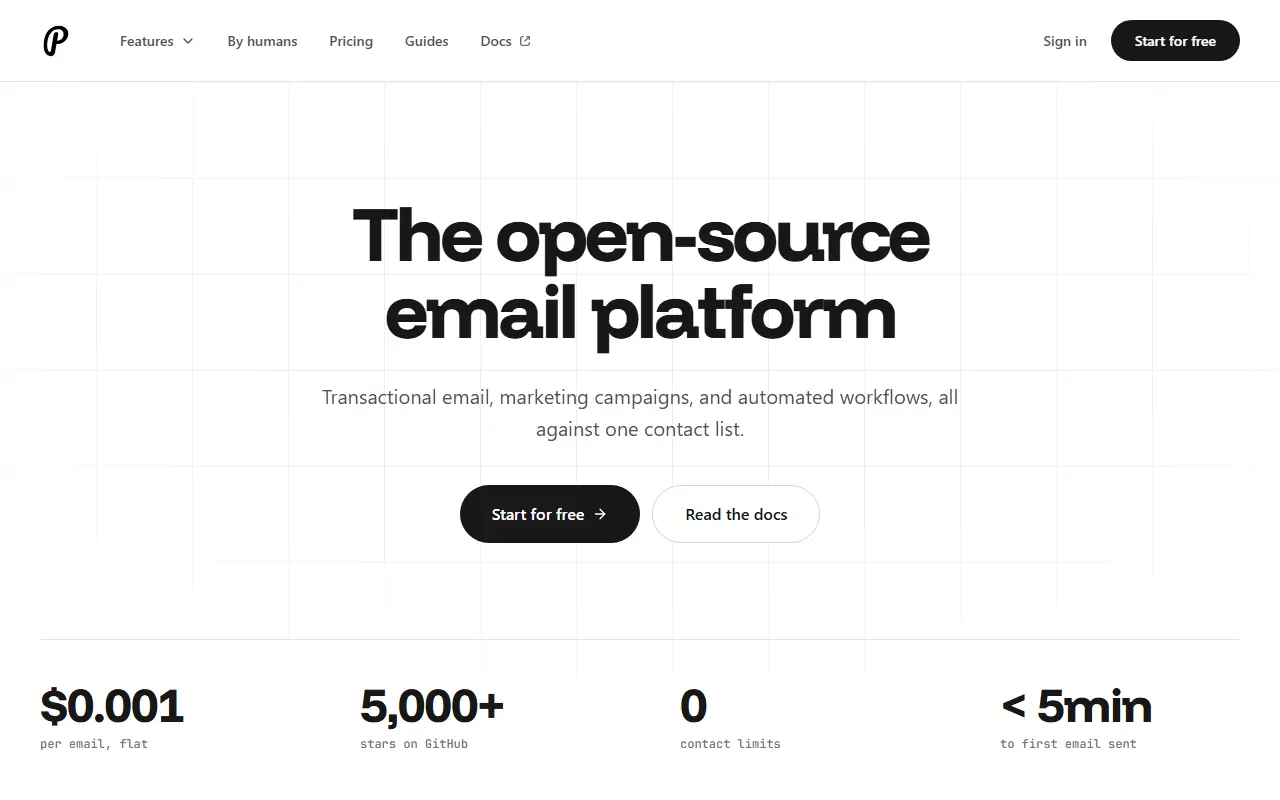
Plunk is an open-source email platform that combines transactional email, marketing campaigns and workflow automation in a single product. Developers can send messages from an API with templates and variable substitution, or use Plunk as an SMTP relay so that existing tools and frameworks can send through it.
Marketing features include campaigns for newsletters and product updates, dynamic segments, and contact management with custom fields and activity history. Workflows add triggers, delays and conditional logic, analytics track opens, clicks and bounces, custom domains are verified with DKIM and SPF, and inbound emails can be received and routed with custom rules.
Plunk is positioned as an open-source, self-hosted alternative to services such as SendGrid, Resend and Mailgun. It is licensed under AGPL-3.0, written in TypeScript, and can be deployed from an official Docker image following the project's documentation. The README cites a rate of $0.001 per email with no contact limits.
Key features
- Transactional email API with templates
- SMTP relay for existing tools
- Campaigns for newsletters and updates
- Workflow automation with delays and conditions
- Dynamic contact segments
- Open, click and bounce analytics
- Inbound email routing
- Custom sending domains with DKIM and SPF
Pricing: Free plan sends 1,000 emails a month. The paid plan charges $0.001 per email with unlimited contacts, and the software can be self-hosted for free.
#4
Mailu is a free mail server packaged as Docker images, bundling SMTP, IMAP, webmail, spam filtering and an admin interface for self-hosters.
- GitHub stars
- 7.6k
- Last commit
- 3 days ago
- Latest release
- 2024.06.68
- Self-hosted
- Yes
mailu.io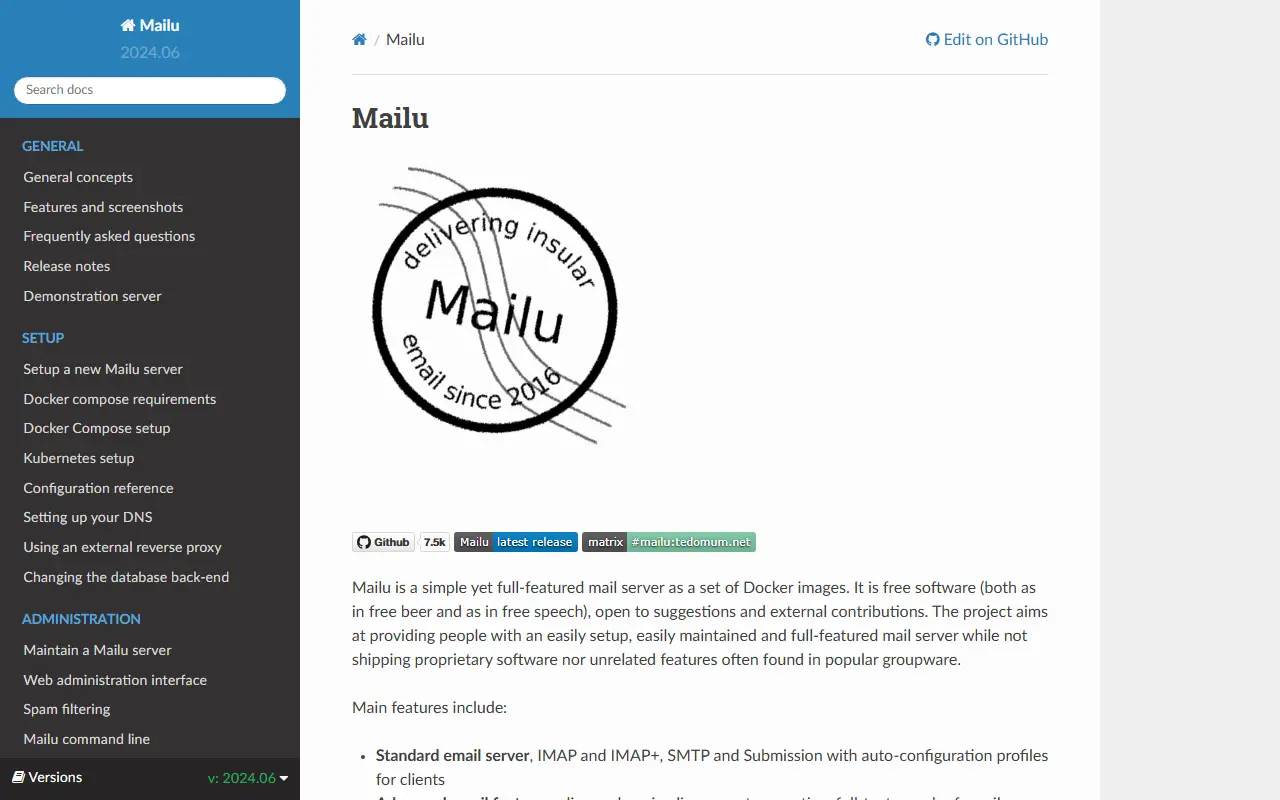
Mailu is a full-featured mail server delivered as a set of Docker images. The project aims to give people an easily set up and maintained mail server made entirely of free software, without proprietary components or unrelated groupware features and without trackers.
It covers the standard email server functions, IMAP and SMTP with client auto-configuration profiles, along with aliases, domain aliases, custom routing and full-text search of attachments. Users get webmail, auto-reply, auto-forward and managesieve, while admins get global admin roles, per-domain delegation, announcements and quotas. Security features include enforced TLS, DANE, MTA-STS, Let's Encrypt certificates, outgoing DKIM and an antivirus scanner, and antispam features include greylisting, auto-learning, DMARC, SPF and anti-spoofing checks.
Mailu is written in Python and deployed with Docker or Docker Compose. The project's own configuration files, Dockerfiles and code are MIT-licensed, and all bundled components are free software compatible with it. A demo server and website documentation are provided.
Key features
- IMAP and SMTP mail server in Docker
- Webmail and admin interface
- Aliases, domain aliases and custom routing
- Enforced TLS, DKIM, DANE and MTA-STS
- Spam filtering with greylisting and SPF
- Per-domain admin delegation and quotas
Pricing: Free and open source; the project's own code and configuration are MIT-licensed.
Single-daemon mail server that handles SMTP and IMAP and replaces Postfix, Dovecot, OpenDKIM and related tools with one configuration.
- GitHub stars
- 6.1k
- Last commit
- 2 days ago
- Latest release
- v0.9.7
- Licence
- GPL-3.0
- Self-hosted
- Yes
maddy.email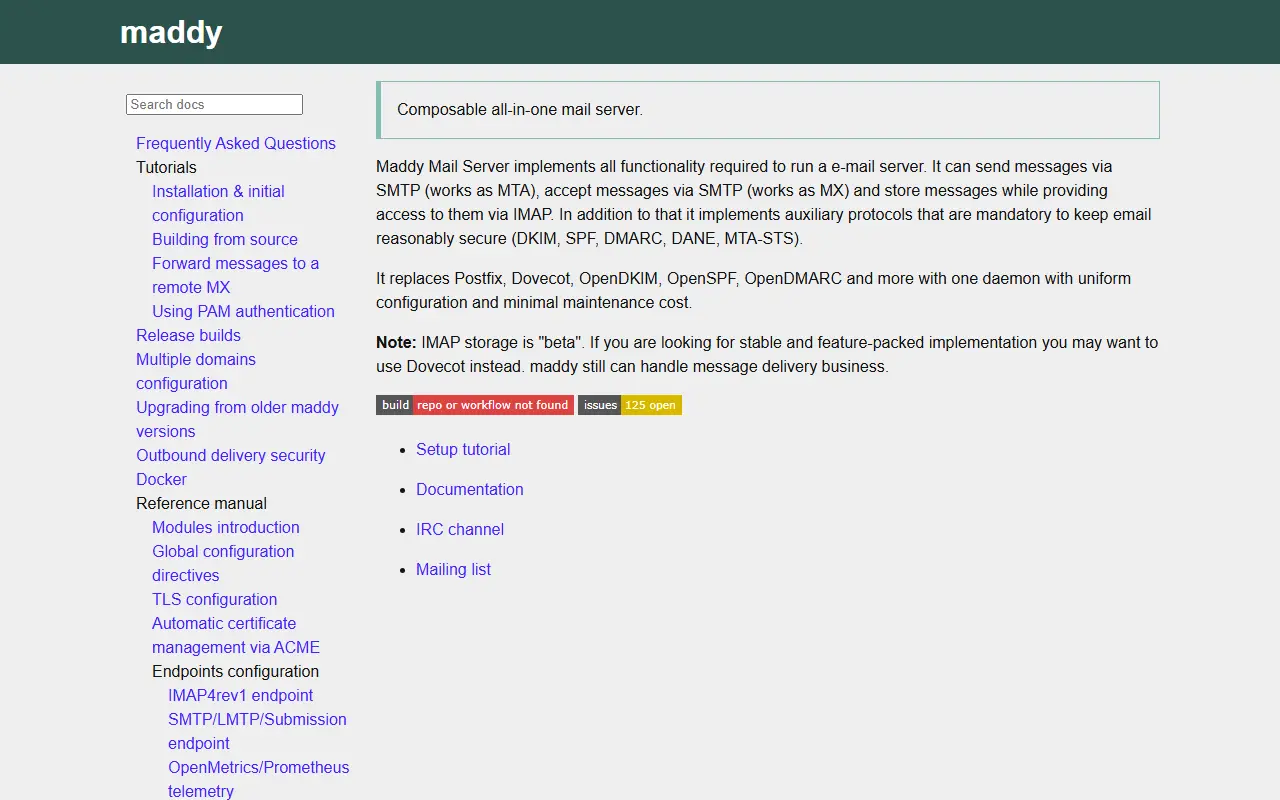
Maddy Mail Server aims to cover everything needed to run an email server in one program. It can send messages over SMTP as an MTA, accept them over SMTP as an MX, and store messages while giving access to them over IMAP.
It also implements the protocols used to keep email reasonably secure: DKIM, SPF, DMARC, DANE and MTA-STS. The project says it replaces Postfix, Dovecot, OpenDKIM, OpenSPF and OpenDMARC with one daemon that has a uniform configuration and minimal maintenance cost.
The documentation covers a setup tutorial, Docker, multiple domains, PAM and LDAP authentication, ACME certificate management, rspamd and DNSBL checks, and SQL, filesystem and Amazon S3 storage. The project warns that IMAP storage is beta and that Dovecot is the choice if you need a stable, feature-packed IMAP implementation. The licence is GPL-3.0.
Key features
- Complete mail server in one program
- Sends and receives over SMTP and serves IMAP
- DKIM, SPF, DMARC, DANE and MTA-STS support
- Replaces several separate mail components

Modoboa is an open-source mail server with a web interface that bundles Postfix, Dovecot and Rspamd into one manageable system.
- GitHub stars
- 3.5k
- Last commit
- 2 days ago
- Latest release
- 2.12.0
- Licence
- ISC
- Self-hosted
- Yes
modoboa.org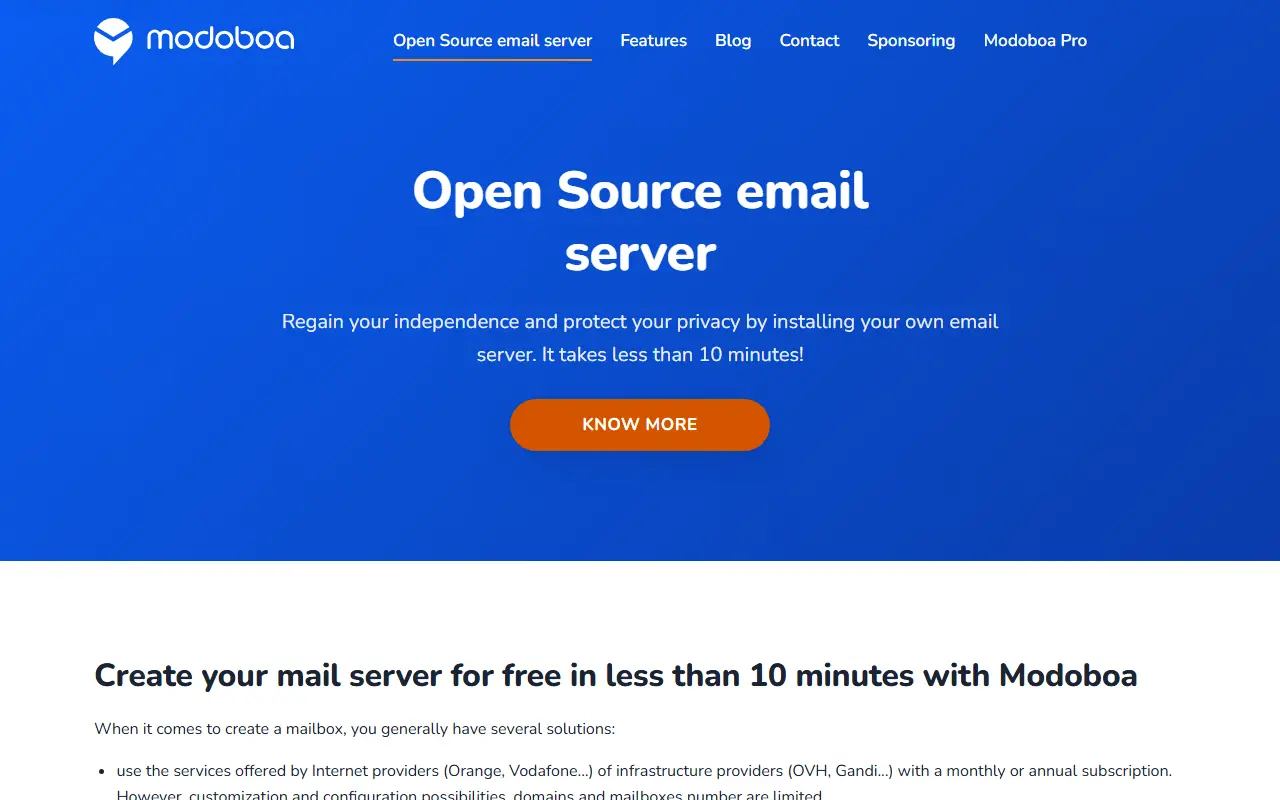
Modoboa is an open-source email server that comes with a modern web interface for administration. Its pitch is that running your own mail server should not require deep technical knowledge: the project says setup takes under ten minutes. It positions itself against paid mailboxes from internet providers, free webmail services that monetize your data, and doing everything by hand.
Under the hood it brings together established open-source components, including Postfix, Dovecot and Rspamd, behind a single interface. The resulting server offers the usual hosting features: webmail, calendars, address books, filtering rules to organize messages, an auto-responder, and unlimited domains, mailboxes and aliases. An administration panel covers managing all of these.
Modoboa is written in Python with Django and a Vue front end, and it is released under the ISC license. You host it yourself, which suits small businesses, associations and individuals who want control over their email and privacy. The website also lists a Modoboa Pro offering and a sponsoring page for supporting development.
Key features
- Web interface for administering the mail server
- Built-in webmail
- Calendar and address book management
- Filtering rules and auto-responder
- Unlimited domains, mailboxes and aliases
- Combines Postfix, Dovecot and Rspamd
Pricing: Free and open source under the ISC license; the website also lists a separate Modoboa Pro offering.
#7
Reaction Commerce, later Mailchimp Open Commerce, an API-first headless commerce platform on Node.js, MongoDB, and GraphQL that has been discontinued.
- GitHub stars
- 12k
- Last commit
- 8 mo ago
- Latest release
- v5.0.0
- Licence
- GPL-3.0
- Self-hosted
- Yes
mailchimp.com
Reaction, formerly Reaction Commerce and later Mailchimp Open Commerce, is an API-first, headless commerce platform built with Node.js, React, MongoDB, and GraphQL. It runs with npm, Docker, and Kubernetes. The repository tagline states that the project has been discontinued, so it should be treated as archived code, not a maintained product. It is released under the GPL-3.0 license.
While it was active it offered a plugin system for choosing integrations, multi-tenant hosting of several shops in one installation, products with options and variants, and an architecture designed to scale from one server to hundreds. The README claimed fast GraphQL queries and use on sites processing tens of thousands of orders a day.
Today it is mostly useful as a reference for headless commerce architecture or as a starting point for teams willing to maintain a fork. Anyone planning a new store should look at actively maintained alternatives.
Key features
- API-first headless commerce architecture
- GraphQL API on Node.js and MongoDB
- Plugin system for integrations
- Multi-tenant shops in one installation
- Products with options and variants
- Docker and Kubernetes deployment
Pricing: Free and open source under the GPL-3.0 license; the project has been discontinued.
#8
OpenSMTPD is a free server-side SMTP implementation from the OpenBSD project that lets ordinary machines exchange email with other SMTP systems.
- GitHub stars
- 587
- Last commit
- 10 days ago
- Latest release
- 7.9.0p0
- Self-hosted
- Yes
opensmtpd.org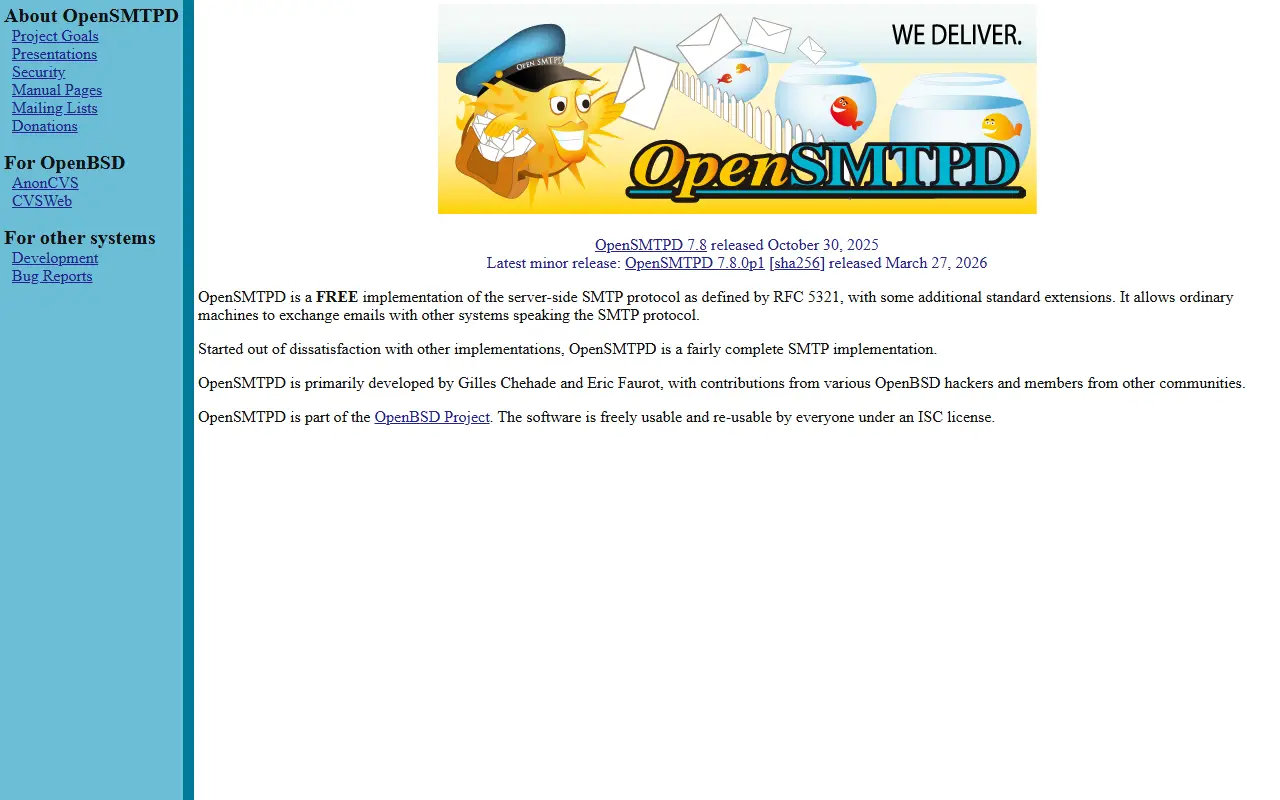
OpenSMTPD implements the server side of the SMTP protocol as defined in RFC 5321, along with some additional standard extensions. It lets ordinary machines exchange email with other systems that speak SMTP. The project started out of dissatisfaction with other implementations and describes itself as a fairly complete SMTP implementation.
It is developed mainly by Gilles Chehade and Eric Faurot, with contributions from OpenBSD developers and members of other communities, and it is part of the OpenBSD Project. The software is freely usable and reusable under an ISC licence. OpenBSD funds development partly by selling CDs, T-shirts, and posters.
The site has pages for project goals, security, manual pages, mailing lists, and bug reports, with separate sections for OpenBSD and for other systems. OpenSMTPD 7.8 was released on October 30, 2025, and 7.8.0p1 followed on March 27, 2026.
Key features
- Server-side SMTP per RFC 5321 with standard extensions
- Lets ordinary machines exchange mail with other SMTP systems
- Developed as part of the OpenBSD Project
- Separate download and development pages for non-OpenBSD systems
- Documented security page and manual pages
SMTP2GO alternatives: questions
- What is the best open-source alternative to SMTP2GO?
- Postal is the top-ranked open-source alternative to SMTP2GO on Enlisted: Postal is an open-source mail delivery platform for sending and receiving email, comparable to Sendgrid, Mailgun or Postmark but run on your own servers. Other strong options are Mail-in-a-Box, Plunk, Mailu and Maddy.
- What are the best commercial alternatives to SMTP2GO?
- Amazon SES, MailerSend, Mailtrap, Resend and Postmark are among the hosted, closed-source alternatives to SMTP2GO listed on Enlisted, which lists 18 in total. Compare their pricing and features on each tool page.
- Are these SMTP2GO alternatives free?
- All 8 are open source, so the code is free to use under its licence, and all of them can be self-hosted on your own server or computer. 1 also offers a paid or managed cloud version if you'd rather not host it yourself.
- How is this list of SMTP2GO alternatives ranked?
- By a score built from GitHub stars, star growth over the last 30 days and how recently the code changed. 7 of these projects shipped code in the last 30 days. Data is refreshed daily, and nobody can pay to move up.
 TrackMedia
 TrackRev