7,363 open-source and SaaS tools, with GitHub stats refreshed every day.

6 alternatives ranked by real activity

Open-source Rollbar alternatives

A curated, ranked list of the 6 best open-source alternatives to Rollbar.

The best open-source alternative to Rollbar is Sentry. If that doesn't suit you, other good options are HyperDX, Highlight.io, Exceptionless and Traceway.

Rollbar alternatives are mainly monitoring & observability tools. 6 of them shipped code in the last 30 days, 6 can be self-hosted, and 3 use a permissive licence.

Last updated October 2, 2026 · ranked by GitHub stars, growth and recent commits

Sentry

A developer-focused platform for error tracking and performance monitoring that helps teams detect, trace and fix issues, with SDKs for most programming languages.

GitHub stars
45k
Last commit
today
Latest release
26.9.0
Self-hosted
Yes
Hosted version
Available
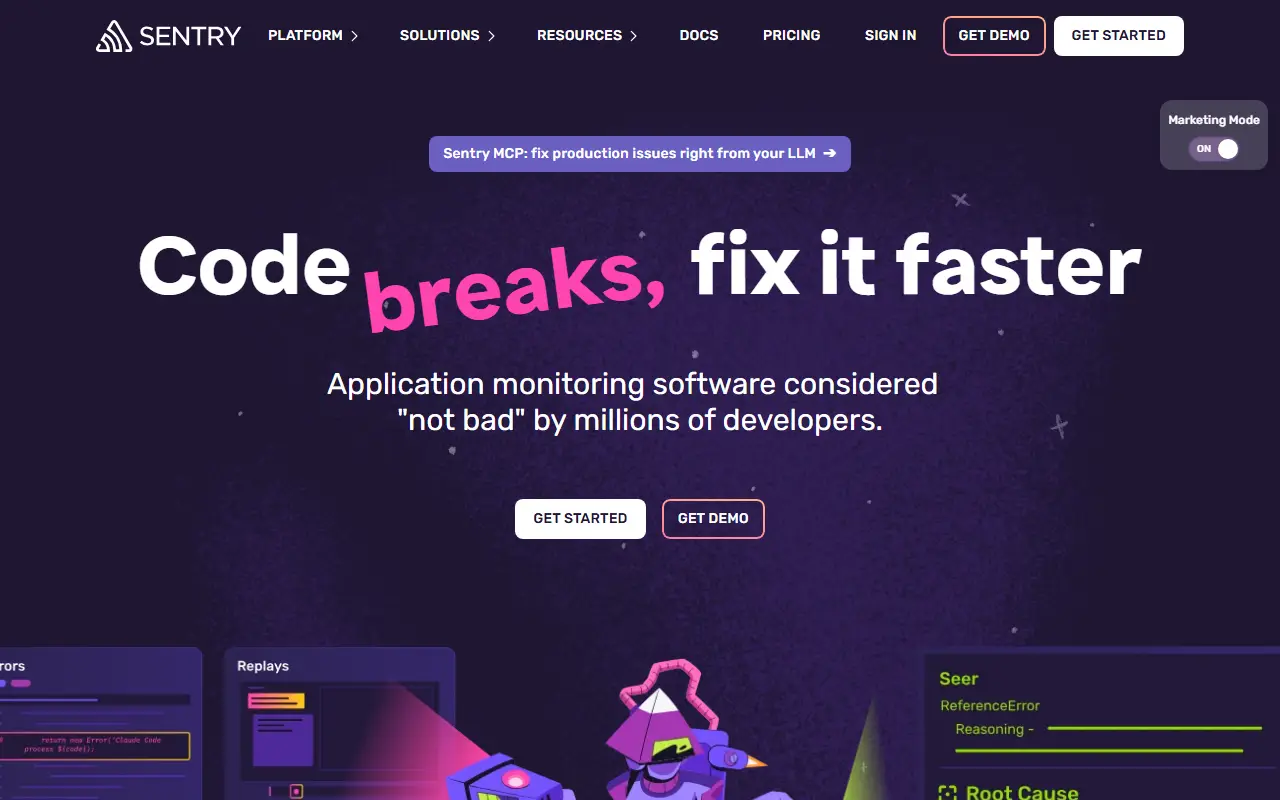
sentry.ioSentry homepage screenshot

Sentry is a debugging platform that helps developers detect, trace and fix problems in their applications. It collects crash reports and errors from running software, groups them into issues, and adds the context needed to understand what happened, alongside performance monitoring for slow requests and transactions.

Integration happens through official SDKs covering web, mobile, desktop, server and game platforms, from JavaScript, Python and PHP to Go, Rust, Java, Kotlin, Swift, Flutter, Unity, Unreal Engine and Godot. The server itself is a Python application built on Django, and topics also mention CSP report collection and application performance monitoring.

Sentry is source available, and its license is listed as 'Other' on GitHub rather than a standard open-source license. It can be run on your own infrastructure, and the company also operates the hosted service at sentry.io. It is used by engineering teams of all sizes as a first stop when something breaks in production.

Key features

  • Error and crash tracking
  • Application performance monitoring
  • Official SDKs for many languages and frameworks
  • Issue grouping with debugging context
  • CSP report collection
  • Self-hosted or hosted deployment

Pricing: Free Developer plan for one user. Team is $26 per month and Business $80 per month when billed annually, with unlimited users; Enterprise is custom. Usage above the included quota is billed pay-as-you-go.

HyperDX

An open-source observability platform that unifies logs, traces, metrics and session replays on top of ClickHouse and OpenTelemetry, a Kibana-style experience for ClickHouse.

GitHub stars
9.9k
Last commit
today
Latest release
cli-v0.6.4
Licence
MIT
Self-hosted
Yes
Hosted version
Available
hyperdx.ioHyperDX homepage screenshot

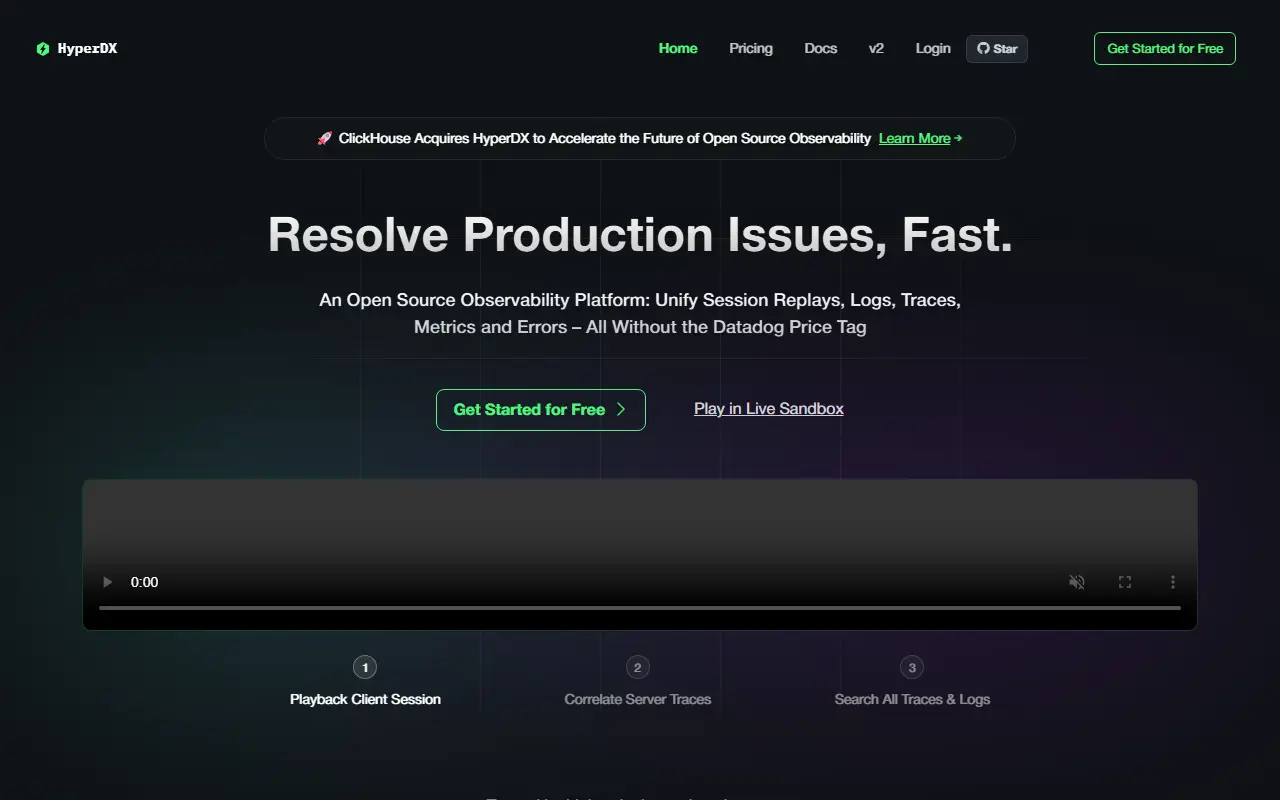
HyperDX is an open-source observability platform for working out why production is broken. It brings logs, metrics, traces, errors and session replays into one place, and works as a search and visualization layer on top of ClickHouse and OpenTelemetry, which the authors compare to Kibana for ClickHouse. It is a core component of ClickStack.

It is schema agnostic and can sit on top of an existing ClickHouse schema. Searching uses full-text and property syntax such as level:err, with SQL as an option, events can be compared with event deltas, high-cardinality events can be charted on dashboards, and alerts can be set up in a few clicks. Live tail shows the newest logs and traces, JSON strings can be queried natively, OpenTelemetry works out of the box, and APM views cover HTTP requests down to database queries.

One deployment option is ClickStack, a bundle of ClickHouse, HyperDX, an OpenTelemetry Collector and MongoDB, and HyperDX can instead be pointed at your own ClickHouse instance. It can also be used with ClickHouse Cloud. The project is MIT licensed and written in TypeScript.

Key features

  • Unified logs, metrics, traces and session replays
  • Schema-agnostic search on ClickHouse
  • Full-text and property search syntax
  • Alerts and event delta analysis
  • Live tail for logs and traces
  • OpenTelemetry support out of the box
  • Dashboards for high-cardinality events

Pricing: Free plan stores up to 3 GB a month. Starter is $20 per month flat with 50 GB included and $0.40 per extra GB; Enterprise is custom. No per-seat or per-host billing.

Sentry

Self-hosted Sentry packaged with Docker Compose, for running the error and performance monitoring platform on your own server.

GitHub stars
9.6k
Last commit
today
Latest release
26.9.0
Self-hosted
Yes
Hosted version
Available
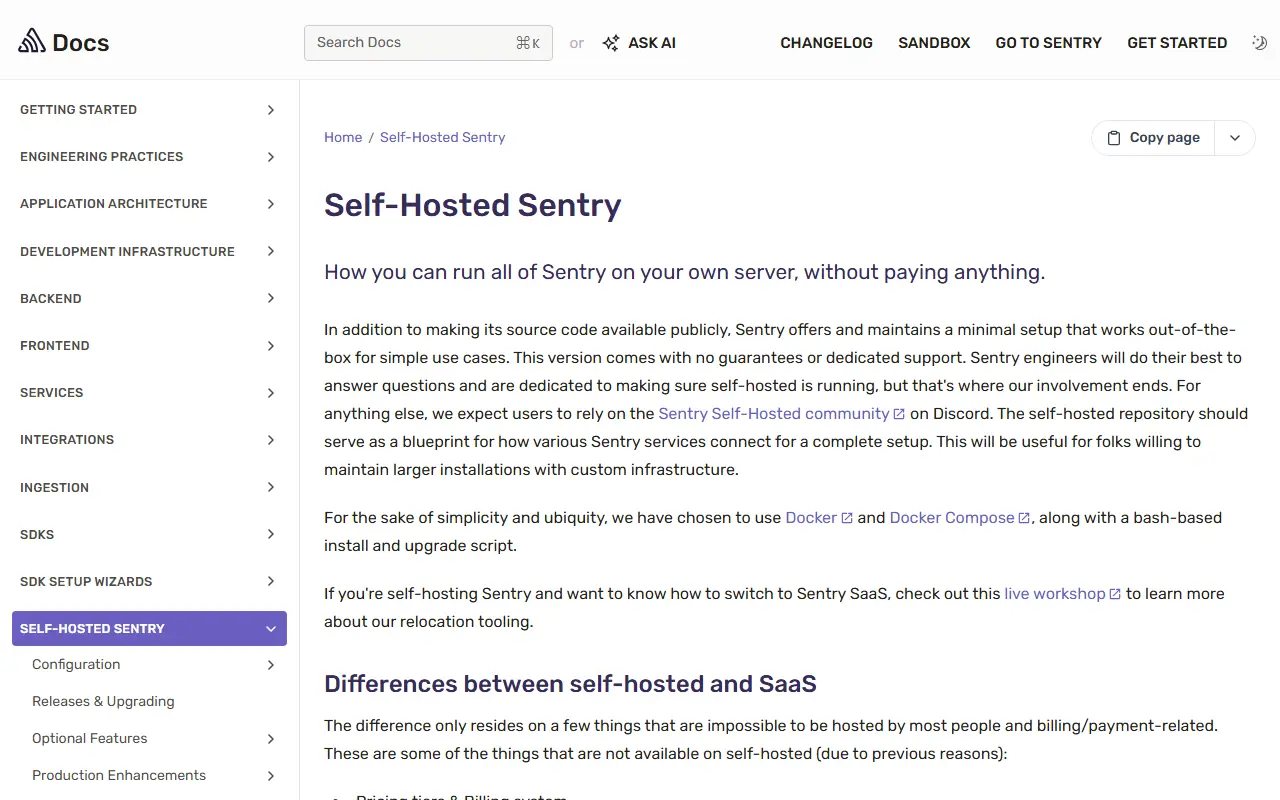
develop.sentry.devSentry homepage screenshot

This repository packages Sentry for self-hosting. It lets organizations run the whole Sentry platform on their own server without paying for the hosted product, and the project describes it as feature-complete but aimed at low-volume deployments and proofs of concept. The entry is listed under the name Develop, taken from the documentation site.

Sentry maintains a minimal setup that works out of the box for simple cases, built on Docker and Docker Compose with a bash-based install and upgrade script. It comes with no guarantees or dedicated support, so users are expected to rely on the community on Discord. For larger installations the repository acts as a blueprint of how Sentry services connect, and the docs cover configuration, upgrades, backup and restore, and production enhancements.

The code is distributed under Sentry's fair-source license rather than a standard open-source one. Documentation also explains the small number of differences between self-hosted and the SaaS version, along with relocation tooling for moving to Sentry's hosted service.

Key features

  • Complete Sentry stack for self-hosting
  • Docker Compose based installation
  • Install and upgrade scripts
  • Backup and restore documentation
  • Reference architectures for larger installs

Pricing: Free to self-host under Sentry's fair-source license with no guaranteed support; a hosted SaaS version is also available.

Highlight.io

An open-source full-stack monitoring platform that combines session replay, error monitoring, logging and distributed tracing, offered hosted or self-hosted.

GitHub stars
9.4k
Last commit
yesterday
Latest release
docker-v0.5.6
Self-hosted
Yes
Hosted version
Available
app.highlight.ioHighlight.io homepage screenshot

Highlight, at highlight.io, is an open-source monitoring platform for developers. Its aim is to give teams one cohesive tool covering the front end and back end, instead of separate products for errors, logs and user sessions.

The core features are session replay, error monitoring and logging, with tracing and metrics also in scope. Console logs from the front end can be analyzed, and errors are embedded alongside the session in which they happened, so you can see what the user was doing beforehand. Session comments let teams discuss user frustration or bugs, there are integrations with other tools, and client SDKs install with a few lines of code.

You can sign up for the free-to-start hosted version at app.highlight.io, or deploy a hobby instance on Linux with Docker, sized at roughly 8 GB of memory, four CPUs and 64 GB of storage. The code is written in TypeScript and Go, and the repository lists the license as Other, so check the licence file for terms.

Key features

  • Session replay for user interactions
  • Error monitoring tied to sessions
  • Logging and console log analysis
  • Distributed tracing and metrics
  • Session comments for team discussion
  • Client SDKs for several platforms
  • Docker hobby self-hosting

Pricing: A hosted version is free to start; a hobby self-hosted instance is available. The repository lists the license as Other.

Exceptionless

Real-time error and event reporting for JavaScript, Node, and .NET applications, available as a hosted service or self-hosted with Docker.

GitHub stars
2.5k
Last commit
yesterday
Latest release
v8.10.0
Licence
Apache-2.0
Self-hosted
Yes
Hosted version
Available
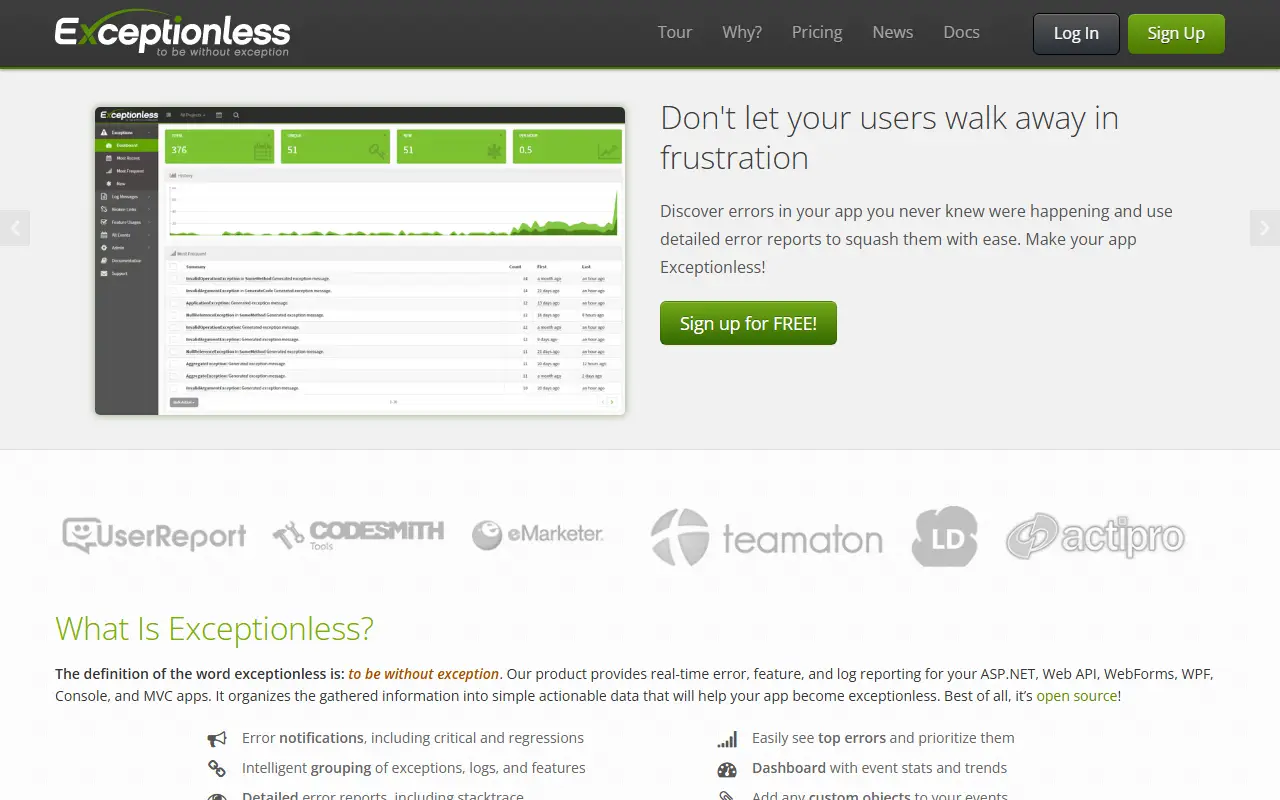
exceptionless.comExceptionless homepage screenshot

Exceptionless provides real-time error reporting for JavaScript, Node, .NET Core, ASP.NET, Web API, WebForms, WPF, console, and MVC applications. It gathers exceptions and logs, groups them into simple actionable data, and helps teams fix problems quickly. The name means without exception. It is released under the Apache-2.0 license.

The topics mention error monitoring, crash reporting, logging, bug tracking, Elasticsearch, Redis, and the Foundatio library, which indicate the stack behind the server. The application is written in C# with a JavaScript front end.

You can use the hosted service run by the project, which the maintainers describe as reasonably priced and as a way to support the project, along with setup and support services, or run the server yourself. A single Docker command starts a local instance on port 7110. It suits development teams who want an open-source alternative to commercial error-tracking tools.

Key features

  • Real-time error and exception reporting
  • Support for JavaScript, Node, and .NET apps
  • Grouped, actionable error data
  • Event logging
  • Docker one-command local setup
  • Hosted service or self-hosting

Pricing: A free plan includes 3,000 events per month. Paid plans range from $15 (Small) to $499 (Enterprise) per month, mainly by event volume; self-hosting is also possible.

Traceway

An OpenTelemetry-native observability platform combining logs, traces, metrics, exceptions, session replay and AI tracing, self-hosted or in the cloud.

GitHub stars
1.6k
Last commit
2 days ago
Latest release
cli/v2.0.3
Licence
MIT
Self-hosted
Yes
Hosted version
Available
tracewayapp.comTraceway homepage screenshot

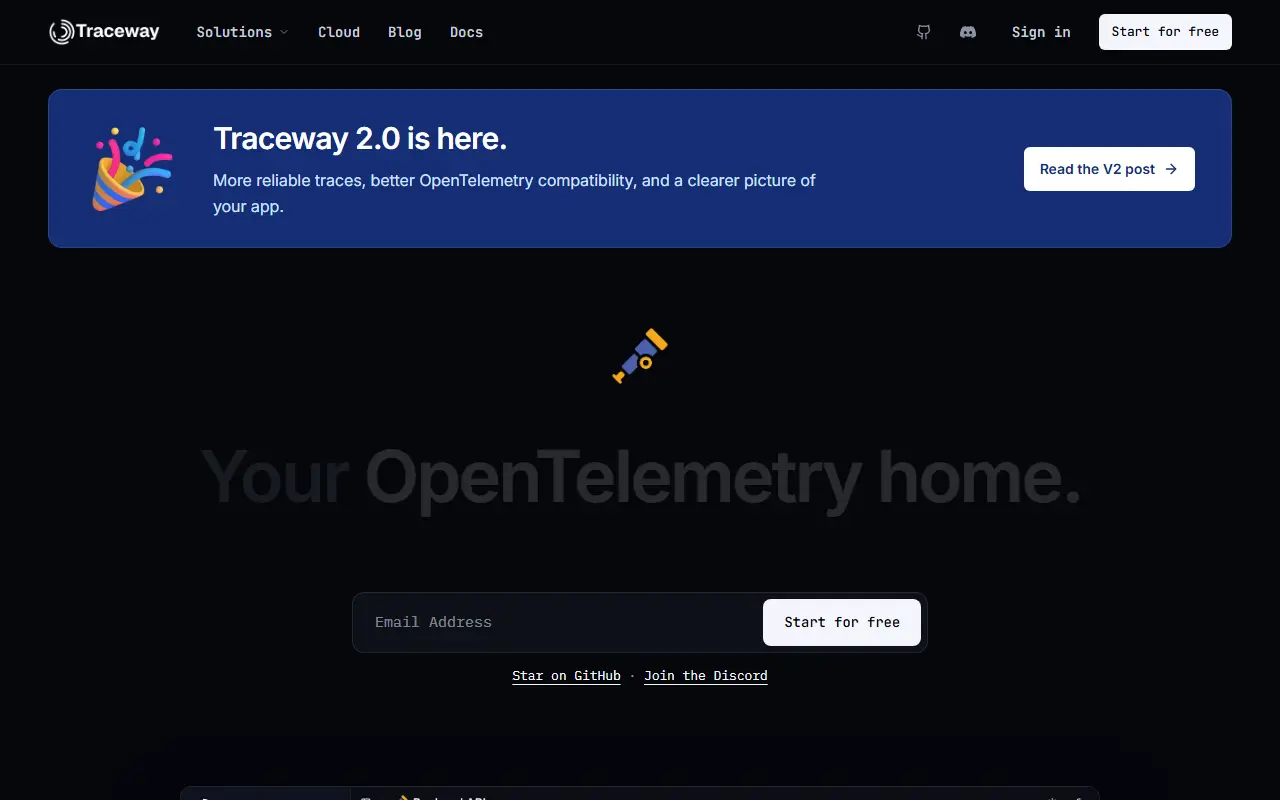
Traceway is an observability platform built natively on OpenTelemetry. It brings logs, traces, metrics, exception tracking, session replay, AI tracing and on-call paging into one product, and you can start by pointing an OTLP exporter at it without a separate collector or a vendor-specific SDK for each language.

Logs are structured and linked to traces, so you can jump from a log line to its span. Traces show end-to-end waterfalls, endpoint views rank routes by latency percentiles and error rate, and exceptions are grouped into ranked issues with source map support. There is experimental profiling with flame graphs, session replay for web and Flutter apps, and LLM observability covering cost, tokens and latency.

The project is written in Go, licensed under MIT and says that every feature ships in the open-source build with no open-core split. You can self-host it for free, using a setup the README says takes about 90 seconds, or run it on Traceway Cloud if you prefer not to manage infrastructure. It suits engineering teams looking for one tool to find and diagnose production problems.

Key features

  • Structured logs linked to traces
  • End-to-end distributed tracing waterfalls
  • Grouped exception tracking with source maps
  • Session replay for web and Flutter
  • LLM cost and latency observability
  • On-call paging and alerting

Pricing: Free to self-host under the MIT licence with all features included; a hosted Traceway Cloud option is also available.

Rollbar alternatives: questions

What is the best open-source alternative to Rollbar?
Sentry is the top-ranked open-source alternative to Rollbar on Enlisted: A developer-focused platform for error tracking and performance monitoring that helps teams detect, trace and fix issues, with SDKs for most programming languages. Other strong options are HyperDX, Highlight.io, Exceptionless and Traceway.
Are these Rollbar alternatives free?
All 6 are open source, so the code is free to use under its licence, and all of them can be self-hosted on your own server or computer. 6 also offer a paid or managed cloud version if you'd rather not host it yourself.
How is this list of Rollbar alternatives ranked?
By a score built from GitHub stars, star growth over the last 30 days and how recently the code changed. 6 of these projects shipped code in the last 30 days. Data is refreshed daily, and nobody can pay to move up.

People also look for alternatives to…

View all