7,363 open-source and SaaS tools, with GitHub stats refreshed every day.

9 alternatives ranked by real activity

Open-source Rocket Money alternatives

A curated, ranked list of the 9 best open-source alternatives to Rocket Money.

The best open-source alternative to Rocket Money is Actual Budget. If that doesn't suit you, other good options are Firefly III, Sure, Wallos and ezBookkeeping.

Rocket Money alternatives are mainly finance & accounting tools. 8 of them shipped code in the last 30 days, 9 can be self-hosted, and 2 use a permissive licence.

Last updated October 3, 2026 · ranked by GitHub stars, growth and recent commits

Actual Budget

Actual is a local-first personal finance and envelope budgeting app that syncs between devices and can be self-hosted or run locally.

GitHub stars
29k
Last commit
today
Latest release
v26.10.0
Licence
MIT
Self-hosted
Yes
Hosted version
Available
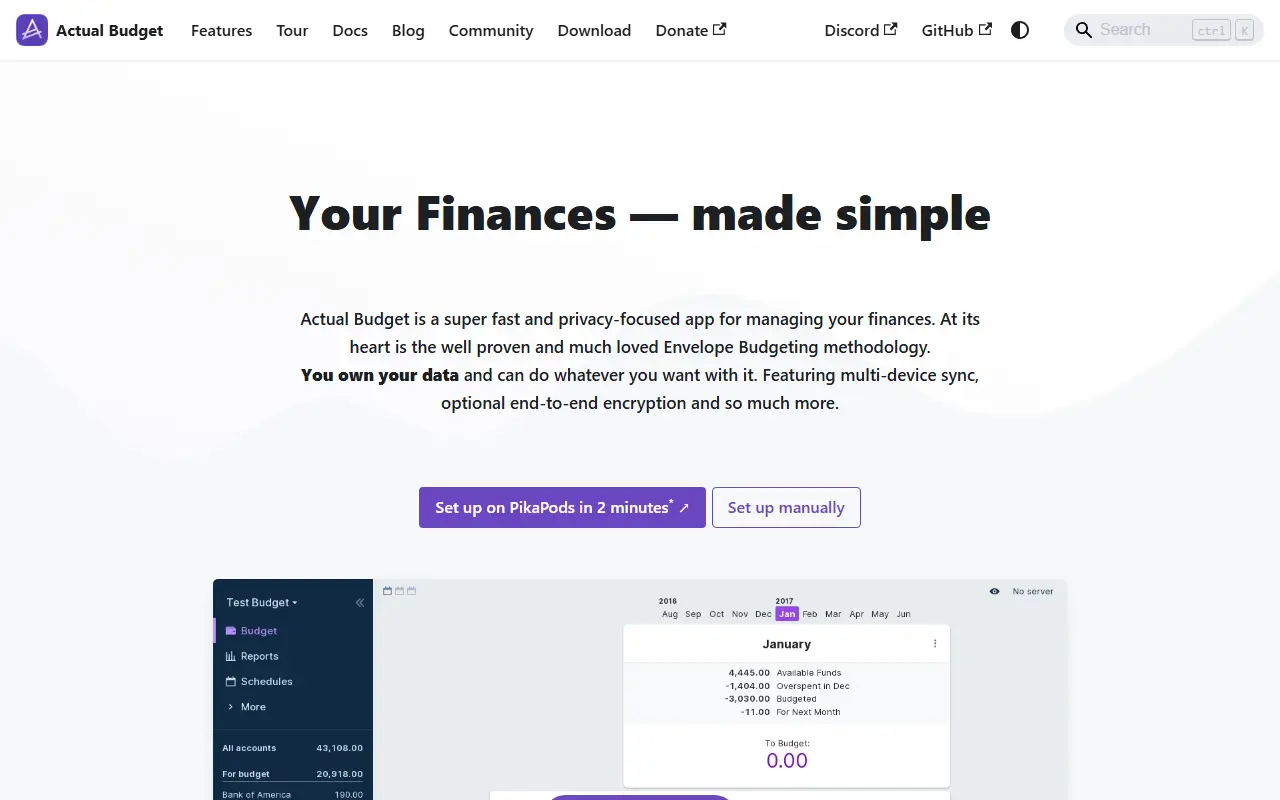
actualbudget.orgActual Budget homepage screenshot

Actual is a personal finance tool built around a local-first design. It is free and open source under the MIT license, written in TypeScript on NodeJS, and includes a synchronization layer so changes move between your devices without much effort. Its budgeting approach follows the envelope method, and the community documentation covers budgeting, account management and tips.

There are four ways to run it: a one-click deployment on PikaPods, managed hosting on Fly.io, self-hosting with a Docker image, or local-only apps for Windows, macOS and Linux that run on your own device. The code is organized into packages such as loot-core for the cross-platform core, desktop-client for the user interface and desktop-electron for the desktop app. The community offers guides for starting fresh and for migrating from other budgeting apps.

Key features

  • Local-first personal finance and budgeting
  • Envelope budgeting method
  • Sync of changes between devices
  • Docker image for self-hosting
  • Desktop apps for Windows, macOS and Linux
  • Migration and starting-fresh community guides

Pricing: Free and open source under the MIT license; optional paid managed hosting through third-party providers is listed in the README.

Firefly III

Firefly III is a self-hosted personal finance manager that tracks income and expenses with budgets, categories, tags and reports.

GitHub stars
25k
Last commit
yesterday
Latest release
v6.7.6
Licence
AGPL-3.0
Self-hosted
Yes
firefly-iii.orgFirefly III homepage screenshot

Firefly III runs on your own server and manages your personal finances. It helps you follow what you earn and spend, with the aim of spending less and saving more, and it supports budgets, categories and tags. The project describes itself as free and open source, with no AI and no cloud, and as privacy friendly. It is written in PHP and released under the AGPL-3.0 license.

A set of import tools brings in data from other sources, and the application offers many financial reports to give insight into where money goes. The author built it out of a wish to feel in control of money rather than stressed by it. You can try a public demo, read the documentation, or install it yourself, and the repository topics point to Docker and Linux deployments. The project originates in the European Union and accepts donations.

Key features

  • Tracks income, expenses and transfers
  • Budgets, categories and tags
  • Import tools for bringing in transactions
  • Financial reports for spending insight
  • Self-hosted with Docker support
  • Public demo for trying it out

Pricing: Free and open source under the AGPL-3.0 license; donations are accepted.

Sure

Self-hostable personal finance app, maintained by the community as a continuation of the abandoned Maybe Finance project.

GitHub stars
10k
Last commit
today
Latest release
v0.7.5-hotfix.1
Licence
AGPL-3.0
Self-hosted
Yes
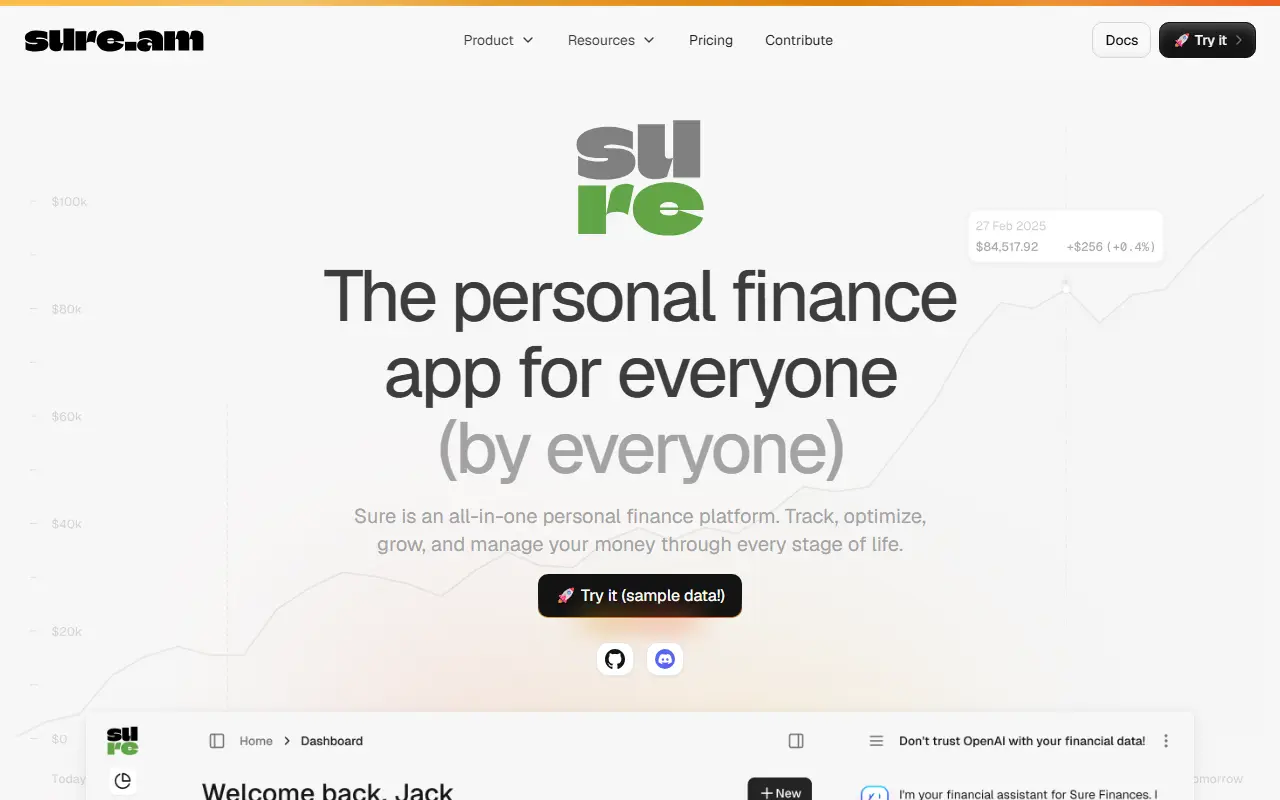
sure.amSure homepage screenshot

Sure is a personal finance application that can be self-hosted with Docker. It is a community-maintained fork of Maybe Finance, a project whose team built a full-featured personal finance and wealth management app and then stopped development after the business did not work out. Sure keeps that codebase alive.

The app can be accessed from a browser, a macOS desktop app, a mobile app, API clients and LLM agents, and the README points to an overview of Sure Clients. It is a fully working finance app for tracking money, and the maintainers invite contributors to join through Discord, GitHub issues and the project website. The README is translated into several languages.

Sure is written in Ruby and released under the AGPL-3.0 license. Anyone may fork it under that license, but forks are asked to include the original license and state that they are based on Maybe Finance and not affiliated with it, to stay compliant and avoid trademark problems.

Key features

  • Personal finance tracking
  • Self-hosting with Docker
  • Browser, macOS and mobile access
  • API access for clients and LLM agents
  • Community fork of Maybe Finance

Pricing: Free Good tier keeps 90 days of data. Better costs $5 and Best $9 per month, or $50 and $90 per year. The app can also be self-hosted.

Read more about SureWebsite GitHub

Wallos

A self-hostable personal subscription tracker for visualizing recurring expenses, with categories, multi-currency support, statistics and notifications.

GitHub stars
8.6k
Last commit
yesterday
Latest release
v5.8.3
Licence
GPL-3.0
Self-hosted
Yes
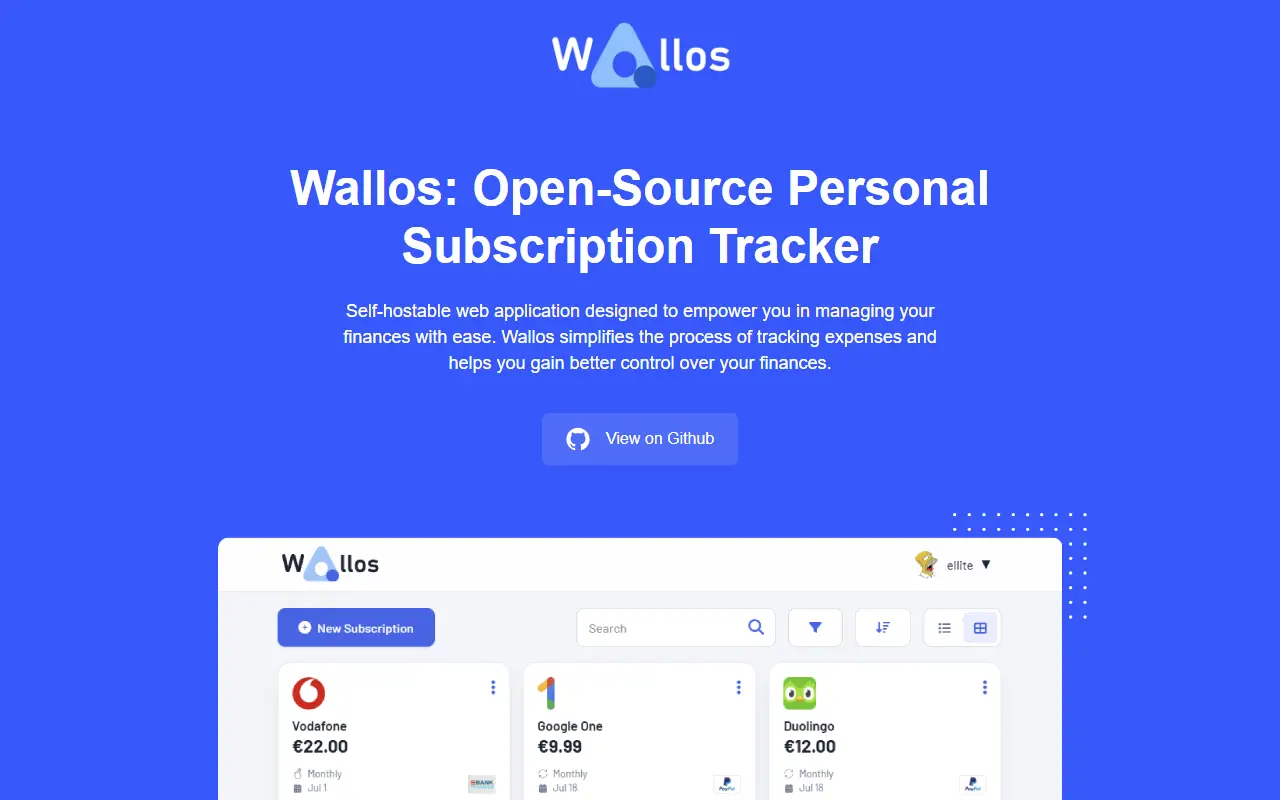
wallosapp.comWallos homepage screenshot

Wallos is a web application you host yourself for tracking recurring subscriptions and understanding where your money goes. It is positioned as a lighter alternative to spreadsheets and expensive finance software, and since it is self-hosted, your financial data stays on your own server.

It tracks subscriptions and payments with due dates, organizes spending into customizable categories, and supports multiple currencies, with currency conversion through the Fixer API so that everything can be seen in one main currency. Other features include customizable themes and display options, sorting options, a web search for subscription logos, a mobile view, statistics on spending and notifications. The documentation also covers OIDC sign-in and an API.

Wallos is written in PHP, licensed under GPL-3.0, and can be installed bare metal or with Docker and Docker Compose. A demo is available, and the project accepts translations and contributions. It suits individuals and households who want a private way to see and trim their subscription costs.

Key features

  • Subscription tracking with due dates
  • Customizable expense categories
  • Multi-currency with Fixer conversion
  • Statistics on spending habits
  • Notifications for upcoming payments
  • OIDC sign-in and API
  • Docker and bare-metal installation

Pricing: Free and open source under the GPL-3.0 licence.

Read more about WallosWebsite GitHub

ezBookkeeping

ezBookkeeping is a self-hosted personal finance app for recording transactions, importing data and analyzing spending, light enough for a Raspberry Pi.

GitHub stars
5.7k
Last commit
yesterday
Latest release
v2.0.1
Licence
MIT
Self-hosted
Yes
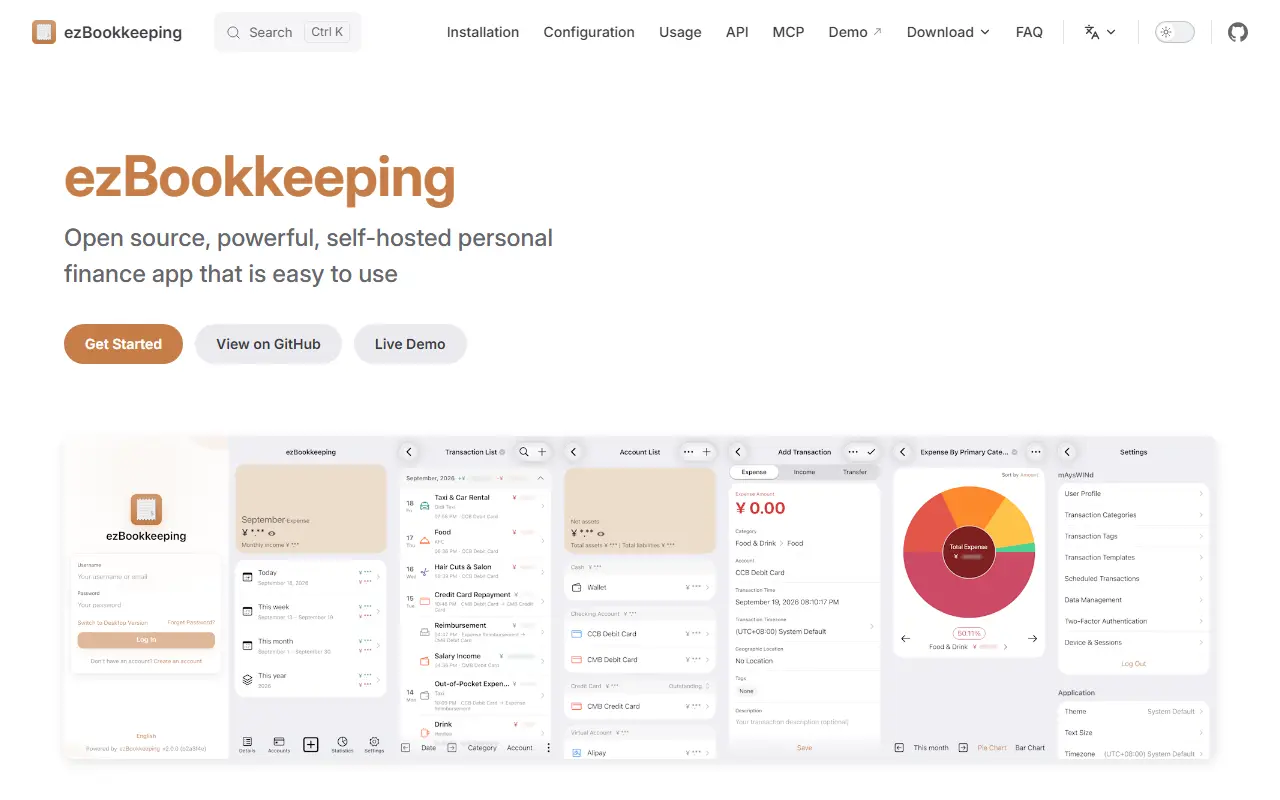
ezbookkeeping.mayswind.netezBookkeeping homepage screenshot

ezBookkeeping is an open-source personal finance app that you host yourself. You log everyday transactions, bring in data from other sources, and search or filter your bills with ease. Built-in charts show historical data, and you can run custom queries with your own chart dimensions to understand spending patterns and financial trends.

It is designed to be easy to deploy, starting with a single Docker command, and to use few resources, so it runs smoothly on a home server, a NAS or a Raspberry Pi. The interface is tailored separately for mobile and desktop screens, with Progressive Web App support so it can be added to a phone's home screen. The backend is written in Go with a Vue and TypeScript front end.

ezBookkeeping is MIT-licensed and has no hosted service described in the input. It suits individuals and households who want a private expense tracker and money manager instead of a commercial budgeting app.

Key features

  • Daily transaction recording
  • Data import from various sources
  • Search and filter for bills
  • Built-in charts with custom queries
  • Single-command Docker deployment
  • PWA with mobile and desktop interfaces

Pricing: Free and open source under the MIT license.

Paisa

Paisa is a personal finance manager built on the ledger double-entry accounting tool, with a web interface for budgets, investments and expenses.

GitHub stars
3.2k
Last commit
27 days ago
Latest release
v0.7.6
Licence
AGPL-3.0
Self-hosted
Yes
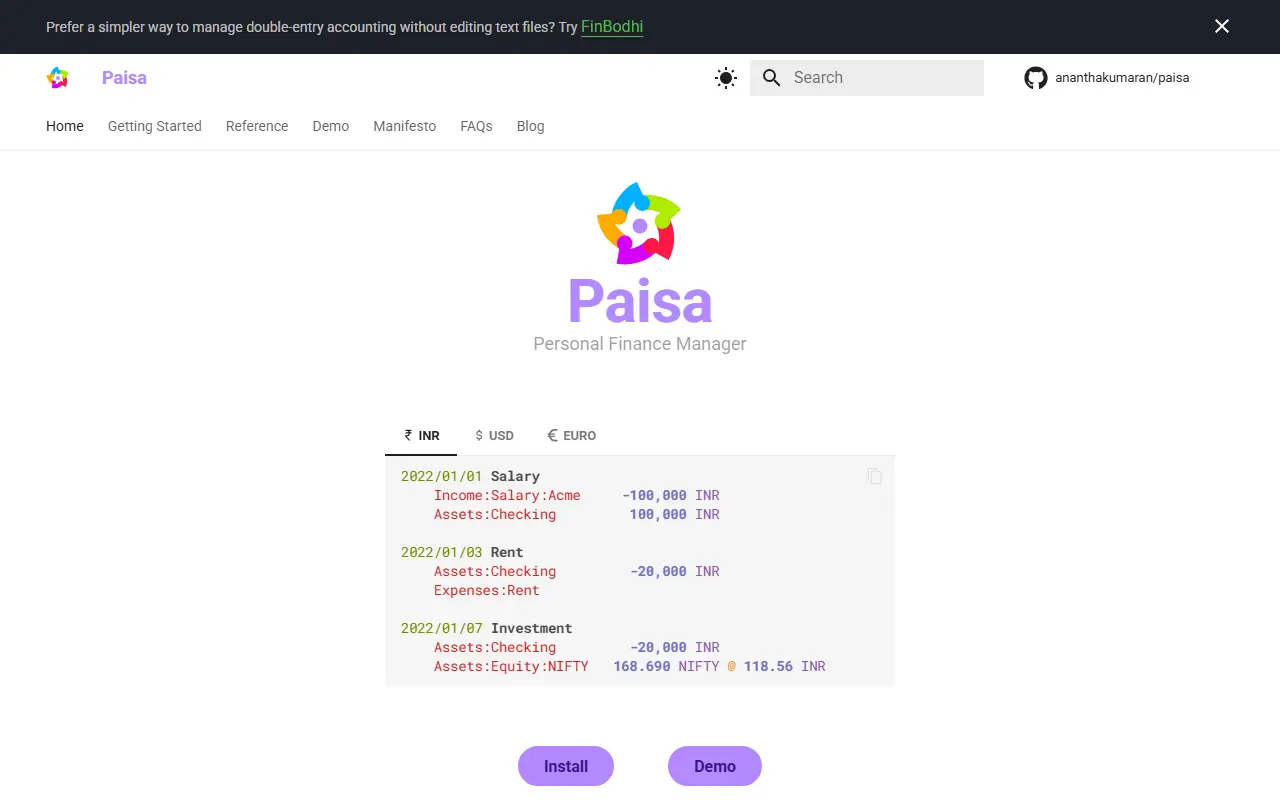
paisa.fyiPaisa homepage screenshot

Paisa is an open-source personal finance manager that builds on top of the ledger double-entry accounting tool. Your financial records live in plain-text journal and configuration files, and Paisa reads them to produce a web interface for visualizing your money. The project states that your financial data never leaves your system.

It helps with tracking investments such as mutual funds and stocks, categorizing expenses, budgeting and money management in general. The documentation covers accounts, commodities, the journal, allocation targets, budgets, bulk edit, imports, recurring transactions, spreadsheets, goals for retirement and savings, credit cards, and tax analysis including capital gains and tax harvesting. Example journals show Indian rupee, US dollar and euro setups.

Paisa is for people comfortable keeping accounts in text files who want charts and analysis on top. It is licensed under AGPL 3 or later, and a public demo shows the interface. The author uses it for personal finances, and questions can be raised through GitHub or a Matrix chat. A separate product is suggested on the site for those who prefer not to edit text files.

Key features

  • Built on ledger double-entry accounting
  • Investment tracking for stocks and mutual funds
  • Expense categorization and budgets
  • Retirement and savings goals
  • Tax and capital gains analysis
  • Multi-currency journals
  • Public demo of the web interface

Pricing: Free and open source under AGPL 3 or later.

Read more about PaisaWebsite GitHub

Money Manager Ex

Money Manager Ex is a free, cross-platform personal finance app for tracking accounts, budgets and cash flow, with portable and mobile versions.

GitHub stars
2.3k
Last commit
today
Latest release
v1.9.4
Licence
GPL-2.0
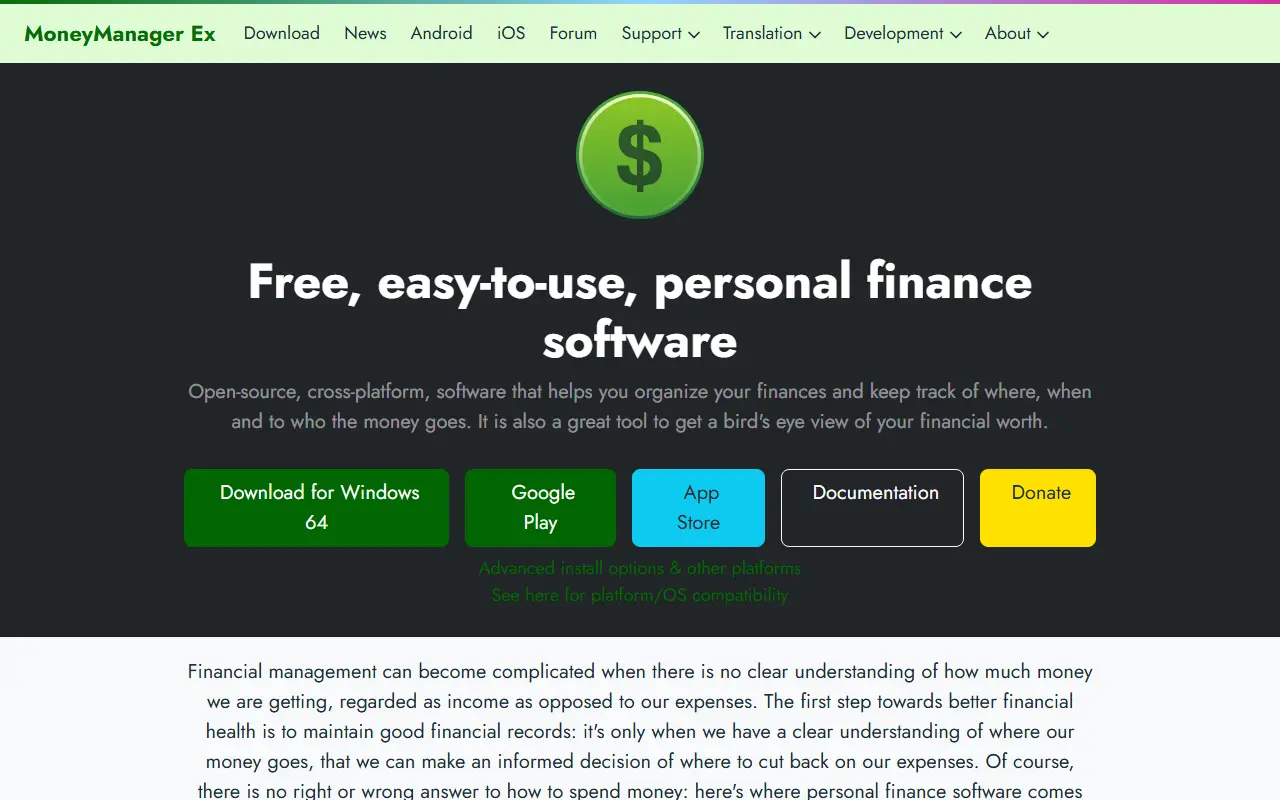
moneymanagerex.orgMoney Manager Ex homepage screenshot

Money Manager Ex, or MMEX, is free, open-source, cross-platform personal finance software for organizing money and tracking cash flow. Its design goals are simplicity and user-friendliness, aiming for an application that people can use every day. It is written in C++ with wxWidgets and stores data in an SQLite database that supports AES encryption.

It supports checking, credit card, savings, stock investment and asset accounts, unlimited nested categories, multiple tags per split transaction, reminders for scheduled bills and deposits, budgeting and cash flow forecasting. One-click reports show graphs and charts, and custom reports are possible. Data can be imported from CSV and Quicken Interchange Format files.

Installation is not required because portable versions can run from a USB drive. Desktop builds exist for GNU/Linux, macOS and Windows, with mobile apps for Android through F-Droid and Google Play and for iOS through the App Store. The software is licensed under GPL-2.0, with stable and development releases offered and translations handled through Crowdin.

Key features

  • Checking, credit card, savings and investment accounts
  • Nested categories and split transaction tags
  • Bill and deposit reminders
  • Budgeting and cash flow forecasting
  • CSV and QIF import
  • Encrypted SQLite database
  • Portable, desktop and mobile versions

Pricing: Free and open source under the GPL-2.0 license.

Cashew

Cross-platform budgeting app built with Flutter for tracking spending, setting custom budgets and monitoring savings goals.

GitHub stars
4.7k
Last commit
6 mo ago
Latest release
5.3.4+396
Licence
GPL-3.0
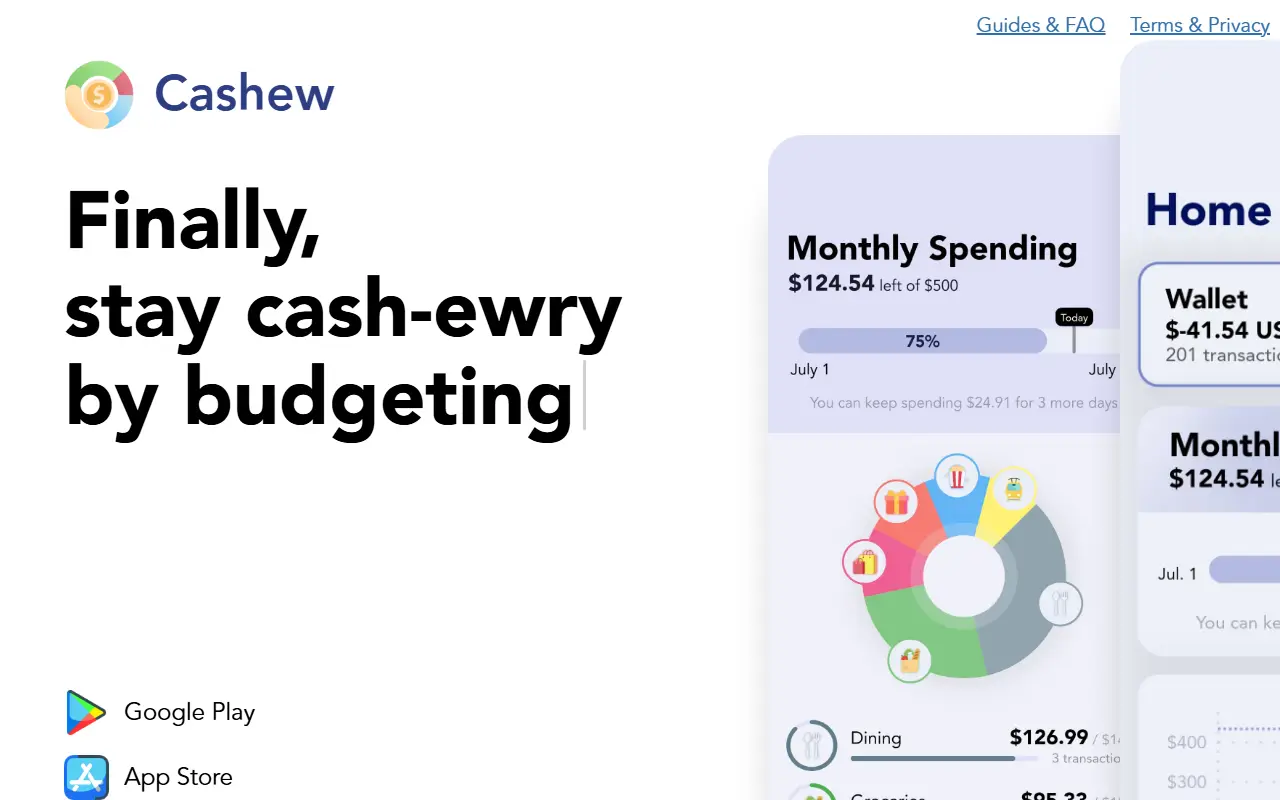
cashewapp.web.appCashew homepage screenshot

Cashew is a personal finance app that helps you plan a budget and keep track of purchases. It is built with Flutter, using Drift for local SQL storage and Firebase, and runs on Android and iOS. A web version is available as a progressive web app, and releases are also distributed through GitHub.

Budgets can use flexible time periods such as monthly, weekly, daily or any custom range, which suits one-off cases like a trip. Transactions can be added to specific budgets, each category within a budget can have its own spending limit, and past budgets can be reviewed to compare how spending changed over time. Goals let you plan spending or saving targets and assign transactions towards them.

The app is open source under the GPL-3.0 license and its development is documented in the repository's commits and changelog. The interface follows Material You styling, and there is a beta testing program for early builds.

Key features

  • Budgets with custom time periods
  • Selected transactions assigned to specific budgets
  • Category spending limits within each budget
  • Past budget history for comparison
  • Spending and savings goals
  • Available on Android, iOS and web
Read more about CashewWebsite GitHub

SubTrackr

Self-hosted subscription tracker built with Go and HTMX that shows spending, renewal dates and reminders, storing everything in SQLite on your server.

GitHub stars
471
Last commit
yesterday
Latest release
v0.6.8
Licence
AGPL-3.0
Self-hosted
Yes
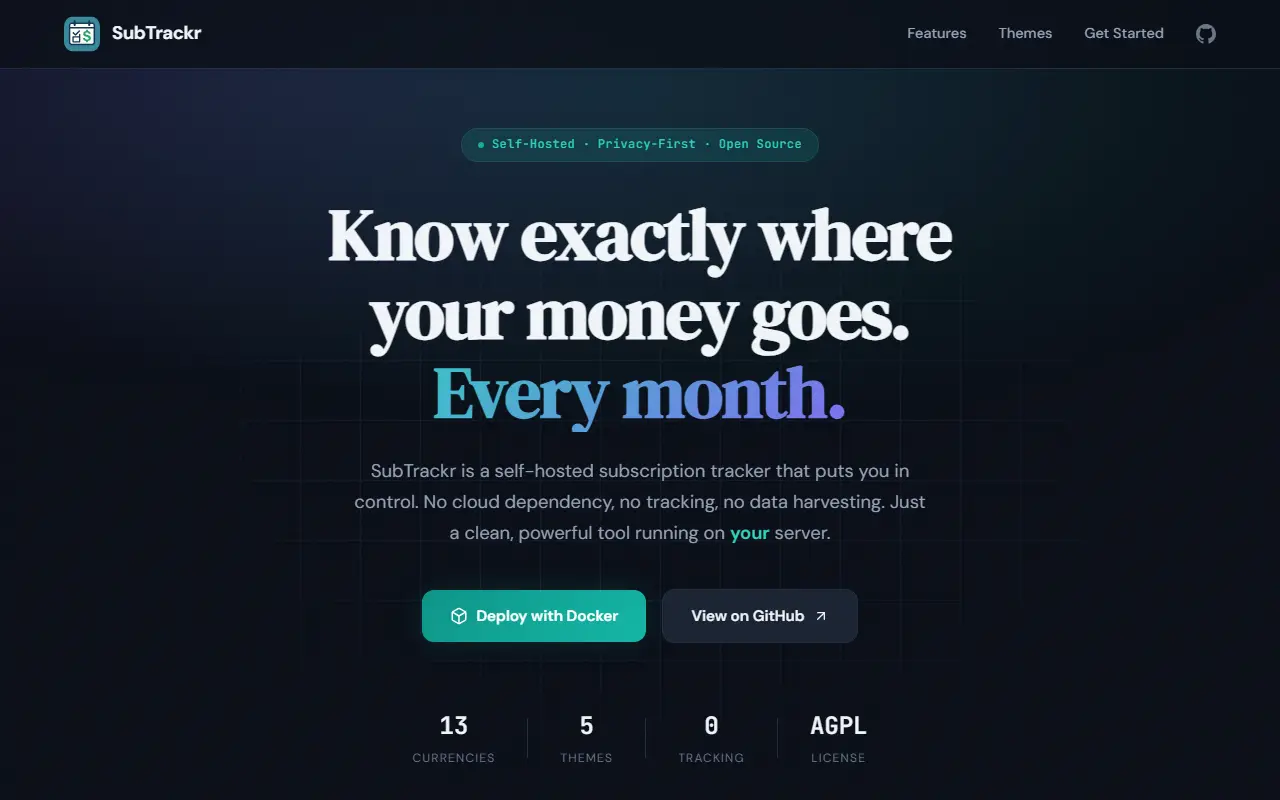
subtrackr.xyzSubTrackr homepage screenshot

SubTrackr is a self-hosted application for keeping track of your recurring subscriptions. It shows how much you spend each month and year, lists every subscription with logos, and sends reminders before renewals so you can cancel or adjust in time. Your data stays on your own server.

A dashboard summarizes spending, a calendar view shows renewal dates with iCal export and a subscription URL, and analytics break spending down by category. Reminders go out by email or through Pushover push notifications. Data can be exported as CSV, JSON or iCal, and many currencies are supported, with optional real-time conversion. An MCP server lets AI assistants such as Claude work with the data, and five themes are included.

It is built with Go and the Gin framework, an HTMX front end and a SQLite database, so no external database is needed, and it deploys with Docker. Authentication is optional. SubTrackr is released under the AGPL-3.0 licence.

Key features

  • Dashboard of monthly and annual spending
  • Calendar view with iCal export
  • Email and Pushover renewal reminders
  • Spending analytics by category
  • Multi-currency support with optional conversion
  • CSV, JSON and iCal data export
  • MCP server for AI assistants

Pricing: Free and open source under the AGPL-3.0 licence.

Read more about SubTrackrWebsite GitHub

Rocket Money alternatives: questions

What is the best open-source alternative to Rocket Money?
Actual Budget is the top-ranked open-source alternative to Rocket Money on Enlisted: Actual is a local-first personal finance and envelope budgeting app that syncs between devices and can be self-hosted or run locally. Other strong options are Firefly III, Sure, Wallos and ezBookkeeping.
Are these Rocket Money alternatives free?
All 9 are open source, so the code is free to use under its licence, and all of them can be self-hosted on your own server or computer. 1 also offers a paid or managed cloud version if you'd rather not host it yourself.
How is this list of Rocket Money alternatives ranked?
By a score built from GitHub stars, star growth over the last 30 days and how recently the code changed. 8 of these projects shipped code in the last 30 days. Data is refreshed daily, and nobody can pay to move up.

People also look for alternatives to…

View all