4 open-source alternatives ranked by real activity

Open-source Roboflow alternatives

A curated, ranked list of the 4 best open-source alternatives to Roboflow.

The best open-source alternative to Roboflow is Platform. If that doesn't suit you, other good options are Label Studio, CVAT and FiftyOne.

Commercial alternatives to Roboflow include Labelbox, SuperAnnotate, V7 and Google Memorystore. See all 21.

Roboflow alternatives are mainly AI infrastructure tools, but some are also developer tools. 4 of them shipped code in the last 30 days, 4 can be self-hosted, and 3 use a permissive licence.

Last updated November 12, 2026 · ranked by GitHub stars, growth and recent commits

Platform

A platform for building full lifecycle computer vision workflows, including data annotation, model training, and deployment.

GitHub stars
63k
Last commit
yesterday
Latest release
v8.4.211
Licence
AGPL-3.0
Hosted version
Available
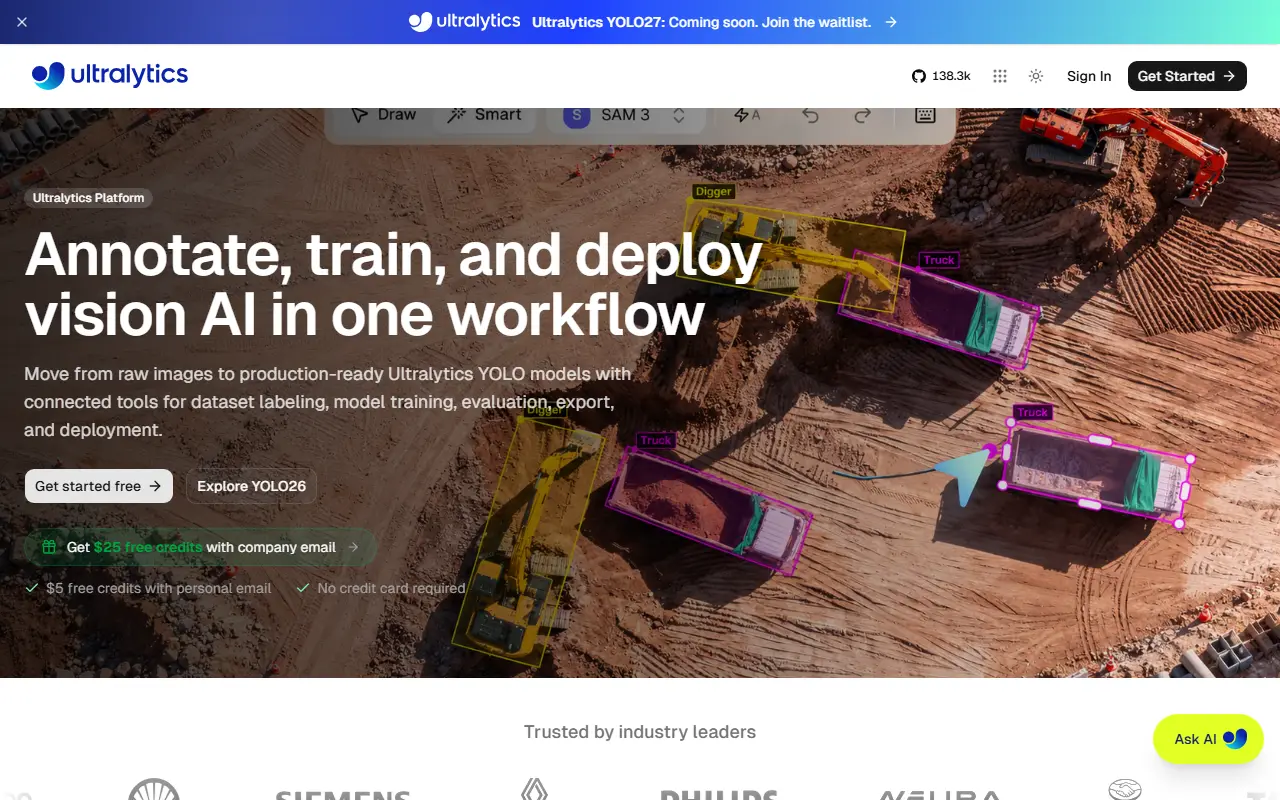
platform.ultralytics.comPlatform homepage screenshot

Ultralytics Platform provides connected tools for dataset labeling, model training, evaluation, export, and deployment. It supports object detection, instance segmentation, semantic segmentation, image classification, pose estimation, and object tracking using Ultralytics YOLO models.

The platform includes smart annotation features powered by SAM, team review and versioning, and cloud GPU training for YOLO models. It is designed for teams working with large visual datasets.

Key features

  • SAM-powered smart annotation for masks and bounding boxes in one click
  • Full AI task coverage: detection, instance segmentation, semantic segmentation, classification, pose, OBB
  • Universal format support: YOLO, COCO, and more
  • Team review and versioning for collaboration
  • Train YOLO models on 26 cloud GPUs with real-time metrics and experiment comparison
  • AutoTrain with Ask AI to start a baseline and propose the next run

Label Studio

Label Studio is an open-source data labeling tool for audio, text, images, video and time series, exporting to many model formats.

GitHub stars
29k
Last commit
yesterday
Latest release
1.23.2
Licence
Apache-2.0
Self-hosted
Yes
Hosted version
Available
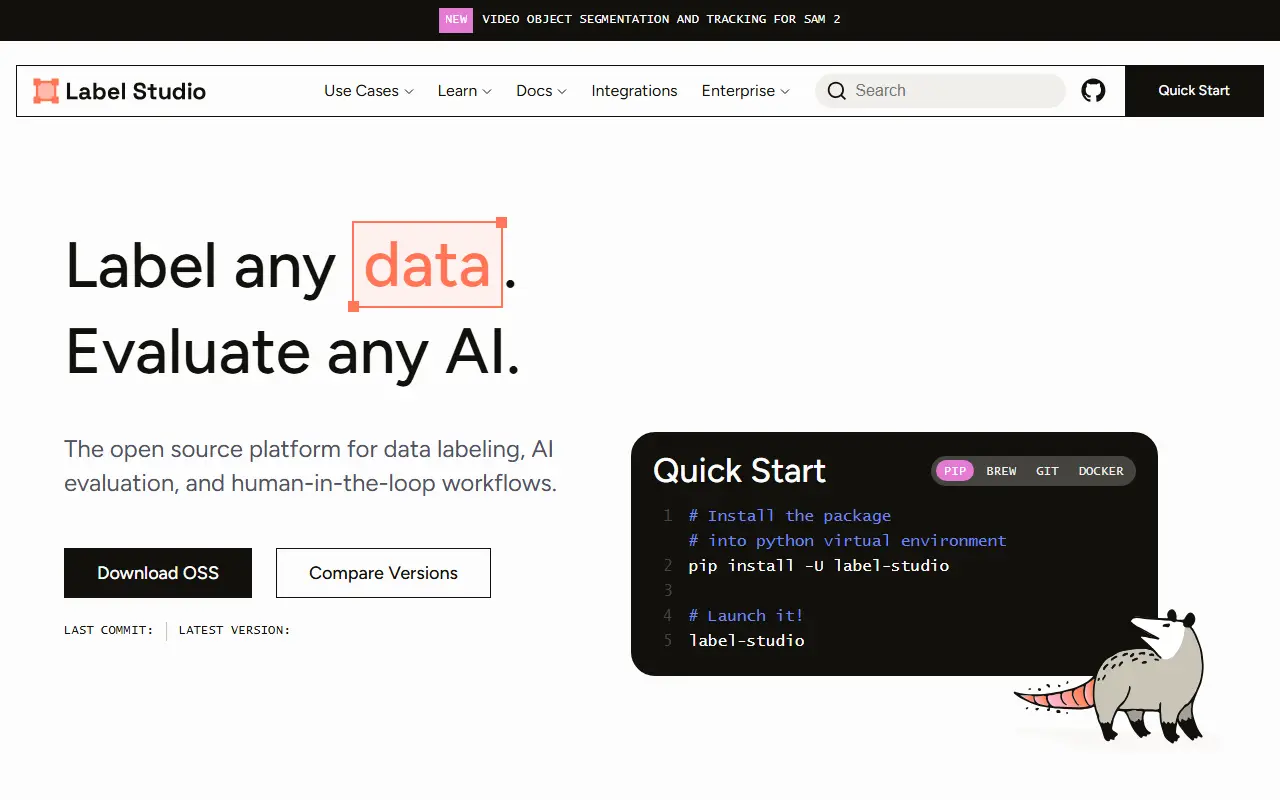
labelstud.ioLabel Studio homepage screenshot

Label Studio is an open-source tool for labeling and annotating data. It handles audio, text, images, videos and time series through a straightforward interface, and exports the labels in formats suited to various machine learning models. Teams use it to prepare raw data or to improve existing training data so models become more accurate. It is written mainly in TypeScript and released under the Apache-2.0 license.

You can install it locally with Docker, Docker Compose, pip, poetry or Anaconda, or deploy it on a cloud instance. The Docker Compose option provides a production-ready stack of Label Studio, Nginx and PostgreSQL. By default the Docker image serves the app on port 8080 and stores a SQLite database and uploaded files in a local directory. The README also covers labeling templates, connecting machine learning models and integrating with existing tools, and mentions a Starter Cloud edition with a free trial.

Key features

  • Labeling for audio, text, images, video and time series
  • Export to various model formats
  • Included templates for common labeling tasks
  • Connect ML models for assisted labeling
  • Docker Compose stack with Nginx and PostgreSQL
  • Install with pip, Docker, poetry or Anaconda

Pricing: Open source under Apache-2.0; a hosted Starter Cloud edition is offered with a free trial.

CVAT

CVAT is an open-source computer vision annotation platform for labeling images, video and 3D data, with team workflows and AI-assisted labeling.

GitHub stars
17k
Last commit
2 days ago
Latest release
v2.82.0
Licence
MIT
Self-hosted
Yes
Hosted version
Available
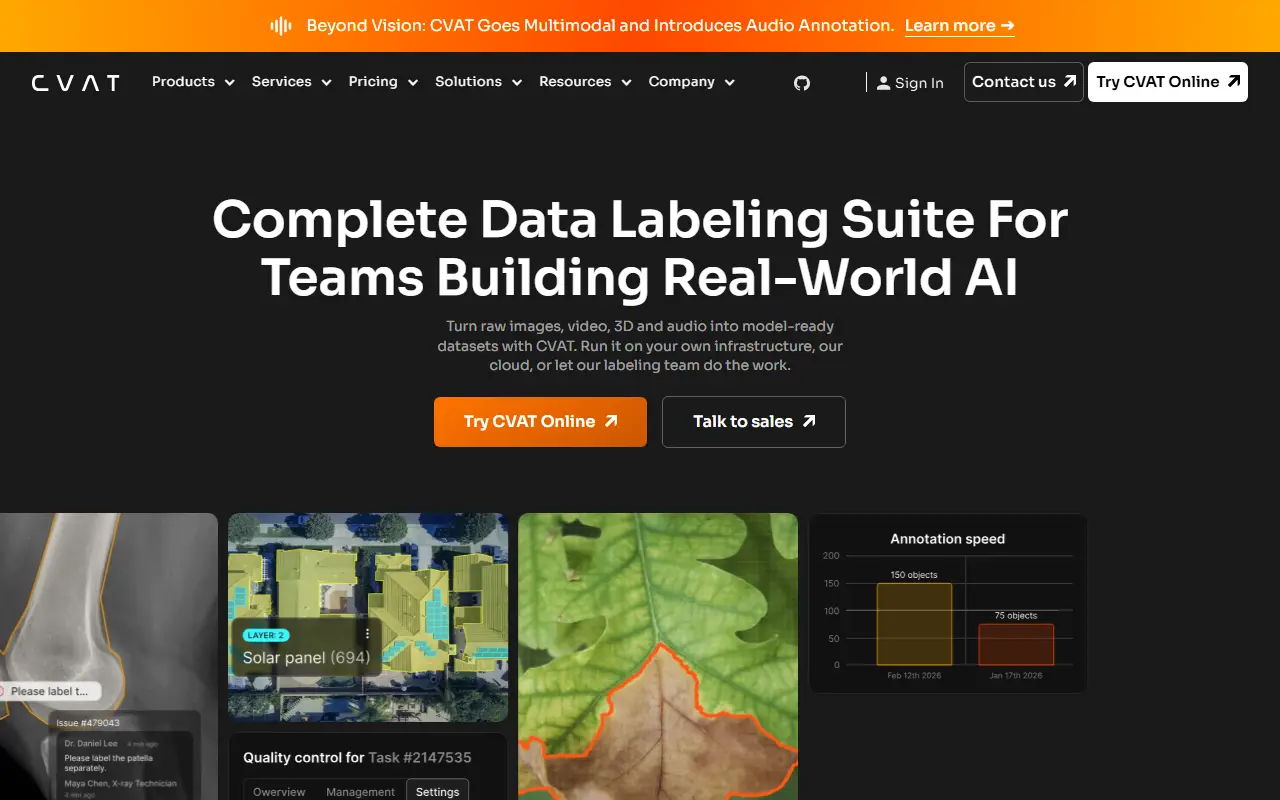
cvat.aiCVAT homepage screenshot

CVAT, the Computer Vision Annotation Tool, is a platform for building labeled datasets for computer vision and other visual AI. The Community edition in this repository is the free, self-hosted open-source version, and it supports image, video and 3D annotation along with dataset management.

Teams can work together with multi-user and multi-organization support, roles, task assignments and review workflows. Users can connect their own machine learning models for detection, segmentation and tracking to speed up labeling, integrate cloud storage, and automate work through SDKs and APIs. Running it in your own infrastructure keeps data inside your environment.

The community core is MIT licensed and written mainly in Python, and it forms the base for CVAT Online, a cloud product, and CVAT Enterprise, which the company also offers alongside labeling services. Topics on the repository cover bounding boxes, semantic segmentation, object detection and tools such as TensorFlow and PyTorch.

Key features

  • Image, video and 3D annotation
  • Bounding box and segmentation labeling
  • AI-assisted labeling with your own models
  • Roles, task assignment and review workflows
  • Cloud storage integration
  • SDKs and APIs for automation

Pricing: CVAT Online has a free plan. Solo and Team cost $33 per month per user ($23 billed yearly); self-hosted Enterprise starts at $12,000 per year.

Read more about CVATWebsiteGitHub#3 Roboflow alternative

FiftyOne

Open-source Python tool for visualizing and labeling datasets, evaluating models and improving data quality in computer vision projects.

GitHub stars
11k
Last commit
yesterday
Latest release
v1.22.1
Licence
Apache-2.0
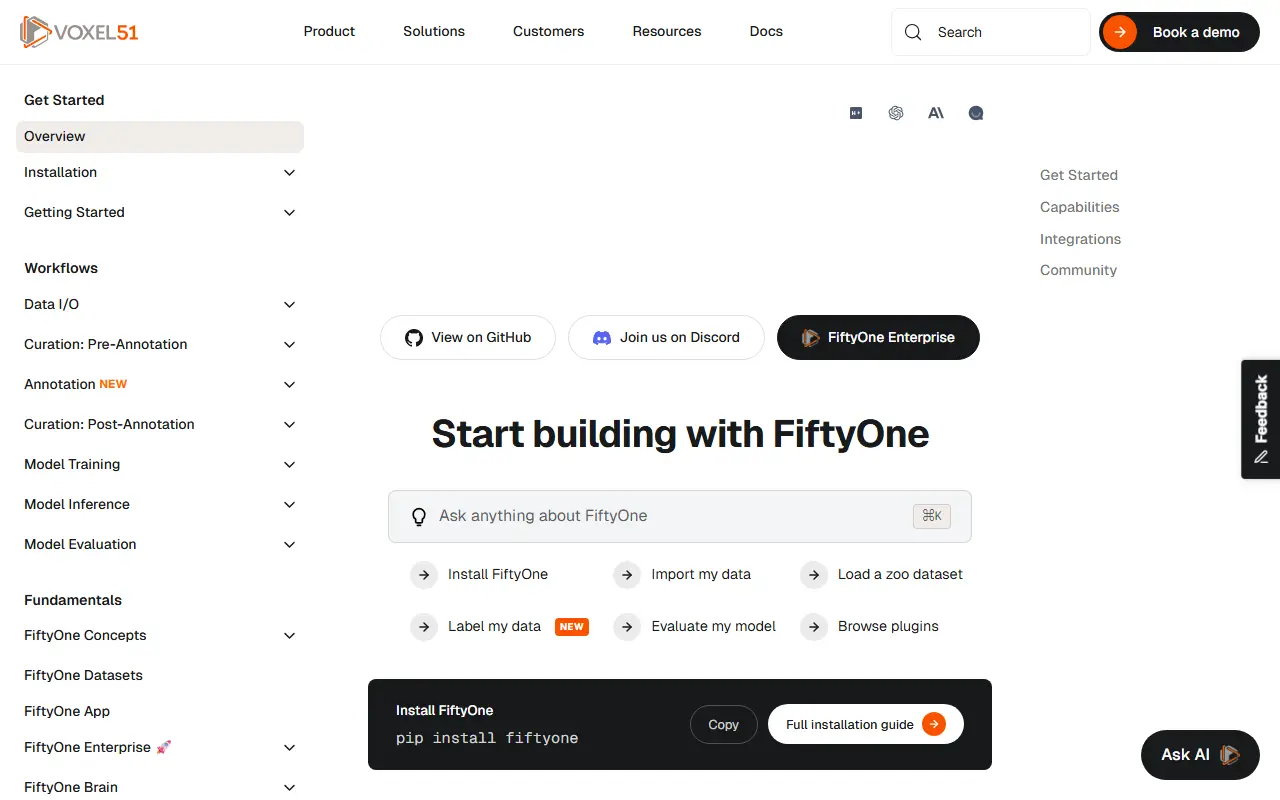
fiftyone.aiFiftyOne homepage screenshot

FiftyOne is an open-source tool from Voxel51 for building high-quality datasets and computer vision models. Its README says it is meant to speed up visual AI development by letting you visualize and label your data, evaluate your models, and raise the quality of both data and models.

The package installs with pip and supports Python 3.10 through 3.13, and the project recommends doing so inside a virtual environment. A source install is also possible: it needs Python, Node.js and Yarn, and the install script builds the App. Developers can point their installation at a MongoDB instance they manage themselves.

The documentation is organised around workflows and guides: importing and exporting data, similarity search with embeddings, finding duplicates and annotation mistakes, model training and inference, and model evaluation. Guides cover object detection, segmentation, depth estimation, 3D, medical imaging and self-driving data. For production-grade, collaborative, cloud-native workloads the README points to Voxel51's enterprise offering.

Key features

  • Visualize and label datasets, evaluate models
  • Installs from PyPI with pip
  • Source install builds the App locally
  • Similarity search, embeddings and duplicate removal
  • Finds classification and detection mistakes
  • Can connect to a self-managed MongoDB instance

Commercial Roboflow alternatives

Hosted, closed-source products that compete with Roboflow. Showing 12 of 21.

See every Roboflow alternative on its tool page

Roboflow alternatives: questions

What is the best open-source alternative to Roboflow?
Platform is the top-ranked open-source alternative to Roboflow on Enlisted: A platform for building full lifecycle computer vision workflows, including data annotation, model training, and deployment. Other strong options are Label Studio, CVAT and FiftyOne.
What are the best commercial alternatives to Roboflow?
Labelbox, SuperAnnotate, V7, Google Memorystore and Baseten are among the hosted, closed-source alternatives to Roboflow listed on Enlisted, which lists 21 in total. Compare their pricing and features on each tool page.
Are these Roboflow alternatives free?
All 4 are open source, so the code is free to use under its licence, and all of them can be self-hosted on your own server or computer. 3 also offer a paid or managed cloud version if you'd rather not host it yourself.
How is this list of Roboflow alternatives ranked?
By a score built from GitHub stars, star growth over the last 30 days and how recently the code changed. 4 of these projects shipped code in the last 30 days. Data is refreshed daily, and nobody can pay to move up.

People also look for alternatives to…

View all