
 Landing AI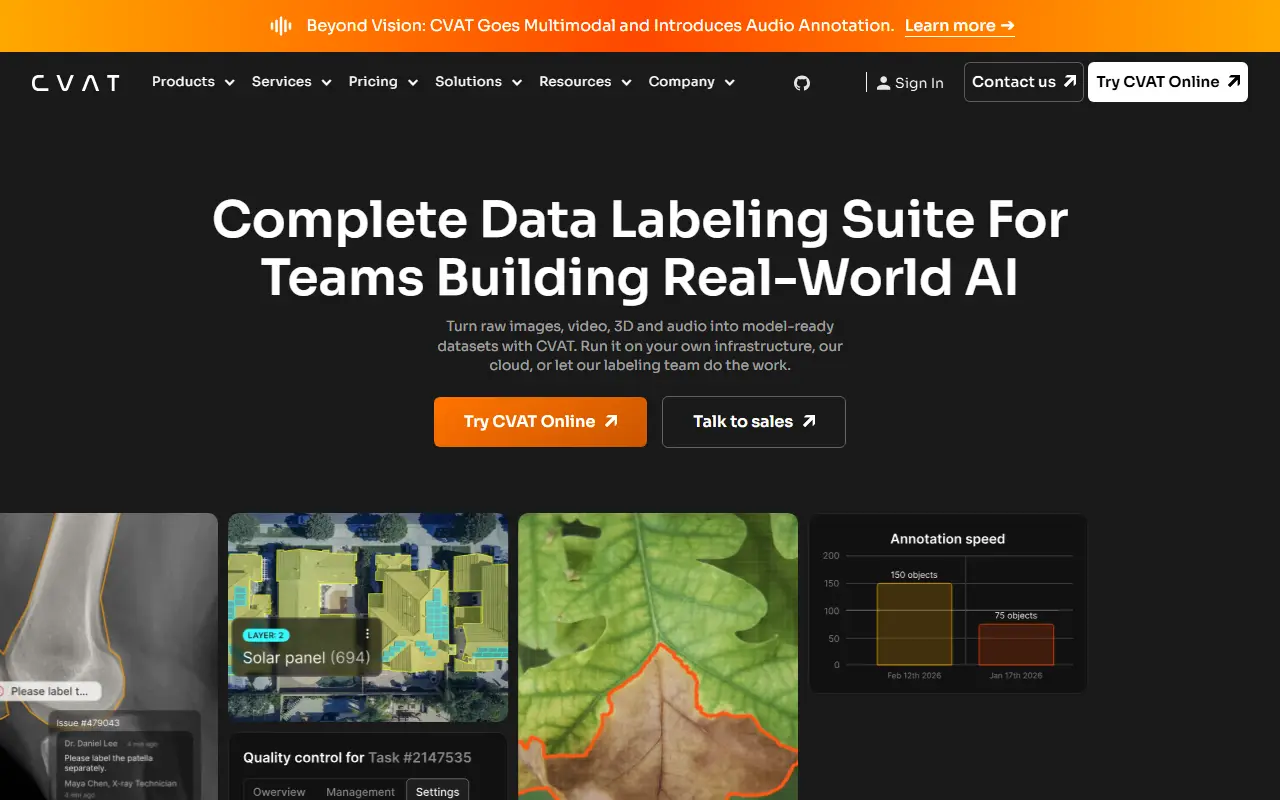
About CVAT
CVAT, the Computer Vision Annotation Tool, is a platform for building labeled datasets for computer vision and other visual AI. The Community edition in this repository is the free, self-hosted open-source version, and it supports image, video and 3D annotation along with dataset management.
Teams can work together with multi-user and multi-organization support, roles, task assignments and review workflows. Users can connect their own machine learning models for detection, segmentation and tracking to speed up labeling, integrate cloud storage, and automate work through SDKs and APIs. Running it in your own infrastructure keeps data inside your environment.
The community core is MIT licensed and written mainly in Python, and it forms the base for CVAT Online, a cloud product, and CVAT Enterprise, which the company also offers alongside labeling services. Topics on the repository cover bounding boxes, semantic segmentation, object detection and tools such as TensorFlow and PyTorch.
Key features
- Image, video and 3D annotation
- Bounding box and segmentation labeling
- AI-assisted labeling with your own models
- Roles, task assignment and review workflows
- Cloud storage integration
- SDKs and APIs for automation
Good fit for
- →Labeling datasets for object detection
- →Annotation teams with review stages
- Built with
- Python
- Tags
- annotation
- computer-vision
- image-labeling
- video-annotation
- machine-learning
- datasets
- self-hosted
- python
CVAT: questions and answers
- What is CVAT used for?
- CVAT is an open-source computer vision annotation platform for labeling images, video and 3D data, with team workflows and AI-assisted labeling. It is a good fit for labeling datasets for object detection and annotation teams with review stages.
- Is CVAT open source?
- Yes. CVAT is open source under the MIT licence. Its source code is on GitHub at cvat-ai/cvat and is written mainly in Python.
- Is CVAT free?
- Yes. CVAT is open source, so the software itself is free to use. A managed cloud version is also available, with paid plans from $33 per seat per month.
- Can I self-host CVAT?
- Yes. CVAT can be self-hosted on your own server or infrastructure.
- What is CVAT an alternative to?
- CVAT is an open-source alternative to Roboflow, Scale AI, Labelbox and SuperAnnotate. Other open-source alternatives to Roboflow include Label Studio.
- Is CVAT actively maintained?
- Yes. The most recent commit to CVAT was on 2 October 2026, and the latest release is v2.77.0, published on 28 September 2026. The project has 17k stars on GitHub.
Open-source alternatives to CVAT
See all
Label Studio
AI Infrastructure
Label Studio is a multi-type data labeling and annotation tool with standardized output fo
Apache-2.0vs Roboflow★ 28k
vLLM
AI Infrastructure
A high-throughput and memory-efficient inference and serving engine for LLMs
Apache-2.0vs Amazon Bedrock★ 93k
Unsloth
AI Infrastructure
Unsloth is an open-source framework for running and training LLMs.
Apache-2.0vs Together AI★ 77k
PrivateGPT
AI Infrastructure
Complete API layer for private AI applications on local models: RAG, skills, tools, MCP, t
Apache-2.0vs ChatGPT★ 58k
exo
AI Infrastructure
Run frontier AI locally.
Apache-2.0★ 48k
MLflow
AI Infrastructure
The open source AI engineering platform for agents, LLMs, and ML models. MLflow enables te
Apache-2.0vs Weights & Biases★ 28k
SaaS alternatives to CVAT
See all
Roboflow
AI Infrastructure
Platform to label images, train and deploy computer vision models
SaaS
Scale AI
AI Infrastructure
Data labeling, evaluation and AI data infrastructure provider
SaaS
Labelbox
AI Infrastructure
Data labeling and model evaluation platform for AI teams
SaaS
SuperAnnotate
AI Infrastructure
Annotation and data management platform for training AI models
SaaS
V7
AI Infrastructure
Computer vision data labeling and workflow automation platform
SaaS
Encord
AI Infrastructure
Data platform for annotating, curating and evaluating multimodal AI training data
SaaS