5 open-source alternatives ranked by real activity

Open-source M-Files alternatives

A curated, ranked list of the 5 best open-source alternatives to M-Files.

The best open-source alternative to M-Files is Paperless-ngx. If that doesn't suit you, other good options are Nextcloud, ownCloud, Teedy and Mayan Edms.

Commercial alternatives to M-Files include DocuWare, Laserfiche, Hyland OnBase and OpenText Documentum. See all 14.

M-Files alternatives are mainly file storage & sharing tools. 4 of them shipped code in the last 30 days, 5 can be self-hosted, and none uses a permissive licence.

Last updated November 13, 2026 · ranked by GitHub stars, growth and recent commits

Paperless-ngx

Paperless-ngx is a GPL-3.0 document management system that turns scanned paper into a searchable archive, deployed mainly with Docker Compose.

GitHub stars
48k
Last commit
yesterday
Latest release
v3.4.2
Licence
GPL-3.0
Self-hosted
Yes

Paperless-ngx is a document management system that turns physical documents into a searchable online archive, so you keep less paper. It is the official successor to the original Paperless and Paperless-ng projects, and the work of supporting it is shared among a team rather than left to one person.

The repository topics mention OCR, PDF, archiving and machine learning, and the code is mostly Python with an Angular front end. The README itself leaves the full feature list and screenshots to the documentation at docs.paperless-ngx.com. A public demo is available, but its content is reset often and confidential files should not be uploaded.

The easiest way to deploy is Docker Compose, with compose files that pull the image from the GitHub container registry and an install script that sets up the environment. Moving from Paperless-ng means dropping in the new Docker image. The interface is translated into many languages coordinated on Crowdin.

Key features

  • Turns paper documents into a searchable archive
  • Docker Compose deployment with an install script
  • Container image pulled from GitHub registry
  • Simple migration from Paperless-ng
  • Public demo for trying it out
  • Translations coordinated on Crowdin
  • Feature requests handled in GitHub Discussions

Nextcloud

A self-hosted file sync, sharing and collaboration platform that stores files, contacts and calendars on a server you choose, extensible with hundreds of apps.

GitHub stars
37k
Last commit
yesterday
Latest release
v33.0.11
Licence
AGPL-3.0
Self-hosted
Yes
Hosted version
Available
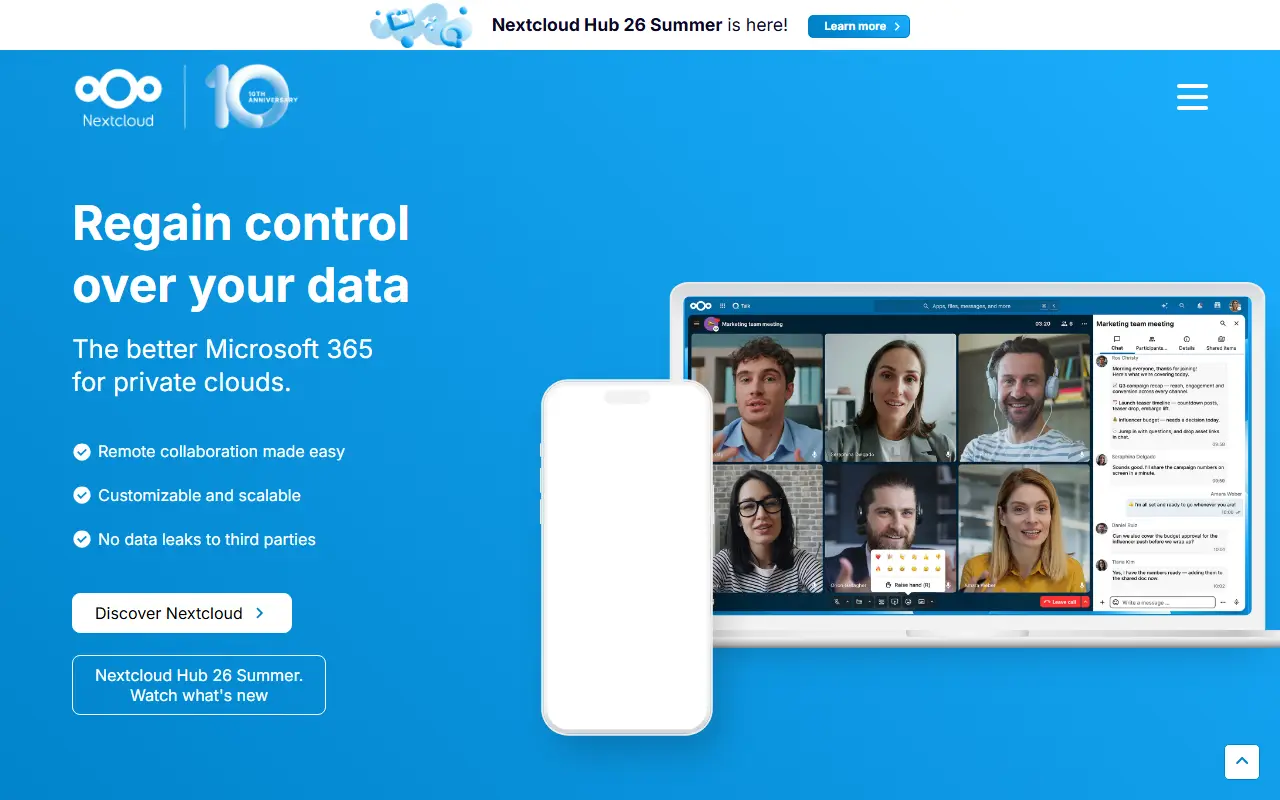
nextcloud.comNextcloud homepage screenshot

Nextcloud Server is a platform for keeping your files, contacts, calendars and other data on a server of your choosing. Content is synchronized across your devices, can be shared with other people for viewing or collaboration, and stays under your control rather than with a large cloud provider. It grew out of the ownCloud lineage.

Functionality can be expanded through hundreds of apps in its App Store, including Calendar, Contacts, Mail and Video Chat. Security measures include encryption mechanisms, a public bug bounty program and two-factor authentication. There are several ways to get a Nextcloud: sign up with a provider, install the server yourself on your own hardware or with a ready-to-use appliance, buy a device that comes with it preinstalled, or find a service provider to host it for you.

The server is written in PHP and JavaScript under the AGPL-3.0 license. Nextcloud GmbH also offers an Enterprise edition aimed at public sector, education and company users. It suits households, schools and organizations that want to replace commercial cloud storage and office suites with something they run themselves.

Key features

  • File storage and sync across devices
  • Contacts and calendar hosting
  • Sharing and collaboration controls
  • App Store with hundreds of apps
  • Two-factor authentication and encryption
  • Self-install, appliance or provider-hosted options

Pricing: Nextcloud Enterprise Standard starts at 42€ per user per year, with subscriptions from 100 users and 31.50€ from 250 users. Nextcloud One managed hosting is offered for smaller teams.

ownCloud

The server core of ownCloud Classic, a self-hosted platform for file storage, sync and sharing with WebDAV, CalDAV and CardDAV support.

GitHub stars
8.8k
Last commit
4 days ago
Latest release
v11.1.0
Licence
AGPL-3.0
Self-hosted
Yes
owncloud.comownCloud homepage screenshot

ownCloud Core is the server component of ownCloud Classic, a self-hosted platform for file storage, synchronization and sharing. It is the foundation on which apps such as Activity, Calendar and Contacts are built, and is written in PHP and JavaScript.

It ships with servers for WebDAV, CalDAV and CardDAV, an app plugin architecture, backends for external storage, support for encryption, user and group management, and a REST API. The server runs on PHP with MySQL, MariaDB, PostgreSQL or SQLite, and is also available as a Docker image on Docker Hub. Its topics point to federated sharing and enterprise use.

ownCloud Classic is licensed under AGPL-3.0, and installation is covered by the official manual. For the next-generation platform, the project points to ownCloud Infinite Scale. Contributors follow a rebase workflow with signed commits and DCO sign-off, and enterprise support is available from the vendor. It suits organizations and individuals who want to keep files on their own servers instead of a public cloud.

Key features

  • File storage, sync and sharing
  • WebDAV, CalDAV and CardDAV servers
  • Plugin architecture for apps
  • User and group management
  • Encryption and external storage support
  • REST API for integrations
  • Docker image available

Pricing: Free and open source under AGPL-3.0; enterprise support is available from the vendor.

Teedy

Teedy, from Sismics, is a lightweight open-source document management system with OCR, full-text search, workflows, tags and a REST API.

GitHub stars
2.6k
Last commit
yesterday
Latest release
v1.11
Licence
GPL-2.0
Self-hosted
Yes
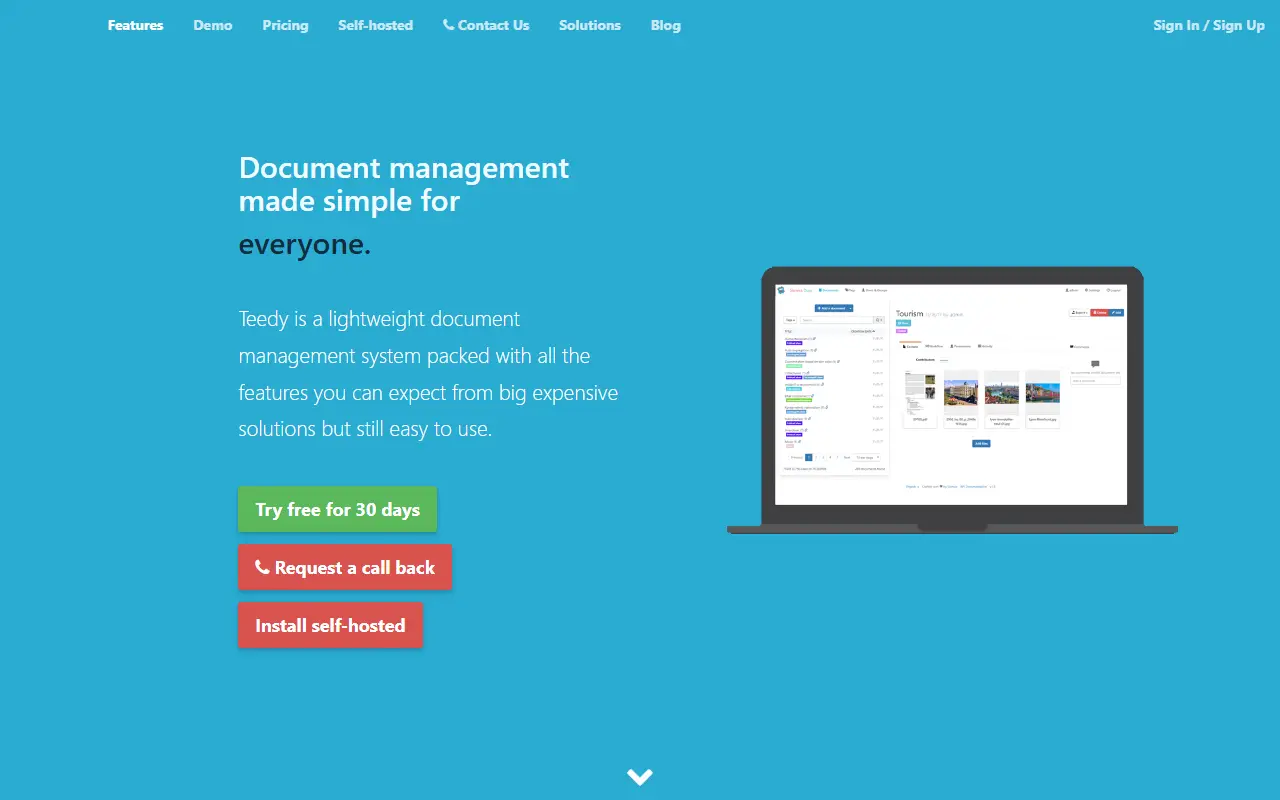
teedy.ioTeedy homepage screenshot

Teedy is an open-source, lightweight document management system for individuals and businesses, developed by Sismics. It is meant to offer the features of larger commercial document systems in a simpler package that you host yourself, with a responsive web interface and a fully featured Android client.

Features include optical character recognition, support for images, PDFs, ODT, DOCX, PPTX and video files, full-text search with suggestions and highlighting, Dublin Core and custom metadata, nested tags, file versioning, 256-bit AES encryption of stored files, a workflow system, LDAP authentication, two-factor authentication, user and group permissions, an audit log, comments, quotas, sharing by URL, email import and inbox scanning, a REST API and webhooks. The project says it has been tested with up to one million documents.

Teedy is built with Java and JavaScript and licensed under GPL-2.0. A preconfigured Docker image includes OCR and media conversion tools and listens on port 8080, using an embedded database for testing and PostgreSQL for production. It suits small organizations and individuals who want to digitize and search paperwork on their own server.

Key features

  • OCR and full-text search across documents
  • Tags, metadata, and file versioning
  • Workflow system and audit log
  • LDAP and two-factor authentication
  • 256-bit AES encryption of stored files
  • REST API, webhooks, and Android client

Pricing: Free and open source under the GPL-2.0 licence.

Mayan Edms

Mayan EDMS is an open-source document management system with versioning, workflows, fine-grained permissions and a REST API.

GitHub stars
851
Last commit
5 mo ago
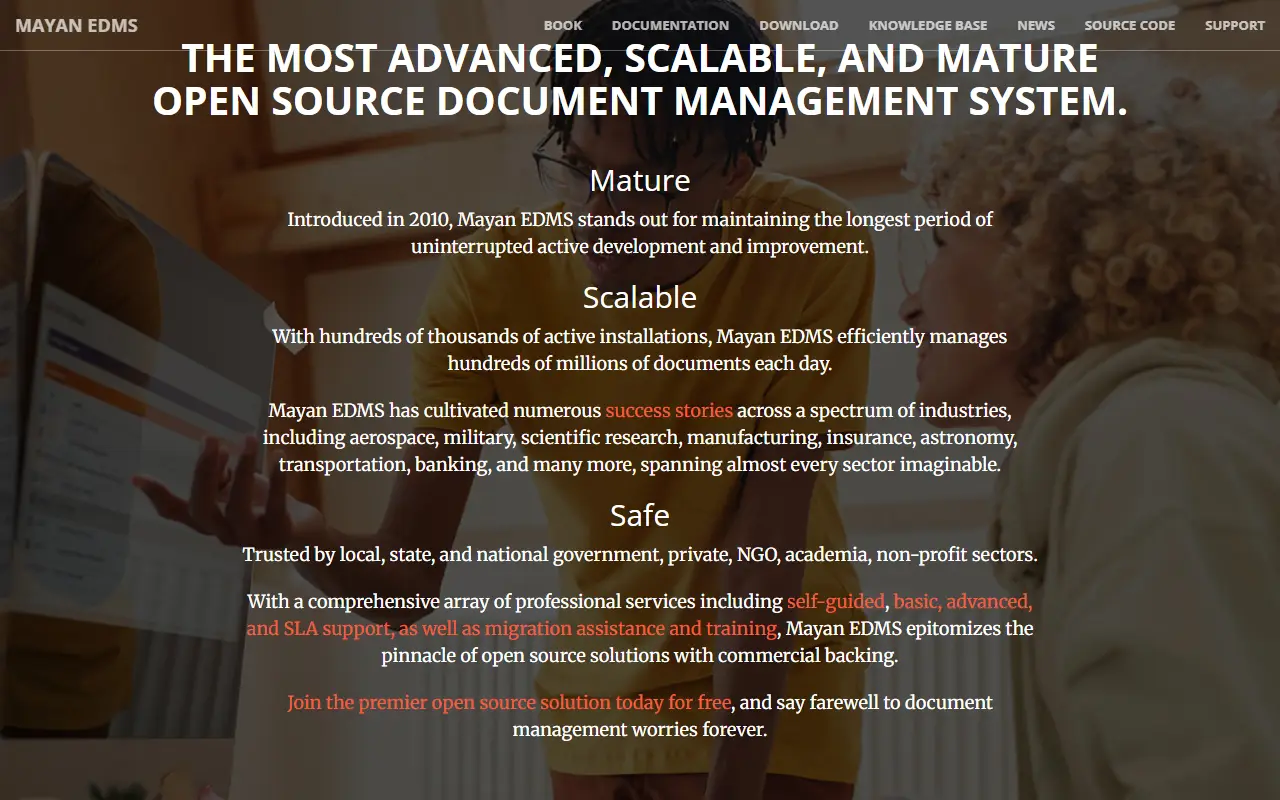
mayan-edms.comMayan Edms homepage screenshot

Mayan EDMS is a document management system. The project says it was introduced in 2010 and lists more than 200 releases, 100 contributors and translations into over 30 languages. It describes itself as open source with commercial backing from Mayan EDMS LLC.

Documents can hold many versions, each with its own access control, and the permission system has an entry for every atomic user operation. Workflows define the states a document can be in and the transitions between them, while smart links create rule-based cross references between related documents.

Almost all behaviour is configurable through a settings system, and functions are reachable from a permission-controlled setup panel in the web interface. An HTTP REST API is provided for integrating with existing infrastructure. Paid services listed include support tiers, migration assistance and training.

Key features

  • Stores many versions of a document
  • Separate access control per version
  • A permission for every atomic user operation
  • Workflows define document states and transitions
  • Rule-based smart links between documents
  • HTTP REST API provided
  • Setup done through a web panel

Commercial M-Files alternatives

Hosted, closed-source products that compete with M-Files. Showing 12 of 14.

See every M-Files alternative on its tool page

M-Files alternatives: questions

What is the best open-source alternative to M-Files?
Paperless-ngx is the top-ranked open-source alternative to M-Files on Enlisted: Paperless-ngx is a GPL-3.0 document management system that turns scanned paper into a searchable archive, deployed mainly with Docker Compose. Other strong options are Nextcloud, ownCloud, Teedy and Mayan Edms.
What are the best commercial alternatives to M-Files?
DocuWare, Laserfiche, Hyland OnBase, OpenText Documentum and Egnyte are among the hosted, closed-source alternatives to M-Files listed on Enlisted, which lists 14 in total. Compare their pricing and features on each tool page.
Are these M-Files alternatives free?
All 5 are open source, so the code is free to use under its licence, and all of them can be self-hosted on your own server or computer. 1 also offers a paid or managed cloud version if you'd rather not host it yourself.
How is this list of M-Files alternatives ranked?
By a score built from GitHub stars, star growth over the last 30 days and how recently the code changed. 4 of these projects shipped code in the last 30 days. Data is refreshed daily, and nobody can pay to move up.

People also look for alternatives to…

View all