7,363 open-source and SaaS tools, with GitHub stats refreshed every day.

8 alternatives ranked by real activity

Open-source Koofr alternatives

A curated, ranked list of the 8 best open-source alternatives to Koofr.

The best open-source alternative to Koofr is Nextcloud. If that doesn't suit you, other good options are Cloudreve, OpenList, Cryptomator and Seafile.

Koofr alternatives are mainly file storage & sharing tools, but some are also security tools. 8 of them shipped code in the last 30 days, 8 can be self-hosted, and none uses a permissive licence.

Last updated October 2, 2026 · ranked by GitHub stars, growth and recent commits

Nextcloud

A self-hosted file sync, sharing and collaboration platform that stores files, contacts and calendars on a server you choose, extensible with hundreds of apps.

GitHub stars
37k
Last commit
yesterday
Latest release
v35.0.1
Licence
AGPL-3.0
Self-hosted
Yes
Hosted version
Available
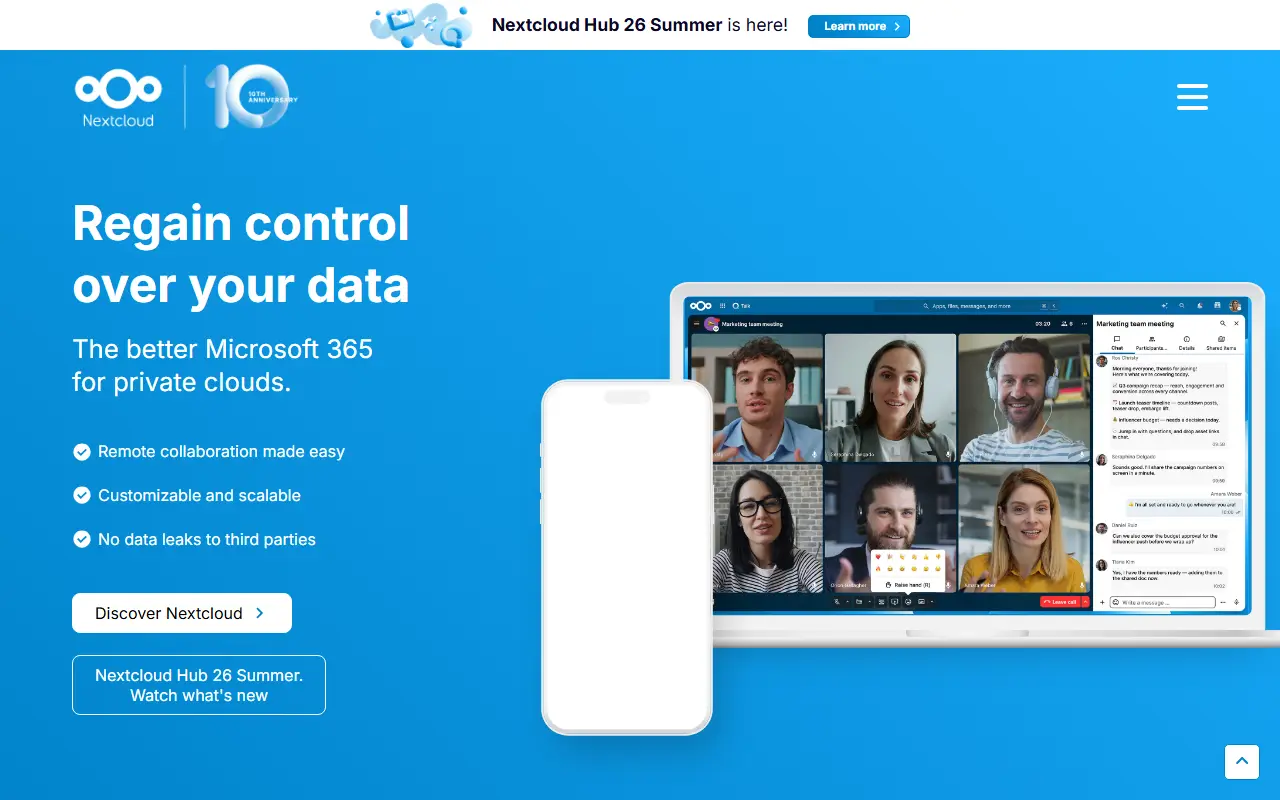
nextcloud.comNextcloud homepage screenshot

Nextcloud Server is a platform for keeping your files, contacts, calendars and other data on a server of your choosing. Content is synchronized across your devices, can be shared with other people for viewing or collaboration, and stays under your control rather than with a large cloud provider. It grew out of the ownCloud lineage.

Functionality can be expanded through hundreds of apps in its App Store, including Calendar, Contacts, Mail and Video Chat. Security measures include encryption mechanisms, a public bug bounty program and two-factor authentication. There are several ways to get a Nextcloud: sign up with a provider, install the server yourself on your own hardware or with a ready-to-use appliance, buy a device that comes with it preinstalled, or find a service provider to host it for you.

The server is written in PHP and JavaScript under the AGPL-3.0 license. Nextcloud GmbH also offers an Enterprise edition aimed at public sector, education and company users. It suits households, schools and organizations that want to replace commercial cloud storage and office suites with something they run themselves.

Key features

  • File storage and sync across devices
  • Contacts and calendar hosting
  • Sharing and collaboration controls
  • App Store with hundreds of apps
  • Two-factor authentication and encryption
  • Self-install, appliance or provider-hosted options

Pricing: Nextcloud Enterprise Standard starts at 42€ per user per year, with subscriptions from 100 users and 31.50€ from 250 users. Nextcloud One managed hosting is offered for smaller teams.

Cloudreve

A self-hosted file management and sharing system that stores files across local disks and many cloud storage providers, with WebDAV, previews and share links.

GitHub stars
29k
Last commit
12 days ago
Latest release
4.19.1
Licence
GPL-3.0
Self-hosted
Yes
cloudreve.orgCloudreve homepage screenshot

Cloudreve is a self-hosted file management and sharing system with support for multiple storage backends. You can keep files on local disk, on a remote node, or with providers including OneDrive, S3-compatible services and several Chinese clouds such as Aliyun, Tencent, Huawei and Qiniu, and clients transfer data directly to the provider.

Everyday file features include drag-and-drop upload of files and folders with parallel, resumable transfers, batch download, compressing and extracting archives, WebDAV access across all storage providers, and background downloads through Aria2 or qBittorrent using one or more download nodes. Media metadata can be extracted so files can be searched by metadata or tag. Multiple users and groups are supported, and share links for files and folders can carry an expiry date. Videos, images, audio and ePub files preview online, and text, Markdown, diagrams and Office documents can be edited.

Cloudreve is written in Go and licensed under GPL-3.0, with a project homepage, online demo, documentation and Telegram and Discord communities. It suits individuals and small organizations that want a private, Chinese-ecosystem-friendly alternative to commercial cloud drives.

Key features

  • Multiple storage backends including S3 and OneDrive
  • Direct client-to-provider transfers
  • WebDAV access to storage
  • Resumable parallel uploads
  • Share links with expiry dates
  • Online preview and editing of documents
  • Multi-user and group management

Pricing: Free and open source under the GPL-3.0 license.

OpenList

OpenList is a community-driven, AGPL-licensed fork of AList, a file list program for browsing and managing files across cloud storage services.

GitHub stars
25k
Last commit
2 days ago
Latest release
v4.2.6
Licence
AGPL-3.0
Self-hosted
Yes
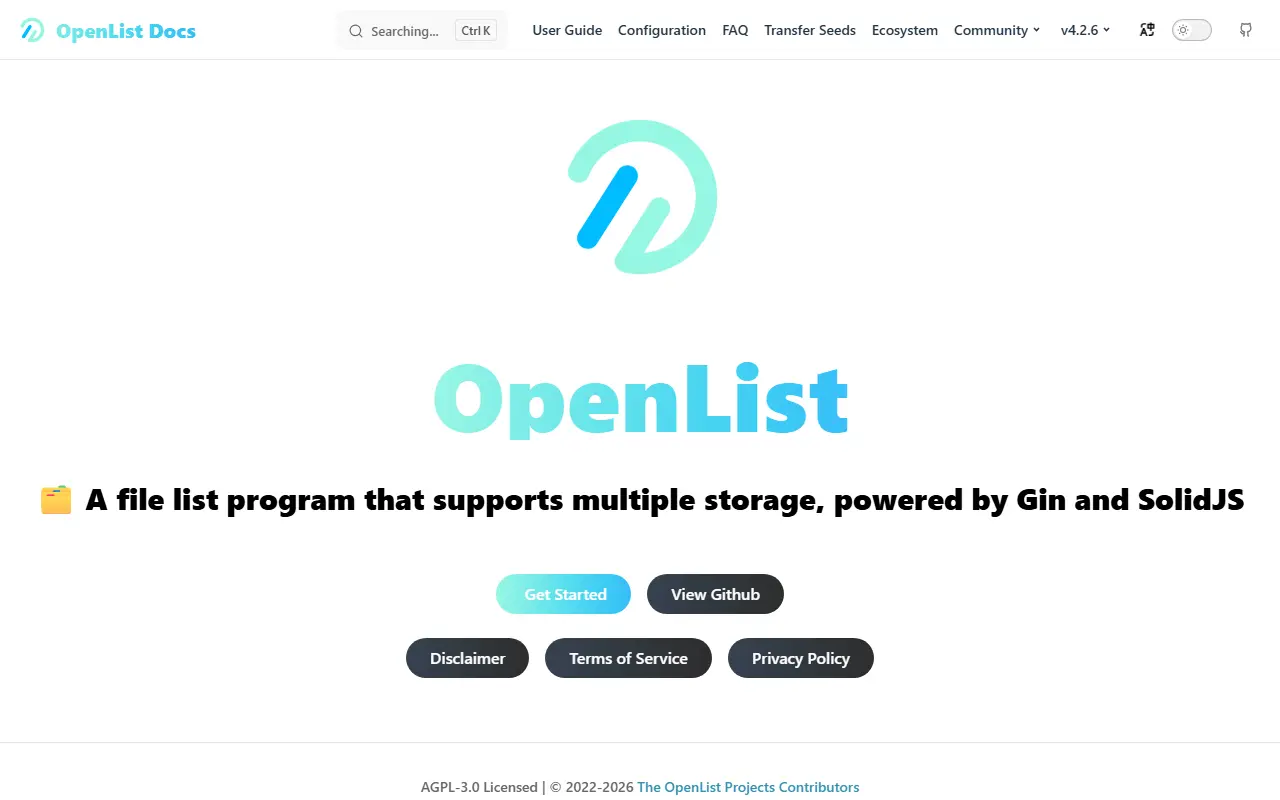
doc.oplist.orgOpenList homepage screenshot

OpenList is a community-driven fork of AList, created in 2025 and written in Go. Its README says the fork aims to provide resilient, long-term governance and to defend open source against trust-based attacks. The project is maintained by the OpenList Team and released under the AGPL-3.0 license, with a stated commitment to complete code openness and transparent modifications.

AList is known as a program that lists and manages files stored on many cloud drives, and the repository topics for OpenList mention Aliyun Drive and Baidu Pan. The maintainers publish a disclaimer asking users to note that OpenList is not affiliated with similarly named third-party projects or paid proprietary software. They state that the project has no paid plans or commercial deployments, that its documentation and API services rely on charitable Cloudflare resources, and that downstream projects must respect the AGPL and avoid impersonating the name.

Key features

  • Community-maintained fork of AList
  • File listing across multiple cloud storage services
  • Written in Go as a single server
  • AGPL-3.0 licensed with open governance
  • Documentation site and API services
  • Translated README in many languages

Pricing: Free and open source under AGPL-3.0; the maintainers state there are no paid plans.

Cryptomator

Cryptomator is a free, open-source desktop app that adds client-side encryption to cloud storage through transparent encrypted vaults.

GitHub stars
16k
Last commit
2 days ago
Latest release
1.19.3
Licence
GPL-3.0
Self-hosted
Yes
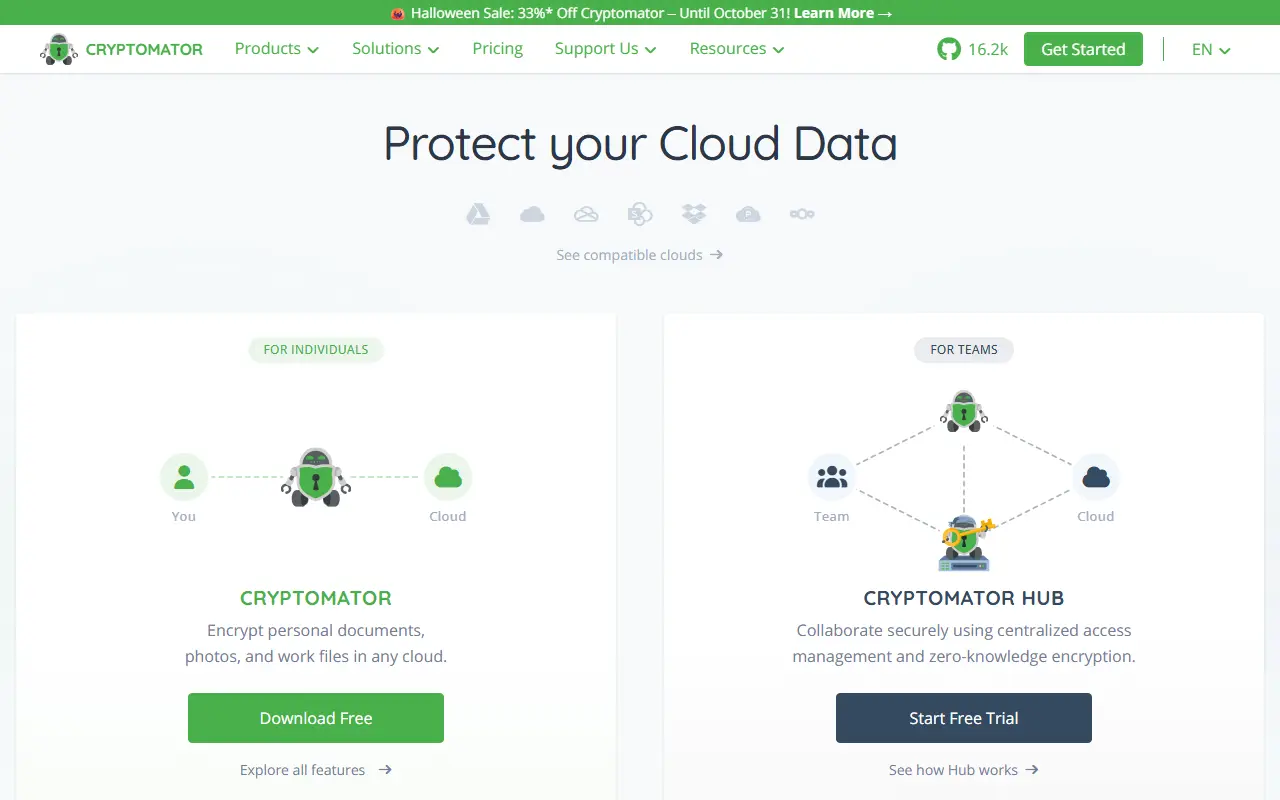
cryptomator.orgCryptomator homepage screenshot

Cryptomator encrypts files on your own device before they reach a cloud storage service. It presents an encrypted vault as a virtual drive, so you work with files as if they were on a USB flash drive while only encrypted data is synced. It runs on Windows, macOS and Linux, is written in Java and is released under the GPL-3.0 license.

It works with any cloud service that synchronizes with a local directory, including Dropbox, Google Drive, OneDrive, MEGA, pCloud, ownCloud and Nextcloud. Files are protected with AES encryption using 256-bit keys, file names are encrypted, and the folder structure is obfuscated. You can keep as many vaults as you like, each with its own password.

The security design uses scrypt key derivation and cryptographically secure random numbers, and it wipes sensitive data from memory quickly. Encryption is client-side, so no account is needed and no data is shared with an online service. The project is provided free of charge and relies on donations and sponsors for development.

Key features

  • Client-side AES-256 encryption for cloud files
  • Transparent virtual drive for each vault
  • Encrypted file names and obfuscated folders
  • Works with Dropbox, Google Drive, OneDrive and more
  • Multiple vaults with separate passwords
  • Scrypt key derivation

Pricing: The desktop app is free for personal use, with optional one-time mobile upgrades from 29.99 euros. Cryptomator Hub has a free self-hosted Community tier, a Standard per-seat tier with a 30-day trial, and Enterprise from 10,000 euros a year.

Seafile

A file sync and sharing platform with desktop and mobile clients that also lets teams organize files with extensible properties and flexible views.

GitHub stars
15k
Last commit
15 days ago
Latest release
v9.0.5
Self-hosted
Yes
Hosted version
Available
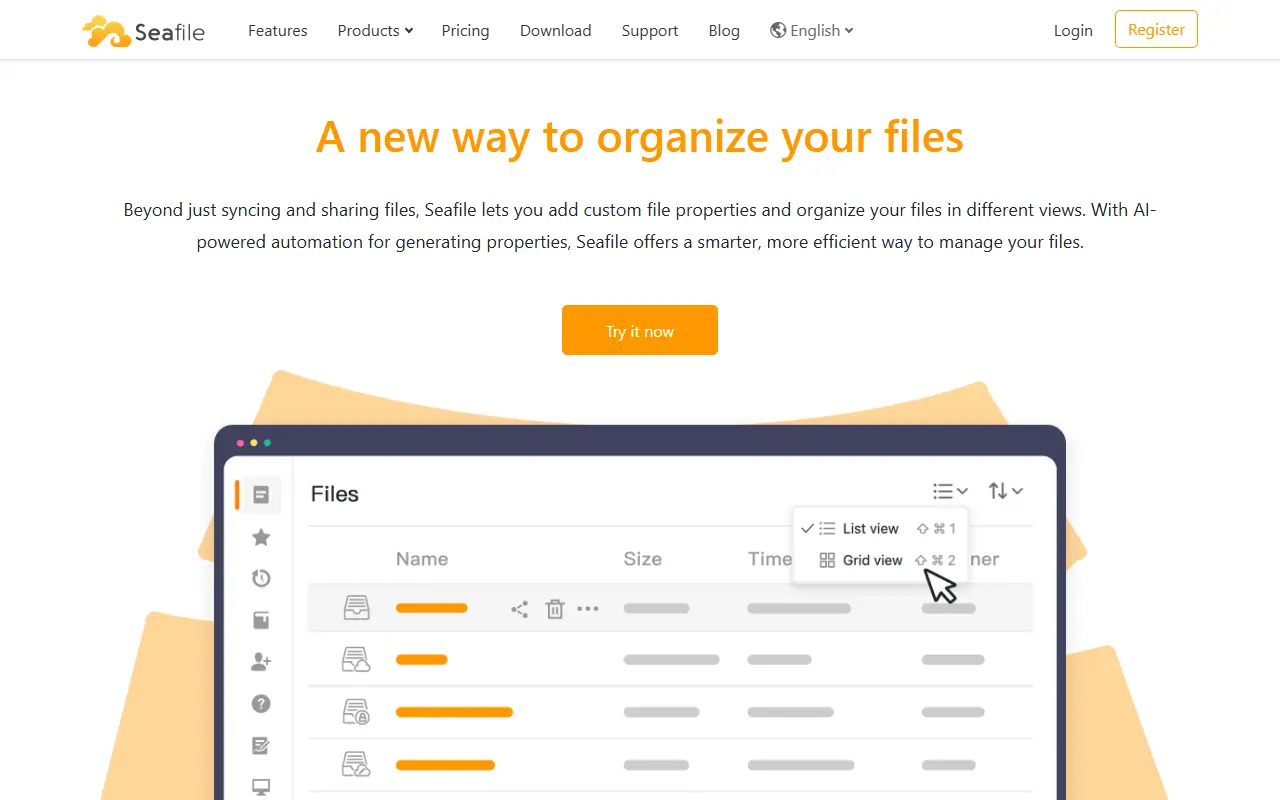
seafile.comSeafile homepage screenshot

Seafile is a file synchronization and sharing platform written mainly in C. Beyond keeping folders in sync across devices and sharing them with others, it describes a newer way of organizing files using extensible file properties and flexible views. Topics also tie it to wikis, Markdown, knowledge management and document management.

The project's homepage could not be fetched while preparing this entry, so the details here come from the repository description, its topics and general knowledge of the product. Seafile is known for client apps on desktop and mobile, libraries as the unit of syncing and sharing, and an emphasis on reliable syncing of large numbers of files.

The core server is open source, with its license listed as 'Other' on GitHub, and the vendor also sells a professional edition and offers hosted service. You can run it on your own servers, which suits teams and organizations that want private cloud storage under their control.

Key features

  • File synchronization across devices
  • File and folder sharing
  • Extensible file properties
  • Flexible views for organizing files
  • Wiki and Markdown document features

Pricing: The Community Edition is free to self-host. Pro Edition is $48 per user per year (free for 3 users); the hosted Plus Team plan is $8 per user per month with a 30-day trial.

Filestash

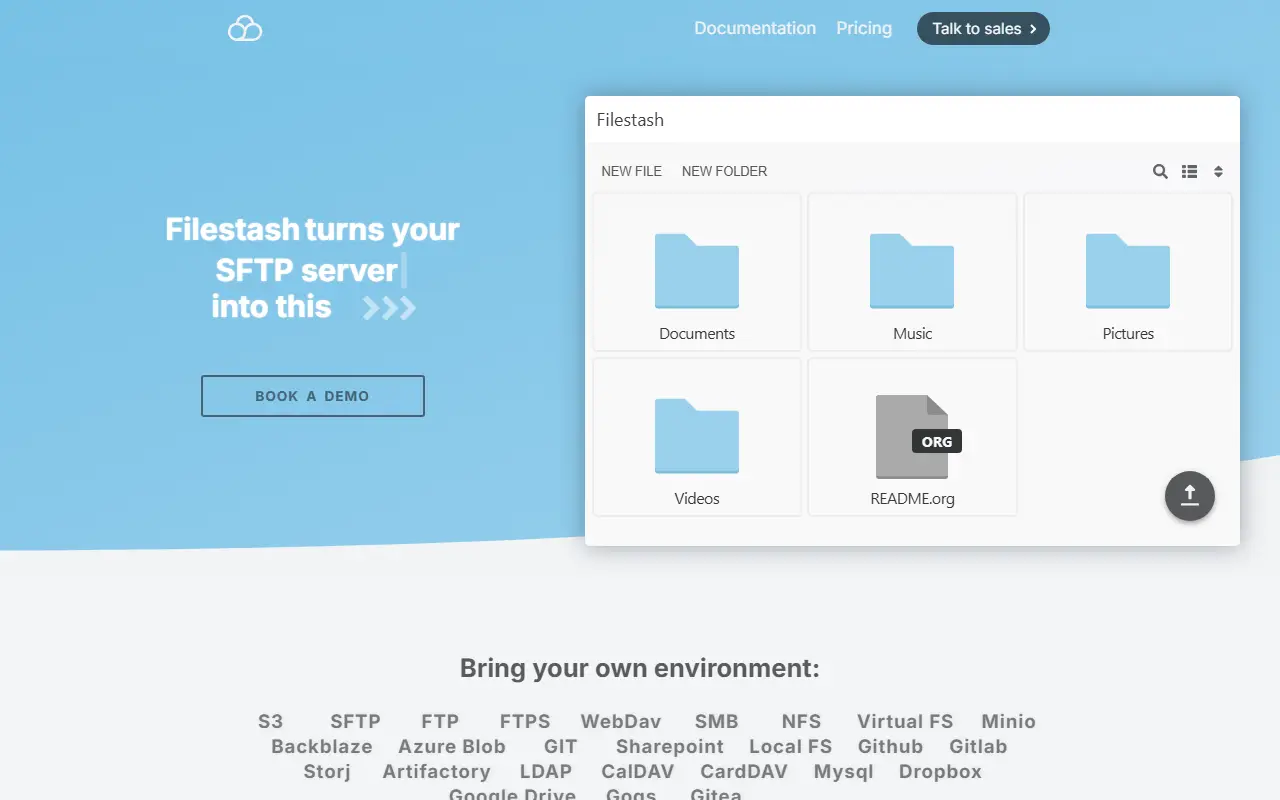
Filestash is a storage-agnostic web file manager that connects to FTP, SFTP, S3, SMB, WebDAV and many other storage backends through plugins.

GitHub stars
15k
Last commit
today
Licence
AGPL-3.0
Self-hosted
Yes
filestash.appFilestash homepage screenshot

Filestash began as a Dropbox-like file manager that speaks many storage protocols, including FTP, SFTP, S3, SMB, WebDAV and IPFS along with about twenty more. It has since grown into a wider file management platform built around three products: a web client for browsing files in a browser, a native client for syncing data to devices, and gateways that expose storage over other protocols.

Its architecture is plugin-driven, so anything beyond the lean core lives in a plugin and requirements are met by adding or writing plugins rather than forking. The web client is written in vanilla JavaScript, and APIs and gateways can expose data over SFTP, S3, FTP, WebDAV, MCP and AS2. Authentication integrations can go as far as delegating login to a WordPress site and using its roles for access control.

A workflow engine automates actions on files by chaining steps on events, ranging from Slack or email notifications to managed file transfer pipelines. Filestash is written in Go and released under the AGPL-3.0 license, and repository topics point to uses in document management and archiving.

Key features

  • Web file manager for FTP, SFTP, S3, SMB and WebDAV
  • Plugin-driven architecture
  • Gateways exposing storage over other protocols
  • Workflow engine for file events
  • Native client for syncing files
  • Pluggable authentication and access control

Pricing: Self-hosted use is free for up to 3 users. Hobby costs $6, Pro starts at $50 and Enterprise at $290 per month, with free trials available.

ownCloud

The server core of ownCloud Classic, a self-hosted platform for file storage, sync and sharing with WebDAV, CalDAV and CardDAV support.

GitHub stars
8.8k
Last commit
5 days ago
Latest release
v11.0.1
Licence
AGPL-3.0
Self-hosted
Yes
owncloud.comownCloud homepage screenshot

ownCloud Core is the server component of ownCloud Classic, a self-hosted platform for file storage, synchronization and sharing. It is the foundation on which apps such as Activity, Calendar and Contacts are built, and is written in PHP and JavaScript.

It ships with servers for WebDAV, CalDAV and CardDAV, an app plugin architecture, backends for external storage, support for encryption, user and group management, and a REST API. The server runs on PHP with MySQL, MariaDB, PostgreSQL or SQLite, and is also available as a Docker image on Docker Hub. Its topics point to federated sharing and enterprise use.

ownCloud Classic is licensed under AGPL-3.0, and installation is covered by the official manual. For the next-generation platform, the project points to ownCloud Infinite Scale. Contributors follow a rebase workflow with signed commits and DCO sign-off, and enterprise support is available from the vendor. It suits organizations and individuals who want to keep files on their own servers instead of a public cloud.

Key features

  • File storage, sync and sharing
  • WebDAV, CalDAV and CardDAV servers
  • Plugin architecture for apps
  • User and group management
  • Encryption and external storage support
  • REST API for integrations
  • Docker image available

Pricing: Free and open source under AGPL-3.0; enterprise support is available from the vendor.

Kodbox

Self-hosted web file manager and private cloud drive with online preview and editing, multi-storage support, sharing, and a built-in web code editor.

GitHub stars
3.3k
Last commit
3 days ago
Latest release
1.69.03
Self-hosted
Yes
kodcloud.comKodbox homepage screenshot

Kodbox is a web-based file manager that can act as a private cloud disk for individuals or an enterprise network drive. It is a redesign of the earlier KodExplorer project and also includes a web code editor, so websites can be edited directly in the browser. The operating experience is modeled on a desktop file explorer, including drag and drop, keyboard selection, and quick search.

A key capability is multi-storage support: files can live on a local disk, FTP, WebDAV, or object storage such as Alibaba Cloud OSS, Tencent Cloud COS, Qiniu, MinIO, or any S3-compatible service. It previews, edits, and plays many office and media formats online, and supports sharing links, collaboration, and fine-grained permission control.

Kodbox runs on Linux, Windows, or macOS and, according to the README, needs only PHP. Clients are available through the web, mobile browsers, iOS, Android, desktop, and WebDAV mounting. The input does not state a license or pricing model, so check the vendor site for current terms. It suits teams and individuals who want to keep documents on their own infrastructure.

Key features

  • Desktop-style web file manager
  • Multi-storage backends including S3-compatible services
  • Online preview and editing of many file formats
  • Built-in web code editor
  • Sharing links with permission controls
  • WebDAV mounting and mobile clients

Koofr alternatives: questions

What is the best open-source alternative to Koofr?
Nextcloud is the top-ranked open-source alternative to Koofr on Enlisted: A self-hosted file sync, sharing and collaboration platform that stores files, contacts and calendars on a server you choose, extensible with hundreds of apps. Other strong options are Cloudreve, OpenList, Cryptomator and Seafile.
Are these Koofr alternatives free?
All 8 are open source, so the code is free to use under its licence, and all of them can be self-hosted on your own server or computer. 2 also offer a paid or managed cloud version if you'd rather not host it yourself.
How is this list of Koofr alternatives ranked?
By a score built from GitHub stars, star growth over the last 30 days and how recently the code changed. 8 of these projects shipped code in the last 30 days. Data is refreshed daily, and nobody can pay to move up.

People also look for alternatives to…

View all