7,363 open-source and SaaS tools, with GitHub stats refreshed every day.

6 alternatives ranked by real activity

Open-source Keboola alternatives

A curated, ranked list of the 6 best open-source alternatives to Keboola.

The best open-source alternative to Keboola is Kestra. If that doesn't suit you, other good options are Airbyte, dbt, Mage AI and Bruin.

Keboola alternatives are mainly data pipeline & ETL tools. 6 of them shipped code in the last 30 days, 6 can be self-hosted, and 5 use a permissive licence.

Last updated October 3, 2026 · ranked by GitHub stars, growth and recent commits

Kestra

An open-source, event-driven orchestration and scheduling platform where data, AI and infrastructure workflows are defined declaratively in YAML and managed from a UI.

GitHub stars
29k
Last commit
yesterday
Latest release
v2.0.4
Licence
Apache-2.0
Self-hosted
Yes
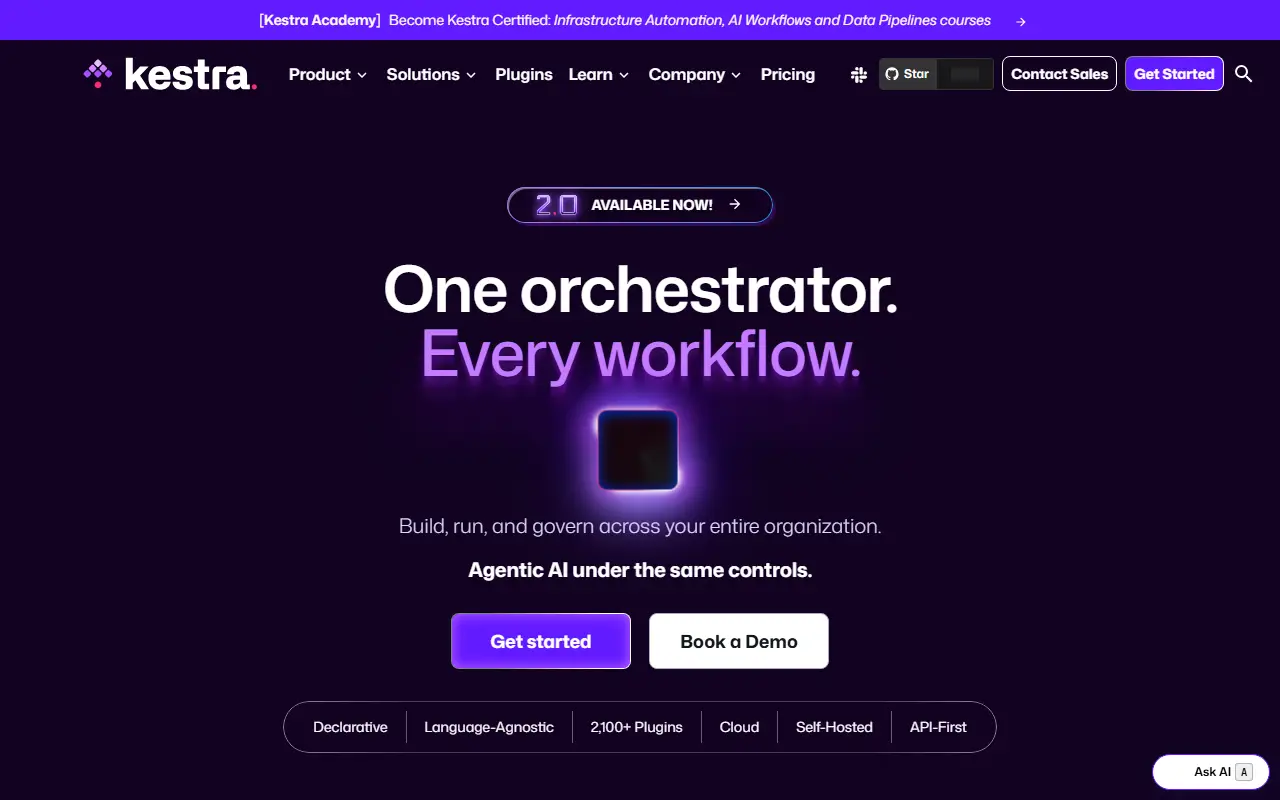
go.kestra.ioKestra homepage screenshot

Kestra is an orchestration platform, open source, for data pipelines, AI workflows and infrastructure automation. It brings scheduled and event-triggered automation together under one declarative interface that does not depend on a programming language, applying infrastructure-as-code practices to pipelines so that reliable workflows can be defined in a few lines of YAML.

Workflows can be built in the UI, written by a built-in AI Copilot, or generated from coding agents such as Claude Code and Cursor using agent skills, and everything can be kept as code with Git integration even when it was authored visually. A large plugin ecosystem connects it to external systems, and key concepts cover tasks, triggers and flows. The project is written in Java, with topics covering orchestration, high availability, pipeline-as-code and DevOps, and the 2.0 release adds new capabilities.

Kestra is Apache-2.0 licensed and can be self-hosted, with a quick start that gets a first workflow running in minutes. It targets data engineers, platform teams and automation developers who want an alternative to schedulers such as Airflow with a more declarative style.

Key features

  • Declarative YAML workflow definitions
  • Scheduled and event-driven triggers
  • Visual editor and AI Copilot
  • Git version control integration
  • Large plugin ecosystem
  • Agent skills for coding agents

Pricing: Free and open source under the Apache-2.0 license.

Airbyte

An open-source data movement platform with hundreds of connectors for ELT pipelines from APIs, databases and files into warehouses, lakes and AI applications.

GitHub stars
22k
Last commit
yesterday
Latest release
v2.0.0
Self-hosted
Yes
Hosted version
Available
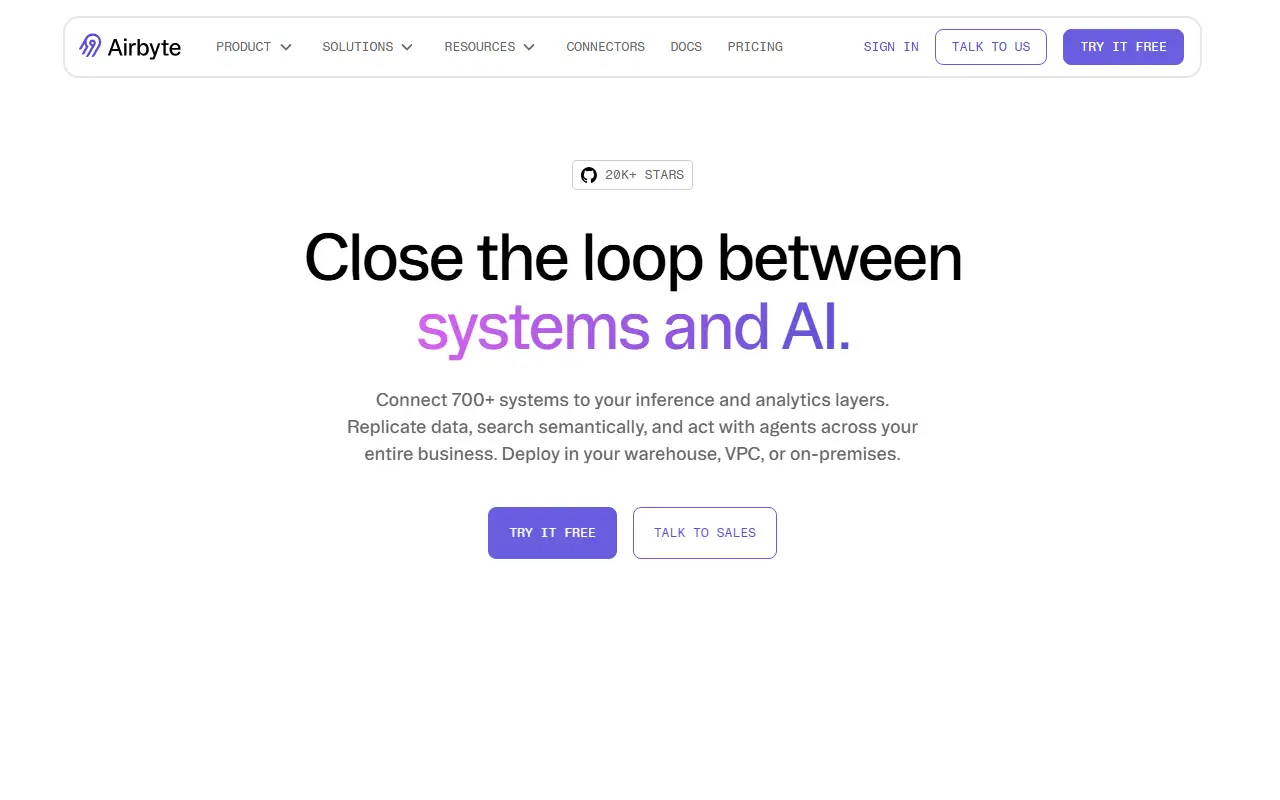
airbyte.comAirbyte homepage screenshot

Airbyte is an open-source data movement platform for moving data from APIs, databases and files into data warehouses, data lakes and AI applications. Its premise is that only an open-source project can reach the long tail of data sources while letting engineers tailor existing connectors, with the aim of moving data from any source to any destination.

It offers a catalog of 600 or more connectors for APIs, databases, warehouses, lakes and AI applications, with warehouse destinations such as BigQuery, Redshift and Snowflake, and topics also mention change data capture. The README distinguishes products by job: Airbyte Open Source or Airbyte Cloud for ELT and ETL into warehouses, lakes or databases, and Airbyte Agents, a managed data and context layer, plus an open-source Agent SDK for giving AI agents and MCP clients real-time access to business data.

Airbyte is written in Python and Java, and its license is listed as 'Other' on GitHub because the project uses a mix of licenses, so review the terms for your use. It can be self-hosted or run as the managed Airbyte Cloud, and suits data teams that need many integrations without writing each pipeline by hand.

Key features

  • 600+ source and destination connectors
  • ELT pipelines into warehouses and lakes
  • Change data capture support
  • Customizable open-source connectors
  • Agent SDK for AI agent data access
  • Self-hosted or Airbyte Cloud

Pricing: The open-source Core edition is free to self-host. Managed cloud starts at $20 a month (Standard) or $189 a month for 40 credits (Plus); Pro and Enterprise Flex are custom. 30-day trial.

dbt

A data transformation framework that lets analysts and engineers build analytics models with software-engineering practices; v2.0 is a ground-up rewrite in Rust.

GitHub stars
14k
Last commit
yesterday
Latest release
v2.0.5
Licence
Apache-2.0
Self-hosted
Yes
Hosted version
Available
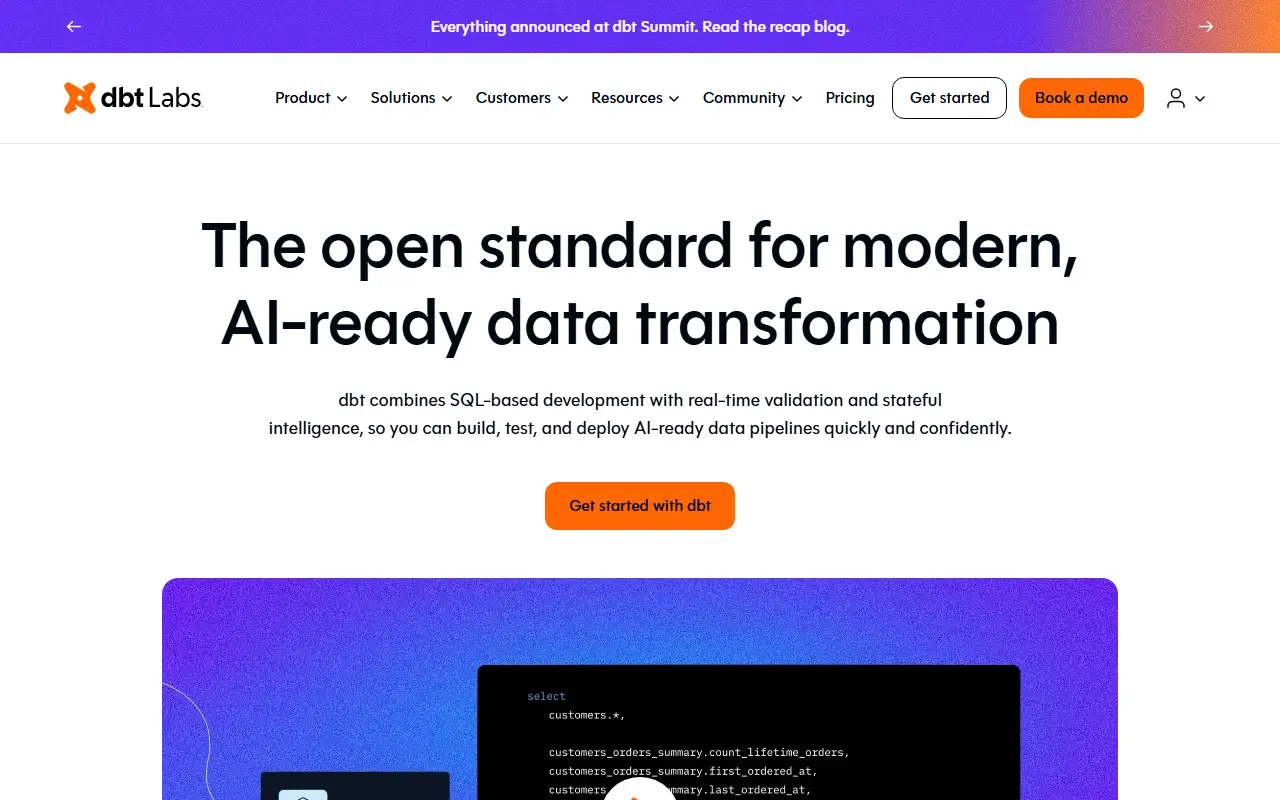
getdbt.comdbt homepage screenshot

dbt is a framework for transforming data in a warehouse using the same practices that software engineers apply to applications. Analysts and analytics engineers write models, and dbt parses, compiles and runs the project so that transformations are version-controlled and repeatable.

The repository now holds the Apache 2.0 source of dbt v2.0, a ground-up rewrite in Rust. According to its README, v2.0 parses and compiles projects much faster than v1, enforces a stricter language specification at parse time, produces Parquet artifacts alongside the existing JSON ones, and ships as one standalone executable, so no Python installation is needed. The local documentation experience was rebuilt around those artifacts to handle large projects.

The Apache 2.0 code is available to everyone, while the packaged dbt distribution adds dbt-specific customizations under a separate dbt product license. v2.0 supports macOS and Linux on x86-64 and ARM. The v1 Python implementation continues on the 1.latest branch. dbt Labs also offers dbt as a commercial cloud platform.

Key features

  • Data transformation using software engineering practices
  • Faster parsing and compiling in v2.0
  • Strict language specification checks at parse time
  • Parquet artifacts for querying project metadata
  • Single binary without a Python runtime
  • Rebuilt local documentation experience

Pricing: A single-seat Developer plan to start free. Starter costs $100 per user per month; Enterprise and Enterprise+ are custom. A trial is available and add-ons are billed on usage.

Mage AI

Mage is an open-source data pipeline tool for building, scheduling and debugging ETL and transformation jobs in Python, SQL or R through a notebook-style UI.

GitHub stars
8.8k
Last commit
21 days ago
Latest release
0.9.79
Licence
Apache-2.0
Self-hosted
Yes
Hosted version
Available
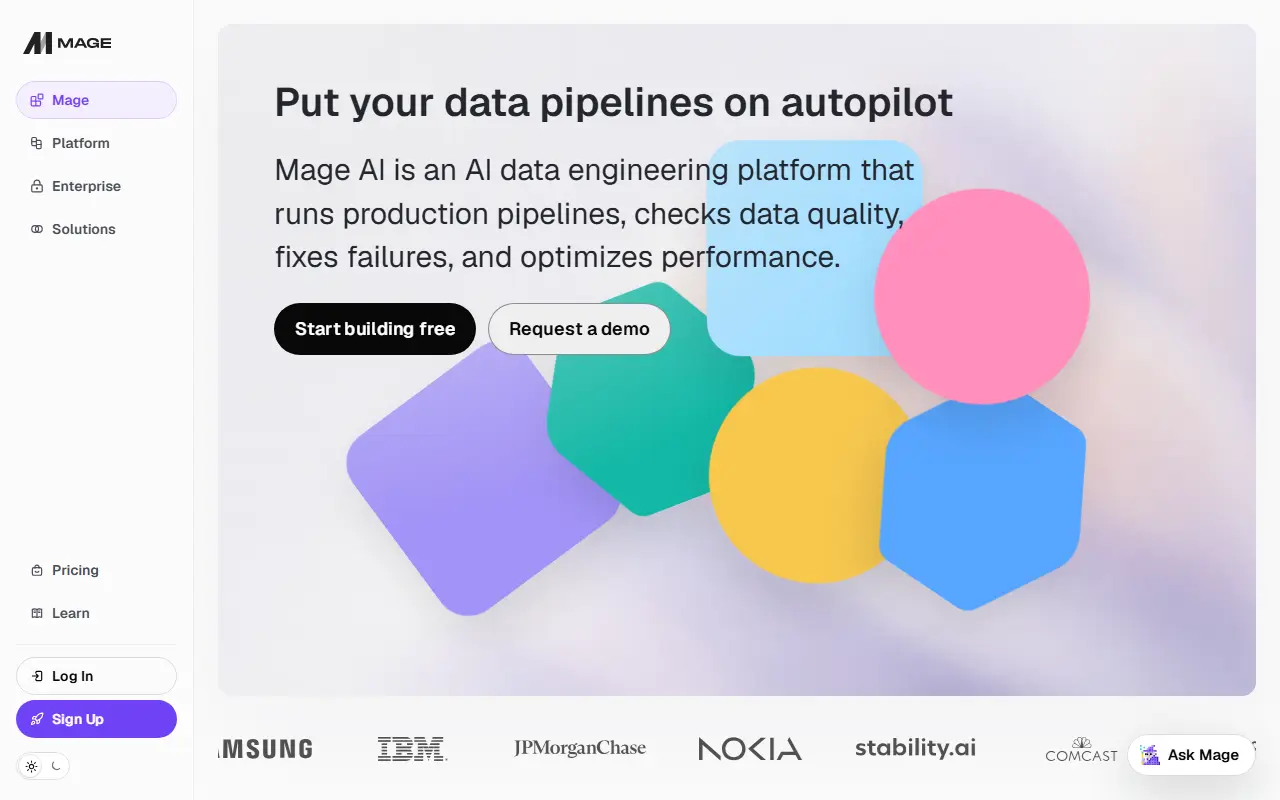
mage.aiMage AI homepage screenshot

Mage, called Mage OSS in its README, is a self-hosted development environment for building data pipelines. It is meant for teams that automate ETL tasks, design data flows or orchestrate transformations, and it presents the work in a notebook-style interface made of modular blocks of code.

Pipelines are written block by block in Python, SQL or R. Jobs can be run manually or on a schedule, including cron expressions, and prebuilt connectors reach databases, APIs and cloud storage. Debugging is visual, with logs, live data previews and execution you can follow step by step, and dbt models can be built and run inside Mage. Topics on the repository also reference Spark, reverse ETL and machine learning workloads.

Mage OSS is licensed under Apache-2.0 and installs with Docker, pip or conda, with no cloud account required. For larger deployments the vendor offers Mage Pro, a commercial platform that adds enterprise orchestration, collaboration and AI-assisted workflows.

Key features

  • Modular pipelines in Python, SQL or R
  • Notebook-style interactive editor
  • Prebuilt connectors for databases, APIs and storage
  • Manual and cron-based scheduling
  • Visual debugging with logs and previews
  • dbt model support inside pipelines

Pricing: Managed Mage starts at $29 per month (Starter) and $100 per month (Team), plus $0.50 per CPU-hour, with a 7-day free trial. Enterprise is by contract.

Bruin

An open-source data pipeline tool that combines ingestion, SQL and Python transformations, and quality checks in one framework you can run locally or in CI.

GitHub stars
1.8k
Last commit
yesterday
Latest release
v0.11.767
Licence
Apache-2.0
Self-hosted
Yes
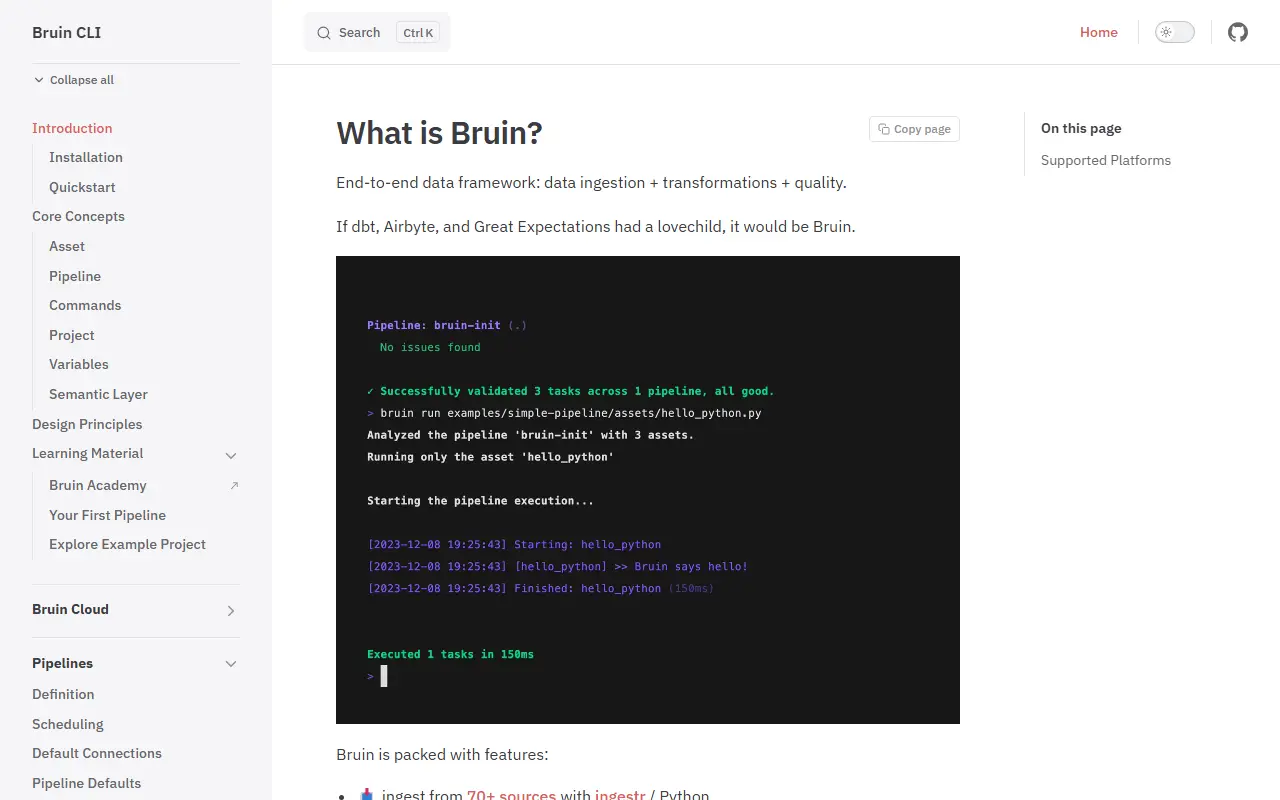
getbruin.comBruin homepage screenshot

Bruin is a data pipeline tool that brings data ingestion, transformation and data quality into a single framework. Instead of stitching together separate tools for loading, modeling and testing, you describe a pipeline with SQL, Python or R assets and run it against the major data platforms, such as BigQuery and Snowflake.

Pipelines can ingest data from different sources, materialize tables and views, and build incremental tables. Python assets run in isolated environments using uv, Jinja templating cuts down on repetition, and built-in quality checks validate results. A dry-run mode validates a pipeline end to end, secrets are injected through environment variables, and a VS Code extension supports day-to-day development.

Bruin is written in Go, licensed under Apache-2.0 and distributed as a command-line tool that is easy to install. It runs on your local machine, an EC2 instance or GitHub Actions, so no dedicated orchestration server is required. It suits data engineers and analytics teams who want pipelines defined as code in a repository.

Key features

  • SQL, Python, and R transformations
  • Data ingestion from multiple sources
  • Table and view materializations with incremental loads
  • Built-in data quality checks
  • Dry-run validation of whole pipelines
  • VS Code extension for development

Pricing: Free and open source under the Apache-2.0 licence.

Duckle

An open-source ETL and ELT platform built on DuckDB that you deploy yourself, with visual or SQL pipelines, dbt, CDC, data quality and an MCP server.

GitHub stars
1.3k
Last commit
yesterday
Latest release
v0.7.4
Licence
Apache-2.0
Self-hosted
Yes
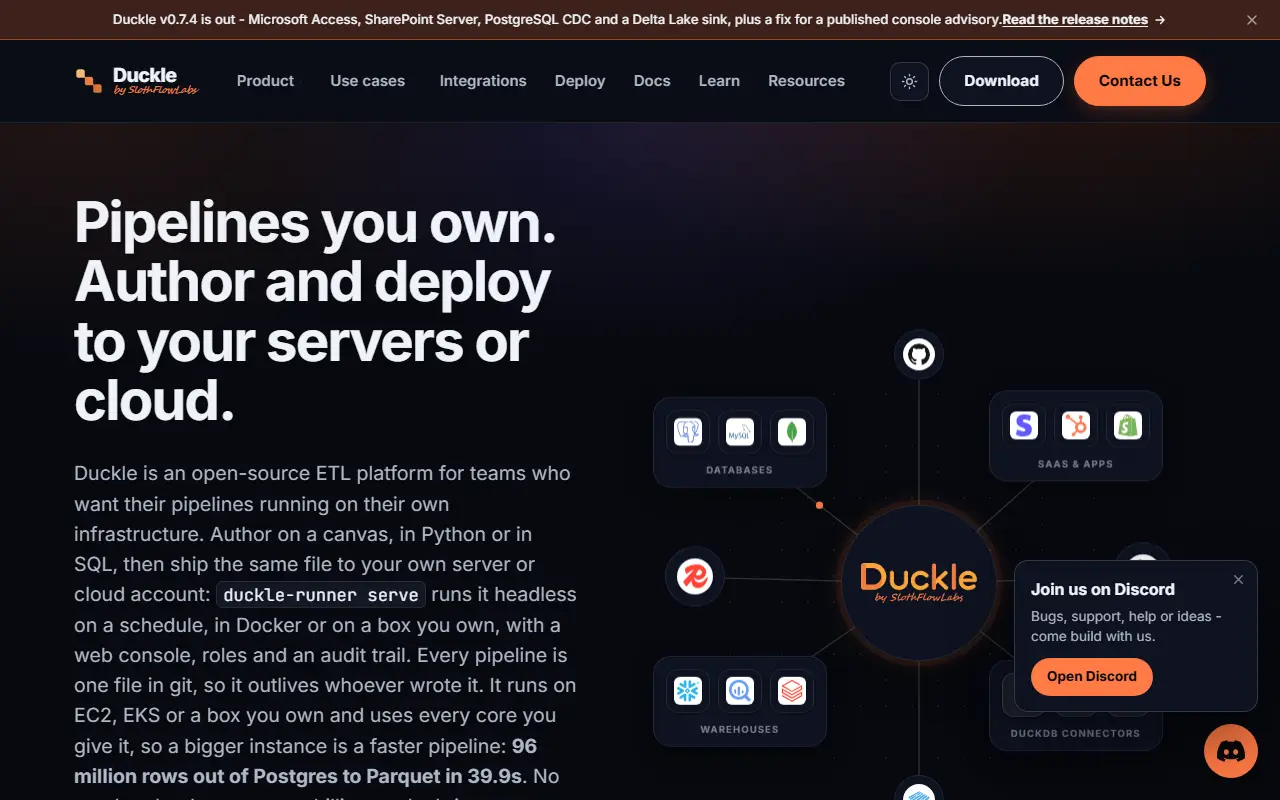
duckle.orgDuckle homepage screenshot

Duckle is an open-source ETL and ELT platform for teams that want their data pipelines running on their own infrastructure. You build pipelines on a visual canvas, in Python or in SQL, then ship the same file to your own server or cloud account, where a headless runner executes it on a schedule.

Pipelines compile to SQL on DuckDB and use all the cores available, so a larger machine runs them faster. The platform lists support for a large catalog of components, dbt, change data capture, data quality checks, reverse ETL and lineage, along with a web console, roles, an audit trail and an MCP server so AI agents such as Claude or Cursor can work with it. Each pipeline is a single file that can live in git.

Duckle is written in Rust and licensed under Apache-2.0, and it runs headless in Docker or on a plain server, with Kubernetes among its topics. It states there is no vendor cloud and no per-row billing. It is an independent project by SlothFlowLabs and is not affiliated with DuckDB Labs or MotherDuck. It suits data engineers who want a self-hosted alternative to managed pipeline services.

Key features

  • Visual canvas, Python, or SQL pipeline authoring
  • Runs on DuckDB across all CPU cores
  • dbt, CDC, and reverse ETL support
  • Data quality checks and lineage
  • Web console with roles and audit trail
  • MCP server for AI agents

Pricing: Free and open source under the Apache-2.0 licence, with no vendor cloud or per-row billing according to the README.

Keboola alternatives: questions

What is the best open-source alternative to Keboola?
Kestra is the top-ranked open-source alternative to Keboola on Enlisted: An open-source, event-driven orchestration and scheduling platform where data, AI and infrastructure workflows are defined declaratively in YAML and managed from a UI. Other strong options are Airbyte, dbt, Mage AI and Bruin.
Are these Keboola alternatives free?
All 6 are open source, so the code is free to use under its licence, and all of them can be self-hosted on your own server or computer. 3 also offer a paid or managed cloud version if you'd rather not host it yourself.
How is this list of Keboola alternatives ranked?
By a score built from GitHub stars, star growth over the last 30 days and how recently the code changed. 6 of these projects shipped code in the last 30 days. Data is refreshed daily, and nobody can pay to move up.

People also look for alternatives to…

View all