#1
A self-hostable no-code database platform that puts a spreadsheet-style interface and auto-generated APIs on top of SQL databases, positioned as an Airtable alternative.
- GitHub stars
- 66k
- Last commit
- yesterday
- Latest release
- 2026.10.1
- Self-hosted
- Yes
- Hosted version
- Available
nocodb.com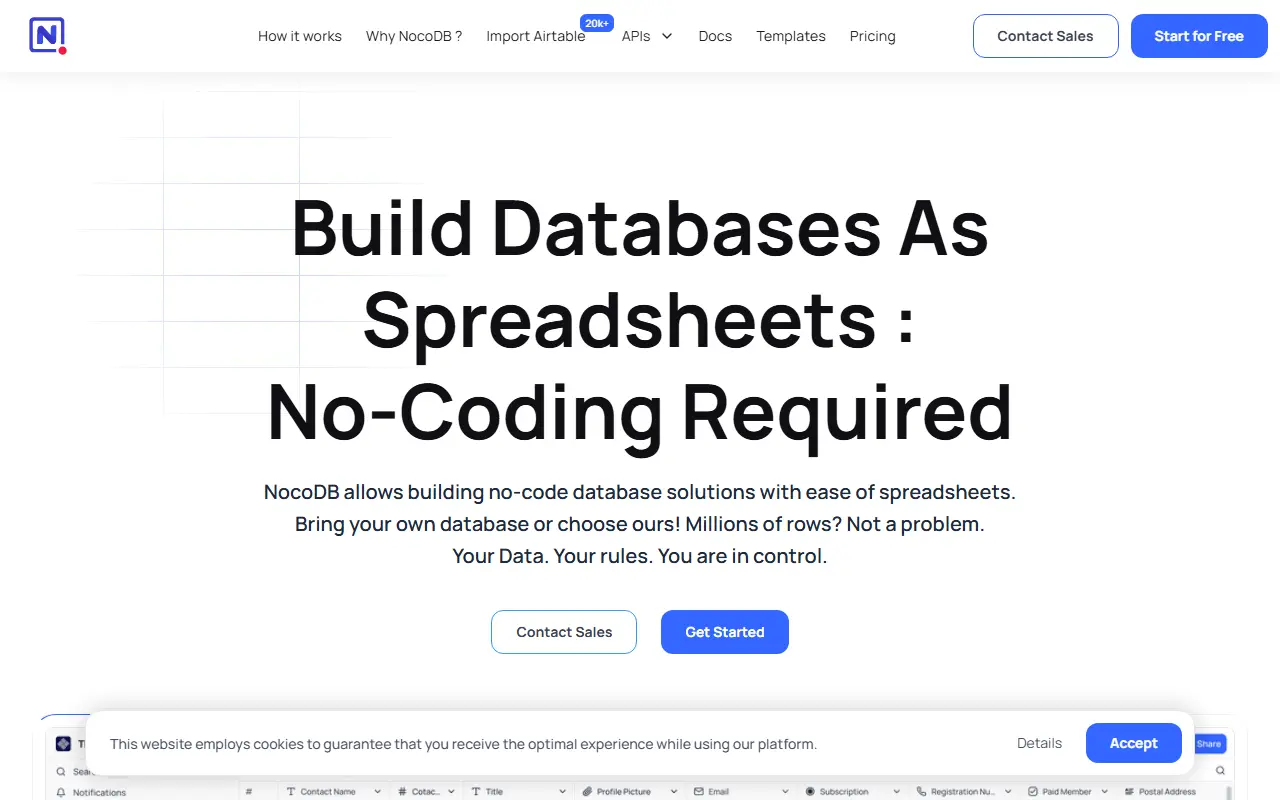
NocoDB is a no-code database platform presented as a free, self-hostable alternative to Airtable. It gives relational databases a spreadsheet-like interface, so people who do not write SQL can create tables, add records and build views, while developers keep a real database underneath.
Its topics point to automatically generated REST APIs documented with Swagger, with PostgreSQL and SQLite among the supported databases. Installation is flexible: you can run it with Docker backed by SQLite or PostgreSQL, or use the auto-upstall script, which sets up a production-style stack with PostgreSQL, Redis and a Traefik gateway through Docker Compose, handles SSL certificates and renewal, and upgrades the install when you run it again. Prebuilt binaries for macOS and Linux are meant only for quick local testing.
The license is listed as 'Other', so check the repository terms before commercial redistribution. NocoDB also runs a hosted service for teams that would rather not manage a server, and it suits groups who want Airtable-style workflows while keeping data in their own database.
Key features
- Spreadsheet-style interface over SQL databases
- Auto-generated REST APIs with Swagger docs
- Works with PostgreSQL and SQLite
- Docker and Docker Compose installation
- One-command production installer with SSL
- Prebuilt binaries for quick local testing
Pricing: Cloud Free covers up to 3 users. Paid plans start at $12 per seat per month billed annually (Plus), then Business $24 and Scale $45. Self-hosted Community is free; Enterprise is custom.
#2
Univer is an open-source SDK for embedding spreadsheet, document and presentation editing into your own product, in the browser or on Node.js.
- GitHub stars
- 23k
- Last commit
- 2 days ago
- Latest release
- v1.4.0
- Licence
- Apache-2.0
- Self-hosted
- Yes
docs.univer.ai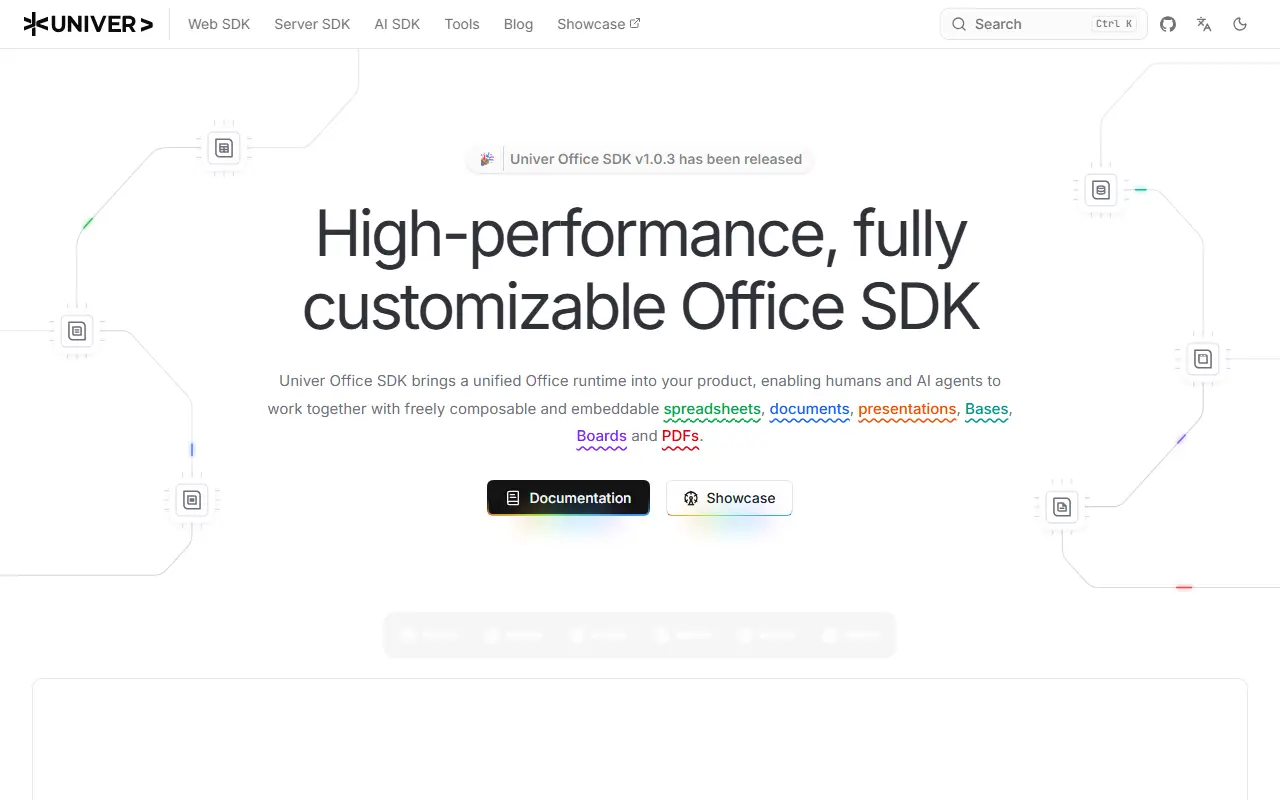
Univer is an open-source SDK that lets you build office-style applications within your own product. It provides components for spreadsheet, document and presentation features, with no requirement to use a hosted app or a fixed interface. The architecture is plugin-based, with rendering on Canvas, a built-in formula engine and a single Facade API usable in browsers and on Node.js. It is written in TypeScript and released under the Apache-2.0 license.
Typical uses include adding spreadsheet or document editing to a SaaS product, an internal tool, a business intelligence workflow or an AI application, and running workbook or document processing on the server with the same architecture as in the browser. Plugins let you include just the capabilities you want, and presets offer a fast way to get going, and extend behavior with custom plugins, commands, services and UI components. The wider Univer family also covers bases, boards and PDFs, and Univer Workspace, a workspace you can host yourself, is built on the SDK as an open-source example. The README distinguishes the open-source scope from the Pro offering.
Key features
- Embeddable spreadsheet and document editing
- Plugin architecture with presets
- Formula engine and Canvas rendering
- Facade API for browser and Node.js
- Server-side workbook processing
- Open-source and Pro editions
Pricing: Core SDK is free and open source under Apache-2.0; the README refers to a separate Pro edition.
#3
A spreadsheet-style AI workspace backed by real PostgreSQL, where data, automated AI workflows and custom apps live together, hosted in the cloud or self-hosted.
- GitHub stars
- 22k
- Last commit
- yesterday
- Latest release
- release.2026-11-10T05-38-53Z.3830
- Self-hosted
- Yes
- Hosted version
- Available
teable.ai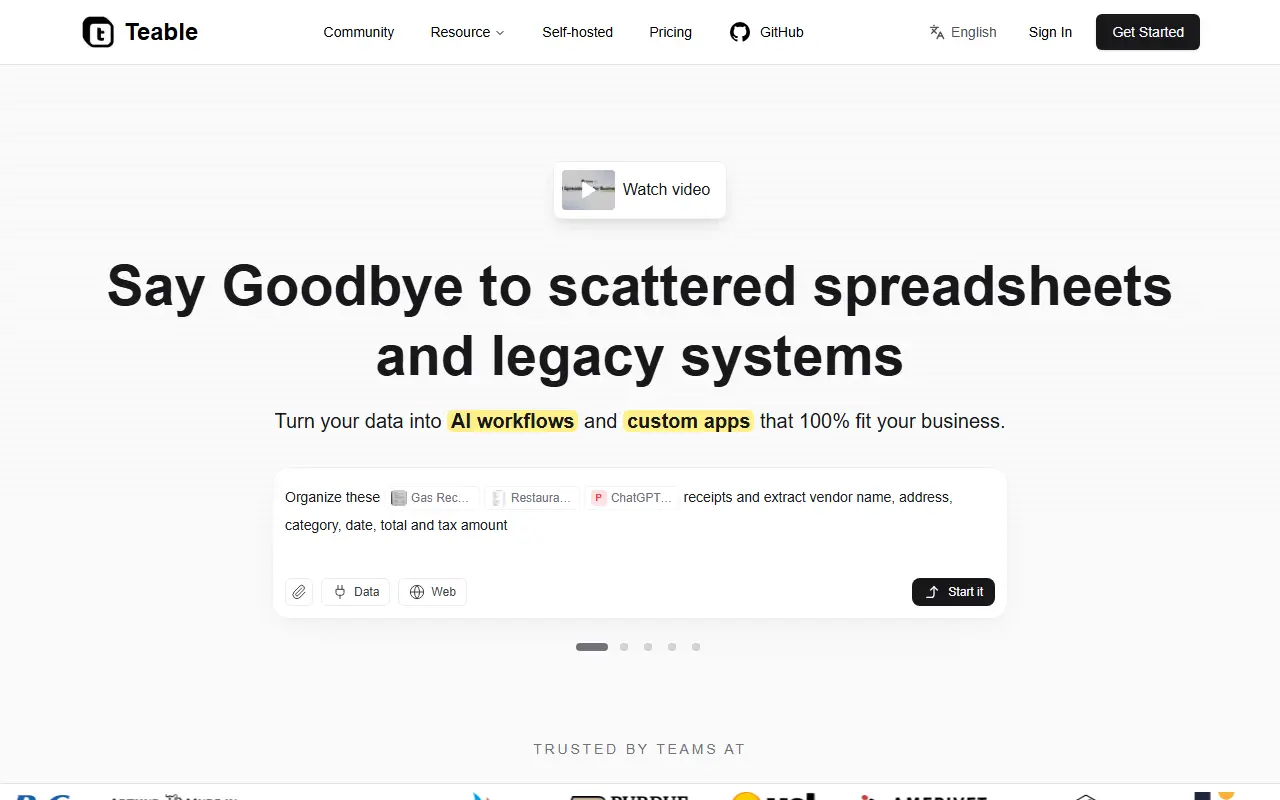
Teable pitches itself as an AI spreadsheet for business. On the surface it behaves like a simple spreadsheet, but underneath it stores data in real PostgreSQL, so teams get an Airtable-style experience on a database they can inspect. Topics tag it as an Airtable alternative, a no-code app builder and an internal tool platform.
The idea is to bring data management, AI workflows and app building into one place, with agents that work inside your live data and processes instead of on exported copies. The self-hosted distribution bundles several platforms together: a sandbox where each AI session runs in its own isolated container that exists only while the session lasts, a lightweight deployment platform for the apps your team builds, an AI chat and an App Builder.
You can try Teable on the hosted cloud at teable.ai, or follow the deployment guide to run a standalone install in minutes or the complete AI platform on your own machines. The code is written in TypeScript, and its license is listed as 'Other' on GitHub, so read the repository terms before commercial redistribution. It suits operations and business teams that want a spreadsheet front end with database-grade foundations.
Key features
- Spreadsheet interface over real PostgreSQL
- AI chat and agent workflows on live data
- Isolated container sandbox per AI session
- App Builder for custom internal apps
- App deployment platform for published apps
- Cloud-hosted or fully self-hosted
Pricing: Free plan for individuals. Pro costs $24 and Business $36 per seat per month, or $13 and $20 per seat per month when billed yearly.
#4
Baserow is a no-code platform for building databases, automations, apps and AI agents, positioned as an open-source Airtable alternative.
- GitHub stars
- 6.3k
- Last commit
- today
- Latest release
- 2.4.2
- Self-hosted
- Yes
- Hosted version
- Available
baserow.io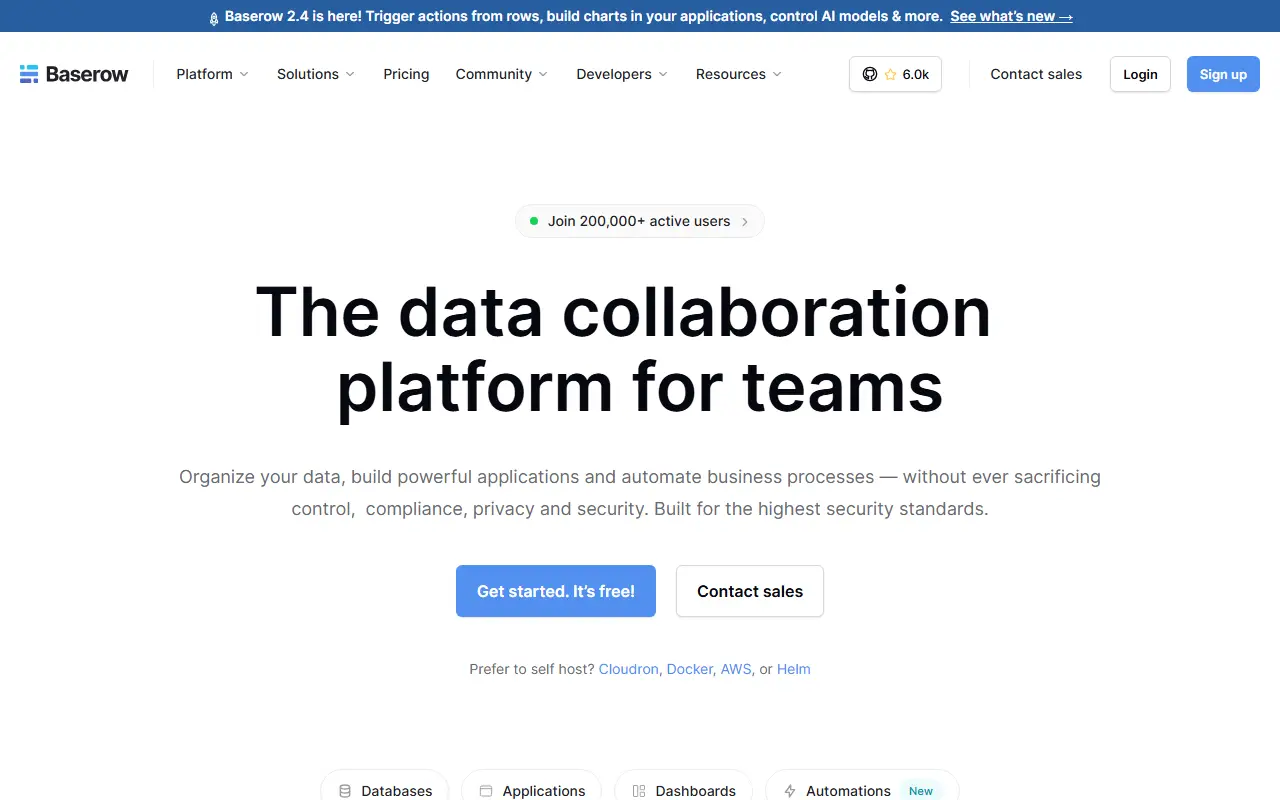
Baserow is an open-source, no-code platform that combines a spreadsheet-style database with automations, application building, dashboards and AI agents. It targets teams that want to structure data and build internal tools without writing code, and its repository is tagged as an Airtable alternative.
Capabilities include an AI Assistant that creates databases and workflows from natural-language instructions, an API-first design with a REST API, and extensibility for connecting to existing tools. The README states that the cloud service meets GDPR, HIPAA and SOC 2 Type II compliance requirements. The backend is written in Python and uses PostgreSQL for storage.
Baserow is available as a managed cloud service and as a self-hosted installation, which suits organizations that need to keep data on their own servers. The repository license is listed as 'Other' on GitHub, reflecting the open-source core alongside separately licensed premium and enterprise features, so check the terms for the features you need.
Key features
- Spreadsheet-style online database
- No-code app and automation builder
- AI Assistant for natural-language setup
- REST API with API-first design
- Dashboards over table data
- Cloud and self-hosted deployment
Pricing: Free plan with 3,000 rows per workspace. Premium costs $12 and Advanced $22 per user per month, or $10 and $18 billed yearly; Enterprise is on request.
#5
Relational spreadsheet that mixes spreadsheet flexibility with database structure, available as a self-hosted server or hosted service.
- GitHub stars
- 12k
- Last commit
- yesterday
- Latest release
- v1.7.22
- Licence
- Apache-2.0
- Self-hosted
- Yes
- Hosted version
- Available
getgrist.com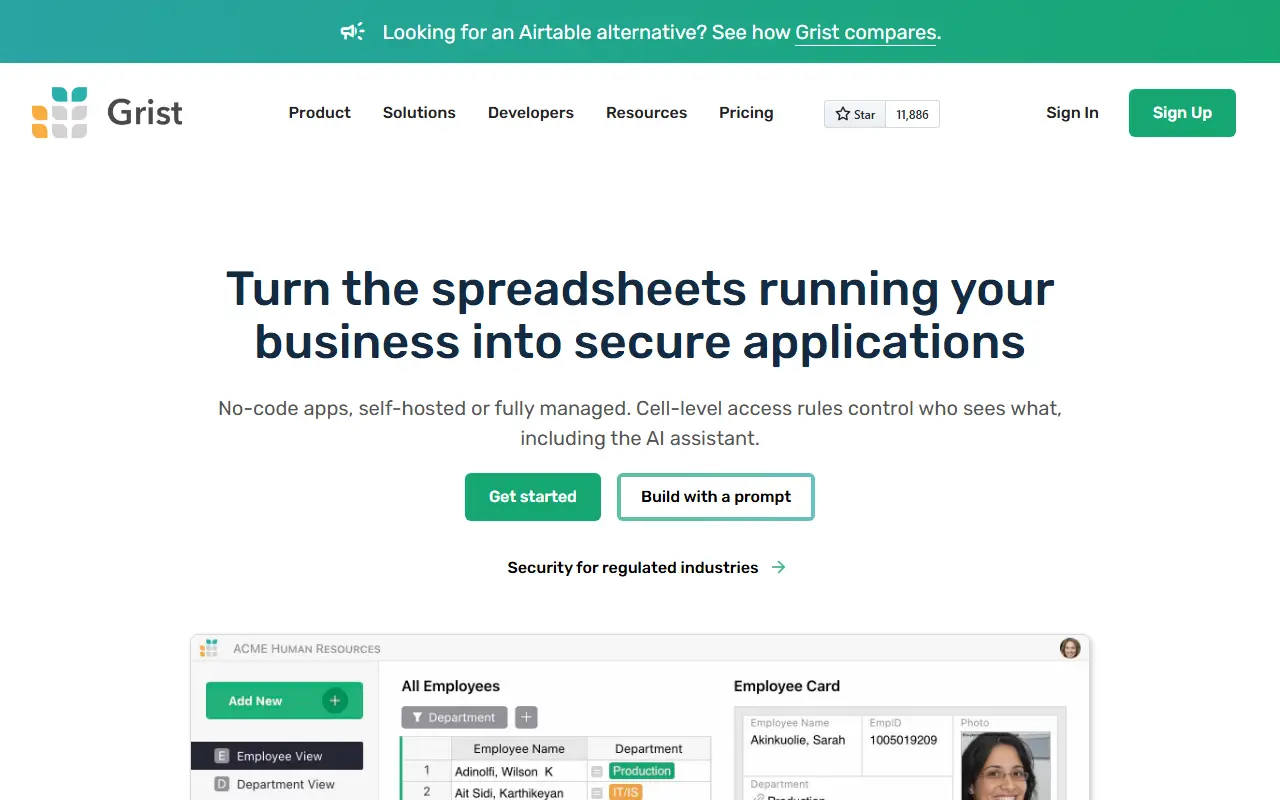
Grist is a relational spreadsheet that aims to combine the flexibility of a spreadsheet with the robustness of a database. Columns behave as they do in a database, with a name and a type, while users still write formulas and arrange data in a familiar grid. This repository, grist-core, is the Community edition that you can run as a server for hosting spreadsheets.
Two sibling projects exist: grist-desktop, an app for Linux, macOS and Windows that edits spreadsheets stored locally, and grist-static, a fully in-browser build that shows spreadsheets on a website without a back end. You can try the core with Docker or the desktop app. A list of extra features that are not in grist-core is maintained for people comparing the editions.
All three repositories are open source under the Apache License 2.0. Grist Labs, an NYC-based company, develops the project, with significant contributions from French government organizations ANCT and DINUM, and sells an edition with additional features. It also runs free and paid hosted services at getgrist.com. Help is available on Discord and a community forum.
Key features
- Typed, database-style spreadsheet columns
- Spreadsheet formulas and grid editing
- Self-hosted Community edition server
- Desktop app for local spreadsheets
- In-browser build via grist-static
- Docker-based deployment
Pricing: Free plan for small documents. Pro is $10 and Business $30 per user per month ($8 and $24 billed annually) with a 30-day trial; Enterprise is quoted. A free self-hosted Community edition exists.
#6
An integrated, free office suite compatible with most document formats and backed by The Document Foundation; this is its read-only core code repository.
- GitHub stars
- 4.6k
- Last commit
- yesterday
- Licence
- MPL-2.0
- Self-hosted
- Yes
libreoffice.org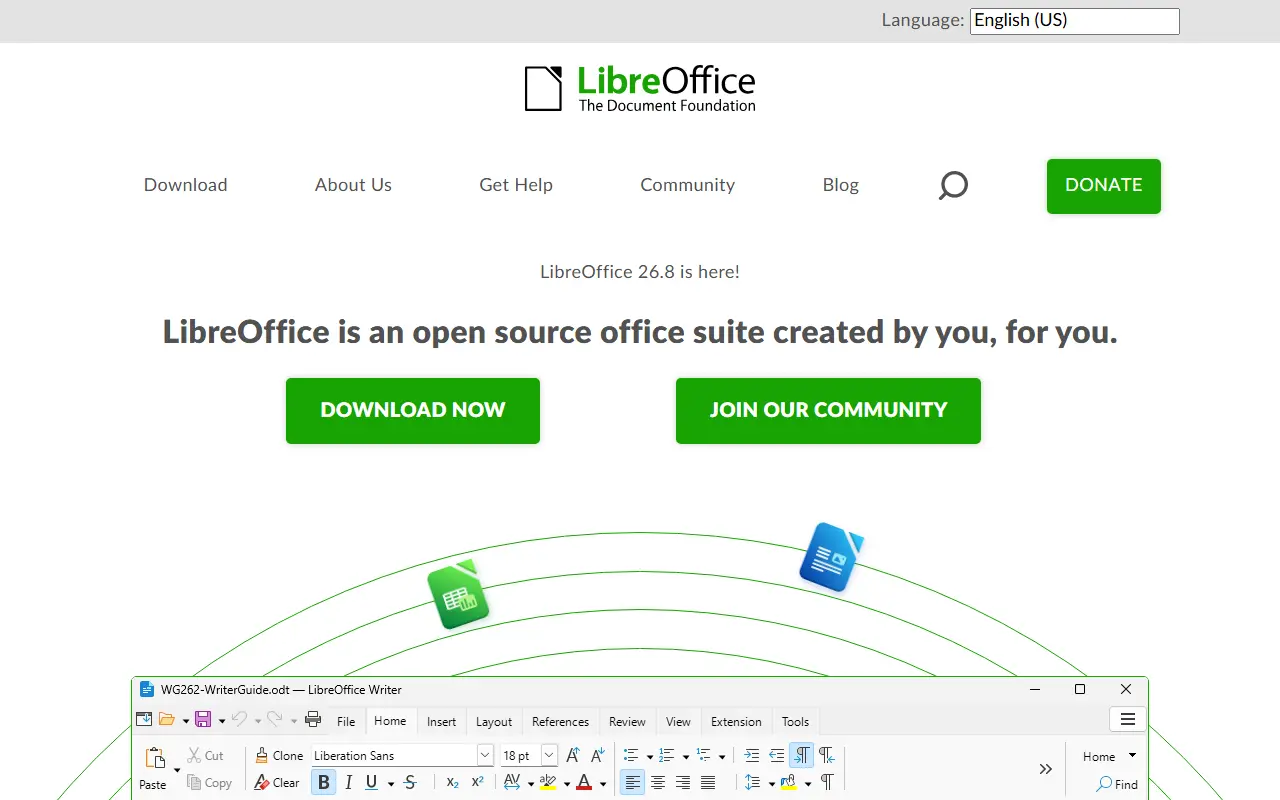
LibreOffice is a free office suite whose licenses are copyleft, built to open and save most common document formats and standards. It is free to download, use and distribute, and it is backed by The Document Foundation, which represents an independent community of enterprises, developers and other volunteers.
This GitHub repository is a read-only mirror of the core code: pull requests are not accepted, contributions go through Gerrit, and downloading a zip is discouraged in favor of the project's source bundles. Developers can add features by working on the code base in C++, or write extensions using the SDK and UNO APIs, which are also used by macro scripting in StarBasic.
The README documents the minimum build and runtime baselines for Windows, macOS and Linux, plus iOS for LibreOfficeKit and Android builds. As is widely known, the suite includes applications for word processing, spreadsheets, presentations, drawing and databases. Its code is written mostly in C++.
Key features
- Integrated office suite
- Compatibility with most document formats
- Word processing, spreadsheets and presentations
- Extensions via SDK and UNO APIs
- Macro scripting with StarBasic
- Builds for Windows, macOS and Linux
Pricing: Free to download, use and distribute.
#7
ONLYOFFICE Docs is an online office suite with real-time collaborative editors for documents, spreadsheets, presentations, forms and PDFs.
- GitHub stars
- 7.1k
- Last commit
- 18 days ago
- Latest release
- v10.0.0
- Licence
- AGPL-3.0
- Self-hosted
- Yes
- Hosted version
- Available
onlyoffice.com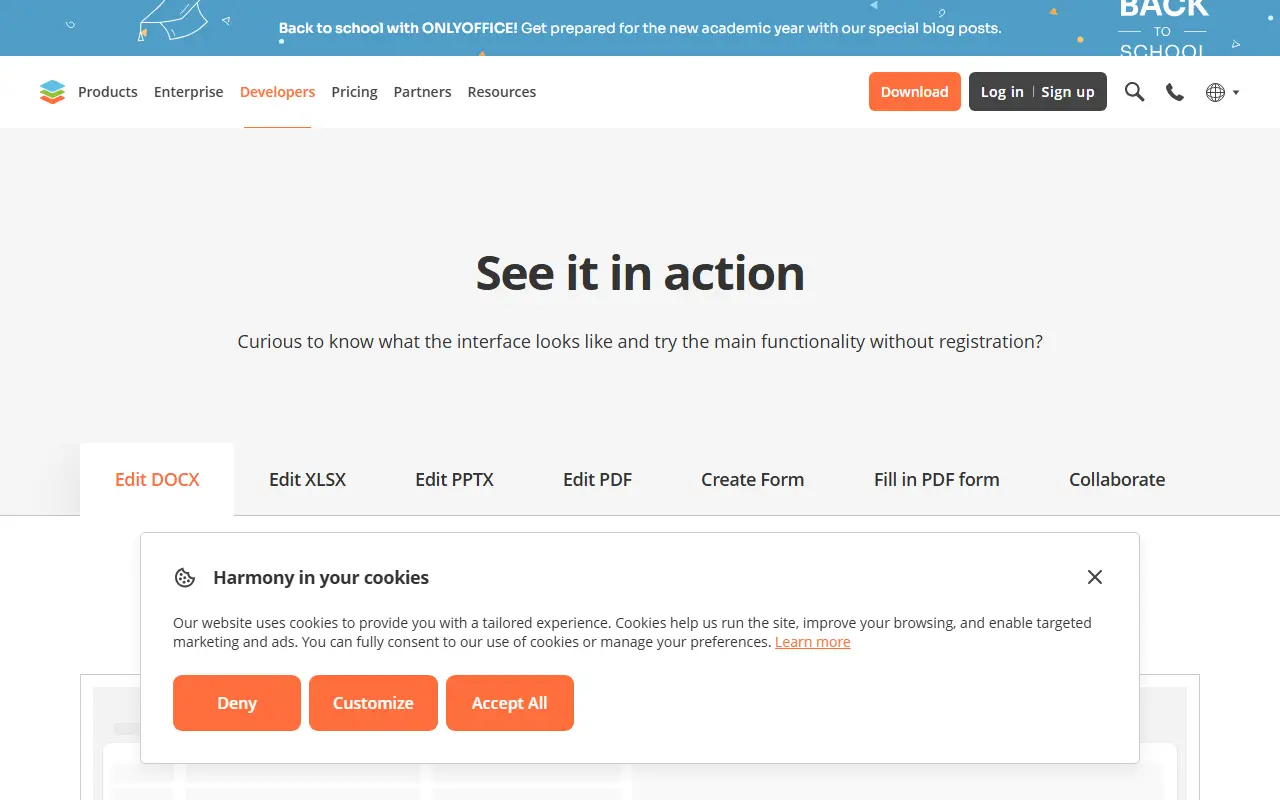
ONLYOFFICE Docs, published in this repository as the document server, is an online office suite that bundles viewers and editors for text documents, spreadsheets, presentations, forms and PDF files. It is built around Office Open XML formats such as docx, xlsx and pptx, and it supports collaborative editing in real time. The server component runs on Node.js and is licensed under AGPL-3.0.
The vendor's site describes several ways to use it. Docs can be connected to other platforms for in-place editing, with ready integrations for products such as Box, Moodle, Nextcloud, Odoo and WordPress. It can be embedded in your own service under your own brand, and it powers the vendor's DocSpace, where you create rooms and invite people to work on documents. A demo lets you try editing and form filling without registration.
Free desktop apps for Windows, Linux and macOS and mobile apps for iOS and Android are offered for working with documents offline or on the go. The site also offers templates for forms, text documents, spreadsheets and presentations, and converters between formats. Commercial plans and pricing are published by the vendor.
Key features
- Editors for documents, spreadsheets and presentations
- Form creation and PDF form filling
- Compatible with docx, xlsx and pptx
- Real-time collaborative editing
- Integrations with Nextcloud, Moodle, Odoo and others
- Desktop and mobile apps
Pricing: Source available under AGPL-3.0; the vendor offers a free DocSpace account and publishes separate plan pricing.
#8
CryptPad is an open-source, end-to-end encrypted collaboration suite where documents sync in real time and the server cannot read their content.
- GitHub stars
- 8.1k
- Last commit
- 3 days ago
- Latest release
- 2026.10.1
- Licence
- AGPL-3.0
- Self-hosted
- Yes
- Hosted version
- Available
cryptpad.org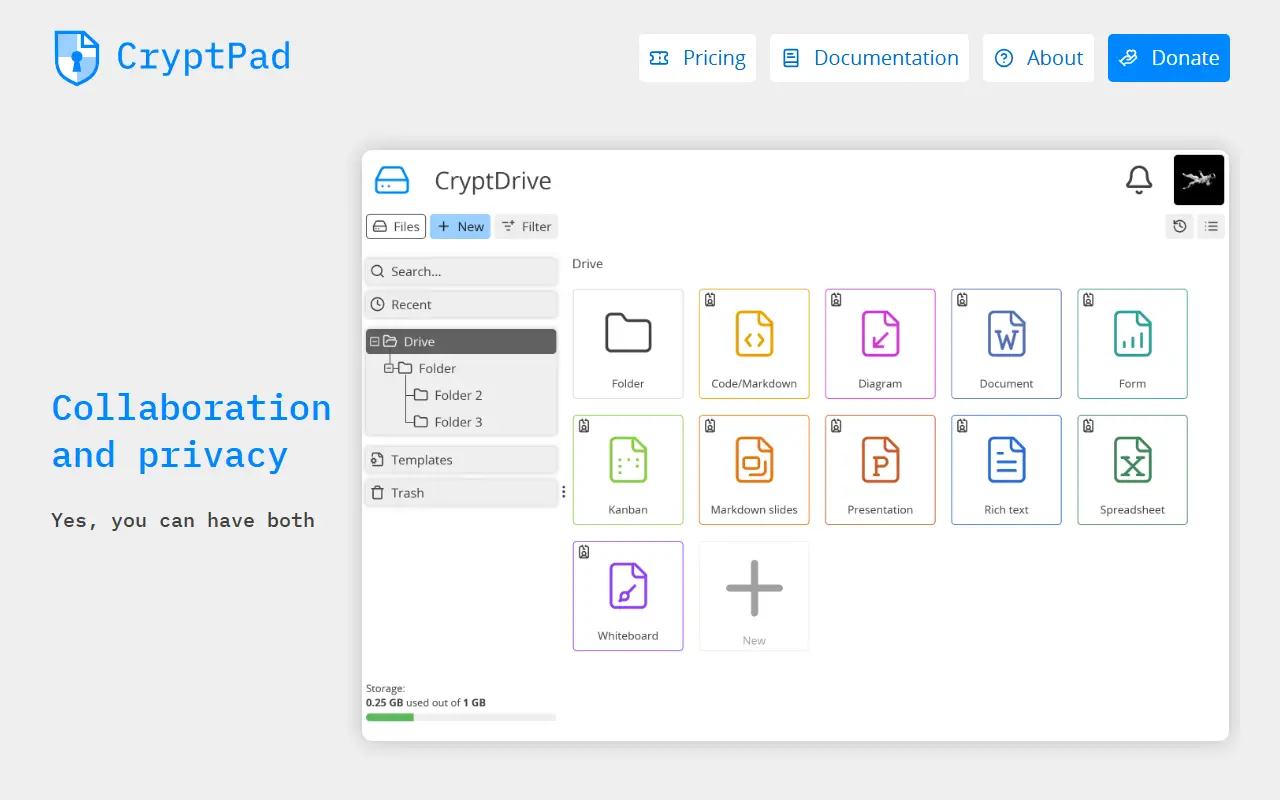
CryptPad is an open-source collaboration suite with end-to-end encryption. Documents are synchronized between collaborators in real time, and because user data is encrypted, an attacker who breaches the server cannot read the stored content. Administrators who run unmodified code and the service itself also cannot see what users store.
The encryption happens in the browser before data is sent to the server or to collaborators. The README is candid about a limit of this model: the code that does the encrypting is delivered by the host server, as on any website, so users must trust the administrator to keep the server secure. Repository topics mention collaborative editing, real-time work and the ChainPad algorithm.
CryptPad is written in JavaScript and licensed under AGPL-3.0. A developer guide covers setting up a local instance, and an admin guide covers production deployments. Official Docker images for AMD64 and ARM64 are published with every release, and a Dockerfile and docker-compose.yml are included in the repository.
Key features
- End-to-end encrypted documents
- Real-time collaborative editing
- Encryption performed in the browser
- Official Docker images for AMD64 and ARM64
- Admin guide for production installs
Pricing: Free accounts are available on public instances, and the software can be self-hosted. Paid plans on CryptPad.fr run €5 to €100 per month; managed own-instance plans start at €3,000 per year.
#9
EtherCalc is a web spreadsheet for real-time collaborative editing, now rewritten in TypeScript and deployable on Cloudflare or with Docker.
- GitHub stars
- 3.1k
- Last commit
- 8 days ago
- Latest release
- 0.20261101.3
- Self-hosted
- Yes
- Hosted version
- Available
ethercalc.net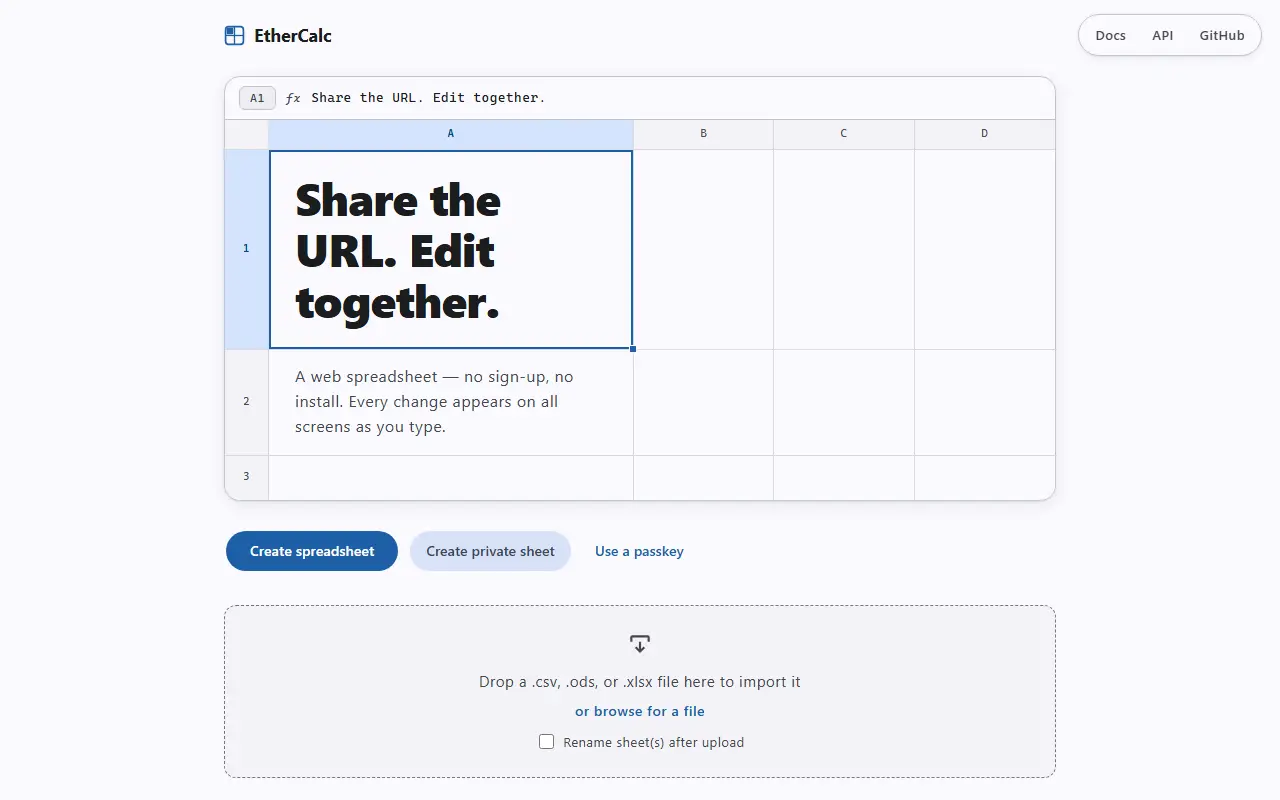
EtherCalc is a web spreadsheet that several people can edit at the same time. It started as a Node.js port of the multi-user SocialCalc engine. The current branch is a TypeScript rewrite aimed at the Cloudflare full stack, using Hono, Workers, Durable Objects, D1, KV and R2, with documentation hosted on its own site and a REST API described in a separate document.
You can deploy it to Cloudflare with wrangler, or self-host it anywhere with docker compose and no Cloudflare account. There is also an npm package that starts a local server on port 8000, which requires Bun on the machine. The Docker route stores spreadsheet room state in a data folder and needs no Redis or Node runtime.
The project warns that the plain Docker setup serves unencrypted HTTP without rate limiting or TLS, so it should be used only on trusted networks such as localhost, an office LAN or a VPN. Anything exposed to the public internet needs a reverse proxy in front. EtherCalc integrates with the Drupal content management system, and translated versions of the site exist.
Key features
- Real-time collaborative spreadsheet editing
- REST API for spreadsheet access
- Deploys to Cloudflare with wrangler
- Self-hosting with docker compose
- Drupal integration
- Local start via an npm command

Apache OpenOffice is a free, open-source office suite with a word processor, spreadsheet, presentation, drawing, database and equation tool.
- GitHub stars
- 1.3k
- Last commit
- yesterday
- Licence
- Apache-2.0
openoffice.org
Apache OpenOffice is an office productivity suite maintained by the Apache OpenOffice project, which describes it as the continuation of the OpenOffice.org project. It bundles six applications: Writer for documents, Calc for spreadsheets, Impress for presentations, Draw for diagrams and illustrations, Base for databases and Math for equations.
The suite stores documents in an open standard format and can also read and write files from other common office packages. The project says it reads most file types of its major competitors, and that its interface is meant to feel familiar to anyone who has used a competing product.
The software is released under the Apache 2.0 License and can be downloaded without a licence fee. It is installed locally and runs on Windows, macOS, Linux variants, FreeBSD and OS/2. The latest release listed on the project site is version 4.1.17, announced on 14 October 2026, and the interface is available in dozens of languages.
Key features
- Writer word processor for letters through whole books
- Calc spreadsheet for calculating, analysing and presenting data
- Impress for building multimedia presentations
- Draw for diagrams up to 3D illustrations
- Base for tables, forms, queries and reports
- Math equation editor with graphical or typed input
- Opens files from competing office suites
Pricing: Free to download and use under the Apache 2.0 License, with no licence fee.
2 more Google Sheets alternatives
Google Sheets alternatives: questions
- What is the best open-source alternative to Google Sheets?
- NocoDB is the top-ranked open-source alternative to Google Sheets on Enlisted: A self-hostable no-code database platform that puts a spreadsheet-style interface and auto-generated APIs on top of SQL databases, positioned as an Airtable alternative. Other strong options are Univer, Teable, Baserow and Grist.
- What are the best commercial alternatives to Google Sheets?
- Rows, Zoho Sheet, Apple Numbers, Airtable and Microsoft Excel are among the hosted, closed-source alternatives to Google Sheets listed on Enlisted, which lists 19 in total. Compare their pricing and features on each tool page.
- Are these Google Sheets alternatives free?
- All 12 are open source, so the code is free to use under its licence, and all of them can be self-hosted on your own server or computer. 7 also offer a paid or managed cloud version if you'd rather not host it yourself.
- How is this list of Google Sheets alternatives ranked?
- By a score built from GitHub stars, star growth over the last 30 days and how recently the code changed. 11 of these projects shipped code in the last 30 days. Data is refreshed daily, and nobody can pay to move up.
 TrackMedia
 TrackRev