#1
A developer-focused platform for error tracking and performance monitoring that helps teams detect, trace and fix issues, with SDKs for most programming languages.
- GitHub stars
- 46k
- Last commit
- today
- Latest release
- 26.10.1
- Self-hosted
- Yes
- Hosted version
- Available
sentry.io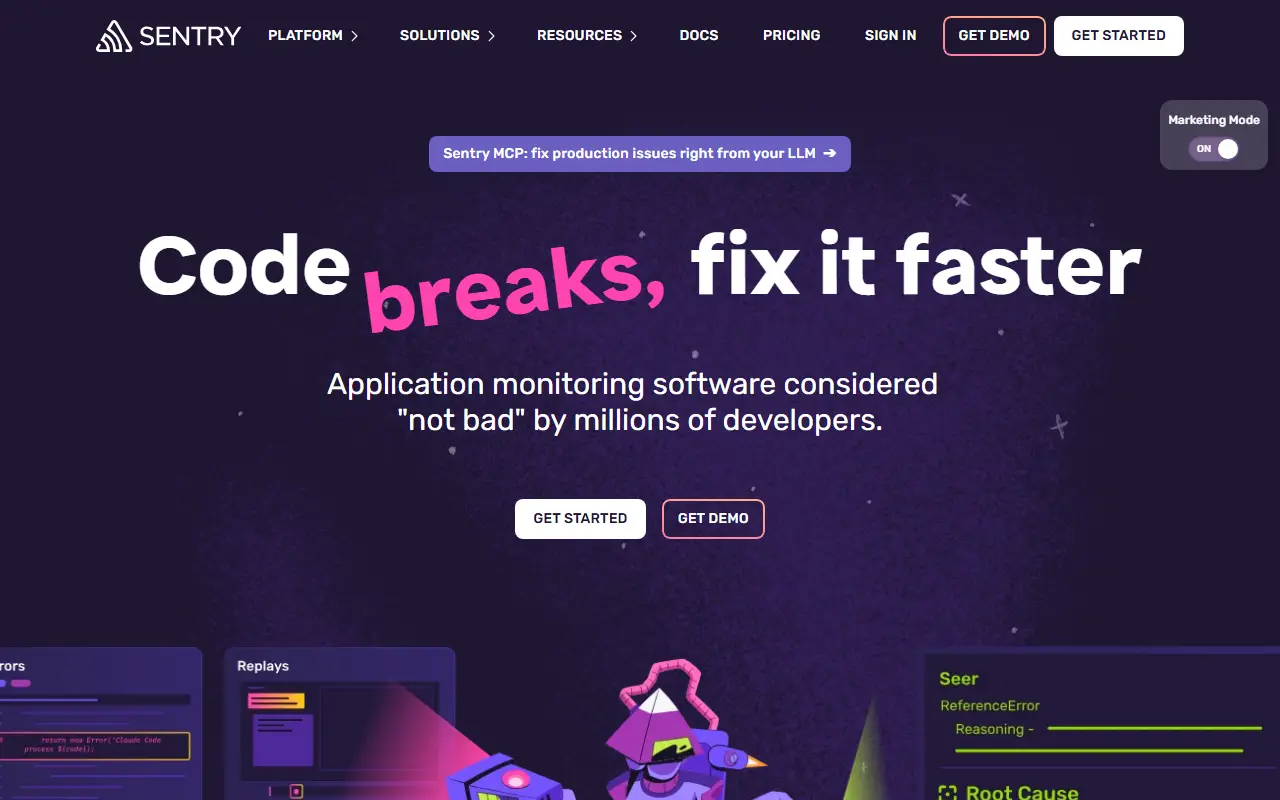
Sentry is a debugging platform that helps developers detect, trace and fix problems in their applications. It collects crash reports and errors from running software, groups them into issues, and adds the context needed to understand what happened, alongside performance monitoring for slow requests and transactions.
Integration happens through official SDKs covering web, mobile, desktop, server and game platforms, from JavaScript, Python and PHP to Go, Rust, Java, Kotlin, Swift, Flutter, Unity, Unreal Engine and Godot. The server itself is a Python application built on Django, and topics also mention CSP report collection and application performance monitoring.
Sentry is source available, and its license is listed as 'Other' on GitHub rather than a standard open-source license. It can be run on your own infrastructure, and the company also operates the hosted service at sentry.io. It is used by engineering teams of all sizes as a first stop when something breaks in production.
Key features
- Error and crash tracking
- Application performance monitoring
- Official SDKs for many languages and frameworks
- Issue grouping with debugging context
- CSP report collection
- Self-hosted or hosted deployment
Pricing: Free Developer plan for one user. Team is $26 per month and Business $80 per month when billed annually, with unlimited users; Enterprise is custom. Usage above the included quota is billed pay-as-you-go.
#2
k6 is an open-source load testing tool where tests are written as JavaScript code and run on a fast Go engine.
- GitHub stars
- 32k
- Last commit
- yesterday
- Latest release
- v2.3.0
- Licence
- AGPL-3.0
- Hosted version
- Available
grafana.com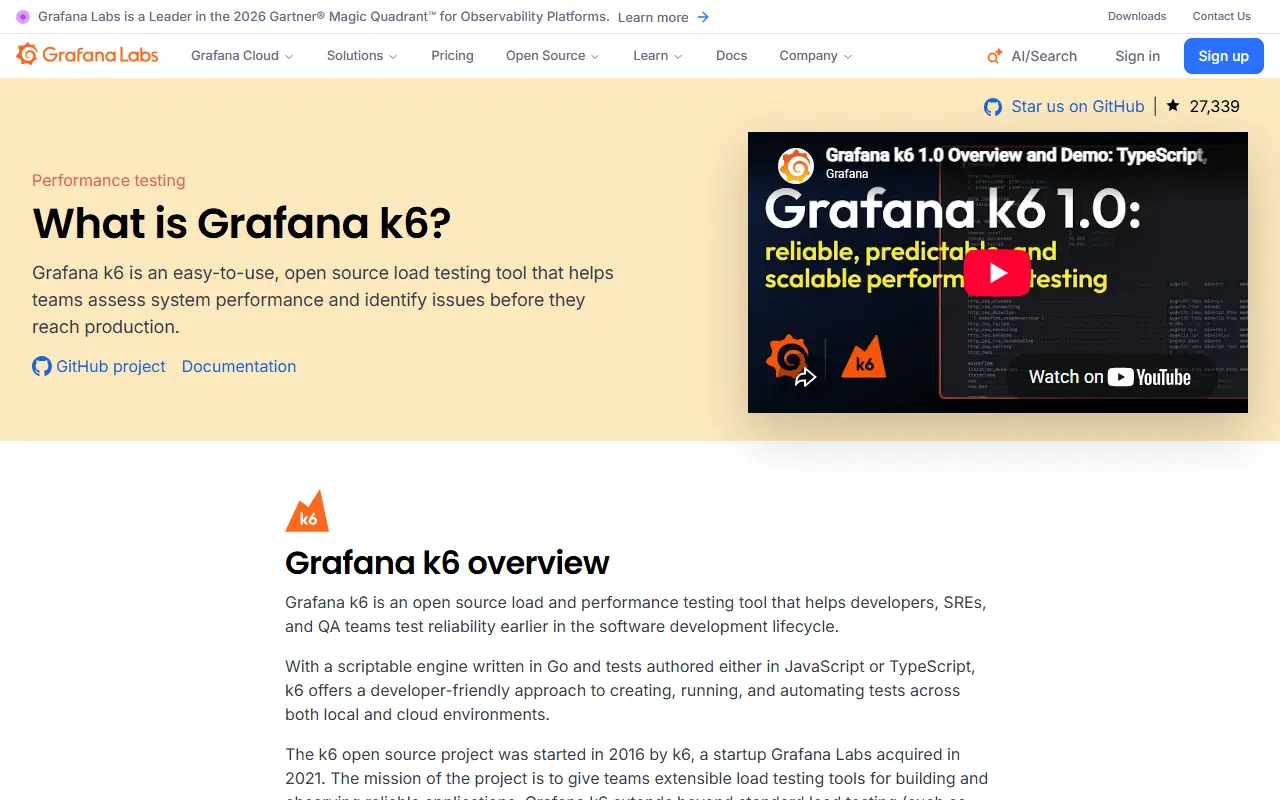
k6 is a load-testing tool for developers and testers, described as unit testing for performance. Test scripts are written in JavaScript and executed by an embedded engine written in Go, combining scripting familiarity with efficient load generation. It is maintained under the Grafana organization and released under the AGPL-3.0 license.
Because tests are code, scripts can be modularized, version controlled and run from the command line, in CI or across a Kubernetes cluster. k6 supports HTTP, WebSockets, gRPC and browser protocols, and an extension ecosystem adds more. Results can be summarized or exported as granular metrics to the service of your choice, and the tool integrates natively with Grafana Cloud for test execution and analysis. For people who prefer not to write code, k6 Studio is a desktop app that generates scripts.
Key features
- Load tests written as JavaScript code
- Go engine for efficient traffic generation
- HTTP, WebSocket, gRPC and browser protocols
- Extension ecosystem for added capabilities
- Flexible metrics export to other services
- k6 Studio desktop app for no-code scripts
Pricing: The Grafana Cloud page, which covers k6 performance tests, lists a free plan, Pro from $19 per month plus usage, and Enterprise starting at a $25,000 per year spend commit.
#3
The OpenTelemetry Collector is a vendor-agnostic service that receives, processes and exports traces, metrics and logs so one agent can feed many observability back-ends.
- GitHub stars
- 7.8k
- Last commit
- today
- Latest release
- v0.165.0
- Licence
- Apache-2.0
- Self-hosted
- Yes
opentelemetry.io
This entry covers the OpenTelemetry Collector, the component of the OpenTelemetry project that handles telemetry data in transit. It is a vendor-agnostic implementation for receiving, processing and exporting telemetry, so teams do not need to run separate agents or collectors for each open-source telemetry format such as Jaeger or Prometheus when sending data to several open-source or commercial back-ends.
The project's stated objectives are to be usable, with sensible default configuration and support for popular protocols, performant and stable under varying loads, observable itself, extensible without touching the core code, and unified, with a single codebase that can run as an agent or a collector for traces, metrics and logs. Documentation covers getting started, configuration, security and monitoring.
The Collector is written in Go, licensed under Apache-2.0 and is part of the CNCF ecosystem, with a special interest group that meets weekly. You deploy it yourself next to your applications or as a central gateway. It suits platform and SRE teams standardizing telemetry pipelines.
Key features
- Receives telemetry in many protocols
- Processes and transforms traces, metrics and logs
- Exports to open-source and commercial back-ends
- Runs as an agent or a gateway
- Extensible through components
- Sensible default configuration
Pricing: Free and open source under the Apache-2.0 licence.
#4
Self-hosted Sentry packaged with Docker Compose, for running the error and performance monitoring platform on your own server.
- GitHub stars
- 9.7k
- Last commit
- 4 days ago
- Latest release
- 26.10.1
- Self-hosted
- Yes
- Hosted version
- Available
develop.sentry.dev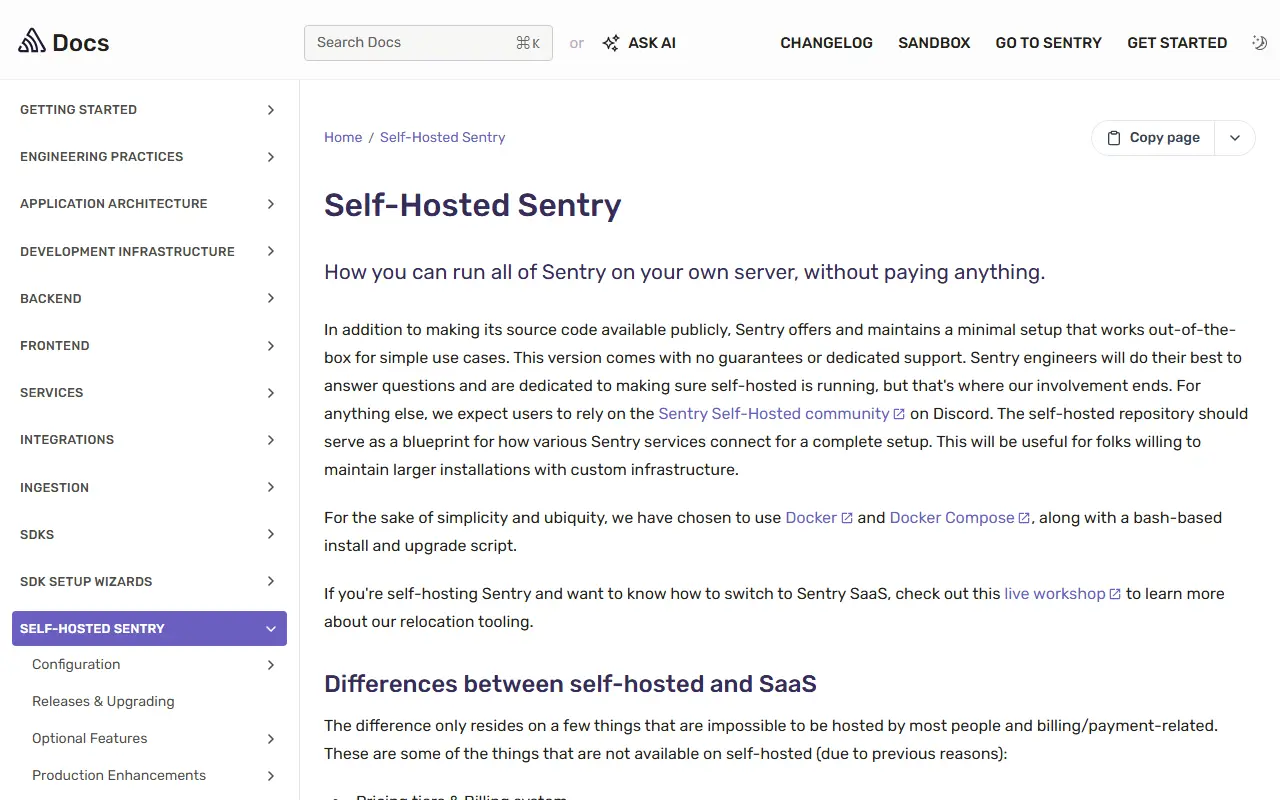
This repository packages Sentry for self-hosting. It lets organizations run the whole Sentry platform on their own server without paying for the hosted product, and the project describes it as feature-complete but aimed at low-volume deployments and proofs of concept. The entry is listed under the name Develop, taken from the documentation site.
Sentry maintains a minimal setup that works out of the box for simple cases, built on Docker and Docker Compose with a bash-based install and upgrade script. It comes with no guarantees or dedicated support, so users are expected to rely on the community on Discord. For larger installations the repository acts as a blueprint of how Sentry services connect, and the docs cover configuration, upgrades, backup and restore, and production enhancements.
The code is distributed under Sentry's fair-source license rather than a standard open-source one. Documentation also explains the small number of differences between self-hosted and the SaaS version, along with relocation tooling for moving to Sentry's hosted service.
Key features
- Complete Sentry stack for self-hosting
- Docker Compose based installation
- Install and upgrade scripts
- Backup and restore documentation
- Reference architectures for larger installs
Pricing: Free to self-host under Sentry's fair-source license with no guaranteed support; a hosted SaaS version is also available.
#5
Countly is a privacy-focused product analytics and customer engagement platform for web, mobile, desktop and IoT apps that you can run on-premises.
- GitHub stars
- 5.9k
- Last commit
- today
- Latest release
- 25.03.58
- Self-hosted
- Yes
- Hosted version
- Available
countly.com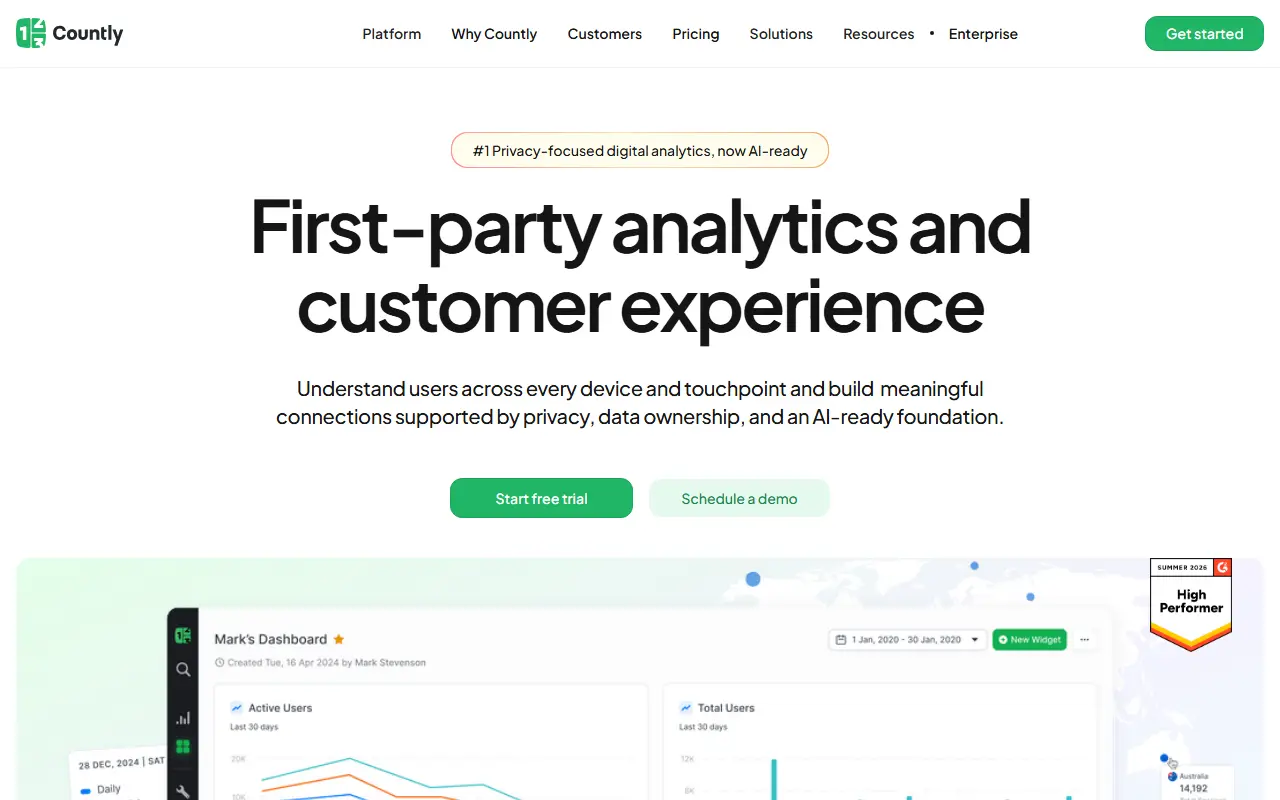
Countly is a product analytics and customer engagement system for organizations that insist on owning their data. Teams use it to see how people behave in mobile, web, desktop and connected products, to improve product experiences, and to automate and personalize how they engage with customers.
The repository topics reflect a broad toolset: web and mobile analytics, crash analytics, push notifications, feature flags, remote configuration, user feedback, dashboards and user journeys. Privacy is a central theme, with references to GDPR, COPPA and HIPAA, and the README stresses that, unlike SaaS-only tools, it can run on your own premises or inside a private cloud. SDKs are provided for many platforms, and the project has a Discord community.
The server code is JavaScript and published under a license that GitHub lists as 'Other', so check the repository for the terms that apply to the edition you use. Countly also offers hosted and enterprise options through the vendor. It suits product and marketing teams that need analytics without sending data to a third party.
Key features
- Cross-platform product and user analytics
- Crash reporting for mobile apps
- Push notifications and engagement tools
- Feature flags and remote configuration
- User feedback collection
- On-premises or private cloud deployment
Pricing: Free self-hosted Lite edition. Flex starts at $175 per month on a managed private cloud with usage-based pricing and a 14-day trial; Enterprise is custom.
#6
A mobile app monitoring platform for crashes, ANRs, performance traces and session replays, positioned as an open-source alternative to Firebase Crashlytics.
- GitHub stars
- 1.4k
- Last commit
- today
- Latest release
- android-v0.23.0
- Licence
- Apache-2.0
- Self-hosted
- Yes
- Hosted version
- Available
measure.sh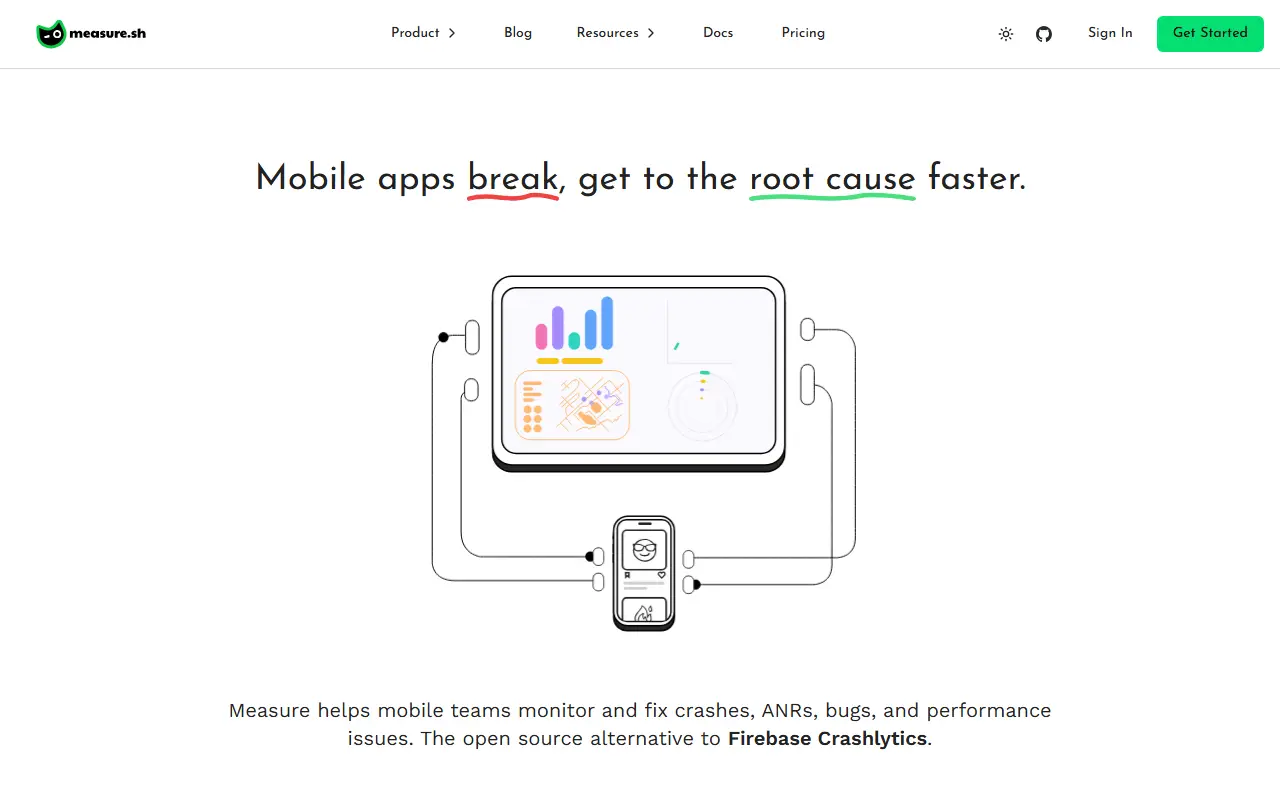
Measure helps mobile teams monitor and fix crashes, ANRs, bugs and performance problems in their apps. It is presented as an open-source alternative to Firebase Crashlytics, with SDKs for Android, iOS, Flutter and React Native so that teams can collect data from the platforms they ship on.
Features include session replays with automatic tracking of clicks, navigation and network calls, crash and ANR reports with screenshots and stack traces, performance traces and spans, bug reports triggered by a device shake, user journeys, network performance views and an app health dashboard. Adaptive capture lets you change data collection settings without releasing an app update, and a Measure Agent lets you investigate issues in natural language from Slack or a coding agent via MCP.
You can sign up to Measure Cloud or self-host it on your own servers. The project is licensed under Apache-2.0 and has a TypeScript codebase on the dashboard side, with Kotlin, Swift and Dart SDK components. It suits mobile development teams who want crash reporting and observability with the option to keep data on infrastructure they control.
Key features
- Crash and ANR tracking with stack traces
- Session replays of user actions
- Performance traces and spans
- Shake-to-report bug reports
- Adaptive capture without app updates
- SDKs for Android, iOS, Flutter, React Native
Pricing: A free plan includes 5 GB of data per month. Pro costs $50 per month with 25 GB included and $2.00 per extra GB; there are no seat limits.
Embrace alternatives: questions
- What is the best open-source alternative to Embrace?
- Sentry is the top-ranked open-source alternative to Embrace on Enlisted: A developer-focused platform for error tracking and performance monitoring that helps teams detect, trace and fix issues, with SDKs for most programming languages. Other strong options are k6, OpenTelemetry Collector, Countly and Measure.
- What are the best commercial alternatives to Embrace?
- Firebase Crashlytics, Raygun, Rollbar, Bugsnag and Splunk Observability Cloud are among the hosted, closed-source alternatives to Embrace listed on Enlisted, which lists 16 in total. Compare their pricing and features on each tool page.
- Are these Embrace alternatives free?
- All 6 are open source, so the code is free to use under its licence, and all of them can be self-hosted on your own server or computer. 5 also offer a paid or managed cloud version if you'd rather not host it yourself.
- How is this list of Embrace alternatives ranked?
- By a score built from GitHub stars, star growth over the last 30 days and how recently the code changed. 6 of these projects shipped code in the last 30 days. Data is refreshed daily, and nobody can pay to move up.
 TrackMedia
 TrackRev