7,363 open-source and SaaS tools, with GitHub stats refreshed every day.

5 alternatives ranked by real activity

Open-source Coveo alternatives

A curated, ranked list of the 5 best open-source alternatives to Coveo.

The best open-source alternative to Coveo is Swirl. If that doesn't suit you, other good options are Fess, Trieve, Open Semantic Search and OpenSearchServer.

Coveo alternatives are mainly search tools. 2 of them shipped code in the last 30 days, 5 can be self-hosted, and 4 use a permissive licence.

Last updated October 2, 2026 · ranked by GitHub stars, growth and recent commits

Swirl

Federated AI search and RAG that queries your existing apps live, ranks results, and returns cited answers without copying data into a vector database.

GitHub stars
3k
Last commit
6 days ago
Latest release
v4.5.0.7
Licence
Apache-2.0
Self-hosted
Yes
swirlaiconnect.comSwirl homepage screenshot

SWIRL is an AI search and retrieval-augmented generation tool that works without moving your data. Instead of copying content into a vector database, it queries your sources live with each user's own permissions, re-ranks the results, and can generate an answer with citations using the language model of your choice. The Community edition in this repository is released under the Apache-2.0 license.

Connectors reach many business applications, and the project's tagline refers to more than 100 apps. The approach avoids building ETL pipelines, standing up a vector store, or maintaining a second copy of data that needs security and audit controls, since permissions are enforced at the source. The stack is Python and Django, and a Docker quick start gets an instance running in about two minutes.

A separate SWIRL Enterprise edition adds a three-pass reranker, canonical answers, an MCP server for agents, and managed support. The Community edition is free to self-host. It suits IT and data teams wanting enterprise search across many systems while keeping data in place.

Key features

  • Federated search across connected apps
  • Live queries with source-level permissions
  • No vector database or ETL needed
  • Cited answers from your choice of language model
  • Django-based with Docker quick start
  • Enterprise tier adds reranking and MCP server

Pricing: Annual platform licences: Departmental $24K, Business $72K and Enterprise from $150K per year. No free plan is listed; a paid $12,000 pilot is credited to the first annual contract.

Fess

Fess is a self-hosted enterprise and site search server built on OpenSearch, with crawlers, an admin UI, a REST API and AI-assisted search.

GitHub stars
1.1k
Last commit
today
Latest release
fess-15.8.0
Licence
Apache-2.0
Self-hosted
Yes
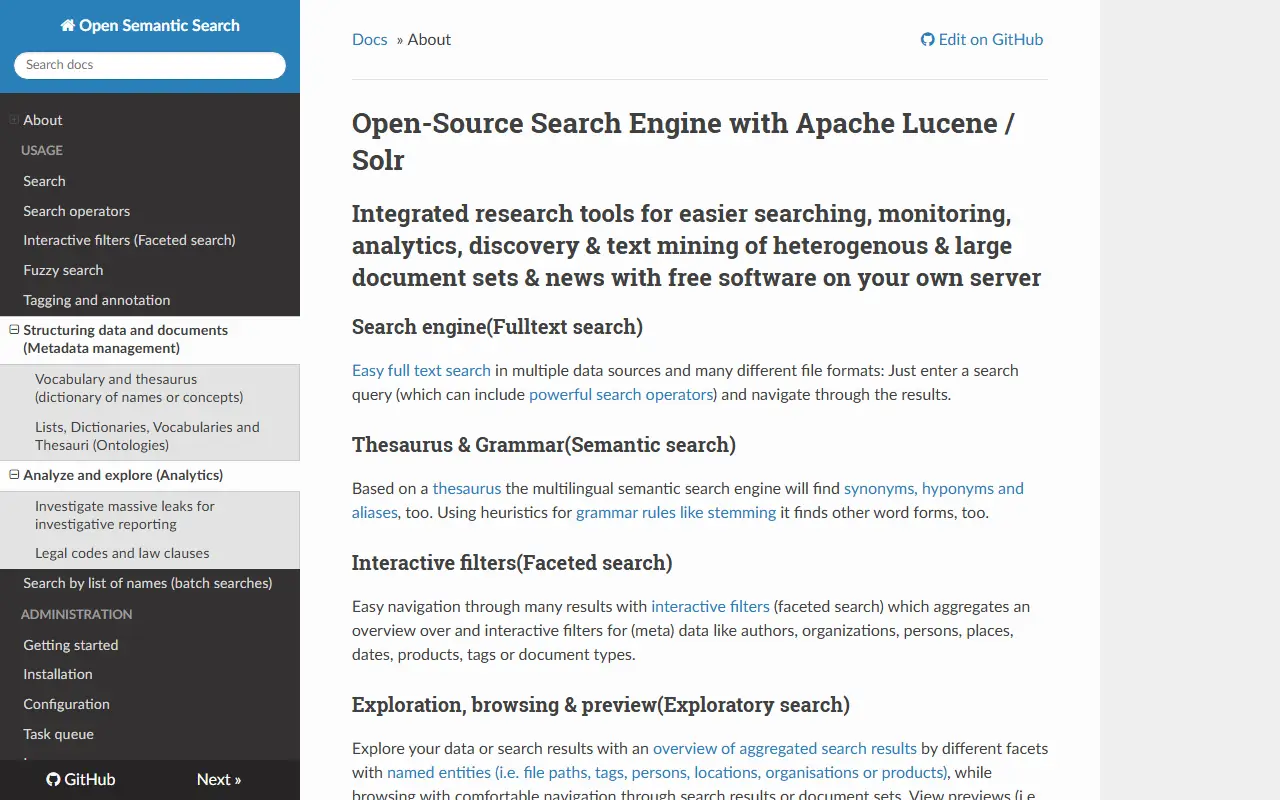
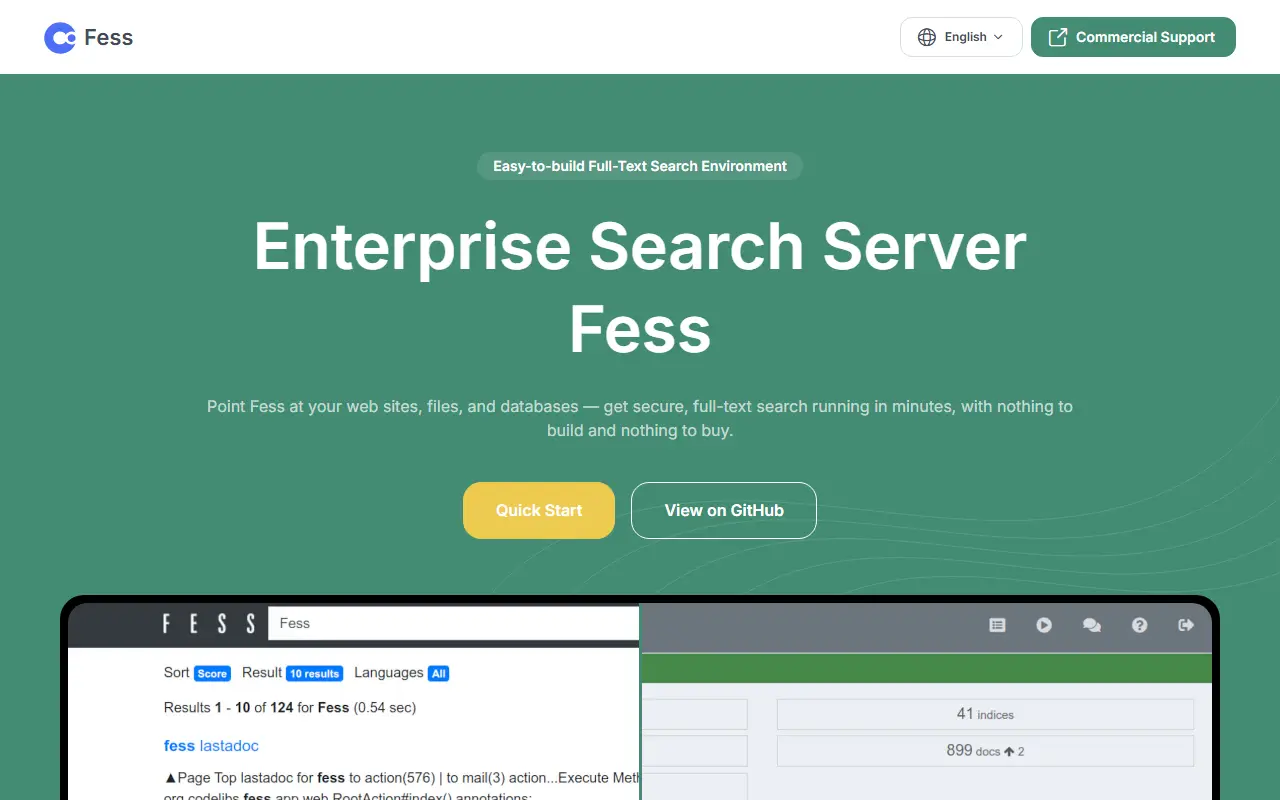
fess.codelibs.orgFess homepage screenshot

Fess is an open-source enterprise search server that you install and run on any platform with a Java runtime. It is built on OpenSearch but does not require prior OpenSearch knowledge, because everything is configured in a browser-based administration interface. It can also serve as a free site search for your own website.

A built-in crawler collects documents from web sites, file systems and data stores such as databases, CSV files, cloud storage and SaaS sources, and handles many formats including Microsoft Office files, PDF and archives. Search supports faceting, sorting and suggestions, results can be filtered by role and permission, and single sign-on works with LDAP, OpenID Connect, SAML, SPNEGO and Microsoft Entra ID. It offers a REST API, text analysis for over 20 languages, plugins, and AI features for RAG and semantic search.

Fess is written in Java and licensed under Apache-2.0. It needs Java 21 or newer for the ZIP, RPM and DEB packages, and Docker images bundle OpenSearch. It suits organizations that want a private, self-managed alternative to Elasticsearch-based setups or Google Site Search.

Key features

  • Crawlers for web, files, and databases
  • Browser-based administration UI
  • Full-text search with facets and suggestions
  • Role-based filtering of results
  • SSO with LDAP, OIDC, SAML, and Entra ID
  • AI, RAG, and semantic search support

Pricing: Free and open source under the Apache-2.0 licence.

Trieve

API platform for search, recommendations, retrieval-augmented generation and analytics, built in Rust on Qdrant and Postgres and available self-hosted or as a hosted service.

GitHub stars
2.7k
Last commit
8 mo ago
Latest release
trieve-helm-0.2.2
Licence
MIT
Self-hosted
Yes
Hosted version
Available

Trieve is an all-in-one platform that exposes search, recommendations, retrieval-augmented generation (RAG) and analytics through an API. Developers upload content as chunks and then query it with semantic, keyword or hybrid search, without assembling the vector database, embedding and reranking pieces themselves.

Its search features include dense vector search with OpenAI or Jina embeddings stored in Qdrant, typo-tolerant neural sparse search, sub-sentence highlighting, recency biasing, merchandising controls and hybrid search with cross-encoder reranking. A recommendations API finds similar chunks or files, and RAG routes use OpenRouter so you can pick the language model. You can also plug in your own embedding, reranking and LLM models.

Trieve can be self-hosted in your VPC or on-premises, with guides for AWS, GCP, Kubernetes and Docker Compose, and it also offers a hosted sign-up with a free allowance of 1,000 chunks. The backend is Rust with Actix and Diesel on PostgreSQL, with a SolidJS front end, an OpenAPI specification and TypeScript and Python SDKs. It is released under the MIT licence.

Key features

  • Semantic vector search with Qdrant
  • Typo-tolerant neural sparse search
  • Hybrid search with cross-encoder reranking
  • Recommendations API for similar items
  • RAG routes with a choice of LLMs
  • Sub-sentence highlighting and recency biasing
  • TypeScript and Python SDKs

Pricing: Open source under the MIT licence and self-hostable; the hosted service advertises a free allowance of 1,000 chunks.

OpenSearchServer

OpenSearchServer is a Java, Lucene-based enterprise search engine with crawlers, a web UI and a JSON web service for adding full-text search to applications.

GitHub stars
517
Last commit
4 yr ago
Licence
Apache-2.0
Self-hosted
Yes

OpenSearchServer is enterprise-class search engine software built on Lucene. With its web user interface, crawlers and JSON web service, you can add advanced full-text search to an application quickly. It runs on Linux, Unix, BSD and Windows.

Search functions include phonetic search, boolean queries with a query language, faceted and collapsed results, filters via sub-requests, geolocation, spell-checking, relevance customization and auto-completion suggestions. Indexing supports 18 languages with per-language analyzers, lemmatization, n-grams, synonyms, automatic language recognition, named entity recognition and automatic classification.

It can index HTML, Microsoft Office and OpenOffice documents, PDFs with OCR, RTF, plain text, audio metadata and images through OCR, using web, file system and database crawlers. OpenSearchServer is licensed under Apache-2.0; the README notes a Docker image was still to come, and documentation and binaries are on the project site.

Key features

  • Lucene-based full-text search
  • Web, file and database crawlers
  • Faceted search with spell-checking
  • Indexing for 18 languages
  • OCR for PDFs and images
  • JSON web service and web UI

Pricing: Free and open source under the Apache-2.0 license.

Coveo alternatives: questions

What is the best open-source alternative to Coveo?
Swirl is the top-ranked open-source alternative to Coveo on Enlisted: Federated AI search and RAG that queries your existing apps live, ranks results, and returns cited answers without copying data into a vector database. Other strong options are Fess, Trieve, Open Semantic Search and OpenSearchServer.
Are these Coveo alternatives free?
All 5 are open source, so the code is free to use under its licence, and all of them can be self-hosted on your own server or computer. 1 also offers a paid or managed cloud version if you'd rather not host it yourself.
How is this list of Coveo alternatives ranked?
By a score built from GitHub stars, star growth over the last 30 days and how recently the code changed. 2 of these projects shipped code in the last 30 days. Data is refreshed daily, and nobody can pay to move up.

People also look for alternatives to…

View all