7,363 open-source and SaaS tools, with GitHub stats refreshed every day.

11 alternatives ranked by real activity

Open-source Claude Code alternatives

A curated, ranked list of the 11 best open-source alternatives to Claude Code.

The best open-source alternative to Claude Code is OpenCode. If that doesn't suit you, other good options are Codex CLI, Gemini CLI, OpenHands and Cline.

Claude Code alternatives are mainly AI tools. 10 of them shipped code in the last 30 days, 11 can be self-hosted, and 11 use a permissive licence.

Last updated October 3, 2026 · ranked by GitHub stars, growth and recent commits

OpenCode

An open-source AI coding agent for the terminal, with a beta desktop app and separate agents for building and read-only planning.

GitHub stars
211k
Last commit
today
Latest release
v1.18.34
Licence
MIT
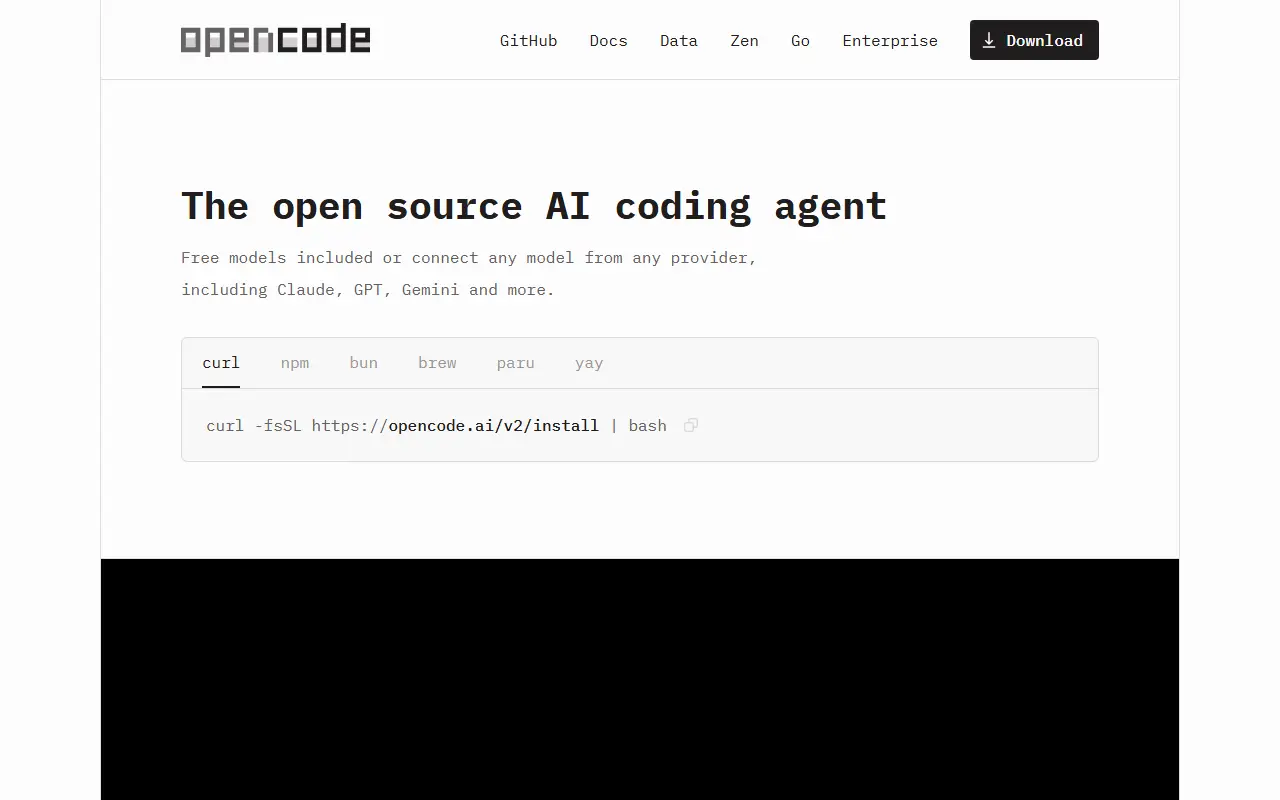
opencode.aiOpenCode homepage screenshot

OpenCode is an open-source coding agent that helps developers write, change and understand code using AI models. It is built in TypeScript, released under the MIT license, and installed through an install script or, in beta, as a desktop application for macOS, Windows and Linux.

It ships with two built-in agents that you switch between with the Tab key. The build agent has full access for everyday development work, while the plan agent is read-only: it denies file edits by default and asks permission before running shell commands, which suits exploring an unfamiliar codebase or planning a change. A general subagent handles complex searches and multistep tasks and can be called with @general in messages.

Configuration is covered in the project documentation, and the install location can be controlled with environment variables. OpenCode suits developers who prefer working from the command line and want an agent whose source code they can read and modify.

Key features

  • Built-in build agent with full development access
  • Read-only plan agent for code exploration
  • Permission prompts before running shell commands
  • General subagent for multistep searches
  • Desktop app in beta for macOS, Windows and Linux
  • Tab key to switch between agents

Pricing: Free and open source under the MIT license.

Read more about OpenCodeWebsite GitHub

Codex CLI

OpenAI's open-source coding agent for the terminal, written in Rust, which can sign in with a ChatGPT plan or use an API key.

GitHub stars
128k
Last commit
today
Latest release
rust-v0.160.0
Licence
Apache-2.0
Hosted version
Available

Codex CLI is OpenAI's coding agent, and it runs locally in your terminal. It is open source under the Apache-2.0 license and written in Rust. Developers start it by running the codex command and then ask it to read, explain and change the code in their project.

It is installed through standalone scripts for Mac, Linux and Windows, through package managers, or by downloading a binary for your platform from GitHub Releases. You can sign in with a ChatGPT account to use it as part of a Plus, Pro, Business, Edu or Enterprise plan, or authenticate with an API key instead.

The README distinguishes the CLI from other Codex surfaces: an IDE extension for VS Code, Cursor and Windsurf, a desktop app launched with codex app, and the cloud-based Codex Web at chatgpt.com/codex. The CLI suits developers who prefer to stay in the terminal and want an agent whose client code is open.

Key features

  • Terminal-based coding agent that runs locally
  • Sign in with a ChatGPT plan or API key
  • Installers for Mac, Linux and Windows
  • Standalone binaries on GitHub Releases
  • Related IDE extension and desktop app
  • Open-source Rust codebase under Apache-2.0

Pricing: The CLI is free and open source under Apache-2.0; model usage comes with eligible ChatGPT plans or an API key.

Read more about Codex CLIGitHub

Gemini CLI

An open-source command-line AI agent that brings Google's Gemini models into the terminal, with built-in tools and Model Context Protocol support.

GitHub stars
107k
Last commit
today
Latest release
v0.62.0
Licence
Apache-2.0
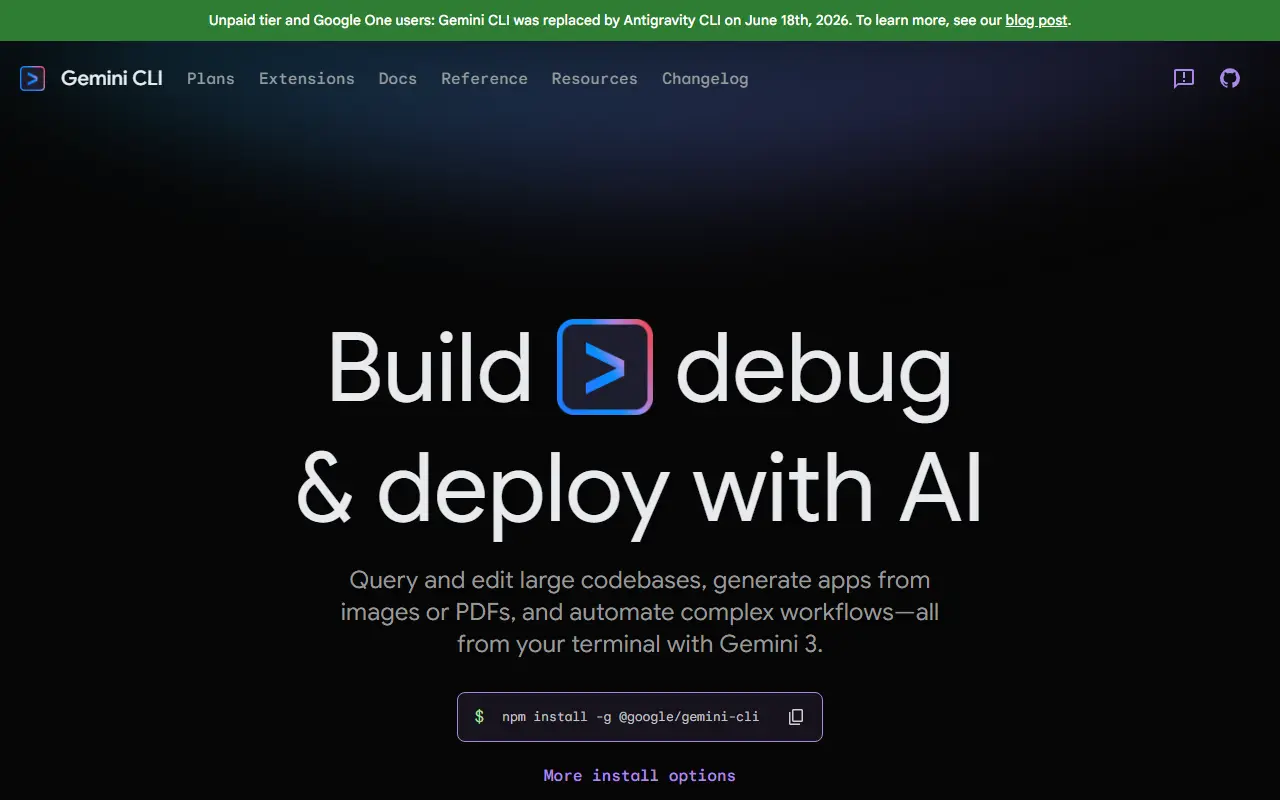
geminicli.comGemini CLI homepage screenshot

Gemini CLI is Google's open-source terminal agent for working with Gemini models from the command line. It offers a lightweight path from a prompt on the command line to the model, and it is designed for developers who spend their day in a shell. The project is written in TypeScript and licensed under Apache-2.0.

Built-in tools cover Google Search grounding, file operations, shell commands and web fetching, and further integrations can be added through the Model Context Protocol (MCP). The project highlights access to Gemini models with a large context window, and a free tier when you sign in with a personal Google account.

You can run it instantly with npx or install it globally with npm, Homebrew, MacPorts or Anaconda. It has preview, stable and nightly release channels published on a regular schedule. It suits developers who want an AI assistant for code and shell tasks without leaving the terminal.

Key features

  • Terminal-first AI agent powered by Gemini
  • Google Search grounding for current information
  • Built-in file, shell and web-fetch tools
  • MCP support for custom integrations
  • Install via npx, npm, Homebrew or MacPorts
  • Preview, stable and nightly release channels

Pricing: Free tier with a Google account; open source so it can be self-hosted. Paid routes (Google AI Pro, AI Ultra, Developer Program, AI Studio pay-as-you-go, Vertex AI) are listed without prices on this page.

OpenHands

A self-hosted control center for running coding agents, including OpenHands, Claude Code and Codex, locally, in Docker or in the cloud, with automations.

GitHub stars
90k
Last commit
today
Latest release
v1.24.0
Licence
MIT
Self-hosted
Yes
Hosted version
Available
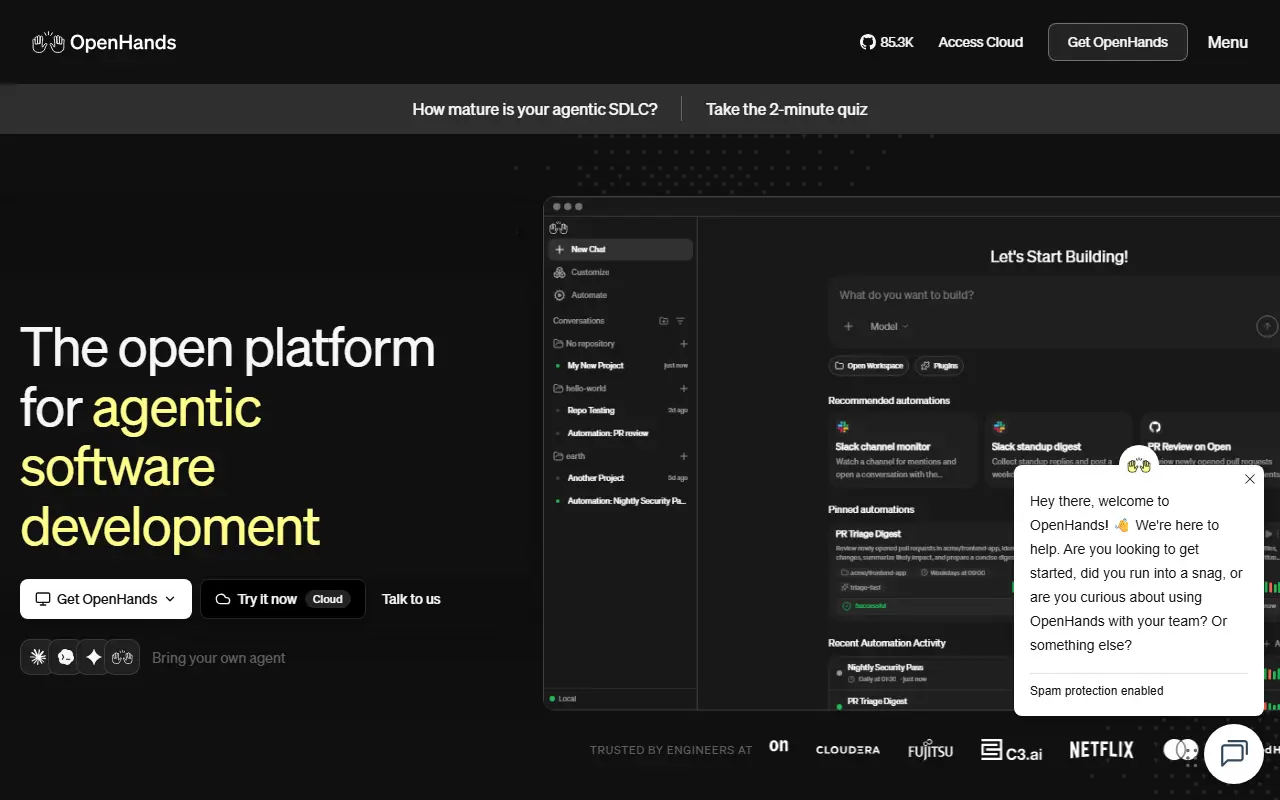
openhands.devOpenHands homepage screenshot

OpenHands is an open-source project for AI-driven software development. Its current README centers on Agent Canvas, a self-hosted developer control center for starting conversations with coding agents and automating everyday engineering tasks. It is written mainly in TypeScript and released under the MIT license.

By default Agent Canvas uses the open-source OpenHands agent, but it can also drive third-party agents such as Claude Code, Codex and Gemini, or any ACP-compatible agent. It runs locally by default and can connect to several agent backends, including Docker containers, virtual machines and company infrastructure, so agents can be moved between local, remote and cloud setups without interrupting your work.

Automations can be triggered on a timetable or by incoming webhook events and connect with tools such as Slack, GitHub, Linear and Notion, for example publishing reports to Slack or breaking GitHub issues into tasks. Agents can optionally run on OpenHands Cloud or OpenHands Enterprise. It suits engineering teams that want to coordinate several coding agents from one self-managed place.

Key features

  • Self-hosted control center for coding agents
  • Runs OpenHands, Claude Code, Codex and Gemini
  • Local, Docker, VM and cloud agent backends
  • Scheduled and webhook-triggered automations
  • Integrations with Slack, GitHub, Linear and Notion
  • Optional OpenHands Cloud and Enterprise hosting

Pricing: Local open-source use and the hosted Individual tier are free (model usage is passed through at cost). Enterprise, in the cloud or self-hosted in your VPC, has custom pricing.

Cline

An open-source autonomous coding agent available as a CLI, desktop app, VS Code extension, JetBrains plugin and SDK.

GitHub stars
70k
Last commit
today
Latest release
desktop-v0.0.42
Licence
Apache-2.0
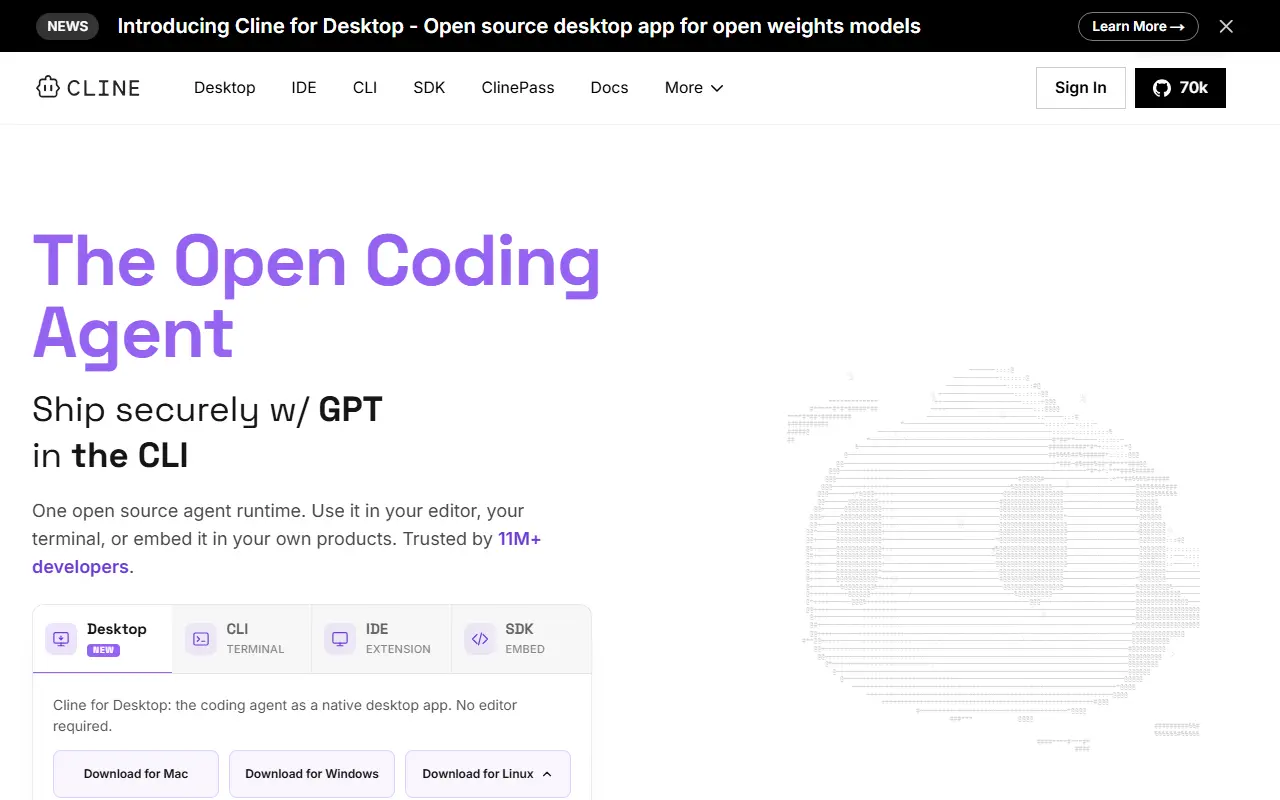
cline.botCline homepage screenshot

Cline is an open-source coding agent that works in your IDE, terminal and desktop. It can edit code across a project, create files, run commands and browse the web, with human-in-the-loop approval for tools in the editor. It is written in TypeScript and released under the Apache-2.0 license.

The same agent engine is offered in several forms: a CLI with an interactive mode and a headless mode for CI/CD and scripting, a native desktop app for macOS and Windows that works from any folder, schedules recurring routines and manages models, plugins and MCP servers, a VS Code extension, a JetBrains plugin for IntelliJ IDEA, PyCharm, WebStorm, GoLand and others, and an SDK.

The SDK is a Node.js programmatic API for building custom agents with custom tools, multi-agent teams, connectors and scheduled automations. The README notes that the JetBrains plugin is not open-sourced. Cline suits developers who want one coding agent across their editor, terminal and automation pipelines.

Key features

  • CLI with interactive and headless modes
  • VS Code extension with approval prompts
  • JetBrains plugin for the IntelliJ family
  • Desktop app for macOS and Windows
  • Node.js SDK for custom agents
  • Scheduled routines and MCP server management

Pricing: The open-source extension is free for individual developers, who pay only for AI inference or use their own API keys. Enterprise adds SSO, SLA and dedicated support at custom pricing.

Read more about ClineWebsite GitHub

Open Interpreter

An open-source coding agent in Rust, forked from OpenAI's Codex, tuned to get good results from low-cost open models such as Kimi, GLM and Qwen.

GitHub stars
68k
Last commit
today
Latest release
rust-v0.0.55
Licence
Apache-2.0
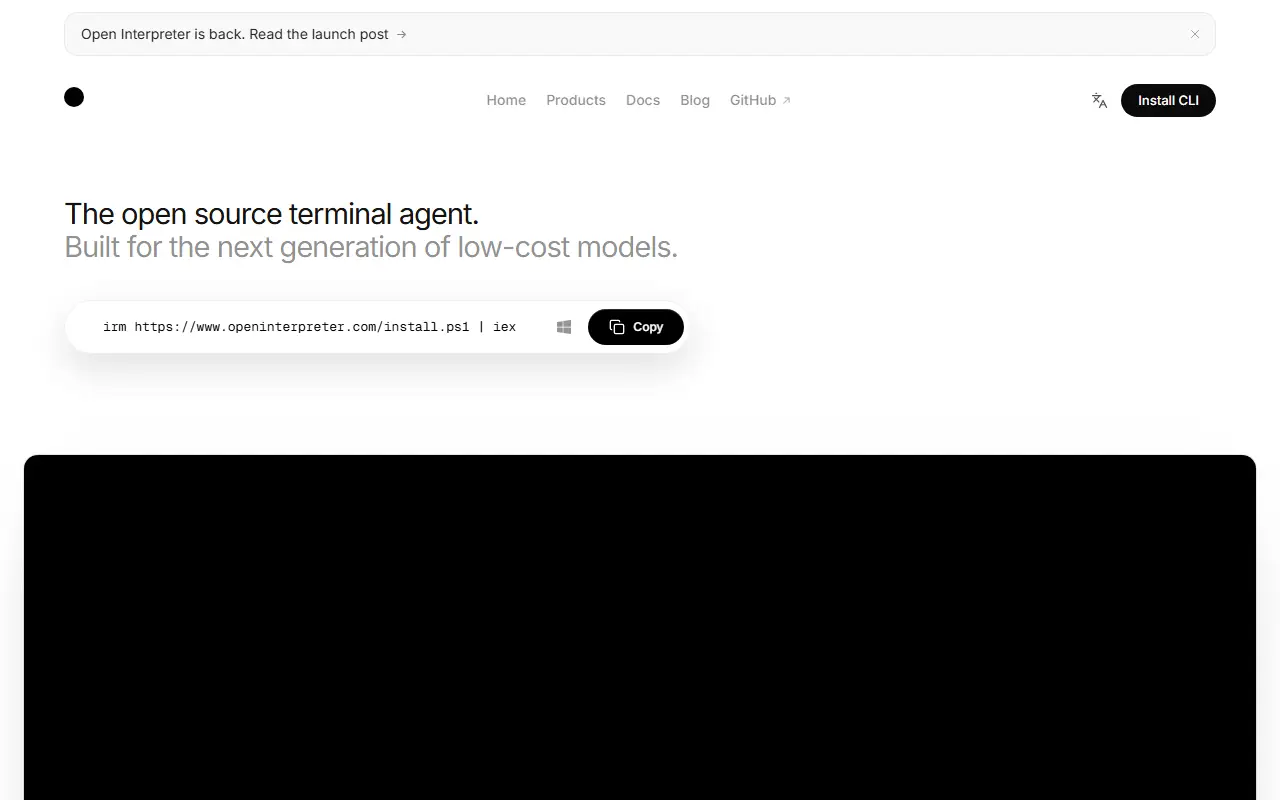
openinterpreter.comOpen Interpreter homepage screenshot

Open Interpreter is a coding agent aimed at open and low-cost models. It is a fork of OpenAI's Codex CLI, written mainly in Rust with some Python, and released under the Apache-2.0 license. After installing on macOS, Linux or Windows, you start a session by typing interpreter, or i, in your terminal.

Its distinguishing idea is harness emulation: it reproduces the agent harness that suits a given model and lets you switch the active harness with a slash command. A recent update reimplemented the Kimi Code harness in Rust for Kimi K3 while keeping a Codex-like interface. Its topics also mention DeepSeek and Qwen models.

Open Interpreter works in editors and clients that support ACP and speaks the same Codex exec protocol, so projects using the Codex SDK can switch with a one-line binary override. It aims to be portable, reusing shared standards such as AGENTS.md, .agents/skills directories, MCP and ACP, and keeps user data in readable files. It suits developers who want a terminal coding agent for cheaper models.

Key features

  • Terminal coding agent for open, low-cost models
  • Switchable agent harness emulation
  • Codex-compatible exec protocol and SDK override
  • ACP support for compatible editors
  • Reuses AGENTS.md, skills directories and MCP
  • Interpreter Workstation client for desktop, browser or headless use

Pricing: Free and open source under the Apache-2.0 license; model costs depend on the provider you choose.

Goose

An open-source, general-purpose AI agent written in Rust, available as a desktop app, CLI and API, that works with many model providers and MCP extensions.

GitHub stars
55k
Last commit
today
Latest release
v1.52.0
Licence
Apache-2.0
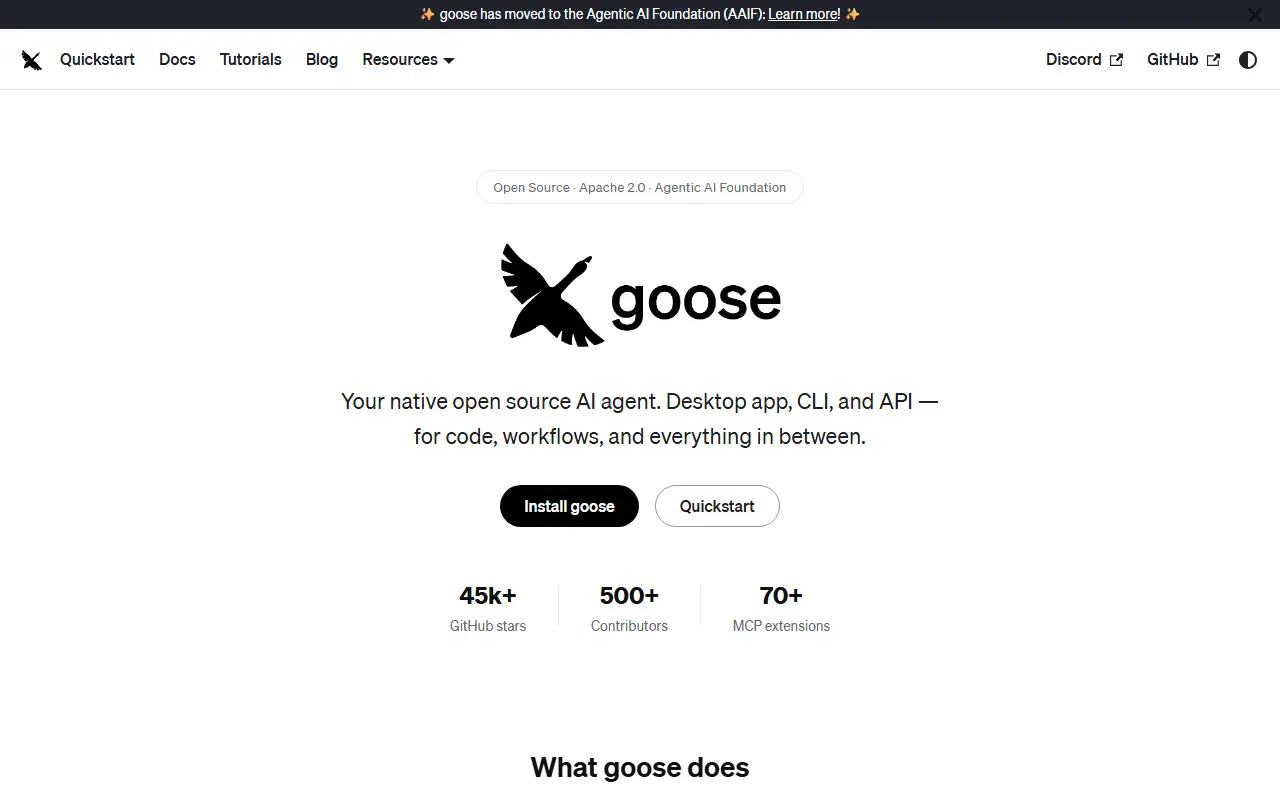
goose-docs.aiGoose homepage screenshot

goose is an AI agent for general tasks that runs locally on your own machine. It is not limited to coding: the project suggests using it for research, writing, automation, data analysis and similar tasks. It is built in Rust, released under the Apache-2.0 license, and available as a desktop application on Windows, Linux and macOS, a full CLI for terminal workflows, and an API for embedding it elsewhere.

goose works with more than a dozen model providers, including Anthropic, OpenAI, Google, Ollama, OpenRouter, Azure and Bedrock, and can use existing Claude, ChatGPT or Gemini subscriptions through ACP as an alternative to API keys. It connects to many extensions through the Model Context Protocol open standard, and custom distributions let teams ship their own goose build with preconfigured providers, extensions and branding.

The project is part of the Agentic AI Foundation at the Linux Foundation, and its documentation covers a quickstart, installation, tutorials and governance. It suits developers and knowledge workers who want a configurable local agent that is not tied to a single model vendor.

Key features

  • Desktop app for Windows, Linux and macOS
  • Full CLI for terminal workflows
  • API for embedding the agent elsewhere
  • Works with many model providers
  • Extensions through the Model Context Protocol
  • Custom distributions with preset providers and branding

Pricing: Free and open source under the Apache-2.0 license; model usage depends on the provider or subscription you connect.

Read more about GooseWebsite GitHub

oh-my-claudecode

A multi-agent orchestration add-on for the Claude Code CLI that coordinates teams of AI agents with workflows and parallel execution, aimed at developers.

GitHub stars
40k
Last commit
today
Latest release
v5.6.0
Licence
MIT
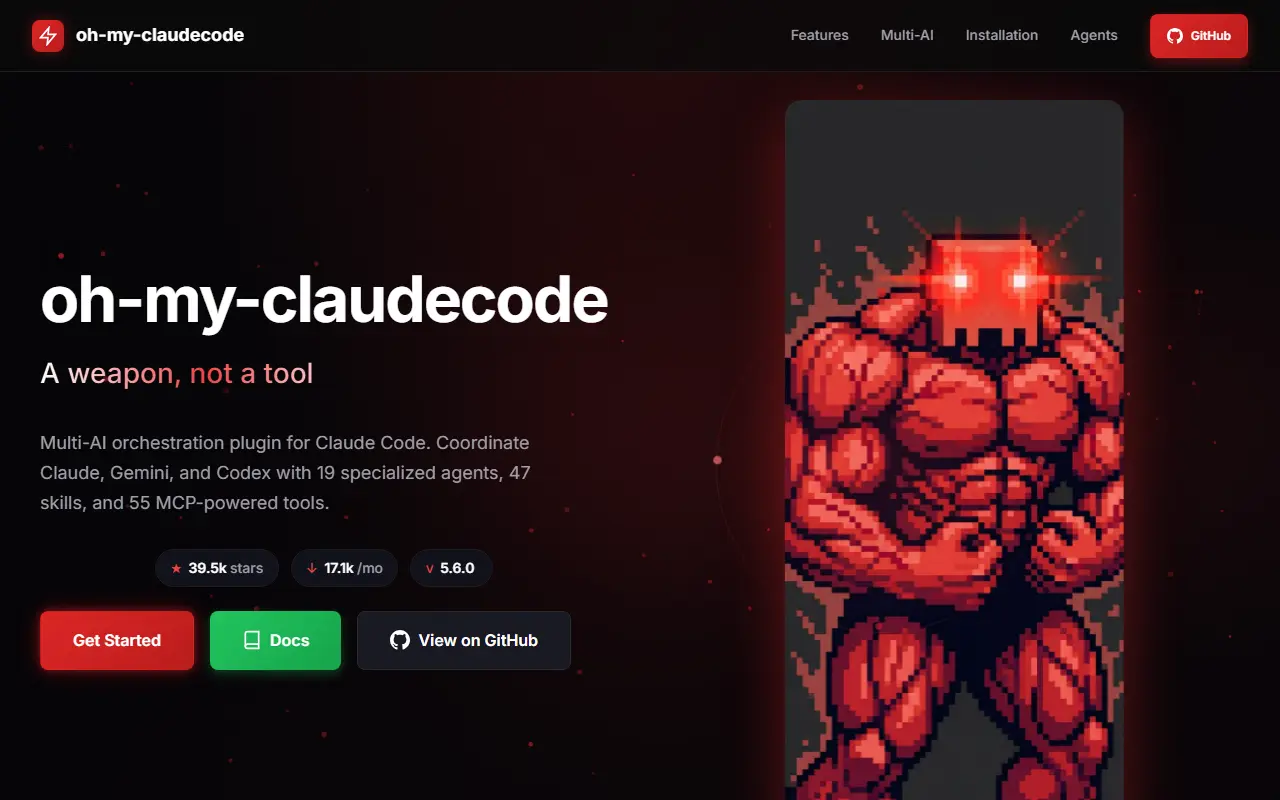
oh-my-claudecode.devoh-my-claudecode homepage screenshot

Oh My Claudecode, often shortened to OMC, is an open-source add-on for Claude Code, Anthropic's command line coding assistant. It is not a standalone application: it layers multi-agent orchestration on top of an existing Claude Code setup so that a team of AI agents can share and run work together.

The project advertises a zero learning curve, meaning developers can use its prepared workflows instead of learning every Claude Code feature themselves. Topics highlight agentic coding, multi-agent systems and parallel execution. The repository points to documentation, a CLI reference, workflows and a migration guide, and it has sibling projects for other tools, including oh-my-codex for the OpenAI Codex CLI and a lighter alternative called gajae-code.

It is MIT licensed and written in TypeScript, with translated READMEs in several languages. Because it runs locally alongside the Claude Code CLI, there is nothing to host. It is intended for developers who already use AI coding agents and want a structured way to coordinate several of them.

Key features

  • Multi-agent orchestration for Claude Code
  • Parallel agent execution
  • Prepared workflows and CLI reference
  • Migration guide between versions
  • Related variant for Codex CLI
  • Translated README files

Pricing: Free and open source under the MIT license.

Continue

Continue is an open-source coding agent for the command line, VS Code and JetBrains; the repository is now read-only and no longer maintained.

GitHub stars
36k
Last commit
today
Latest release
v2.0.0-vscode
Licence
Apache-2.0
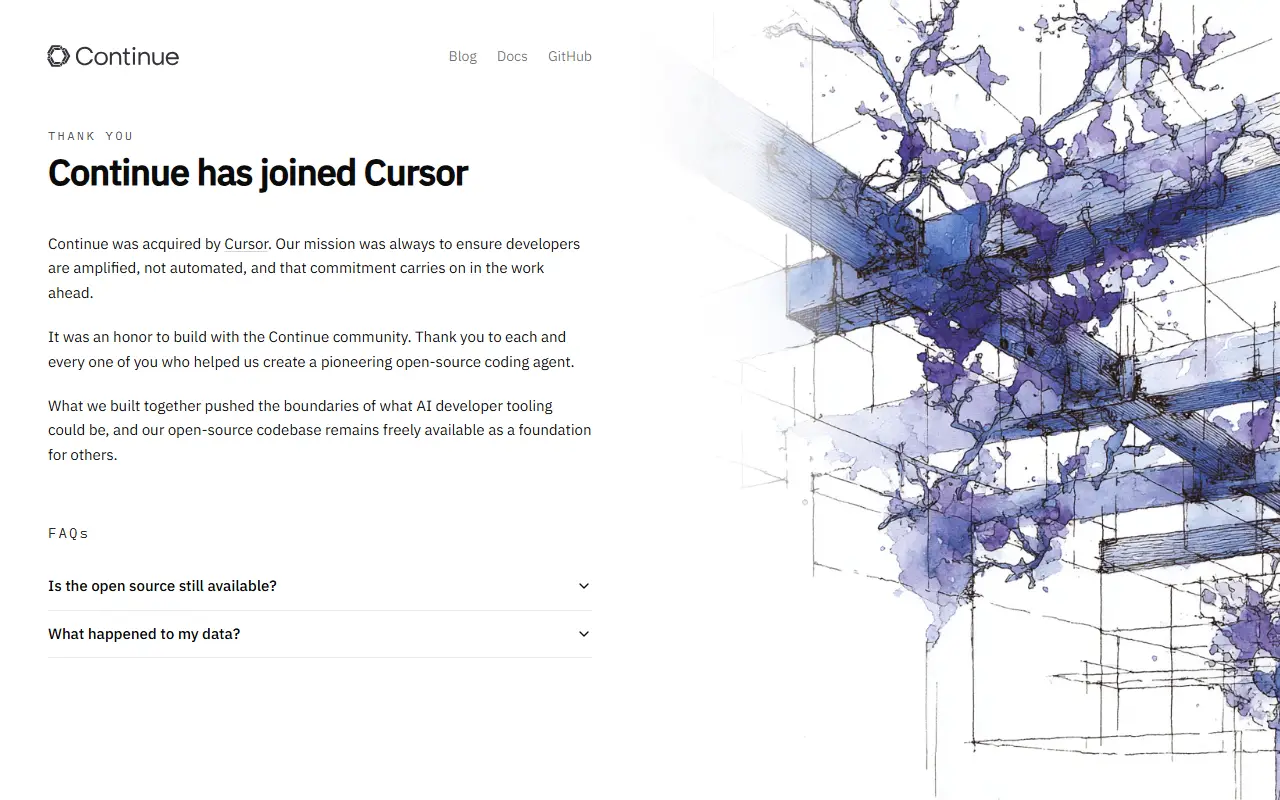
continue.devContinue homepage screenshot

Continue is an open-source coding agent that was offered as a command-line tool, a VS Code extension and a JetBrains plugin. It is written in TypeScript and released under the Apache-2.0 license. According to the README, the project's GitHub repository has stopped receiving active maintenance and is now read-only, so new features and fixes should not be expected from it.

The team shipped a final 2.0.0 release for the VS Code extension, the CLI and the JetBrains plugin. That release removed anonymous telemetry and authentication, and fixed a batch of bugs. The maintainers recommend the CLI over the JetBrains plugin, and they point to the documentation for configuration and customization. The project describes the codebase as a foundation that others can build on, which makes it relevant as reference code more than as an actively developed product.

Key features

  • Agent-style assistant usable from a terminal CLI
  • VS Code extension and JetBrains plugin
  • Configurable through project documentation
  • Final release removed telemetry and authentication
  • Apache-2.0 codebase open for reuse
  • Repository archived as read-only

Pricing: Free and open source under the Apache-2.0 license.

Read more about ContinueWebsite GitHub

Kilo Code

Kilo Code is an open-source AI coding agent for VS Code, JetBrains and the command line that works with hundreds of models.

GitHub stars
27k
Last commit
today
Latest release
v7.8.3
Licence
MIT
Hosted version
Available
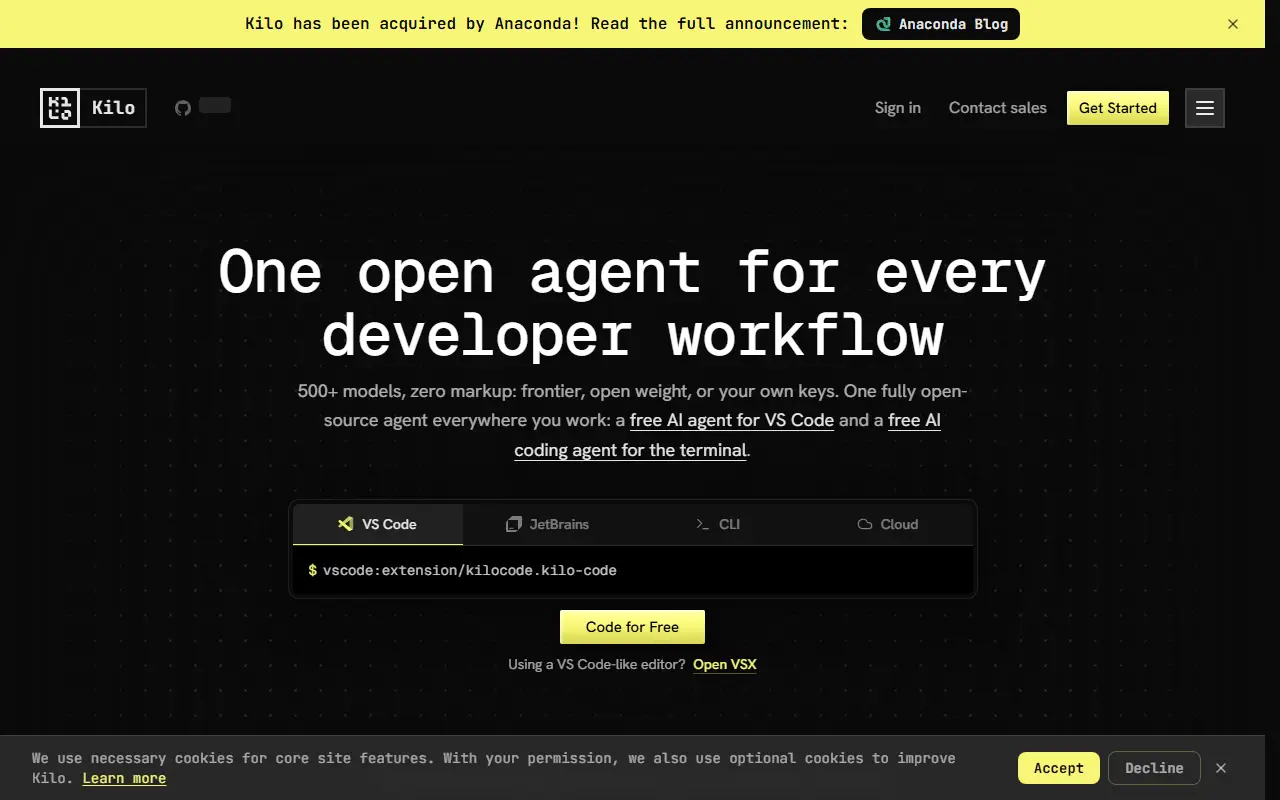
kilo.aiKilo Code homepage screenshot

Kilo Code is an AI coding agent that you can use in VS Code, in JetBrains IDEs or from the CLI. It is open source under the MIT license and written in TypeScript. According to the README, you can pick from more than 500 models and switch between them in the middle of a task, and you pay the model provider's rate with no markup. No API keys are needed to start.

Besides the local extensions, a Cloud Agent runs Kilo from the web without a local machine, and automated AI code reviews can be set up for pull requests. The CLI is started with the kilo command in a project directory and can be installed from release binaries for Windows, macOS on Apple Silicon and Intel, and Linux on x64 and ARM, with variants for older CPUs and Alpine-style images. The repository started in 2025 and its README is translated into many languages.

Key features

  • Agent for VS Code, JetBrains and CLI
  • Choice of hundreds of AI models
  • Switch models mid-task
  • Cloud Agent that runs from the web
  • Automated AI reviews for pull requests
  • CLI binaries for Windows, macOS and Linux

Pricing: The open-source extensions are free, with AI inference billed separately. Teams costs $15 per user per month with a 14-day trial; Enterprise is custom. Optional Kilo Pass credits start at $19 per month.

Read more about Kilo CodeWebsite GitHub

1 more Claude Code alternative

Claude Code alternatives: questions

What is the best open-source alternative to Claude Code?
OpenCode is the top-ranked open-source alternative to Claude Code on Enlisted: An open-source AI coding agent for the terminal, with a beta desktop app and separate agents for building and read-only planning. Other strong options are Codex CLI, Gemini CLI, OpenHands and Cline.
Are these Claude Code alternatives free?
All 11 are open source, so the code is free to use under its licence, and all of them can be self-hosted on your own server or computer. 3 also offer a paid or managed cloud version if you'd rather not host it yourself.
How is this list of Claude Code alternatives ranked?
By a score built from GitHub stars, star growth over the last 30 days and how recently the code changed. 10 of these projects shipped code in the last 30 days. Data is refreshed daily, and nobody can pay to move up.

People also look for alternatives to…

View all